The best wire-free robot mower has four-wheel drive, but the map still matters
“Wire-free” is useful shorthand, but it conceals the decision that matters most. A mower can navigate by satellite correction, local LiDAR, cameras, cloud services, or some combination of them. All avoid a buried powered perimeter cable. None avoids setup, map correction, edge trimming, debris clearing, or the occasional rescue.
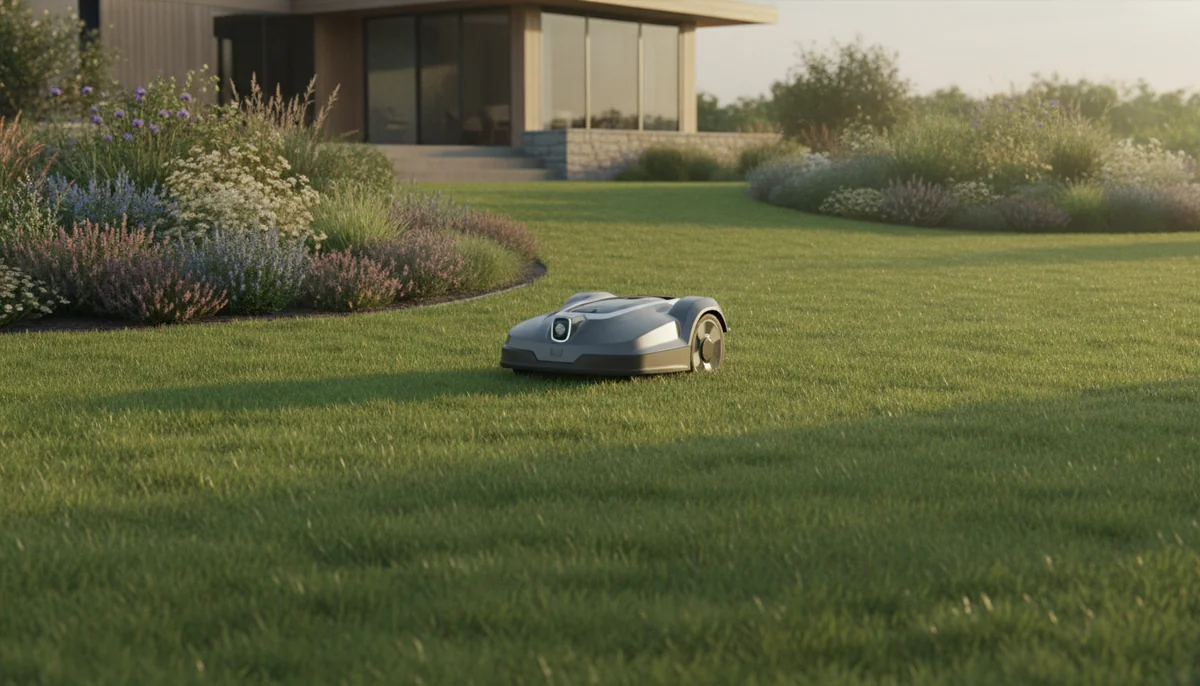
The X430 wins because it solves more physical lawn problems than the average virtual-boundary mower. Its 17-inch twin-disc deck is wide enough to make a large-yard rating credible, its 0.75-to-4-inch range suits both close cutting and taller summer turf, and its steerable four-wheel-drive chassis is less likely to grind a turn into the grass than a heavy skid-steer machine. It is still sensitive to dock placement, firmware behavior, low debris, and dangerous edges, but those are manageable objections rather than reasons to choose a weaker mower.
The harder exception is a lawn beneath mature trees or between tall buildings. There, onboard LiDAR can be worth more than the X430’s superior deck and steering because a mower that cannot establish its position is merely expensive garden furniture. The DREAME A3 AWD models and Mammotion LUBA 3 are the serious alternatives, while compact LiDAR machines from ECOVACS, MOVA, Sunseeker, and Segway make more sense on smaller shaded properties.
The mower has to fit the ground before it fits the acreage
Start by measuring mowable grass rather than the parcel. An acre rating describes the area a robot can maintain through repeated cutting and charging, not what it finishes on one battery or even in one afternoon. Complex boundaries, islands, cautious obstacle avoidance, narrow routes, and slopes all reduce effective throughput. Buying near the printed ceiling turns every rainy day, missed schedule, and charging delay into a backlog.
Then identify the yard’s actual failure mode. Open sky and smooth turf favor an RTK mower. Trees, eaves, and narrow spaces beside a house favor onboard LiDAR. Ruts, roots, abrupt paving transitions, and steep banks favor AWD, suspension, and sensible steering. A physically disconnected lawn still requires someone to open a gate or carry the machine, regardless of how many zones the app can store.
For the underlying differences, Smart Lawn Bots explains how virtual-boundary mowers work without a perimeter cable and compares RTK, LiDAR, and camera navigation. Those distinctions matter more than the number of objects a product page claims its camera can recognize.
These machines maintain grass; they do not reclaim it.
Give the lawn a conventional first cut, remove branches and loose objects, and run the robot often enough that it removes tiny clippings. Small pivoting blades create little suction, so flattened weeds and long stems can survive a pass. The clippings remain on the lawn as mulch rather than entering a collection bag.
At a Glance: All wire-free robotic lawn mowers Compared
| Feature | Editor's Pick Navimow X430 | Mammotion LUBA 3 AWD 5000 | ECOVACS goat A2000 LiDAR Pro | ECOVACS goat O1000 RTK Care | Segway Navimow i110N | Segway Navimow i206 AWD Robot | MOVA LiDAX Ultra 1000 | Mammotion LUBA Mini 2 1500H | WORX WR320 | LawnMaster OcuMow 200 series | ECOVACS goat O1000 LiDAR Pro | Sunseeker S4 | Husqvarna Automower 410iQ Robotic Mower | Eufy E15 robot lawn mower | Mammotion YUKA Mini 600H | ANTHBOT M9 Robot Lawn Mower | WORX WR344 | ANTHBOT Genie600 Robot Lawn Mower | BESTMOW Robot Lawn Mower — | Navimow i215 LiDAR | ANTHBOT M5 | Husqvarna Automower 420iQ Robotic Mower | Greenworks C20Z Wire-Free Robotic Lawn | Dreame A3 AWD Pro 3500 | Yarbo lawn mower | Husqvarna Automower 440iQ Robotic Mower | Eufy E18 robot lawn mower | HOOKII Neomow X2 SE | RoboUP Raccoon 2 SE | Mammotion LUBA 3 AWD 3000H | WORX Robot Lawn Mower for | Sunseeker X5 AWD Robot Lawn | [Latest Upgrade All-Terrain Wire-Free] DREAME | YARDCARE AI Vision Robotic Lawn | YARDCARE V100 |
|---|---|---|---|---|---|---|---|---|---|---|---|---|---|---|---|---|---|---|---|---|---|---|---|---|---|---|---|---|---|---|---|---|---|---|---|
| Price Range | $1,500–$3,000 | Under $200 | Under $200 | $500–$1,000 | $500–$1,000 | $500–$1,000 | $500–$1,000 | Under $200 | $1,000–$1,500 | $200–$500 | $500–$1,000 | $500–$1,000 | $1,500–$3,000 | $1,000–$1,500 | Under $200 | Under $200 | $1,500–$3,000 | Under $200 | Under $200 | Under $200 | $500–$1,000 | $1,500–$3,000 | $1,000–$1,500 | $1,500–$3,000 | $3,000+ | $3,000+ | Under $200 | Under $200 | Under $200 | $3,000+ | $500–$1,000 | $1,000–$1,500 | $1,500–$3,000 | $200–$500 | $200–$500 |
| Cutting height | 0.75–4 inches | — | 1.18–3.54 inches, adjusted in the app | 1.2 to 3.2 inches, manually adjusted | 2–3.6 inches, manual adjustment | — | 1.2–3.9 inches | — | — | 1–2.5 in | 1.18 to 3.15 inches | 1.6–3.2 inches, manual dial | — | 1–3 inches, electronically adjusted | 2–3.5 inches | — | 1.57–3.54 in | — | — | — | — | — | — | 3–10 cm / 1.2–3.9 inches | 1.2 to 4 inches | — | 1–3 in | — | 1.18–3.15 inches | 2.2–4.0 inches | — | — | — | — | — |
| Recommended lawn size | Up to 1 acre of mapped grass | 1.25 acres | Up to ½ acre over repeated mow-and-charge cycles | Up to 1/4 acre | Up to 0.25 acre | — | 0.25 acre | 0.37 acre / 1,500 m² | Up to half an acre | — | Up to 0.25 acre | 0.25 acre | — | — | — | — | Up to 1 acre | — | — | — | About 1/8 acre | — | — | Up to 3,500 m² / 0.87 acre | Up to 6.2 acres through repeated work and charging cycles | — | 0.3 acre, or 13,000 sq ft | Up to 0.75 acre | — | Up to 0.75 acre / 3,000 m² | — | — | — | — | About 1,076 sq ft, with 1,600 sq ft claimed as the ceiling |
| Cutting width | 17 inches | 15.7 inches | 12.96 inches | 8.66 inches | 7.1 inches | — | 7.9 inches | — | — | 6.3 in | 8.66 inches | 7 inches | — | 8 inches | 7.5 inches | — | 8.7 in | — | — | — | — | — | — | 40 cm / 15.8 inches | 20 inches | — | 8 in | — | 7.9 inches | 15.7 inches | — | — | — | — | 6.3 inches |
| Check Price on Amazon | Check Price on Amazon | Check Price on Amazon | Check Price on Amazon | Check Price on Amazon | Check Price on Amazon | Check Price on Amazon | Check Price on Amazon | Check Price on Amazon | Check Price on Amazon | Check Price on Amazon | Check Price on Amazon | Check Price on Amazon | Check Price on Amazon | Check Price on Amazon | Check Price on Amazon | Check Price on Amazon | Check Price on Amazon | Check Price on Amazon | Check Price on Amazon | Check Price on Amazon | Check Price on Amazon | Check Price on Amazon | Check Price on Amazon | Check Price on Amazon | Check Price on Amazon | Check Price on Amazon | Check Price on Amazon | Check Price on Amazon | Check Price on Amazon | Check Price on Amazon | Check Price on Amazon | Check Price on Amazon | Check Price on Amazon | Check Price on Amazon |
The 35 wire-free mowers, ranked
The top places go to machines with a credible match between navigation, chassis, deck, and supported lawn size; the final places remain here because an attractive feature list is not enough to overcome missing evidence, poor owner satisfaction, or unresolved product identity.
1. Navimow X430 — The Segway Navimow X430 is the best overall choice for a large, difficult lawn.
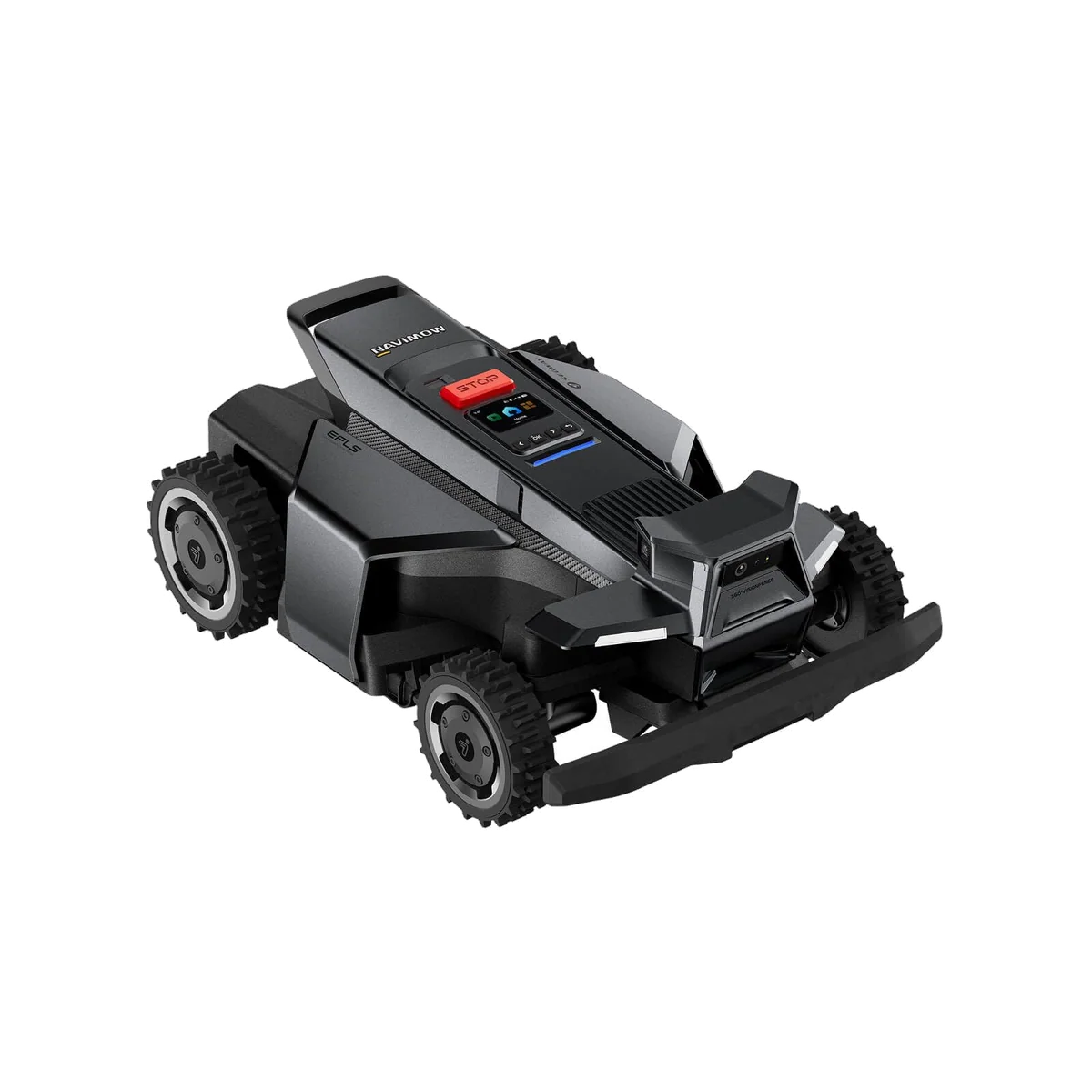
Its 17-inch twin-disc deck, steerable four-wheel drive, suspension, and 0.75-to-4-inch cutting range make its one-acre rating more believable than those attached to narrow residential machines.
Dock positioning can be fussy, low debris still gets missed, and one serious height-control failure means the first return, docking, and cutting cycles deserve supervision.
Choose it over the LUBA 3 for conventional large yards where tall fescue, clean throughput, and reduced turn damage matter most. Choose LiDAR-led Mammotion or DREAME hardware instead when buildings and dense canopy make positioning the overriding concern.
Strengths
- The 17-inch dual-disc system covers large lawns more credibly than a narrow entry-level cutting deck.
- Four-wheel traction, suspension and steerable wheels make difficult transitions and slopes its natural territory.
- The 0.75-to-4-inch range accommodates both closely cut grass and tall fescue.
- Virtual mapping, zones and systematic routes remove the labor of installing perimeter wire.
- Frequent quiet cutting can keep a remote property maintained between visits.
Limitations
- Dock placement and positioning can demand trial, error and post-update troubleshooting.
- One owner reported an uncontrolled height drop that scalped grass and scraped concrete.
- Repeated dock and channel routes can wear visible tracks despite the turf-friendly steering.
- Raised borders, corners and obstacle clusters still require manual trimming.
- Thin hazards, storm debris and heavy leaves must still be cleared from the lawn.
2. Mammotion LUBA 3 AWD 5000 — The Mammotion LUBA 3 AWD 5000 is the large-lawn specialist for severe slopes and obstructed sky.
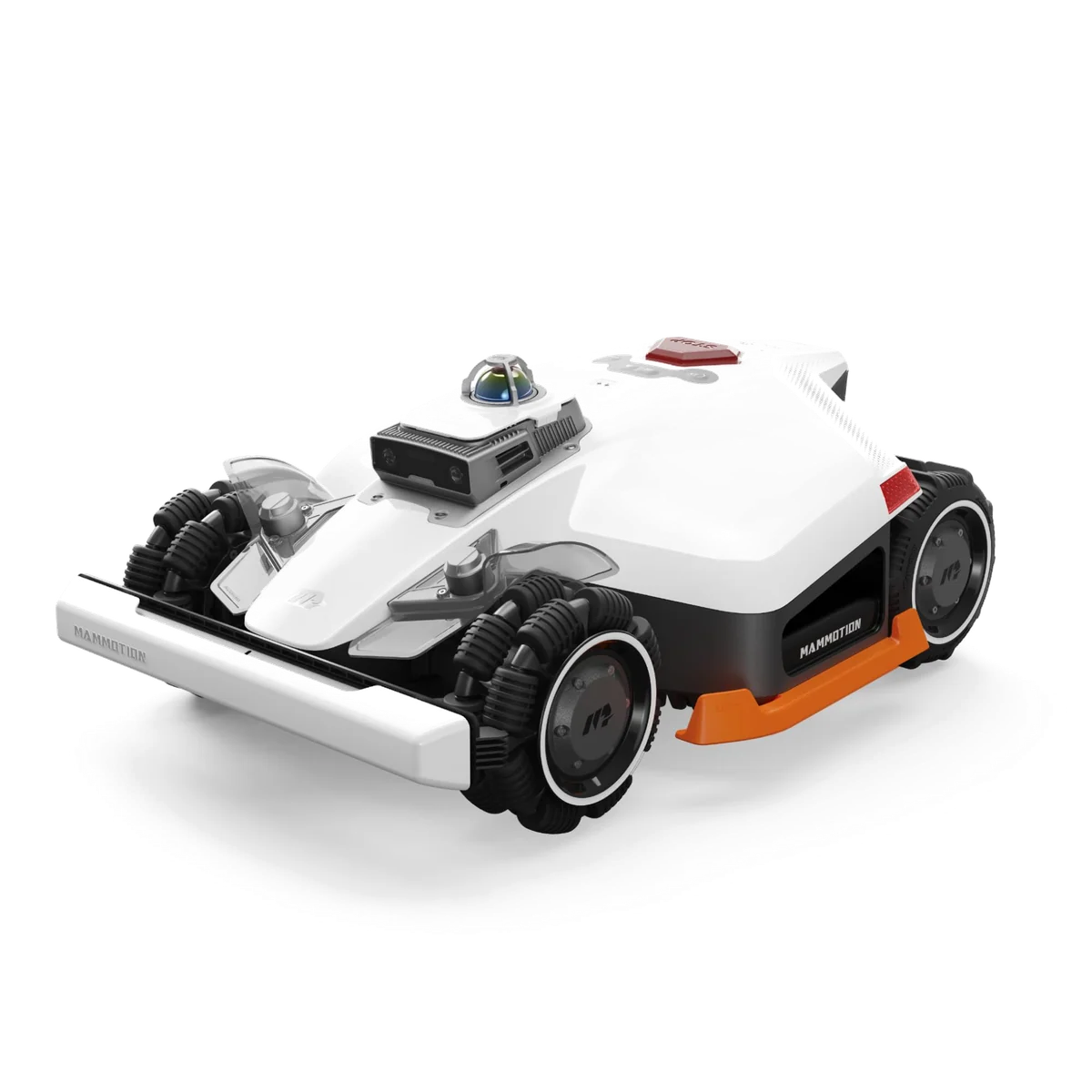
Its 1.25-acre managed-area rating, 15.7-inch twin deck, four driven wheels, and LiDAR, NetRTK, and camera fusion form the strongest case for a complicated property with trees, buildings, and firm steep ground.
Its fixed-wheel turning can chew soft, wet, sandy, or thin turf, while map loss, firmware regressions, and uneven support make ownership less polished than the formidable hardware suggests.
This exact listing is the standard-height AWD 5000 with a 1-to-2.7-inch range, not the taller 5000H. It is the better specialist than the X430 under severe cover, but the X430 is kinder to ordinary turf and cuts taller.
Strengths
- Four-wheel drive makes severe banks, ruts and rough transitions credible autonomous territory.
- LiDAR, NetRTK and dual cameras maintain position beneath trees and beside buildings.
- The wide 12-blade deck produces clean stripes when it is allowed to mow frequently.
- Long runtime and automatic recharge make the 1.25-acre management limit practical.
- Quiet operation allows long jobs without turning the yard into a work site.
Limitations
- Turning and docking can tear sandy, wet or fragile turf.
- Automatic mapping is unreliable enough that complex yards should be mapped manually.
- The app is powerful but firmware regressions and map-loss reports undermine confidence.
- Walls, posts and irregular borders still require regular string trimming.
- Return freight, repair access and long-term battery service need checking before purchase.
3. ECOVACS goat A2000 LiDAR Pro — The ECOVACS GOAT A2000 LiDAR PRO is the best half-acre LiDAR mower for a clearly divided, reasonably smooth lawn.
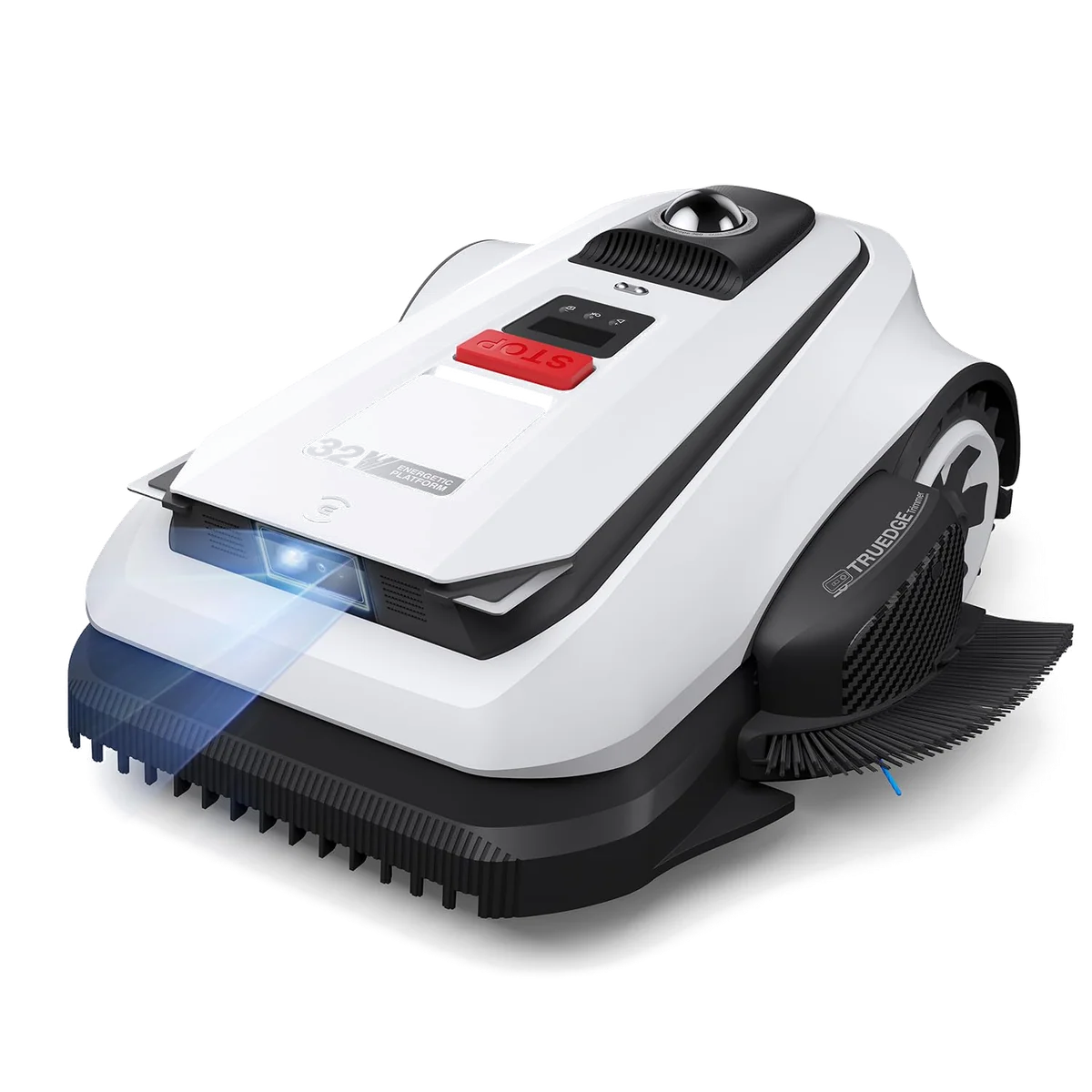
Onboard dual LiDAR, a 12.96-inch overlapping twin-disc deck, electronic height control, and a powered side trimmer give it the most complete medium-size cutting package here.
Its short mowing cycles and stubborn tendency to merge closely adjoining fence-separated zones can turn an otherwise excellent cutter into a mapping and route-recovery project.
The side trimmer substantially reduces cleanup along long flush borders, but it operates as a separate, louder task and cannot finish tight corners, downspouts, irregular rocks, or conservative no-go buffers. Its rear-drive chassis also belongs on firm turf rather than loose soil, curbs, or wet slopes.
Strengths
- Dual LiDAR maps without boundary wire, an RTK pole, or a clear view of the sky.
- The wide overlapping deck produces tidy systematic lanes on frequently maintained grass.
- The integrated string trimmer substantially reduces cleanup along straight, accessible borders.
- Automatic charging, resumption, zone settings, and quiet operation suit frequent unattended maintenance.
Limitations
- Map correction is too restrictive when automatic boundaries or merged zones are wrong.
- The 50-minute battery can require several charging stops on lawns far below the headline capacity.
- Rear-wheel drive and small front casters are vulnerable on rough grades, loose soil, and drop-off edges.
- Corners, irregular rocks, flattened grass, leaves, and heavy overgrowth still require conventional tools.
4. ECOVACS goat O1000 RTK Care — The ECOVACS GOAT O1000 RTK Care is a lower-cost choice for a small, open, uncomplicated lawn.
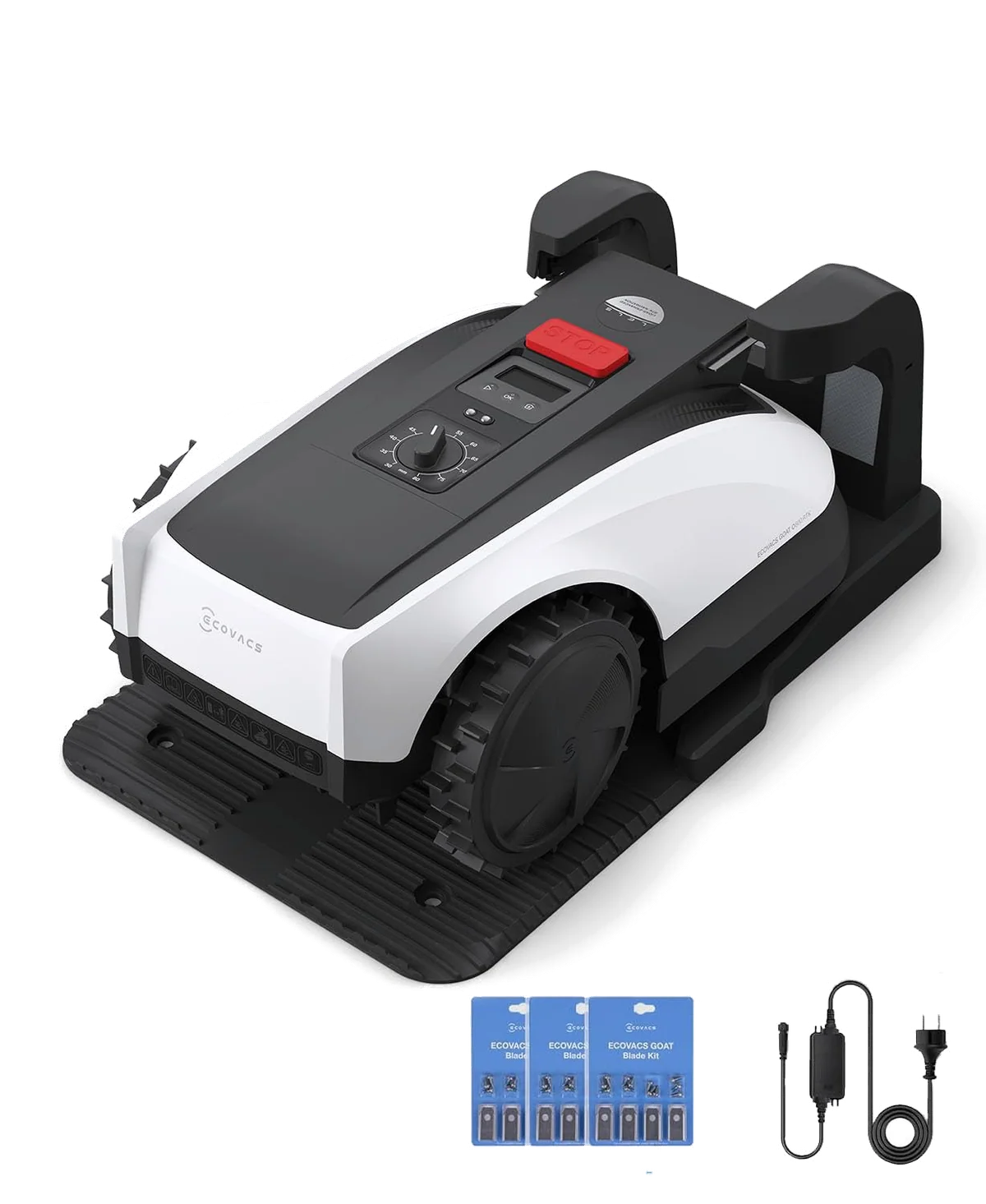
It cuts systematic rows, handles low-cut turf, includes useful spare blades, and can be rational when a fixed RTK station has a clear view of the sky.
It requires external RTK hardware, struggles with some narrow routes and adjoining zones, and lacks the powered side trimmer fitted to the similarly named LiDAR PRO model.
The O1000 LiDAR PRO is the stronger family choice beneath trees or beside buildings. The customer-review feed for this RTK listing contains A2000 material, so claims about dual discs, electronic height, camera recording, and a powered string trimmer do not belong to this mower.
Strengths
- The systematic single-disc cut produces orderly coverage and convincing lawn stripes.
- The compact 24.25-pound body is quiet, manageable and suited to smaller lawns.
- The Care bundle includes useful blade consumables and an RTK extension cable.
Limitations
- Map merging, route failures and physical-reset lockouts can defeat unattended multi-zone mowing.
- The external antenna demands good placement and makes the wire-free claim less effortless than it sounds.
- The recessed center disc still leaves trimming around walls, fences, posts and raised edges.
5. Segway Navimow i110N — The Segway Navimow i110N remains the established value pick for a flat, open quarter acre.
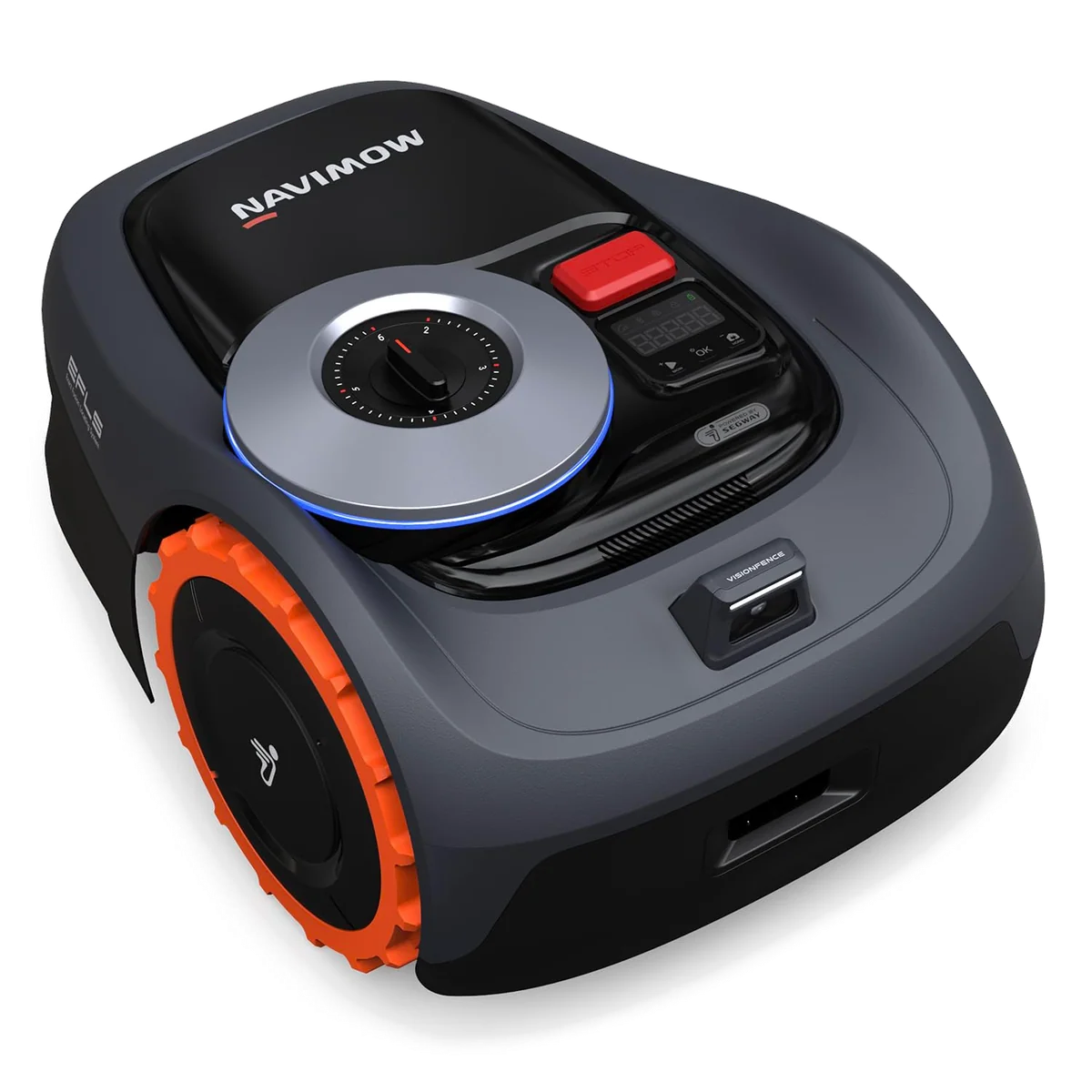
Its mature exact-model owner record, quiet systematic mowing, flexible virtual boundaries, and 120-minute nominal runtime make it easier to trust than many newer small-yard launches.
The separate satellite antenna, seven-inch deck, small casters, and non-AWD drive make heavy canopy, ruts, roots, wet slopes, and awkward building corridors poor matches.
It makes sense when the antenna has an obvious home and the lawn is smooth enough that traction is not the limiting factor. The i110N and i206 comparison is the useful next step when capacity and rough-ground ability are pulling in opposite directions.
Strengths
- Virtual boundaries remove the cost and inconvenience of burying a perimeter wire.
- Systematic, frequent cutting keeps compatible lawns at a consistently tidy height.
- The larger i1 battery makes sense for lawns approaching one-quarter acre.
- Quiet operation allows regular maintenance without combustion-mower noise.
- Flexible zones, channels, no-go areas, and boundary modes reward careful setup.
Limitations
- Small dips, ruts, roots, thick turf, and wet slopes can cause repeated rescues.
- The antenna, powered dock, mapping walk, and boundary refinement make installation more involved than the wire-free label suggests.
- A quarter-acre cycle normally requires multiple work and charging sessions.
- Walls, fences, raised beds, and unsafe edges still require trimming.
- Navigation quality remains exposed to satellite conditions and firmware changes.
6. Segway Navimow i206 AWD Robot — The Segway Navimow i206 AWD is the cautious small-yard step-up when traction matters more than capacity.
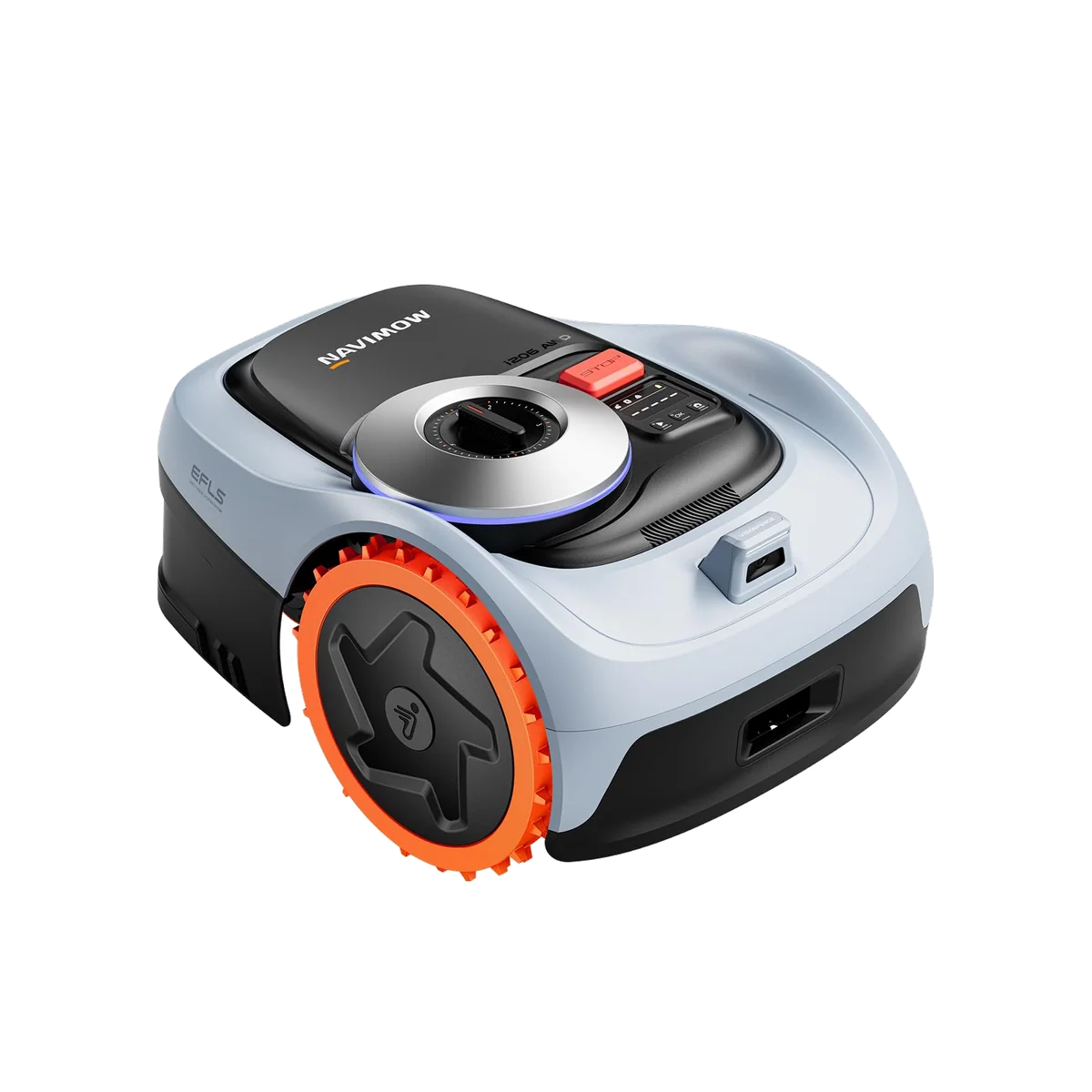
All-wheel drive, all-terrain tires, Network RTK, and a compact body directly address the grounding and wheel-slip problems that can defeat the i110N on an uneven 0.15-acre lawn.
Reports of failed automatic mapping and maps disappearing after manual setup or brief lifting are too serious for this newer model to receive an unconditional recommendation.
Its smaller managed-area rating is the trade, not a typo. Prove every boundary, route, lift event, charge return, and scheduled restart while the retailer’s return option remains useful.
7. MOVA LiDAX Ultra 1000 — The MOVA LiDAX Ultra 1000 is the tall-cut LiDAR value pick for a firm small lawn.
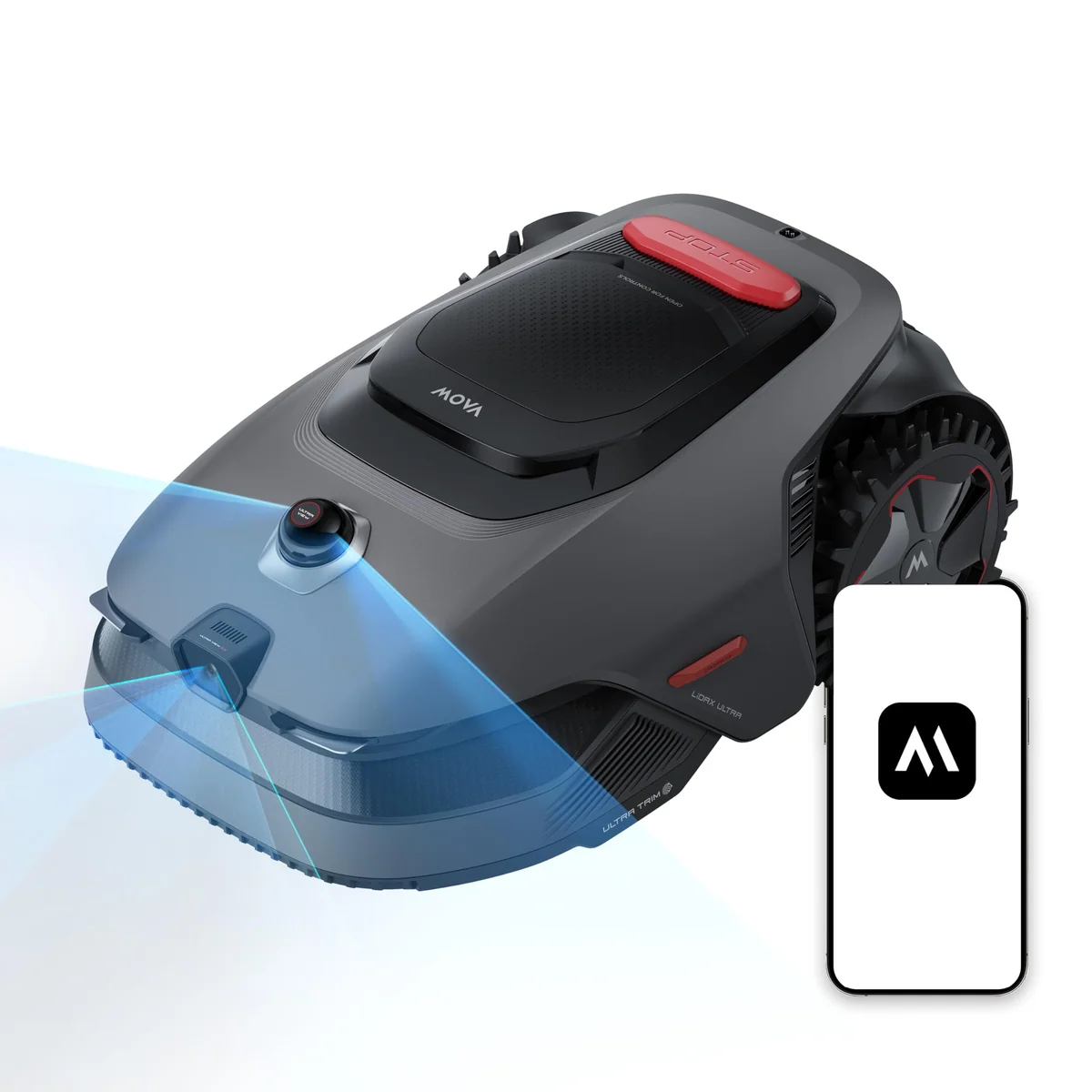
Its antenna-free LiDAR and vision system, 1.2-to-3.9-inch electronic range, structured lanes, two maps, and unusually deep zone controls offer plenty of capability below a quarter acre.
Passive front casters catch in sand, soft soil, turf runners, ledges, and seams while the powered rear wheels keep digging, which can make frequent physical rescues part of ownership.
UltraTrim reaches close to favorable borders but uses a fixed low edge height near 1.2 inches, so it can scalp a pale track around grass maintained at three or four inches. The LiDAX Ultra 1000 and 2000 comparison shows when moving up in size is worthwhile.
Strengths
- LiDAR navigation removes the boundary wire and RTK antenna without surrendering organized mowing under trees.
- The main deck produces a clean systematic cut across an unusually broad 1.2–3.9-inch height range.
- Quiet operation, automatic recharge and deep zone controls suit frequent background maintenance.
Limitations
- Passive front casters can strand the mower on sand, soft soil, small ledges and awkward transitions.
- The quarter-acre map rating can mean several charges and most of a day rather than one quick session.
- UltraTrim cuts at a fixed low height, so it may scalp the very tall-cut lawn the main deck otherwise handles well.
- Edges, low objects, occasional rescues and immature map editing prevent genuine set-and-forget ownership.
8. Mammotion LUBA Mini 2 1500H — The Mammotion LUBA Mini 2 1500H is the premium compact choice for steep, rooty, shaded ground.
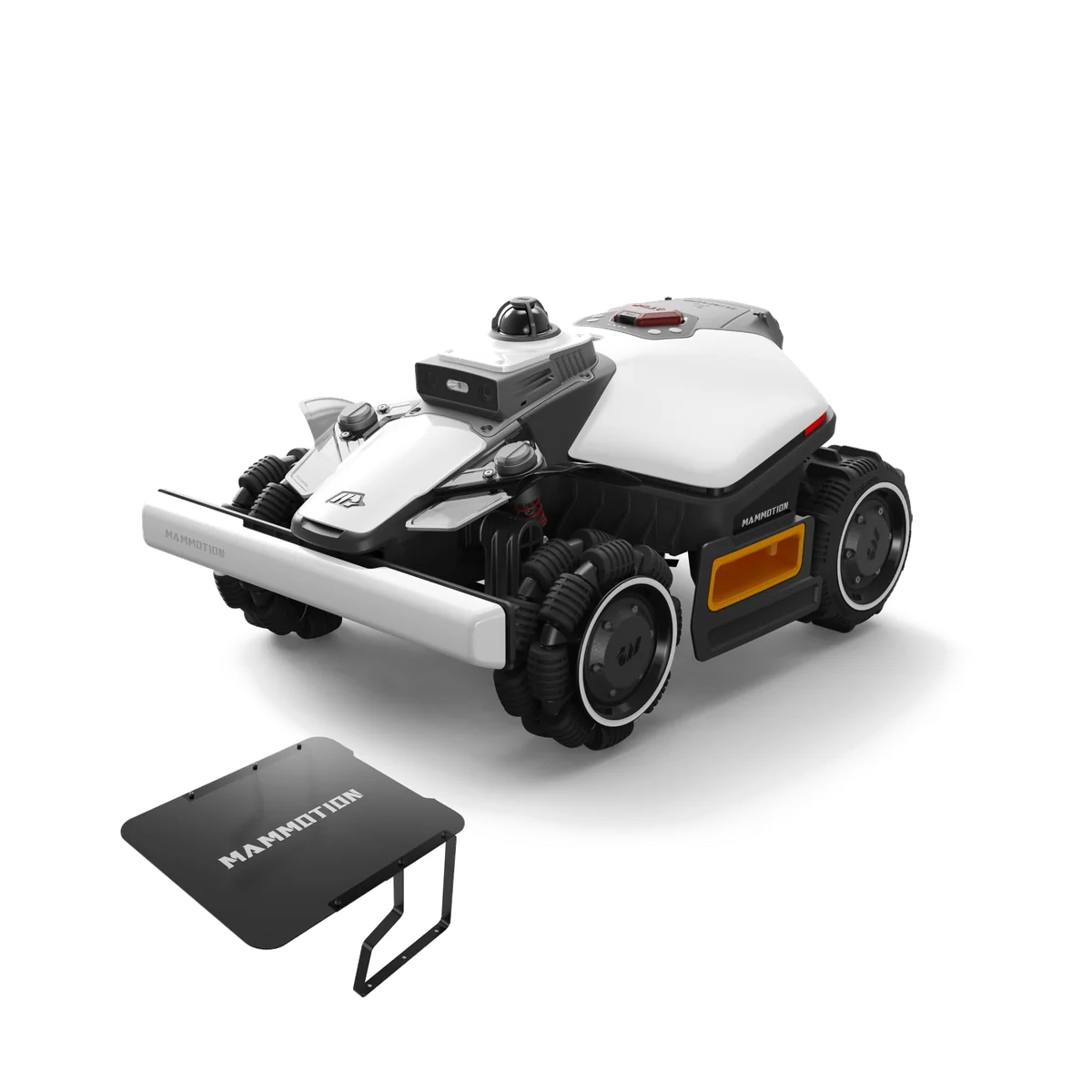
Its short AWD chassis, onboard LiDAR, dual cameras, edge disc, and 0.37-acre rating give difficult small properties a combination that ordinary rear-drive LiDAR mowers cannot match.
It is expensive, slow near its area ceiling, capable of scuffing weak turf, and dependent on software and support that have not always matched Mammotion’s excellent mechanical ambition.
Confirm that the order title says “LUBA Mini 2 1500H,” because stale catalogue material for this ASIN describes the older 800H and should not be used to infer capacity or cutting range. The bundled garage ships separately and protects against sun and debris rather than theft.
Strengths
- Four-wheel drive gives it genuine authority on banks, roots, dips and rough transitions.
- LiDAR and dual cameras remove both the perimeter wire and the physical RTK antenna.
- The edge disc, multi-zone mapping and replaceable battery make the compact chassis unusually capable.
Limitations
- Raised edges and tight corners still leave enough grass to require a string trimmer.
- Near its area limit, a complete cut can consume several charges and much of the mowing day.
- App quirks, firmware changes and inconsistent support make ownership less settled than the hardware suggests.
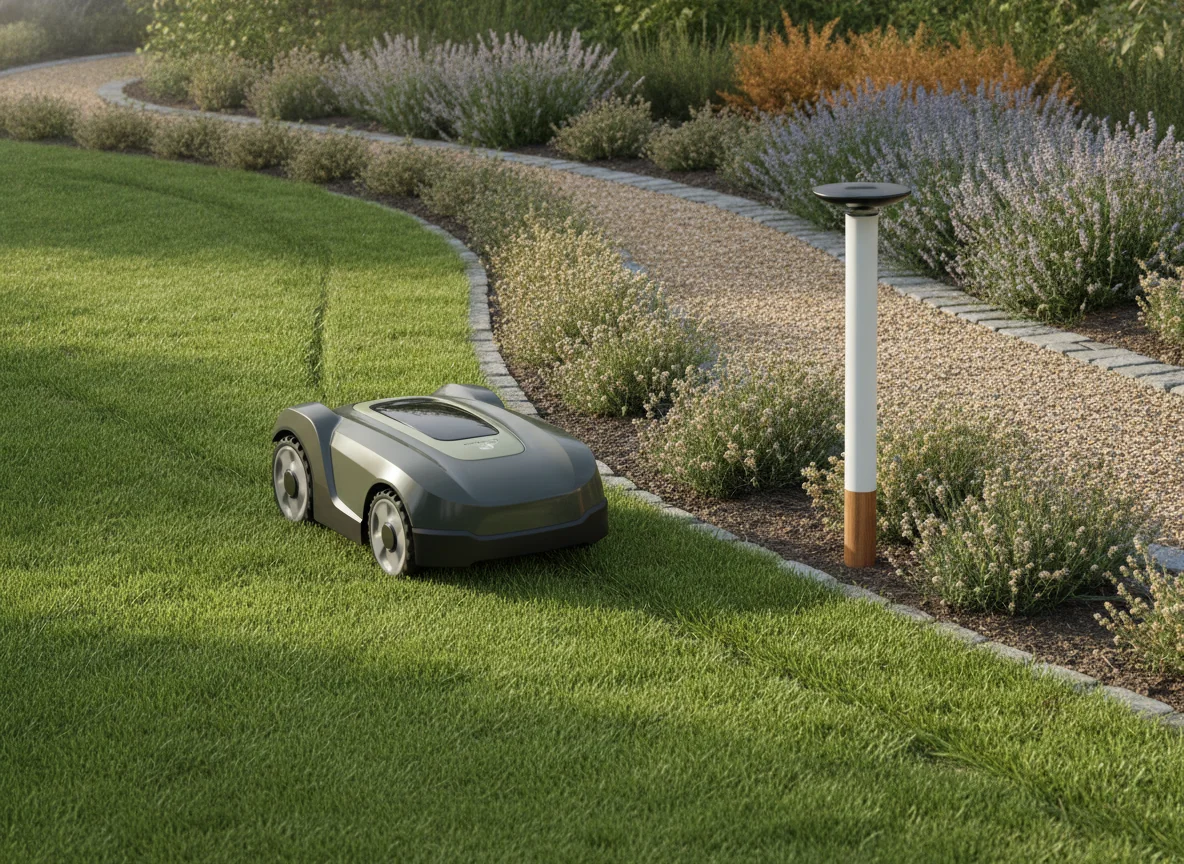
9. WORX WR320 — The WORX WR320 is the half-acre cloud-RTK choice for buyers who value a removable PowerShare battery.
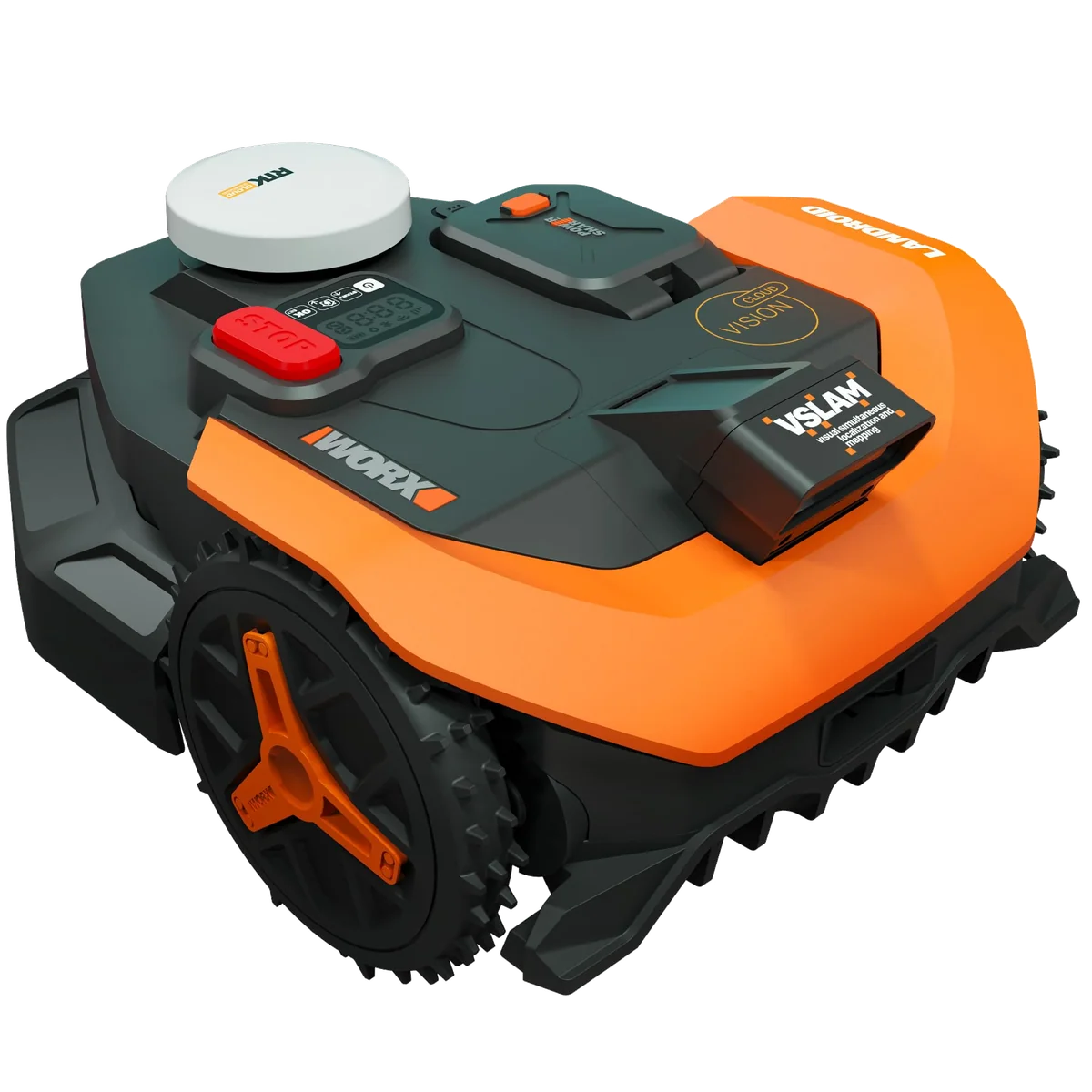
It avoids both buried wire and a local RTK pole, cuts deliberate patterns, can continue through partial canopy, and offers one of the category’s clearest paths to replacing a worn battery.
App recovery, map editing, docking geometry, false obstacles, and two-wheel traction create too much friction for soft turf, St. Augustine, hollows, or owners expecting appliance-like setup.
This ASIN is the plain WR320 with RadioLink, not the WR320.1 with headlights and active Cut-to-Zero hardware. The A2000 is the stronger cutter at this size, while the WORX ecosystem is the reason to choose this one.
Strengths
- Cloud RTK removes both the buried boundary wire and a separate local antenna.
- Systematic patterns produce cleaner, more complete-looking coverage than older random Landroids.
- Automatic mapping works unusually well on lawns with clear visual boundaries.
- Vision and V-SLAM provide useful obstacle recognition and a credible fallback beneath partial tree cover.
- The removable PowerShare battery adds convenience for existing WORX tool owners.
Limitations
- The app makes boundary edits, task changes and error recovery harder than they should be.
- Two-wheel traction can dig into soft, stressed or stolon-heavy turf.
- The half-acre rating requires repeated charge cycles and does not promise same-day completion.
- The plain WR320 omits the Cut-to-Zero module and headlights.
- Vertical borders, debris clearing and occasional rescues remain human work.
10. LawnMaster OcuMow 200 series — The LawnMaster OcuMow 200 Series is the simplest carry-out helper for a tiny enclosed lawn.
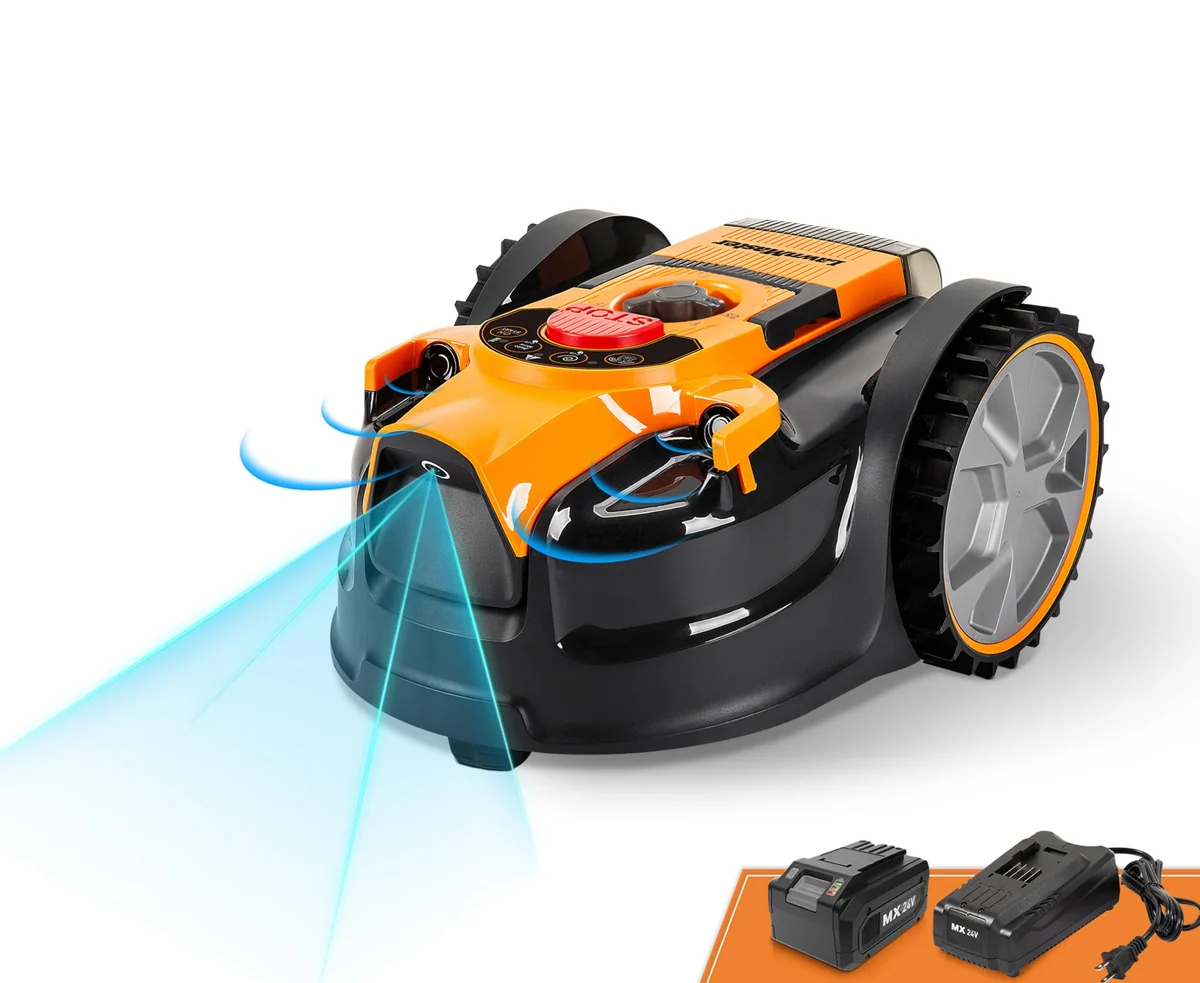
It needs no app, account, dock, saved map, antenna, or outdoor outlet, and several hours of quiet random mowing can maintain a small, crisply bordered rectangle.
The owner must deploy, retrieve, and recharge it after every run, while ambiguous boundaries, random missed tufts, daylight dependence, wide edge strips, and weak parts support prevent true set-and-forget use.
Plan around roughly 1,000 square feet per charge rather than the conditional 2,000-square-foot claim. This is the original removable-battery orange 200 Series, not a newer autocharging OcuMow sibling.
Strengths
- No app, dock, antenna or powered perimeter installation is required on a clearly bordered lawn.
- The removable battery and carry handle make indoor charging and storage practical.
- The cutting system can leave a very even finish after enough repeated passes.
- Quiet operation and strong rear-wheel torque suit frequent daytime maintenance.
Limitations
- Every session still requires manual placement, startup, retrieval and charging.
- Random navigation can leave missed tufts and offers no predictable completion time.
- Optical containment can fail where grass edges are ambiguous or consequences are serious.
- A noticeable perimeter remains for manual trimming, and rough slopes can expose chassis instability.
- Past parts shortages and support complaints weaken confidence beyond the warranty period.
11. ECOVACS goat O1000 LiDAR Pro — The ECOVACS GOAT O1000 LiDAR PRO is the compact edging pick for a shaded quarter-acre lawn.
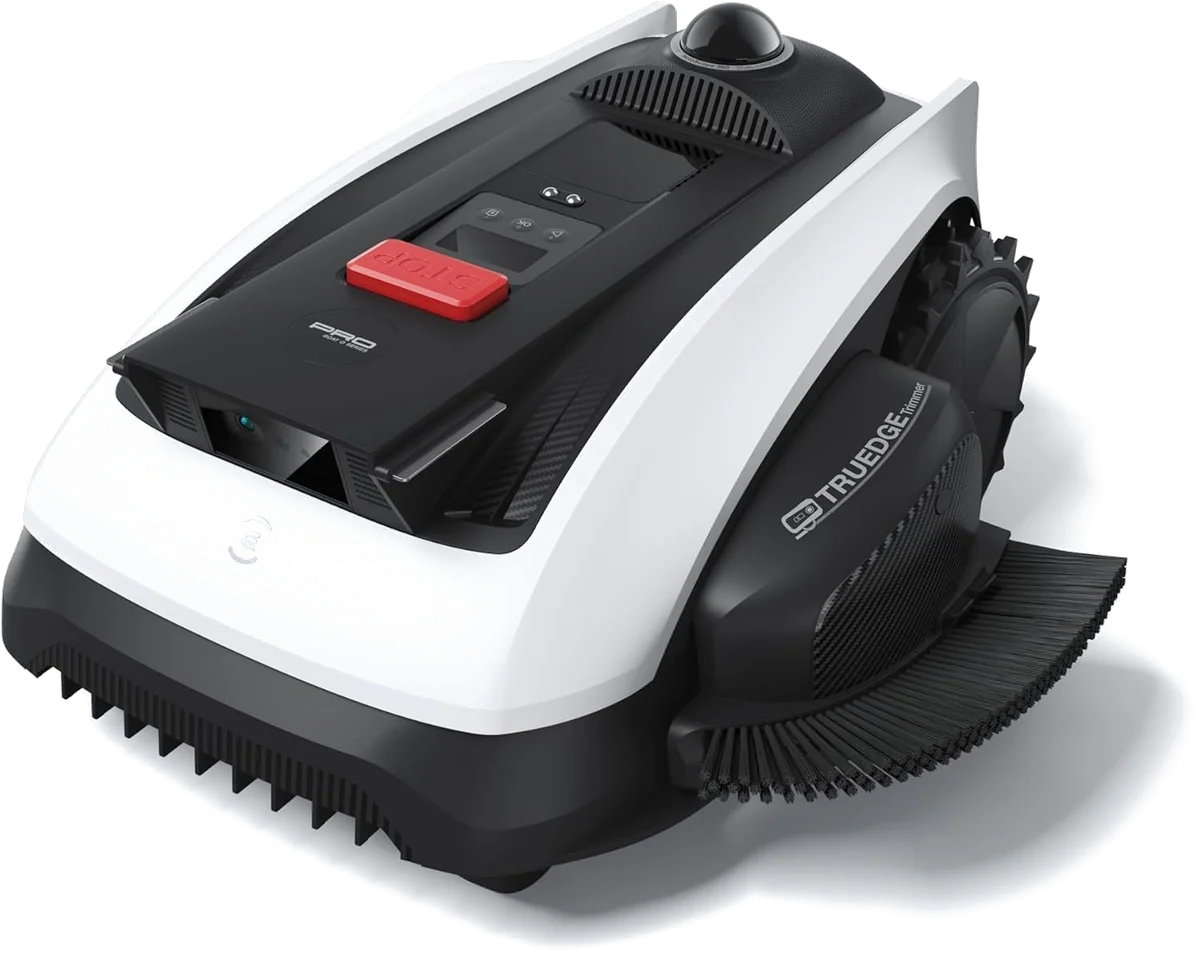
Dual onboard LiDAR, narrow-passage ability, automatic charge and resume, electronic height control, and a powered side trimmer make it unusually capable in a connected small yard with trees and firm ground.
Its narrow deck is slow, its virtual joystick makes manual boundaries awkward, and tiny front casters dislike ruts, loose soil, abrupt transitions, and thick runners.
The trimmer can remove most grass beside long accessible borders, but fences, posts, inside corners, and cautious exclusion zones still leave work. Choose the A2000 for more area and throughput, or the MOVA when a 3.9-inch maximum cut matters more than active trimming.
Strengths
- Dual onboard LiDAR removes the buried wire, external antenna and clear-sky positioning problem.
- Systematic mowing produces clean lines and continues automatically after charging.
- The compact chassis, quiet mower and configurable zones suit complicated small properties.
- The real side trimmer can substantially reduce cleanup along long, flush borders.
Limitations
- Manual mapping makes straight invisible boundaries unnecessarily difficult.
- TruEdge still misses fences, tight corners, raised edges and buffered no-go zones.
- The narrow deck needs multiple sessions as lawn area approaches a quarter acre.
- Rear drive and small front casters are poor insurance on soft, rough or steep ground.
- Specialty-parts supply and technical support remain ownership risks.
12. Sunseeker S4 — The Sunseeker S4 is the shaded-garden specialist for a structured, moderate-terrain lawn.
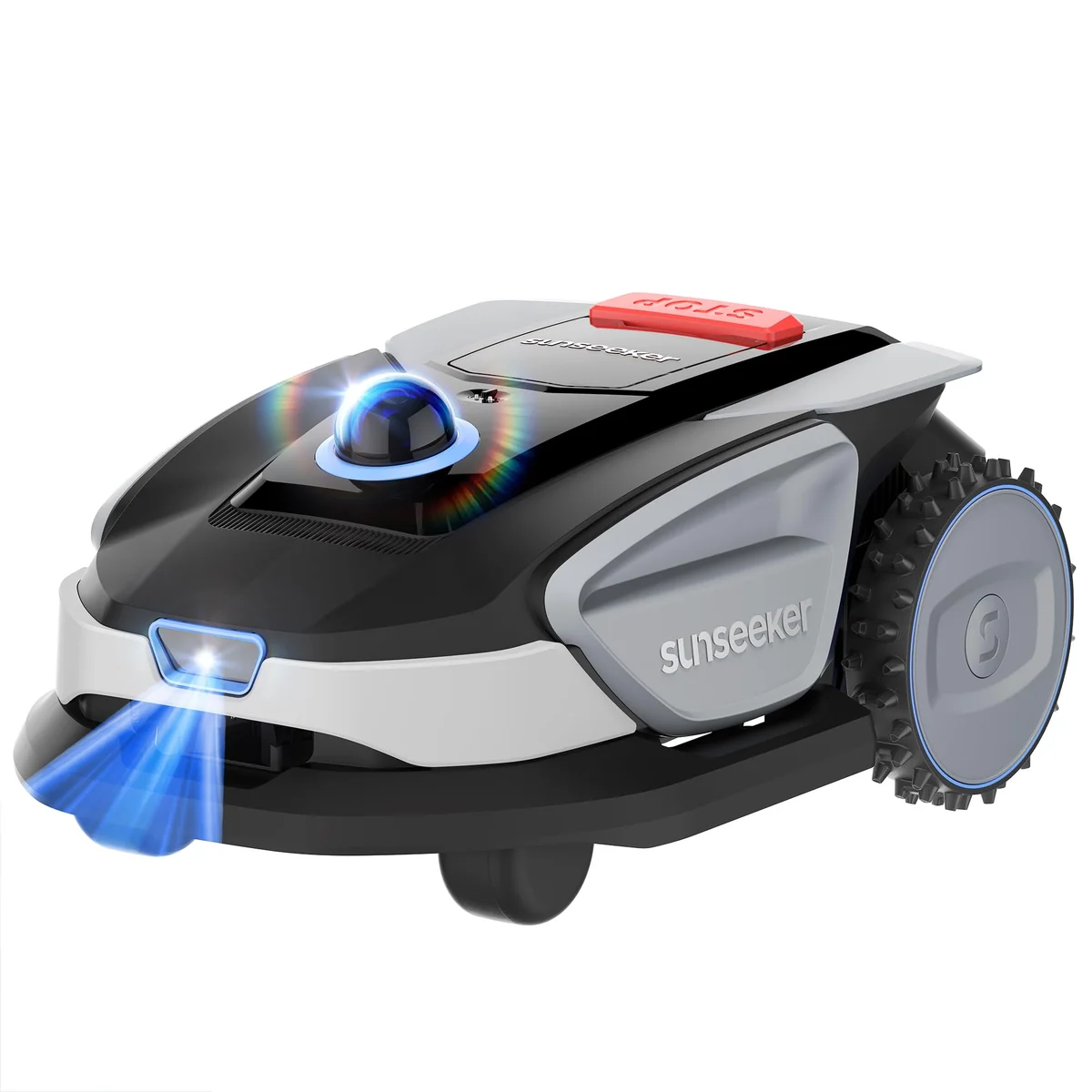
Its onboard LiDAR avoids an RTK mast, holds planned lanes under trees, and pairs useful boundary tools with quiet operation across a connected quarter acre.
The seven-inch deck is slow, the inset disc leaves a broad strip at vertical borders, and its rear-wheel-drive chassis can require frequent rescues at humps, dips, and abrupt transitions.
Treat it as rear-wheel drive despite one conflicting owner description. The O1000 LiDAR adds active trimming, while the S4 and X5 comparison separates antenna-free positioning from the larger mower’s AWD proposition.
Strengths
- Onboard LiDAR removes both perimeter wire and RTK antenna placement from setup.
- Systematic mowing produces an even cut and convincing straight stripes.
- Automatic docking, charging and job resumption work as real conveniences.
- Obstacle avoidance is cautious around obvious tools, rocks and toys.
- Mapping supports several zones, corridors and awkward shaded sections.
Limitations
- The seven-inch deck and 90-minute runtime make coverage slow.
- Vertical borders leave a manual trimming strip because the blade sits well inside the body.
- Tall weeds can be mistaken for obstacles and remain standing.
- Rear-wheel drive can beach on abrupt humps and narrow depressions.
- There is no native GPS or cellular radio for tracking beyond Wi-Fi.
13. Husqvarna Automower 410iQ Robotic Mower — The Husqvarna 410iQ is the half-acre legacy-brand option for buyers with a strong local service route.
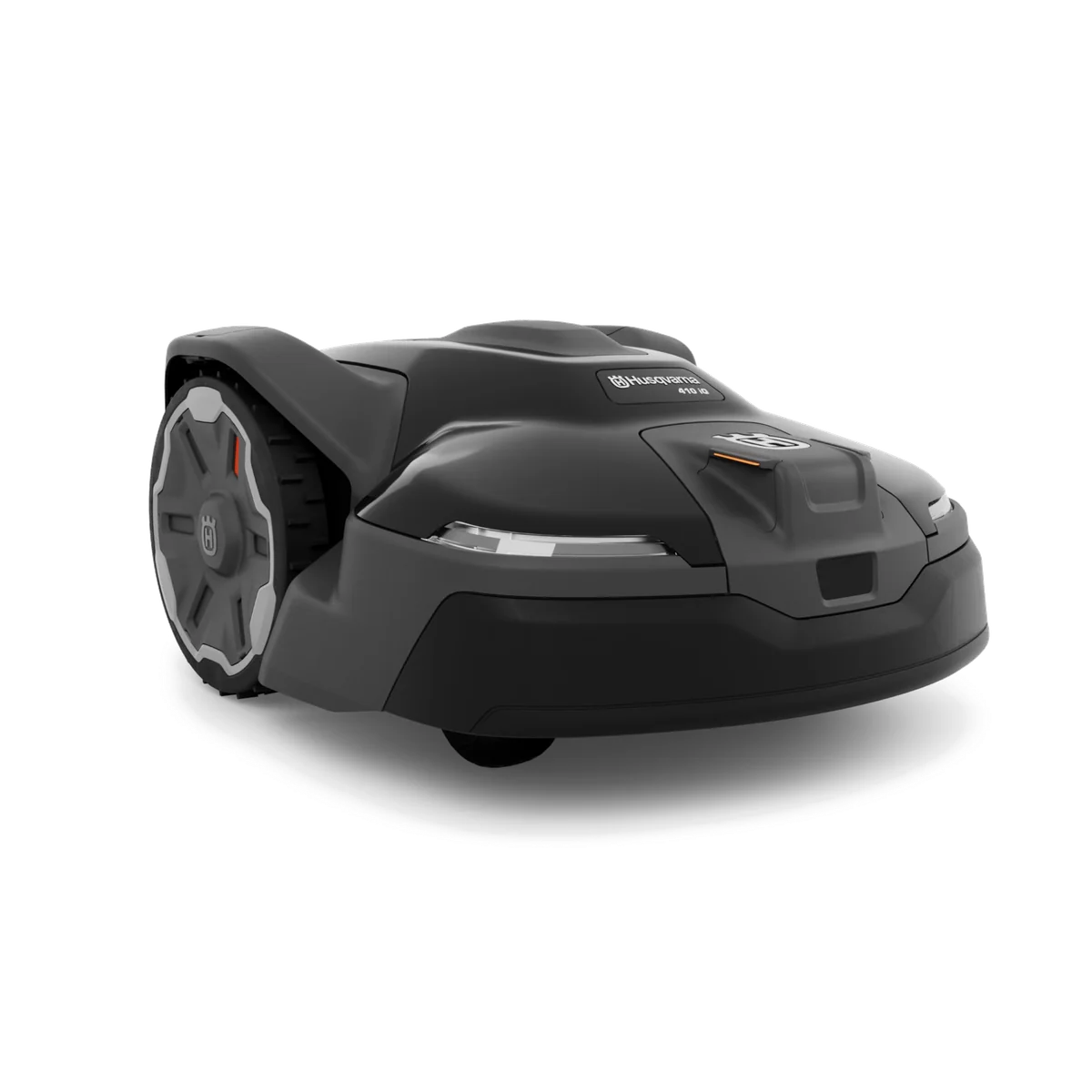
Its 1-to-4-inch electronic range, established Automower parts heritage, app patterns, and long mower warranty create a credible ownership case for open lawns and existing Husqvarna customers.
High cost and polarized reports of EPOS loss beside houses, dock failures, firmware trouble, and disappointing support undermine the assumption that the familiar badge guarantees an easier experience.
Test the complete route along both sides of the house, not merely the open front and rear grass. The review pool mixes several iQ models, so sibling failures and successes should not be assigned to the 410iQ without exact identification.
14. Eufy E15 robot lawn mower — The eufy E15 is the easiest camera-only install for a neat lawn comfortably below 0.2 acre.
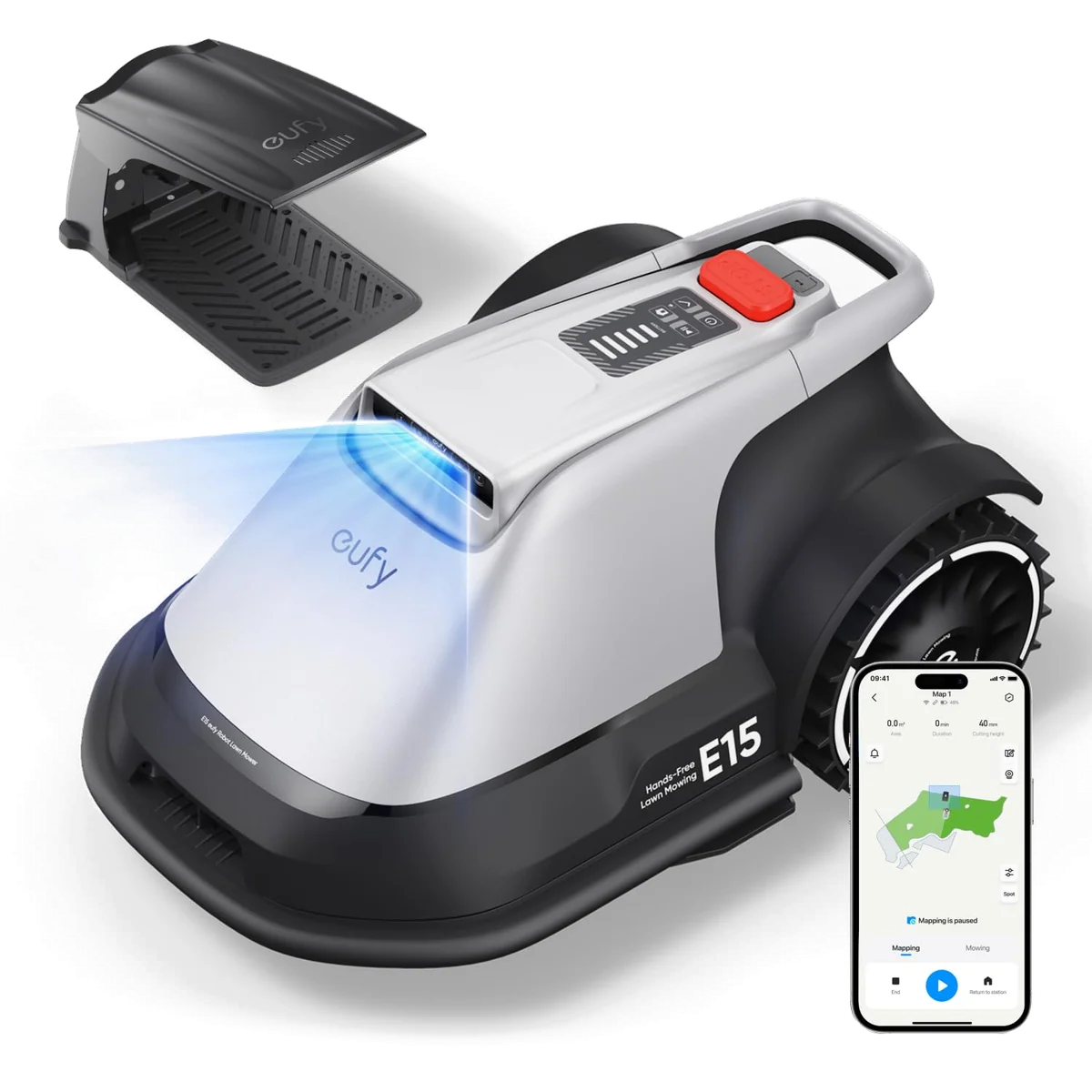
Automatic visual mapping, a clear app, systematic lines, electronic height control, and no antenna make it appealing on smooth, connected grass with obvious borders and dependable daylight.
Camera navigation can misread leaves, sparse grass, bare soil, open property lines, and low light, while the front caster and rear wheels struggle with hollows, damp turf, and rough transitions.
It is simpler than RTK on a visually tidy shaded rectangle, but it is not the right machine for disconnected lawns, dense St. Augustine, severe terrain, or wall-to-wall edging. The E18 increases mapped capacity without providing a tougher chassis.
Strengths
- Automatic camera mapping removes both perimeter-wire installation and RTK antenna placement.
- The mower produces clean parallel cuts with app-controlled height, direction, and spacing.
- Quiet operation, automatic docking, and frequent scheduling can remove most routine mowing labor.
- No-go areas, must-mow regions, zones, and pathways provide useful tools for correcting the first map.
- The included roofed base protects the mower while it charges.
Limitations
- Damp grass, small undulations, holes, and soft ground can defeat the 2WD chassis.
- Camera navigation depends on daylight and can misread sparse grass, flowers, leaves, or ambiguous boundaries.
- Closed gates and disconnected lawns undermine autonomous multi-zone operation.
- Fences, walls, curbs, and many flush borders still require manual trimming.
- Battery replacement, major spare parts, and post-warranty repair options are not clearly established.
15. Mammotion YUKA Mini 600H — The Mammotion YUKA Mini 600H is a promising small-lawn mower that is not ready for a main recommendation.
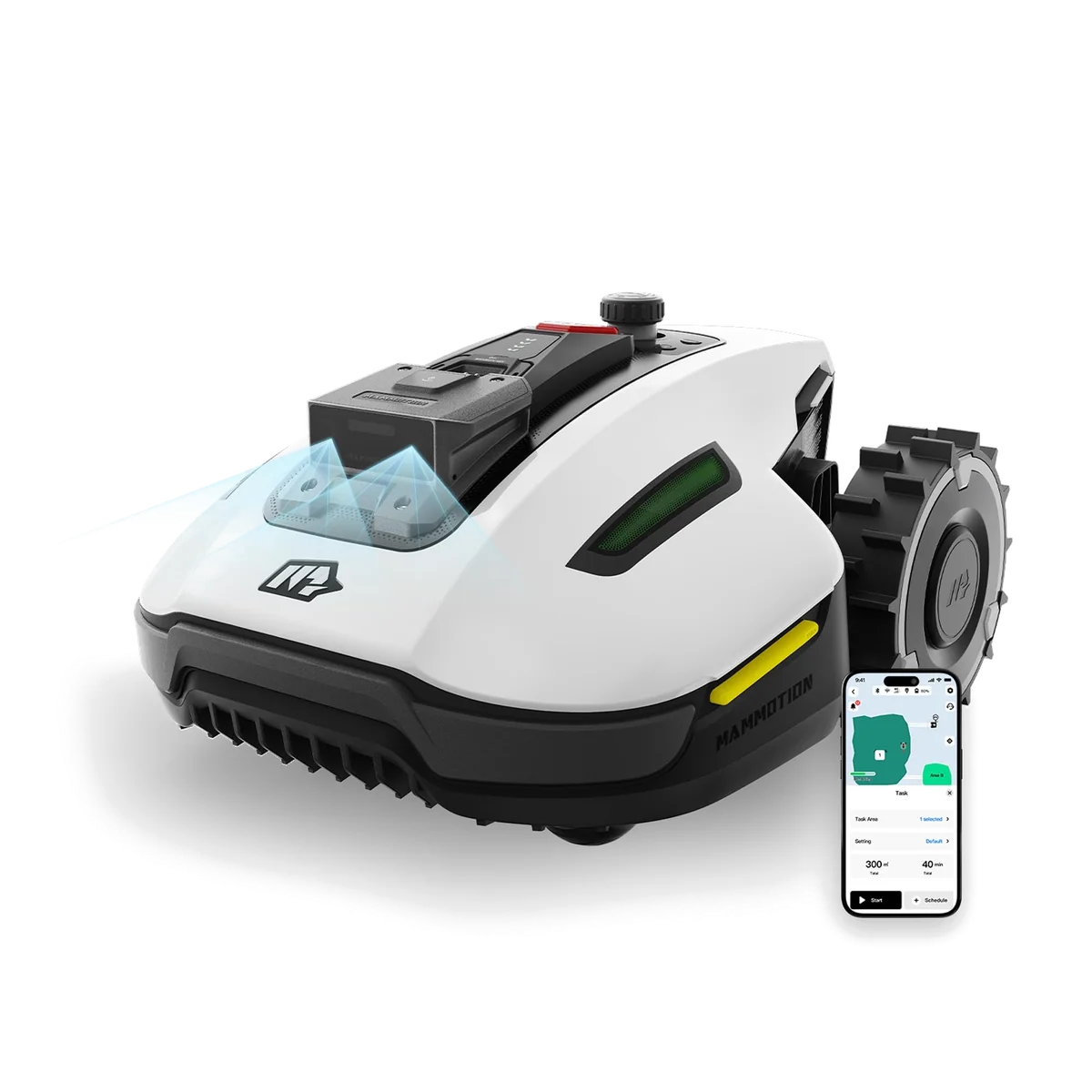
It can cut quiet planned stripes, manage multiple zones, and use network correction plus vision without burying a wire or necessarily mounting the included local RTK station.
Severe exact-listing reports of early shutdowns, sticking, a wheel-sensor failure, and refused support outweigh the appeal of its specification sheet until the reliability record improves.
Treat 0.15 acre as the sensible target, because a short mowing cycle makes the higher advertised ceiling difficult to accept. “No RTK installation” means dependence on network correction, connectivity, and service terms rather than infrastructure-free navigation.
Strengths
- Planned straight-line mowing leaves open, maintained grass clean and evenly striped.
- Virtual boundaries, multiple zones and editable paths avoid the burden of buried perimeter wire.
- The compact 23-pound body suits tight small lawns and remains manageable when a rescue or manual transfer is necessary.
- The replaceable battery and simple pivoting blades make routine mechanical upkeep approachable.
Limitations
- The 55-minute mowing cycle makes the claimed 0.3-acre maximum a ceiling rather than a sensible buying target.
- Two-wheel drive is vulnerable to wet slopes, roots, holes, soft ground and awkward turns.
- Vision avoidance can be cautious around harmless foliage yet still miss low or thin hazards.
- Exact-ASIN failures, firmware regressions and inconsistent repair experiences make after-sales support the decisive risk.
- The centered cutting disc leaves manual trimming beside fences, walls and cautious obstacle buffers.
16. ANTHBOT M9 Robot Lawn Mower — The ANTHBOT M9 has too many unanswered ownership questions to qualify as a best pick.
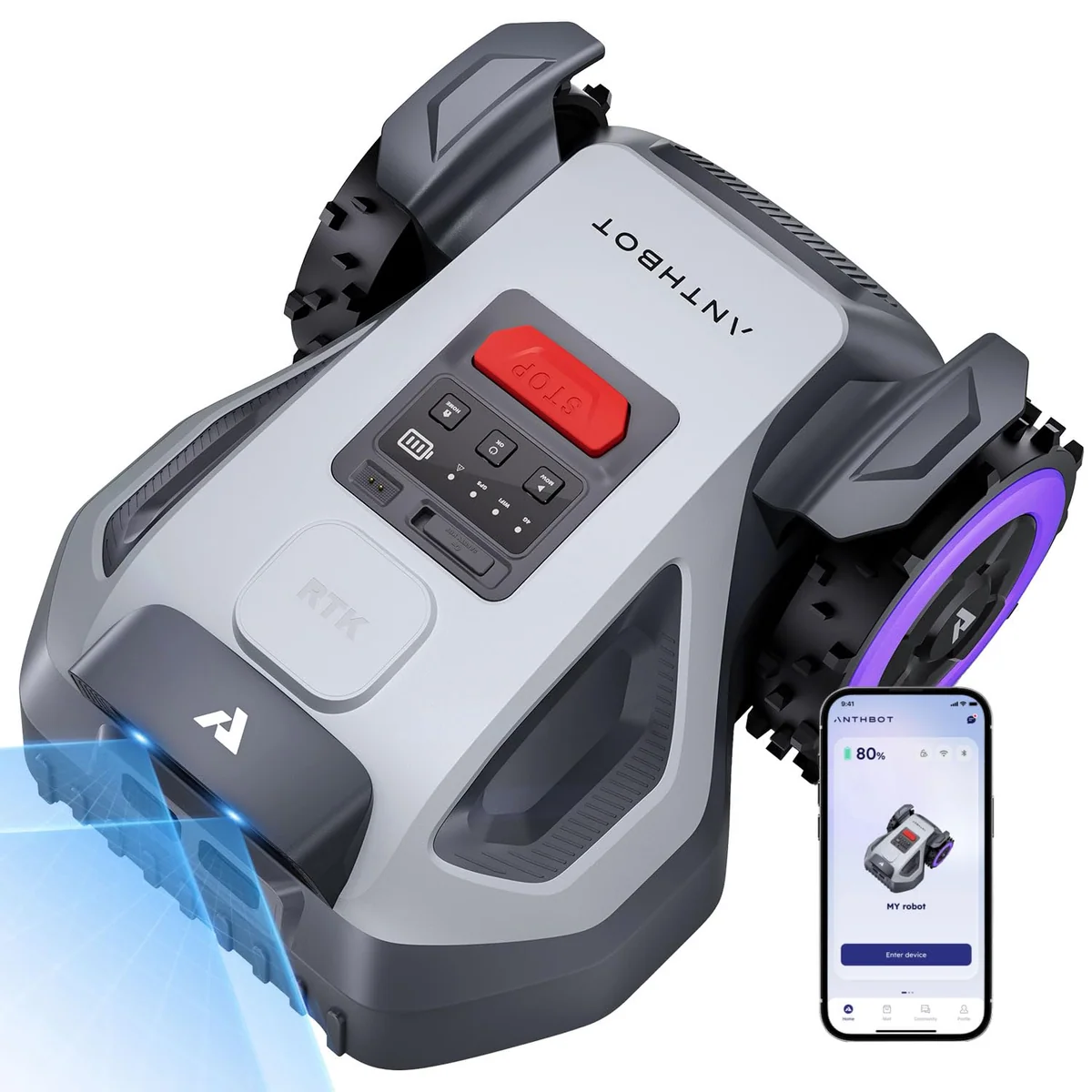
Dual cameras, local and network RTK, electronic height, automatic mapping, and extensive zone claims give it a competitive quarter-acre feature list.
A weak satisfaction record and missing evidence for runtime, throughput, parts, warranty, weather behavior, map retention, and service make the purchase difficult to justify.
Do not infer dependable recognition from the advertised object count or dependable setup from the ten-minute mapping claim. The exact listing is the M9, despite catalogue references to “Genie,” and its evidence should not be mixed with the Genie600 or M5.
17. WORX WR344 — The WORX WR344 is the terrain specialist for a connected acre whose owner accepts slow coverage and cloud dependence.
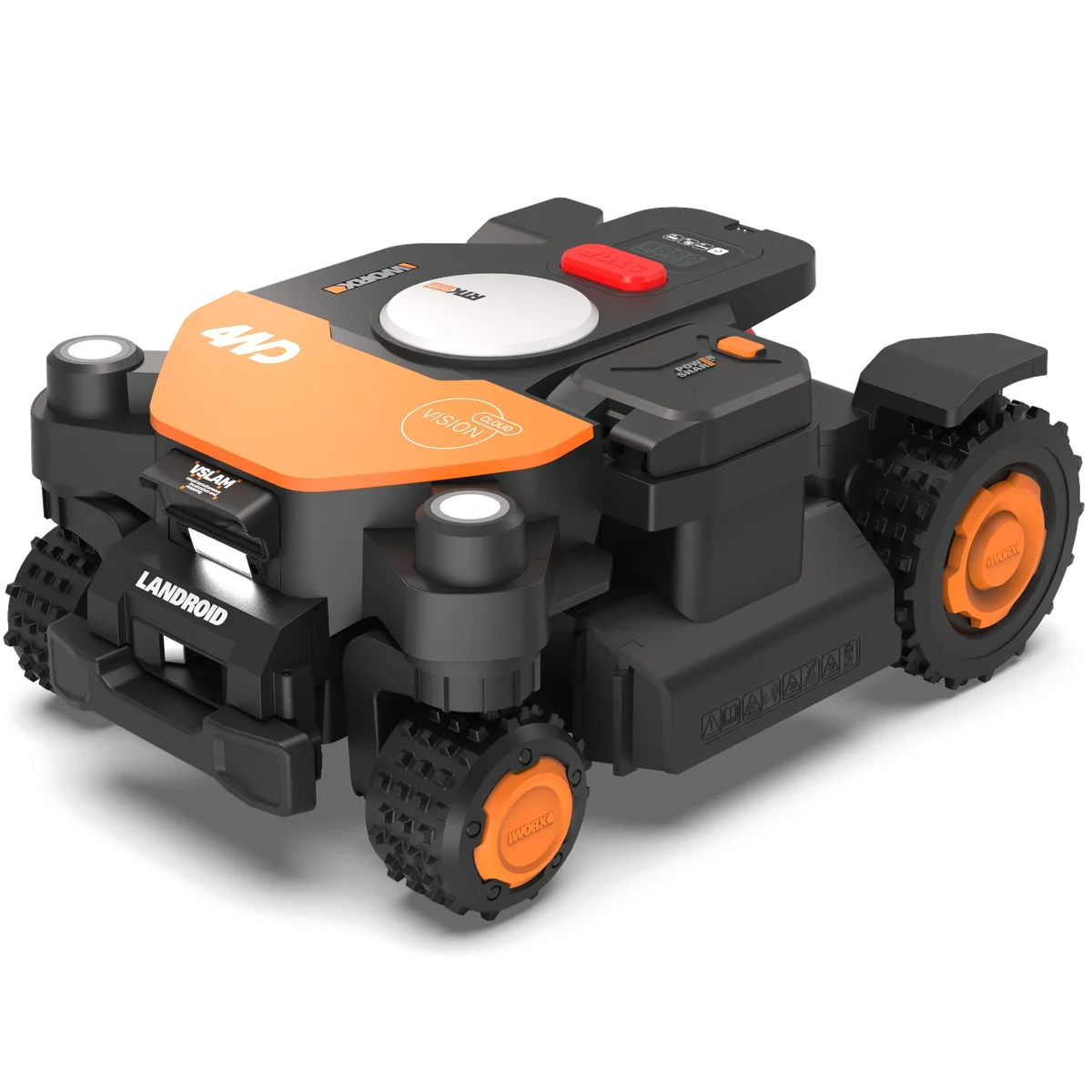
True four-wheel drive, articulation, steerable front wheels, a compact body, and a removable PowerShare battery form an exceptional mechanical platform for steep, lumpy, transition-heavy ground.
Its 8.7-inch deck, short real mowing bouts, immature commissioning flow, and low early owner score keep it below the wider X430 as a general large-lawn recommendation.
The WR344 can be gentler in turns and better through cramped hostile terrain than a skid-steer mower, but near-acre jobs need carefully divided zones and plenty of calendar time. Treat Wi-Fi, SIM activation, NTRIP correction, recharge, and route completion as parts of the return-window trial.
Strengths
- Four driven wheels, articulation and front steering deliver exceptional traction without routine skid-turn damage.
- Cloud RTK removes both the perimeter wire and the owner-installed correction mast.
- Frequent dry mowing produces a clean, quiet cut with precise narrow patterns.
- The removable PowerShare battery makes the most failure-prone consumable unusually easy to replace.
Limitations
- Wi-Fi, SIM and NTRIP failures can prevent an expensive mower from completing basic setup.
- The 8.7-inch deck makes full-acre maintenance slow and dependent on many charging cycles.
- Shadows, tall tufts, bare ground and low branches can provoke false obstacle or trapped errors.
- Cut-to-Zero still leaves manual trimming at walls, posts, corners and uneven borders.
18. ANTHBOT Genie600 Robot Lawn Mower — The ANTHBOT Genie600 is an interesting RTK and four-camera design that still belongs on the wait list.
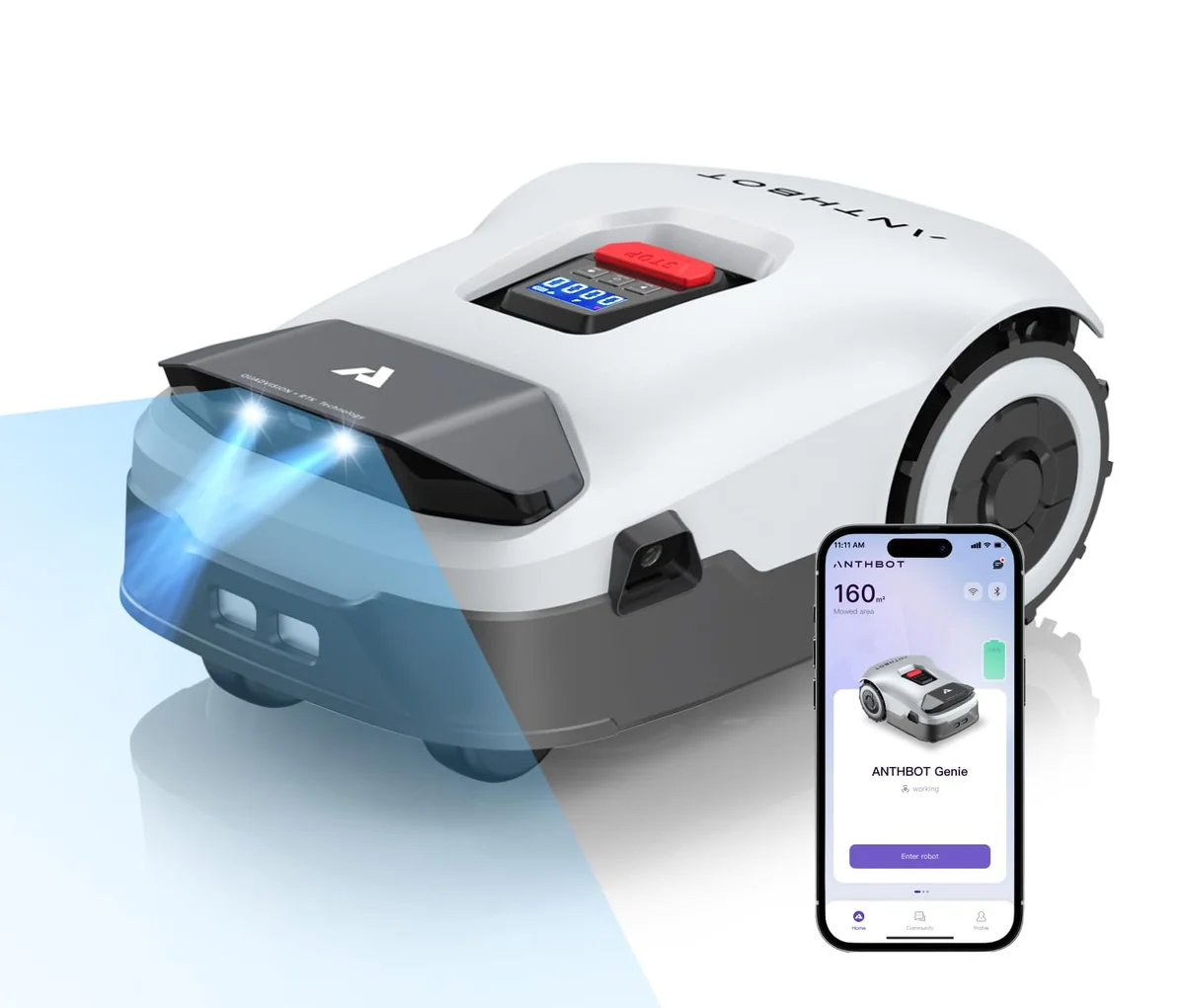
Its proposed combination of automatic boundary recognition, manual fallback, systematic planning, and more than 20 zones addresses the right problems for a small wire-free mower.
Cut width, height range, runtime, charging, slope ability, weather protection, parts, subscriptions, and long-term owner outcomes remain too poorly established for a recommendation.
Four cameras are not four pieces of performance evidence, and the advertised object count does not replace documented detection thresholds. The name alone does not establish an exact 600-square-meter capacity or equivalence with a “Genie600 II.”
19. BESTMOW Robot Lawn Mower — — The BESTMOW T100 makes a large-acreage promise without supplying enough of the machine behind it.
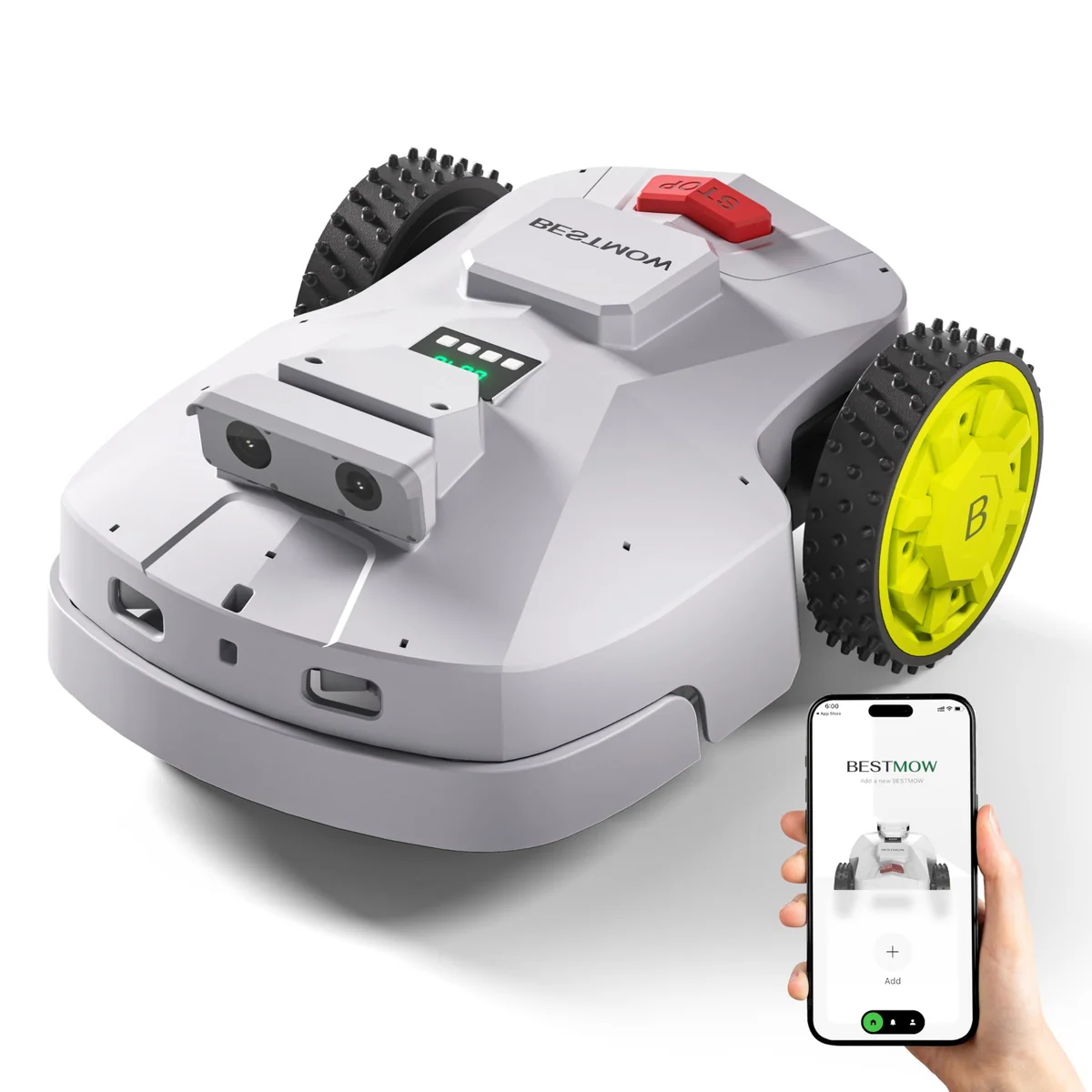
Four-hour runs, a 4-inch maximum cut, local RTK, four cameras, and a 1.5-acre managed-area claim could suit a broad, mostly open property if every compatibility and support question were resolved first.
Conflicting slope figures and missing details about the deck, drive, battery, charging, warranty, blades, repairs, activation, and service terms make it a poor alternative to established large-yard picks.
Its acreage figure still implies many charging shifts, not a single-pass mow. Network requirements, router compatibility, activation transfer, regional virtual correction, and the exact replacement-parts route all deserve written answers before purchase.
20. Navimow i215 LiDAR — The Segway Navimow i215 LiDAR is the balanced choice for a structured lawn beneath trees.
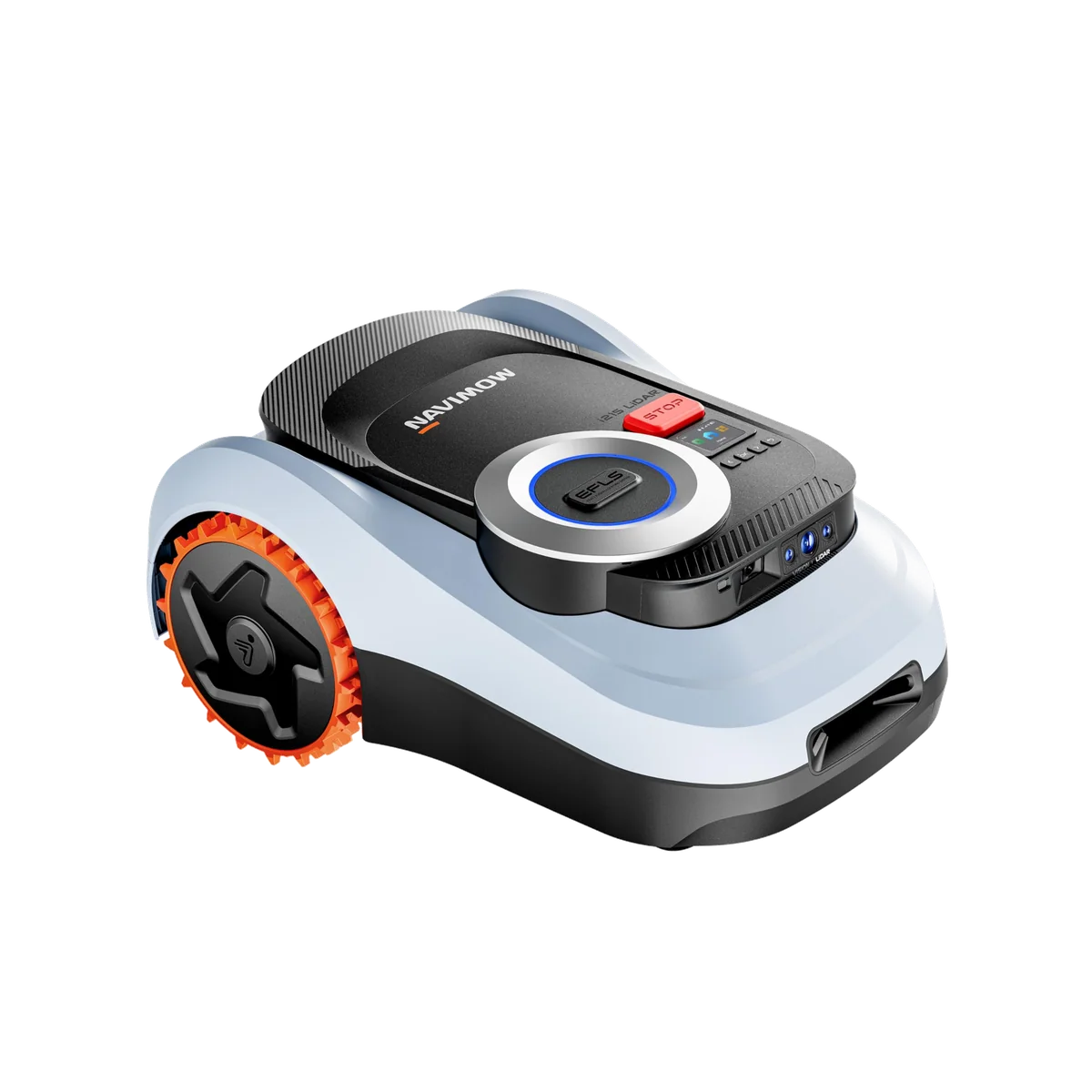
Solid-state LiDAR and vision remove the antenna problem, while a 2-to-4-inch range, systematic cutting, quiet operation, and a 0.37-acre map allowance suit a prepared residential property with blocked sky.
Rear-wheel drive, variable real throughput, wide obstacle detours, an inset disc, and reports of docking and error-code failures rule out soft ground, severe cross-slopes, and hazardous drops.
It beats small RTK mowers when trees and buildings are the main obstacle, but the i210 AWD is the logical sibling when traction matters more than covered-sky positioning. Keep conservative buffers beside steps, water, roads, and retaining edges because a virtual boundary is not a cliff sensor.
Strengths
- LiDAR and vision remove the perimeter wire and external RTK antenna from a genuinely complicated setup.
- Editable zones, schedules, directions, and cutting heights make it adaptable to divided residential lawns.
- Frequent systematic mowing is quiet, leaves tiny mulched clippings, and can keep the main lawn consistently presentable.
- Tree cover, fences, and buildings can become useful navigation landmarks instead of satellite obstacles.
Limitations
- Docking, missed strips, and connector routes are inconsistent enough that the first successful map cannot be trusted by itself.
- Rear-wheel drive struggles with some ruts, thick turf, leaves, wet transitions, and lateral slopes.
- There is no dedicated cliff sensor, so immediate drop-offs need a deliberately conservative virtual boundary.
- Raised edges and cautious obstacle avoidance leave real string-trimmer work behind.
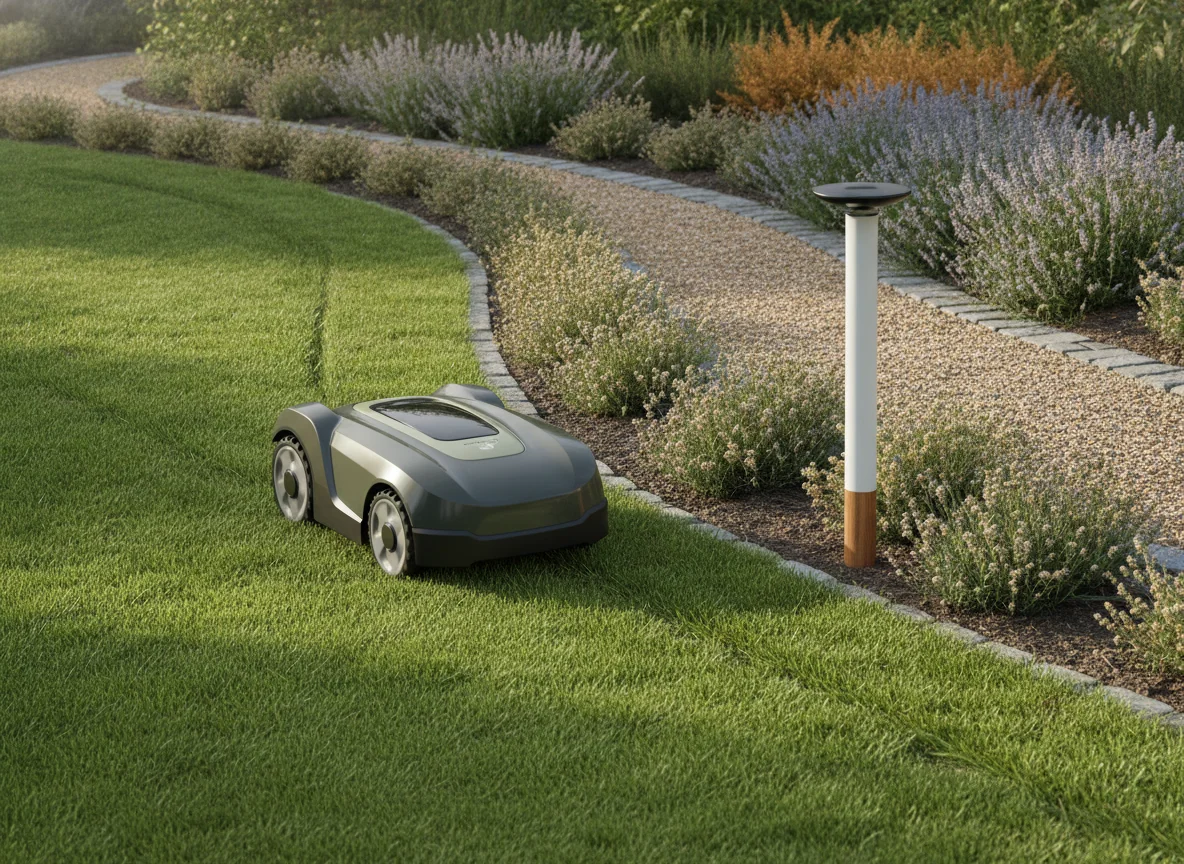
21. ANTHBOT M5 — The ANTHBOT M5 is the conditional value choice for a smooth open lawn around one eighth of an acre.
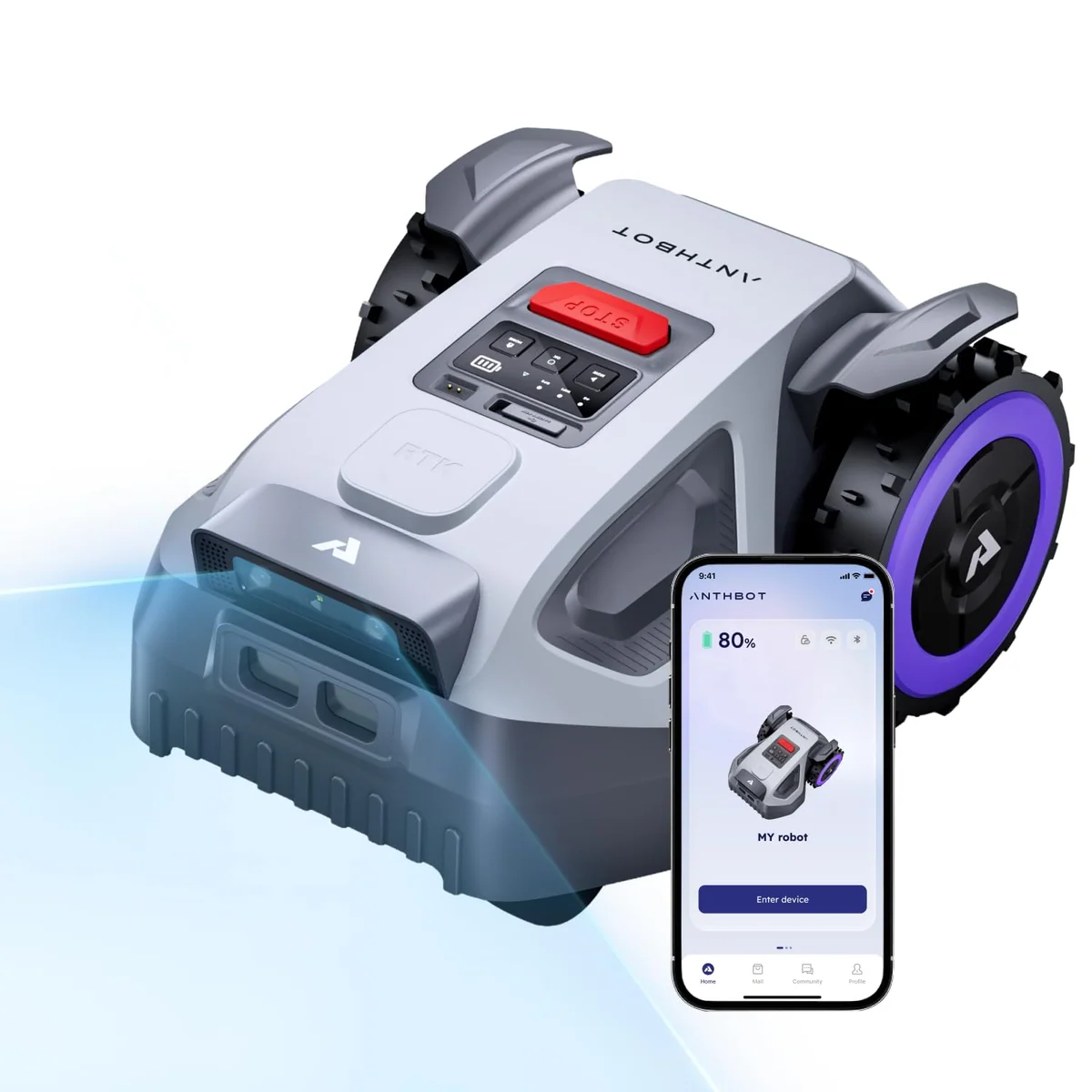
Local full-band RTK, dual cameras, systematic patterns, electronic height, multiple zones, automatic charging, and useful app controls provide a lot of small-yard function when the antenna has broad sky exposure.
Conflicting hill performance, uncertain low-object detection, vertical-border trimming, proprietary software, and a review pool contaminated with M9 and accessory comments require a cautious purchase.
Manual phone-guided mapping is the dependable fallback when automatic boundary recognition dislikes the lawn. Do not confuse this standard RTK M5 with the separately described M5 LiDAR, and do not stretch its comfortable area to the higher marketing limit.
Strengths
- Wire-free mapping avoids the labor and future repairs of a buried perimeter cable.
- Systematic lanes, adjustable angles, and a five-blade disc produce an attractive maintenance cut.
- Zones, paths, no-go areas, electronic height control, and scheduling give the app useful depth.
- Automatic charging and resumption let a longer job continue without manual intervention.
- Quiet operation makes frequent daytime mowing easy to live with.
Limitations
- RTK accuracy depends on an open, stable antenna position with good satellite visibility.
- The inset cutting disc leaves a fringe beside walls, fences, beds, and drops.
- Obstacle avoidance can miss small or transparent objects and changes sharply with sensitivity.
- Overgrown grass exposes clumping, missed strips, and the limits of a razor-disc mower.
- Hill performance is not proven at the advertised maximum and owners report conflicting results.
- The proprietary app ecosystem offers no demonstrated local API or Home Assistant integration.
22. Husqvarna Automower 420iQ Robotic Mower — The Husqvarna 420iQ is the one-acre choice for buyers prioritizing parts access and dealer familiarity.
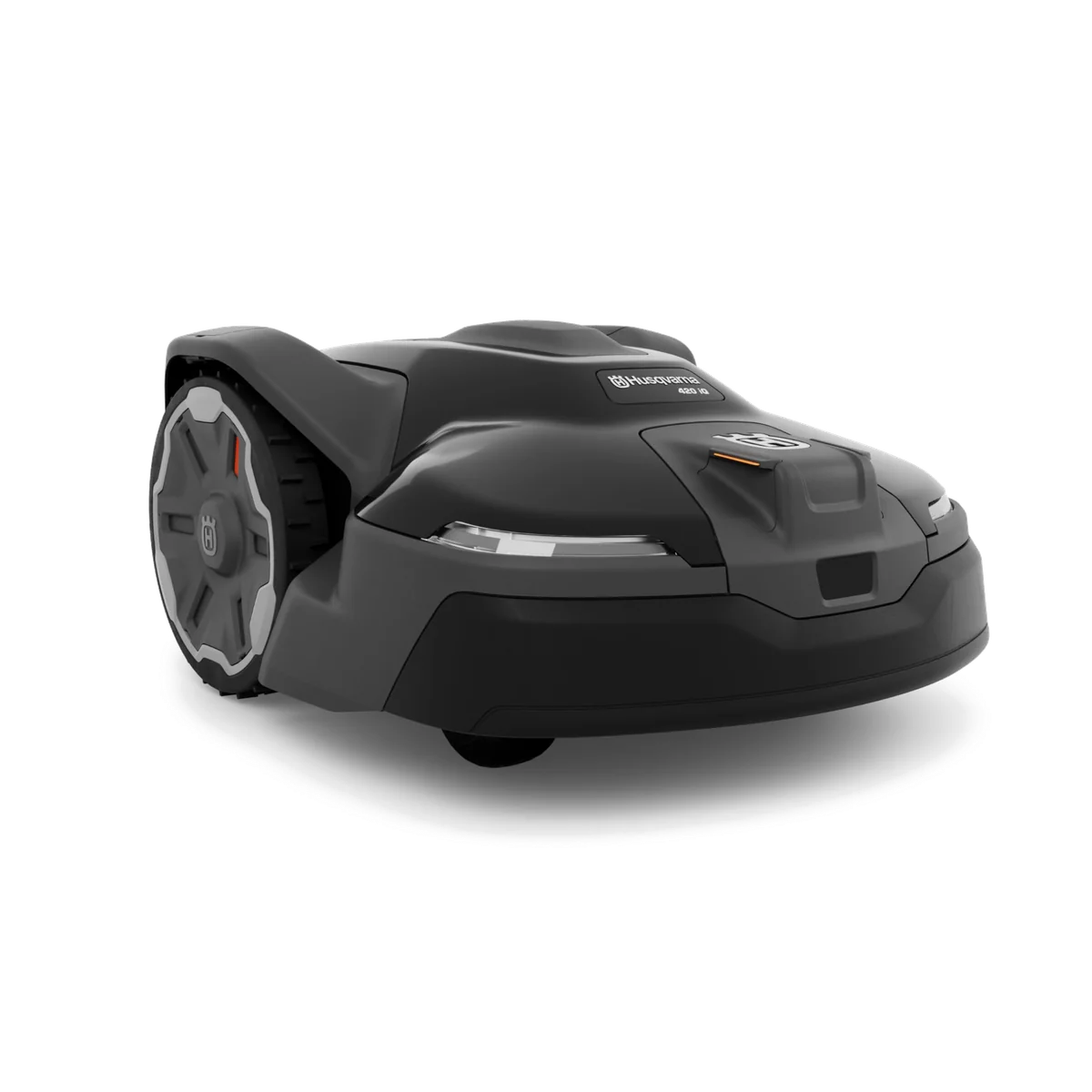
Its 1-to-4-inch range, replaceable consumables, established repair ecosystem, quiet patterned mowing, EPOS mapping, and long warranty distinguish it from newer brands with uncertain long-term hardware support.
Satellite loss under trees and beside buildings, finicky setup, map drift, awkward editing, docking trouble, and severe mixed-family support reports make it a qualified rather than effortless premium purchase.
The 420iQ’s strongest argument is serviceability, not superior navigation in every yard. Its review pool mixes 410iQ, 420iQ, 440iQ, and older Automower experiences, so exact performance should be established across the entire property during the return window.
23. Greenworks C20Z Wire-Free Robotic Lawn — The Greenworks C20Z should be avoided until its owner record improves substantially.
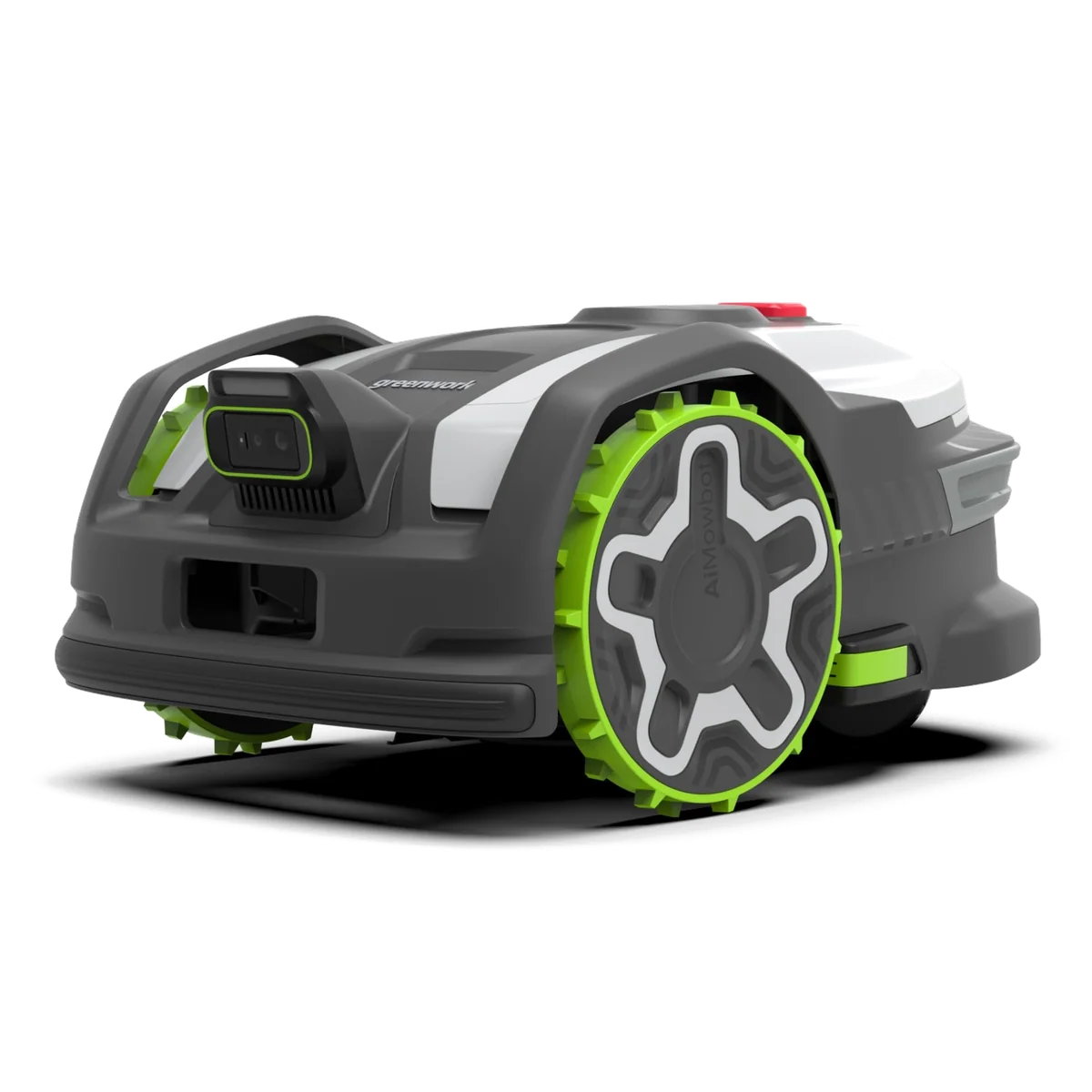
RTK, vision, electronic height, quiet operation, and a half-acre claim look competitive on paper, but the feature list does not outweigh exceptionally poor early customer satisfaction.
The supplied record does not explain the failures behind that dissatisfaction, which means navigation, terrain, support, safety, and finished-cut claims cannot be trusted enough for a positive recommendation.
Two-wheel drive also makes the absolute all-terrain language unconvincing. Wait for a clearer exact-model ownership record rather than paying to discover which part of the promise breaks first.
24. Dreame A3 AWD Pro 3500 — The DREAME A3 AWD Pro 3500 is the best large LiDAR mower for a firm, hilly, tree-covered property.
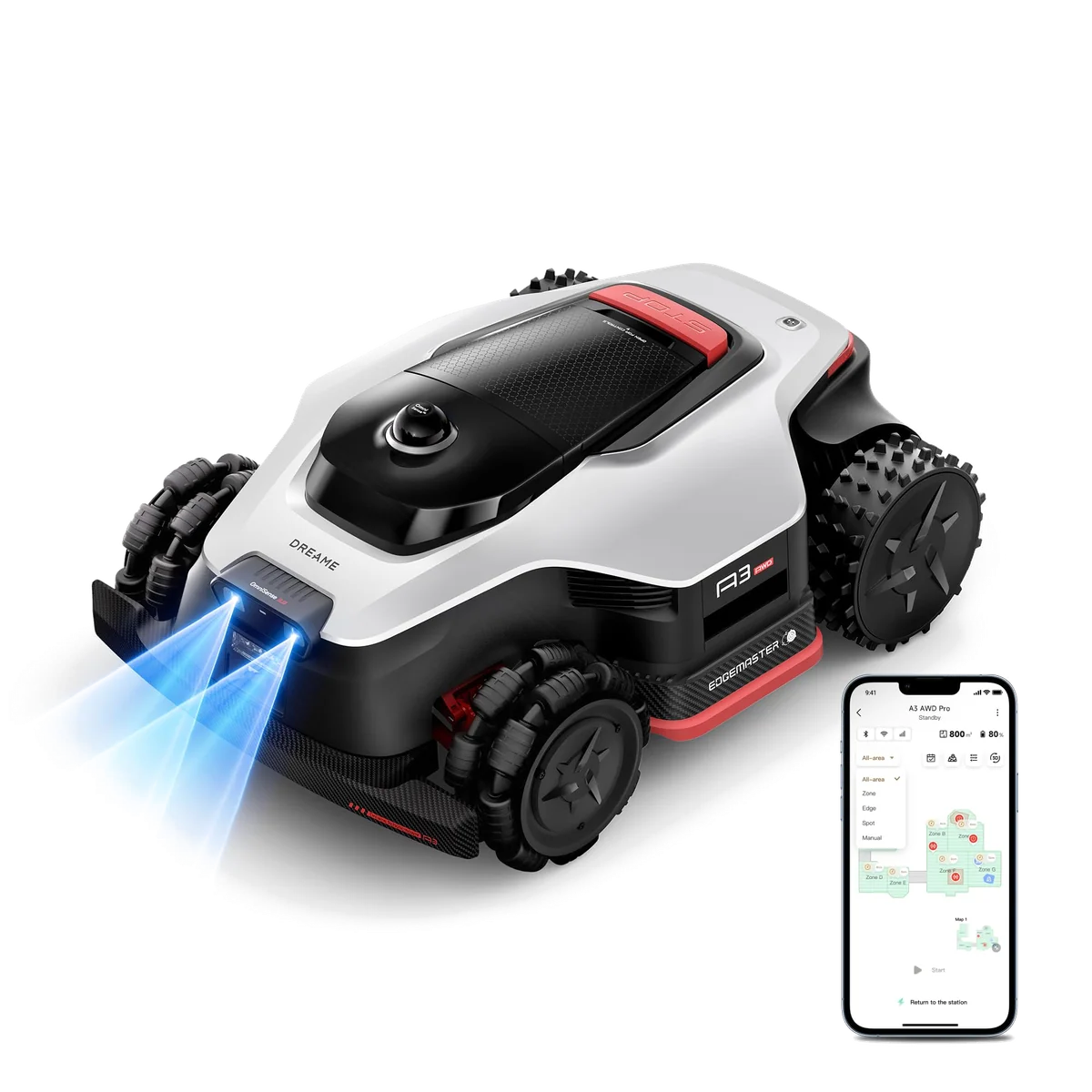
True four-wheel drive, a 15.8-inch twin deck, a 1.2-to-3.9-inch range, local 360-degree LiDAR, and dual vision solve both blocked-sky positioning and difficult terrain without an RTK antenna.
Its weight and powered wheels can rut soft ground, while map editing, updates, heat-related LiDAR pauses, and the fixed low EdgeMaster pass demand more supervision than the premium hardware implies.
It is the stronger choice than the standard A3 for a lawn approaching an acre, but the printed 80 percent grade is a favorable-surface ceiling rather than a routine plan. Disable EdgeMaster on taller turf if its low outward pass creates a scalped racetrack.
Strengths
- LiDAR navigation remains precise beneath trees and beside buildings without an external RTK antenna.
- True four-wheel drive handles firm slopes, roots and uneven transitions that stop ordinary robot mowers.
- The wide dual-disc deck produces clean stripes and fine mulch on frequently maintained grass.
- Obstacle recognition is unusually capable with ordinary garden objects and explains many detections in the app.
Limitations
- Its weight and turning routine can rut wet turf or dig into sand, thin grass and loose soil.
- EdgeMaster cuts at a fixed 3 cm and can visibly scalp lawns maintained higher.
- Automatic mapping is unreliable around ambiguous borders and dangerous drop-offs.
- Software, docking and early hardware reliability remain less consistent than the underlying mowing hardware.
25. Yarbo lawn mower — The standard YARBO lawn module is a multi-acre yard robot that should not be trusted as the sole mower.
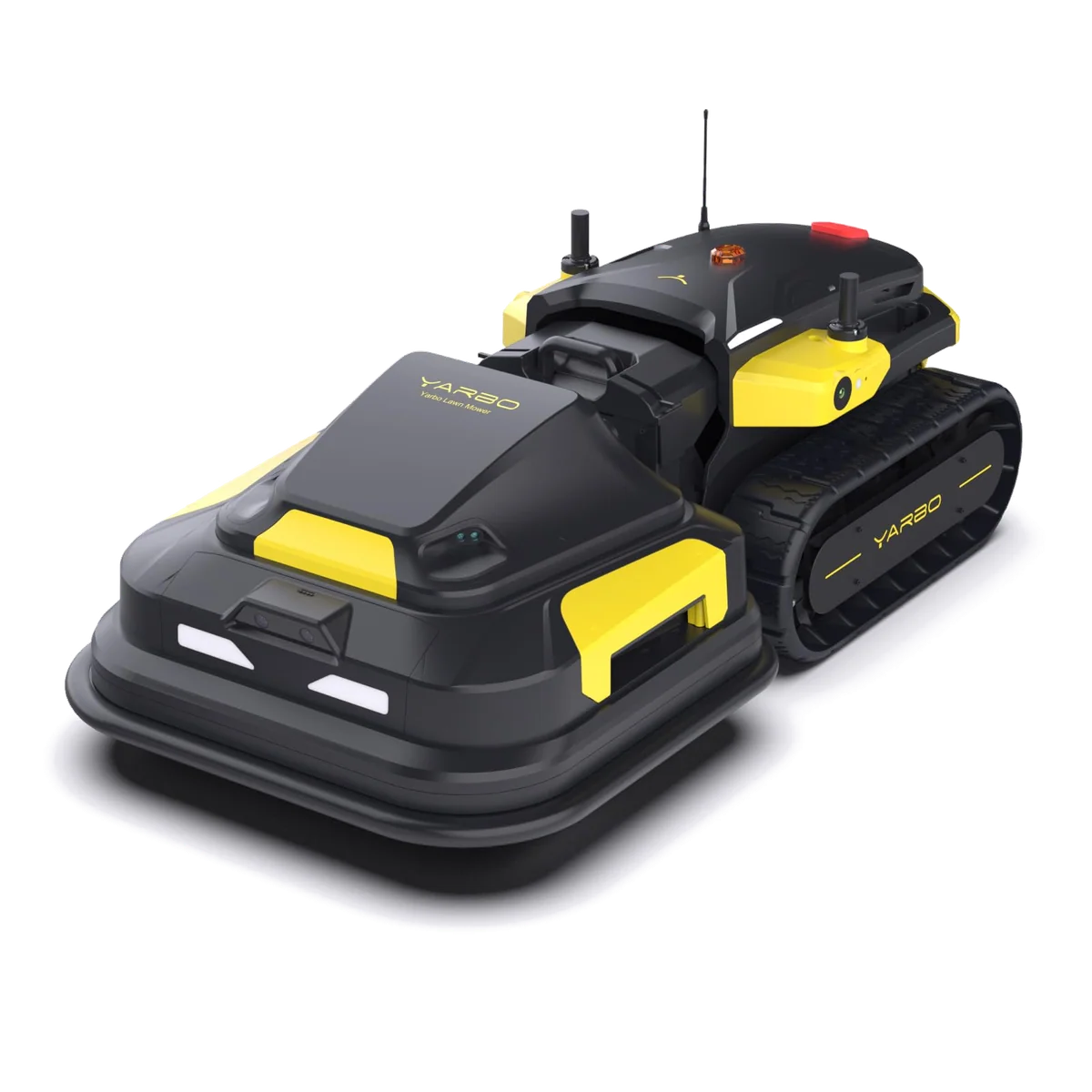
Its tracked 200-pound platform, 20-inch cutting width, broad height range, and modular core have genuine appeal on a large, mostly open property that also needs towing or seasonal attachments.
Repeated core, track, battery, charging, mapping, and module failures, plus unresolved security concerns and one shared mechanical core, make backup equipment mandatory.
Installation still involves a sky-exposed data center, power, networking, dock preparation, and manually driven maps. The standard mower uses razor discs rather than the newer Pro blade system, and the 6.2-acre claim describes continuous scheduled management rather than one mowing session.
Strengths
- The 20-inch deck and automatic charge-and-resume cycle can maintain substantially more open grass than ordinary residential robot mowers.
- The tracked chassis has genuine advantages on sand, mud, slopes and uneven multi-acre properties.
- Frequent dry mowing can produce a consistently short lawn with crisp directional patterns.
- Interchangeable snow and leaf modules give the Core a credible year-round purpose for the right property.
Limitations
- Repeated Core, charging, battery, track, mower-module and Data Center failures make it unsafe to rely on as the only mower.
- The standard razor-disc deck clogs and falls behind when grass is wet, tall, coarse or littered with debris.
- RTK installation, wired networking, manual mapping and route tuning make the wire-free label sound easier than the setup is.
- The heavy tracks can wear turning points and travel routes while broad avoidance margins leave substantial trimming.
- Documented remote-access and stop-control failures require clear, version-specific proof of remediation.
26. Husqvarna Automower 440iQ Robotic Mower — The Husqvarna 440iQ is the premium two-acre option for owners buying serviceability rather than simplicity.
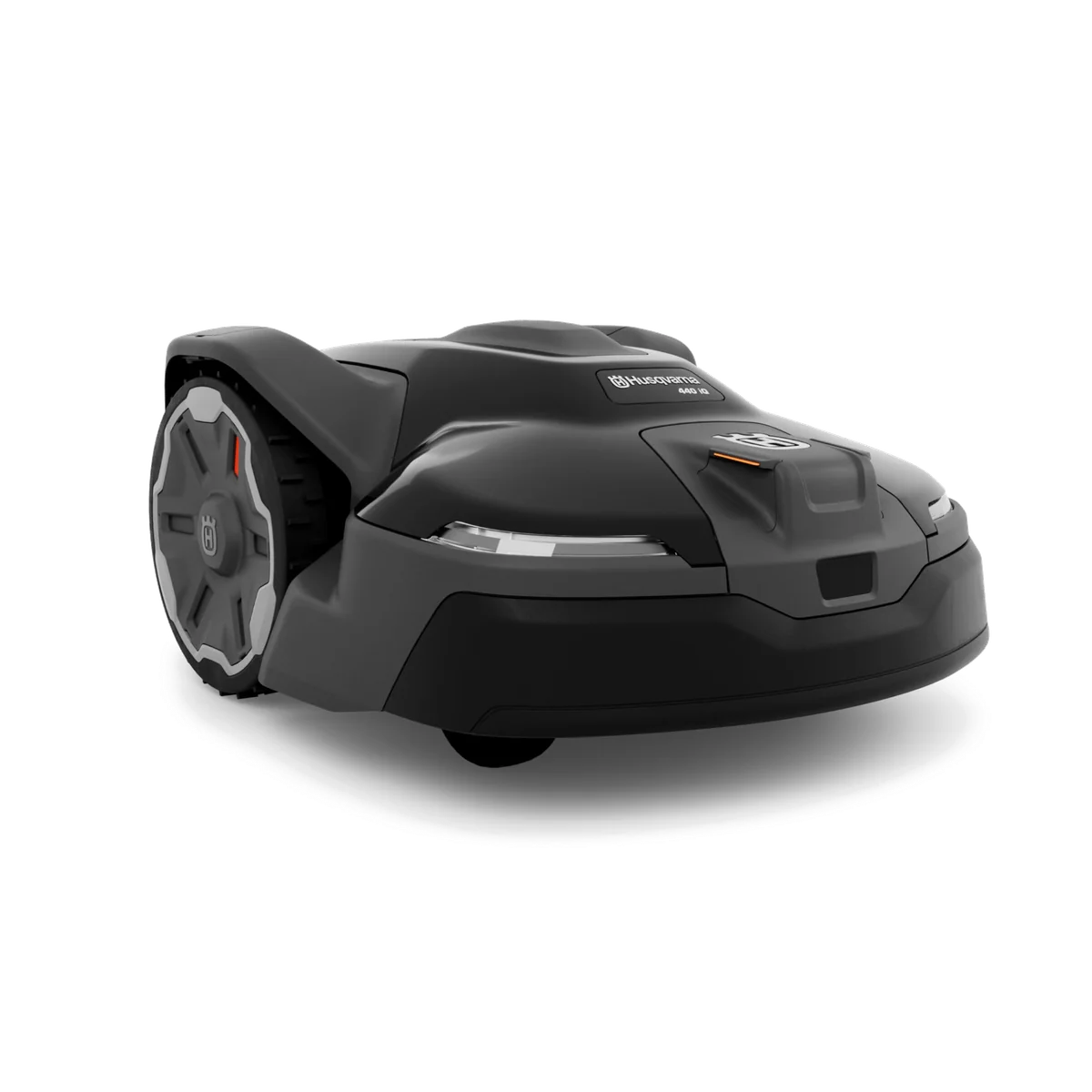
Its high cutting range, quiet running, anti-theft features, familiar blades, repairable brand ecosystem, and credible long-duration mowing make it one of the few residential machines with a serious multi-acre proposition.
Very long zone times, satellite dependence, schedule quirks, difficult map edits, docking complaints, mixed support, and substantial cost prevent a general best-overall verdict.
Large zones can occupy most of a day through repeated charging, so the two-acre figure belongs to a persistent maintenance schedule. A strong dealer and property-wide positioning trial are more important here than confidence borrowed from the Husqvarna name.
27. Eufy E18 robot lawn mower — The eufy E18 is the camera-only choice for a smooth connected lawn that exceeds the E15’s map allowance.
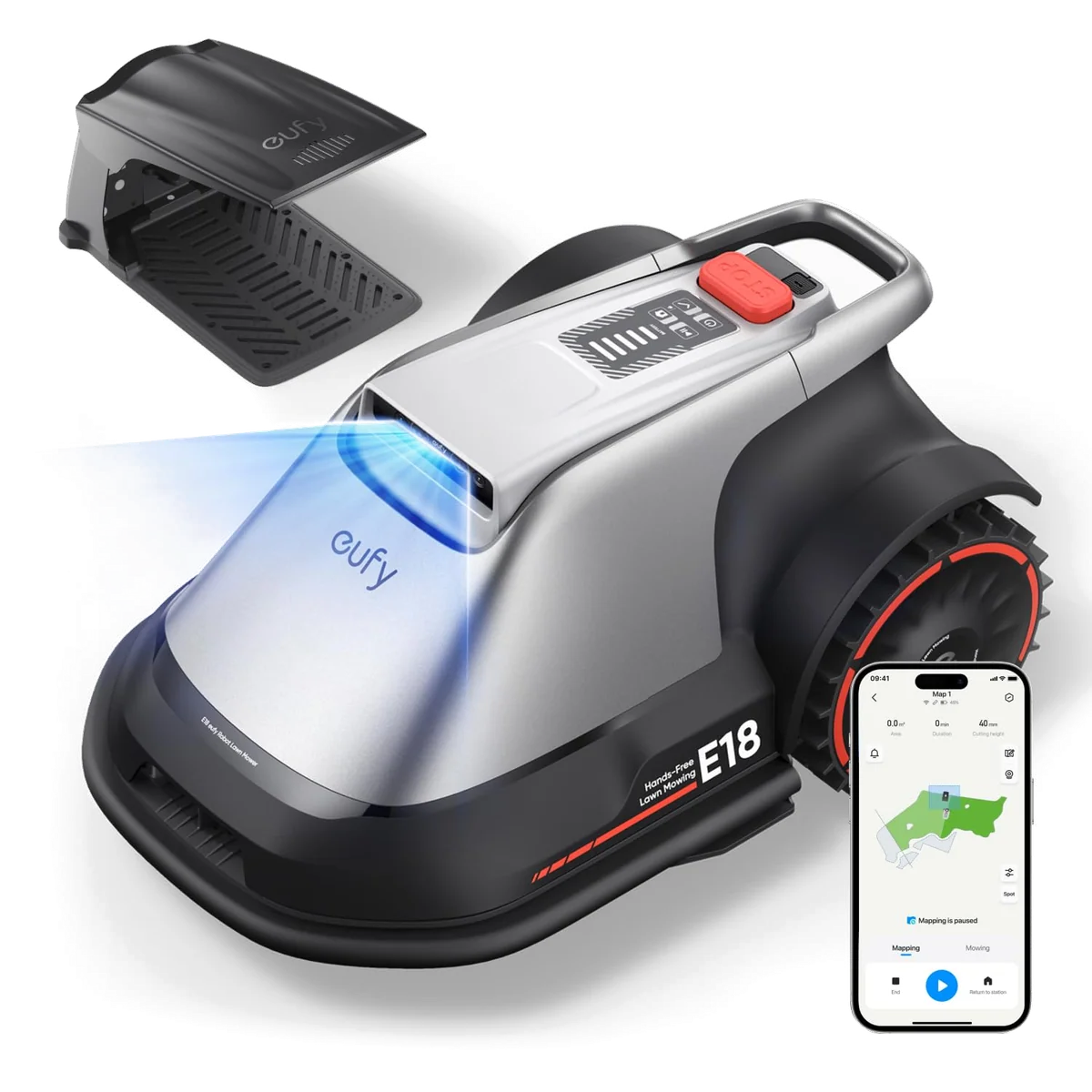
It brings automatic visual mapping, excellent ordinary-object recognition, clean systematic stripes, electronic height, and a 0.3-acre ceiling without buried wire or an RTK antenna.
The larger rating does not bring a tougher chassis or larger battery, so daylight limits, hollows, damp grass, ambiguous borders, disconnected zones, and lengthy elapsed mowing remain.
Treat the E18 as a capacity variant of the E15 rather than a rough-ground upgrade. The E15 and E18 comparison is useful when the lawn size sits near the point where the smaller map allowance becomes restrictive.
28. HOOKII Neomow X2 SE — The HOOKII Neomow X2 SE is an early-adopter LiDAR option for a firm lawn beneath trees.
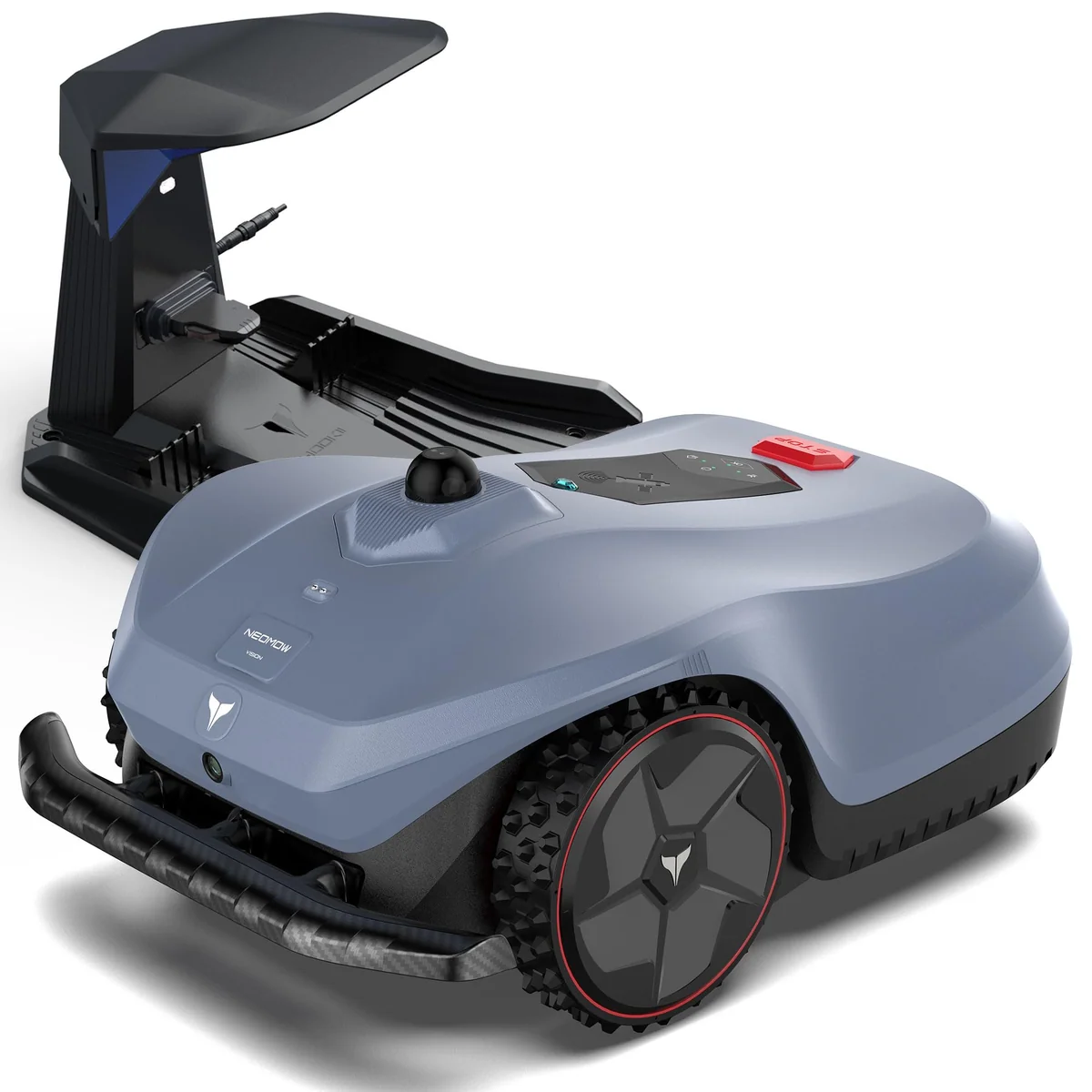
Its large battery, antenna-free 3D LiDAR, systematic lanes, and positive hands-on support reports show real potential on maintained ground where satellite reception is unreliable.
Uncertain auto-mapping hardware, missed rows, weak traction, docking errors, firmware loops, interrupted cellular service, and a reported wheel-retention failure make the ownership experience too inconsistent for a leading rank.
Confirm whether the vision module required for automatic mapping is included, as well as the duration and terms of cellular service. ECOVACS offers the more mature LiDAR proposition, while an AWD mower is safer for loose, steep, or transition-heavy ground.
Strengths
- Three-dimensional LiDAR gives tree-covered and building-shadowed lawns a wire-free route around RTK signal problems.
- Systematic mowing can produce straight, well-overlapped lanes with very little operating noise.
- The 13Ah battery and 0.75-acre managed-area claim make it relevant to lawns larger than the usual compact LiDAR mower serves.
- HOOKII support has delivered unusually hands-on help when replacements, map transfers, or engineering attention were required.
Limitations
- Software, docking, and error-recovery failures make unattended operation less dependable than the navigation hardware suggests.
- The centered cutting system leaves meaningful grass beside raised borders, walls, and drop edges.
- Long grass, loose ground, threshold lips, and wet slopes expose limits in cutting power and front-wheel-drive traction.
- Auto-mapping appears to depend on an upgrade module whose inclusion and total cost are not established by the base listing.
- A detailed wheel-retention failure and uncertain long-term parts access add hardware risk to an already young platform.
29. RoboUP Raccoon 2 SE — The RoboUP Raccoon 2 SE is suitable only for a small lawn enclosed by obvious physical borders.
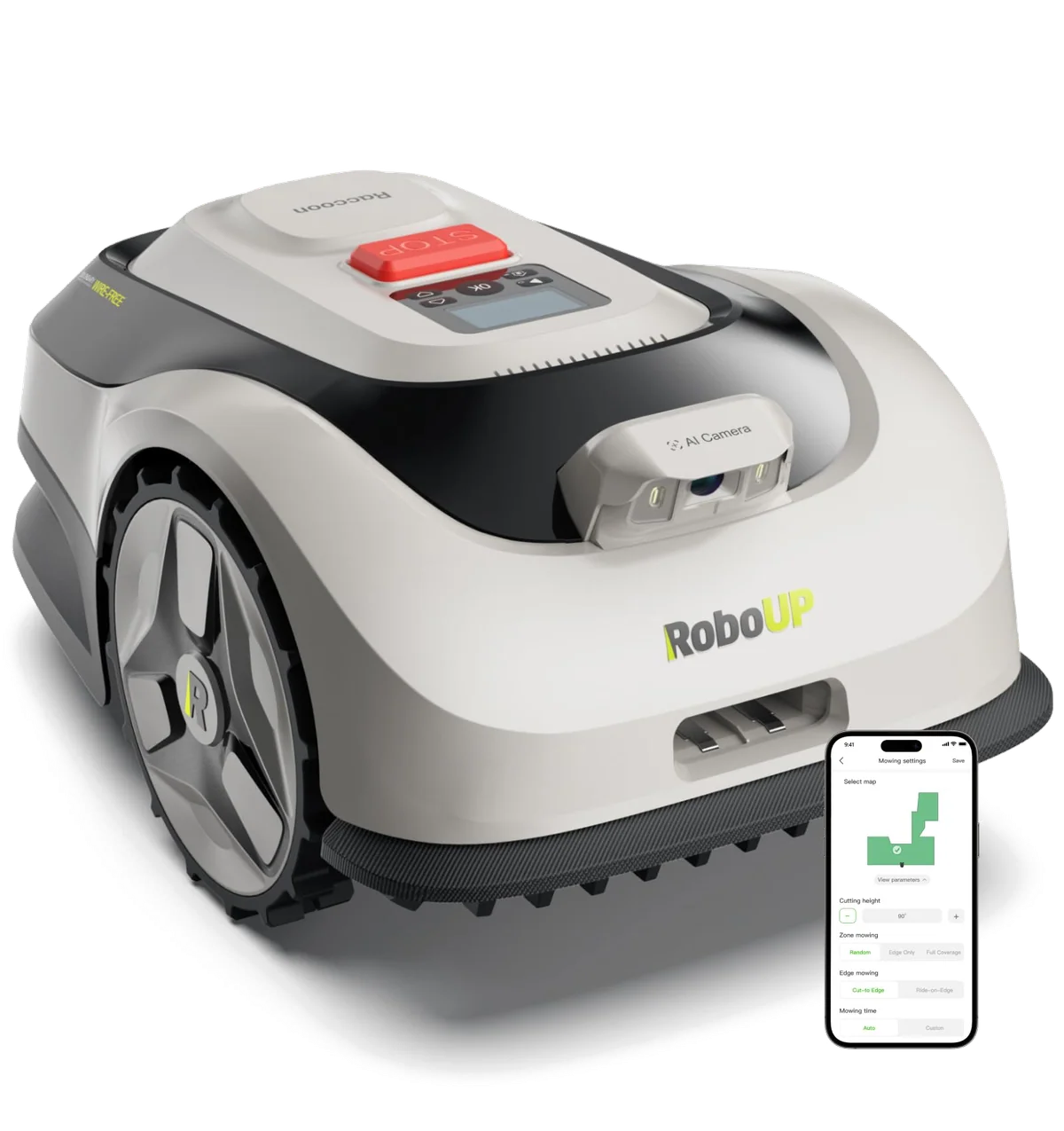
Its quiet camera-led operation, long battery endurance, onboard controls, and app-optional basic use can maintain a compact fenced patch without a powered perimeter cable.
Random whole-lawn travel, unreliable restraint where grass continues beyond the property, weak handling of leaves and bare soil, missed small objects, and a wide edge strip rule out general virtual-boundary use.
A saved map should not be treated as a dependable fence, and its battery endurance does not make random coverage efficient. It is a poor choice for a remote property because bark beds, dead ends, and boundary escapes can still require a nearby rescuer.
Strengths
- No perimeter wire or RTK antenna is required.
- Simple onboard controls make the app optional on a straightforward lawn.
- The quiet cutting system reliably maintains grass it actually reaches.
- Battery endurance is stronger than the normal route efficiency.
Limitations
- Normal whole-lawn coverage is random and cannot guarantee a complete pass.
- Open grass boundaries can let the mower leave its saved area.
- Tennis balls, hoses, and wildlife-sized objects are not detected consistently.
- Raised edges can leave roughly four inches for the string trimmer.
- Long-term parts, battery, warranty, and service support remain unclear.
30. Mammotion LUBA 3 AWD 3000H — The Mammotion LUBA 3 AWD 3000H is the high-cut specialist for a rough three-quarter-acre lawn.
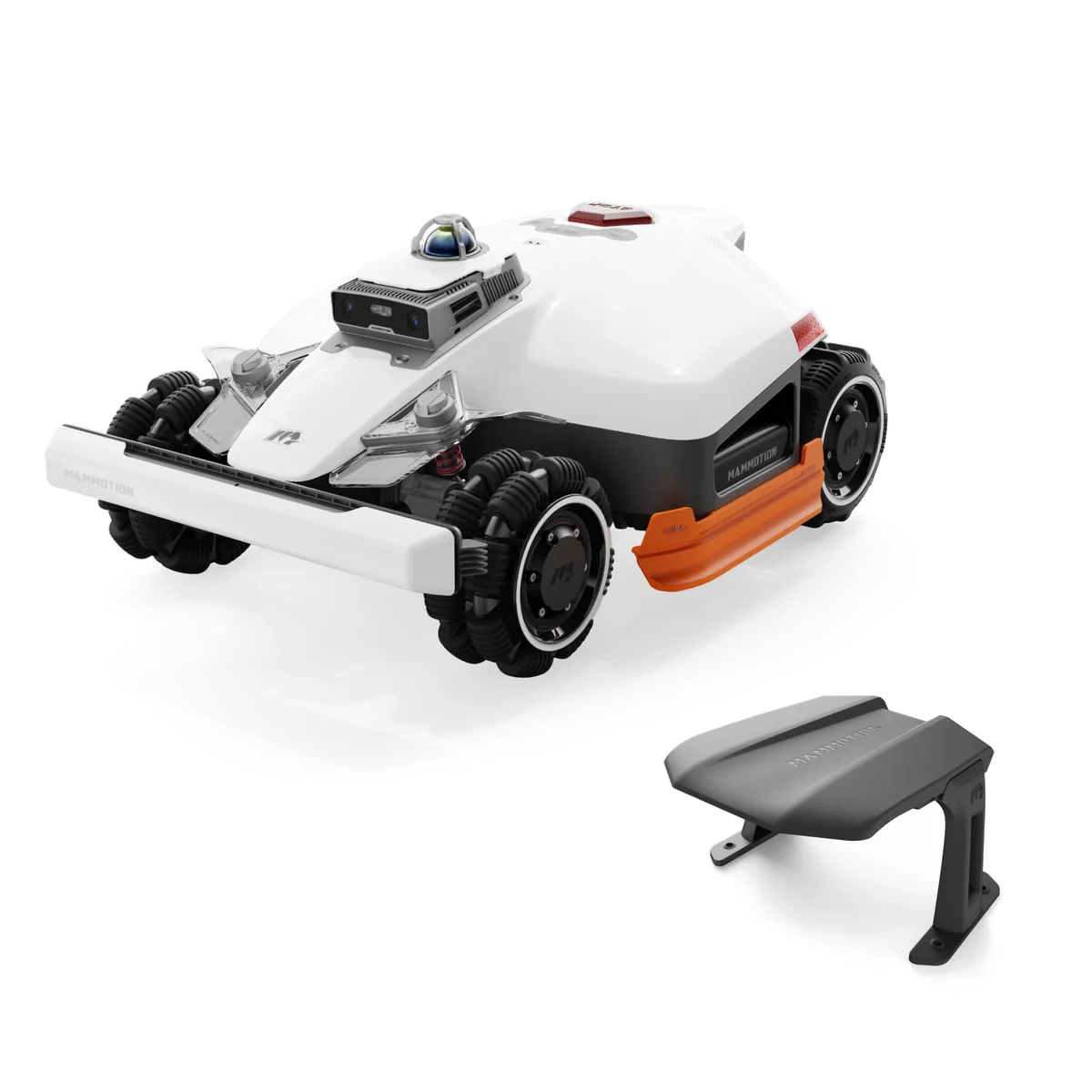
Its 2.2-to-4-inch range, 15.7-inch twin deck, LiDAR, NetRTK, dual cameras, and four driven wheels fit cool-season turf spread across roots, ruts, banks, and mixed transitions.
Heavy fixed-wheel turns can scar weak ground, while automatic mapping, connectivity, firmware, battery service, and support remain less dependable than the excellent terrain hardware.
The H suffix matters because the standard variants do not share this tall cutting range. The bundled garage ships separately, and network correction should be treated as a conditional antenna-free mode rather than a promise that every property needs no positioning hardware.
Strengths
- AWD traction carries it across banks, roots, ruts and transitions that stop many two-wheel-drive robots.
- LiDAR, NetRTK and dual cameras maintain useful navigation across both open grass and obstructed areas.
- The 2.2- to 4-inch range suits lawns that should not be scalped to standard robot-mower heights.
- Its wide twin-disc deck leaves clean patterns once the lawn is on a frequent maintenance schedule.
Limitations
- Fixed front rollers and pivot turns can scar soft, sandy, wet or thin turf.
- Automatic mapping is unreliable around invisible boundaries and complex hazards.
- App lag, connection failures and firmware regressions remain credible ownership risks.
- Battery access, parts availability and repair turnaround are weak points for such expensive equipment.
31. WORX Robot Lawn Mower for — The WORX Landroid Vision Cloud WR310 is the quarter-acre ecosystem pick for a simple, firm lawn.
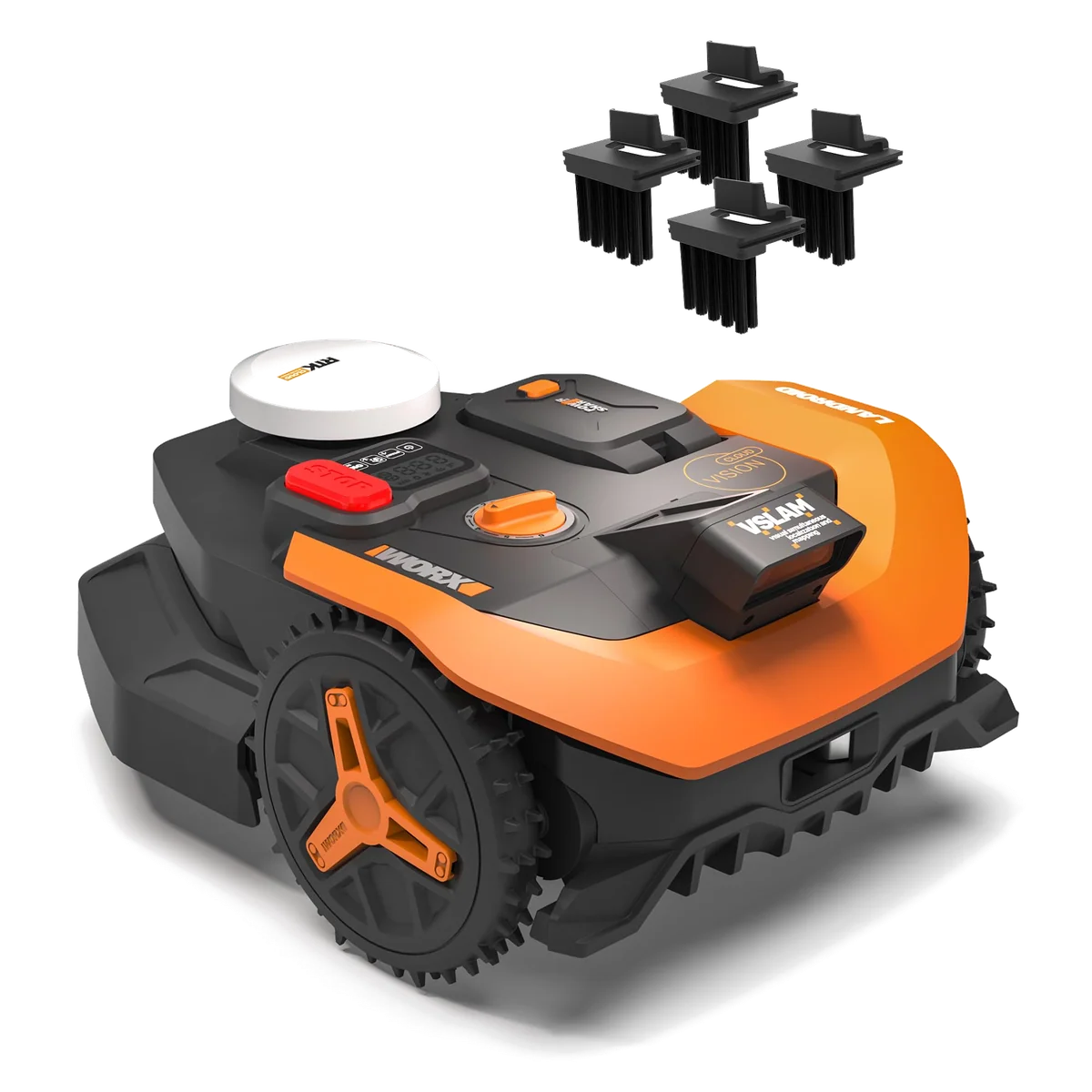
Cloud RTK, vision and V-SLAM backup, patterned mowing, RadioLink, wheel-cleaning brushes, and a replaceable PowerShare battery create an appealing escape from buried-wire failures.
Clumsy map correction, connection loops, stale errors, poor phone steering, dusk stoppages, and two-wheel traction make it unsuitable for fragile creeping turf, recurring slopes, or buyers seeking plug-and-play automation.
The brushes clean the wheels rather than cut grass. This ASIN is the quarter-acre WR310, so half-acre WR320 capacity and hardware claims in the mixed family review feed should not be transferred to it.
32. Sunseeker X5 AWD Robot Lawn — The Sunseeker X5 is a promising half-acre AWD mower whose evidence is not yet clean enough for a strong award.
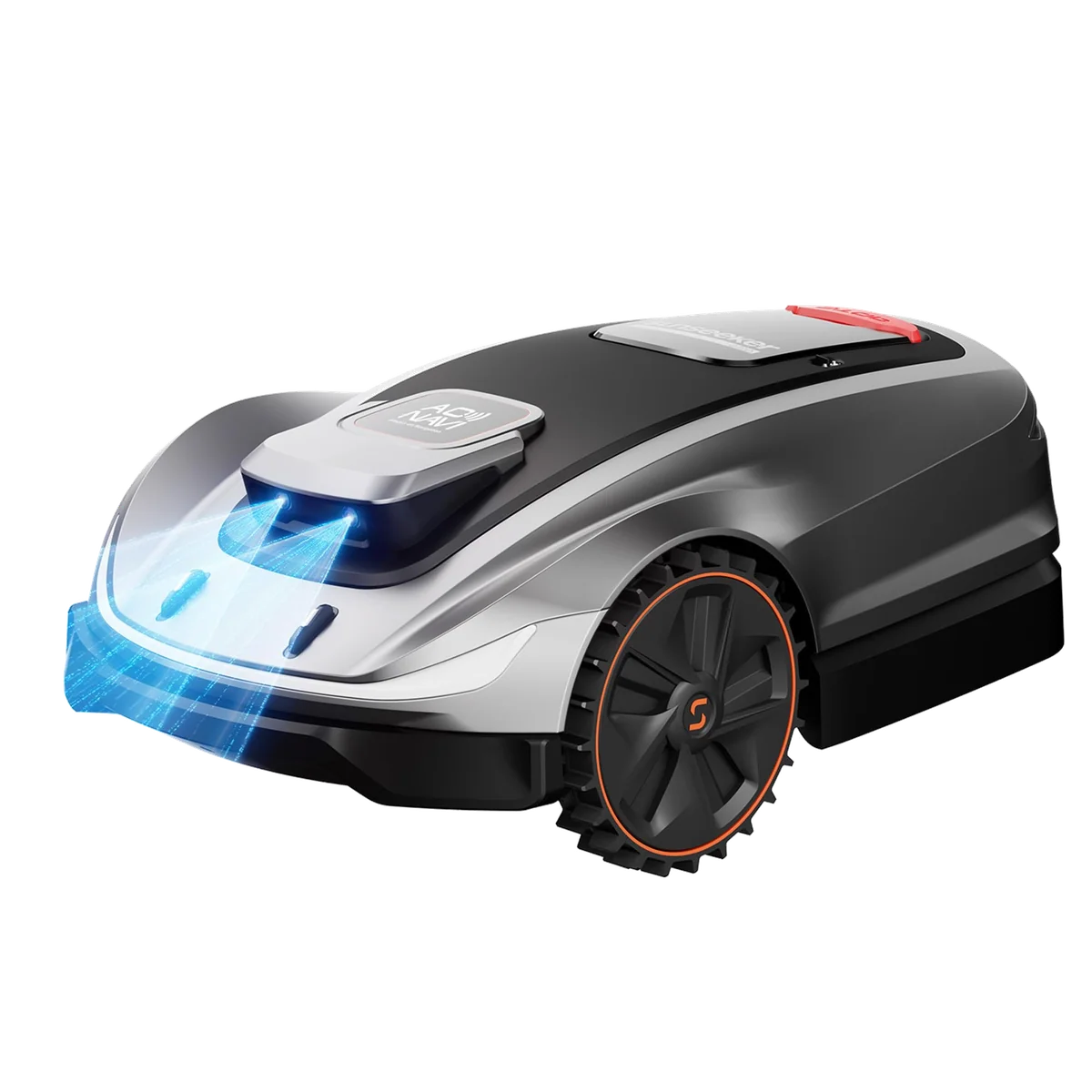
Its exact listing combines AWD, independent suspension, an 8.7-inch floating deck, hybrid RTK and vision navigation, five maps, and a claimed 30-degree limit in an attractive medium-size specification.
The supplied owner material is duplicated and substantially contaminated with S4 reviews, so tree-cover performance, recharge behavior, rescue frequency, and long-term reliability remain unproven for this exact model.
Consider it when half-acre capacity and ordinary hill traction matter, but do not promote it above the deeply documented DREAME or Segway alternatives on listing claims alone. The X5 still relies on RTK, which makes a LiDAR mower the safer choice where blocked sky is the central problem.
33. [Latest Upgrade All-Terrain Wire-Free] DREAME — The DREAME A3 AWD 1000 is the best specialist for a wooded, steep, obstacle-filled quarter acre.
![[Latest Upgrade All-Terrain Wire-Free] DREAME](/assets/b0h46ddhkc.webp)
Local 360-degree LiDAR, dual vision, a physical bumper, and true four-wheel drive allow it to handle walls, tree cover, banks, holes, and linked zones that expose the weaknesses of simpler small mowers.
Its single narrow disc is slow, automatic mapping depends on legible borders, saved-map editing is weak, and four driven wheels can still mark turf during damp turns and dock rotations.
This is the standard A3 1000 with one three-blade disc, not the much wider Pro 3500 described in several mixed reviews. Allow multiple mowing cycles for map refinement, overlap flush paving during boundary setup, and treat the advertised 80 percent grade as a ceiling rather than a routine working slope.
34. YARDCARE AI Vision Robotic Lawn — The YARDCARE AI Vision listing is too uncertain to recommend even as a budget shortcut.
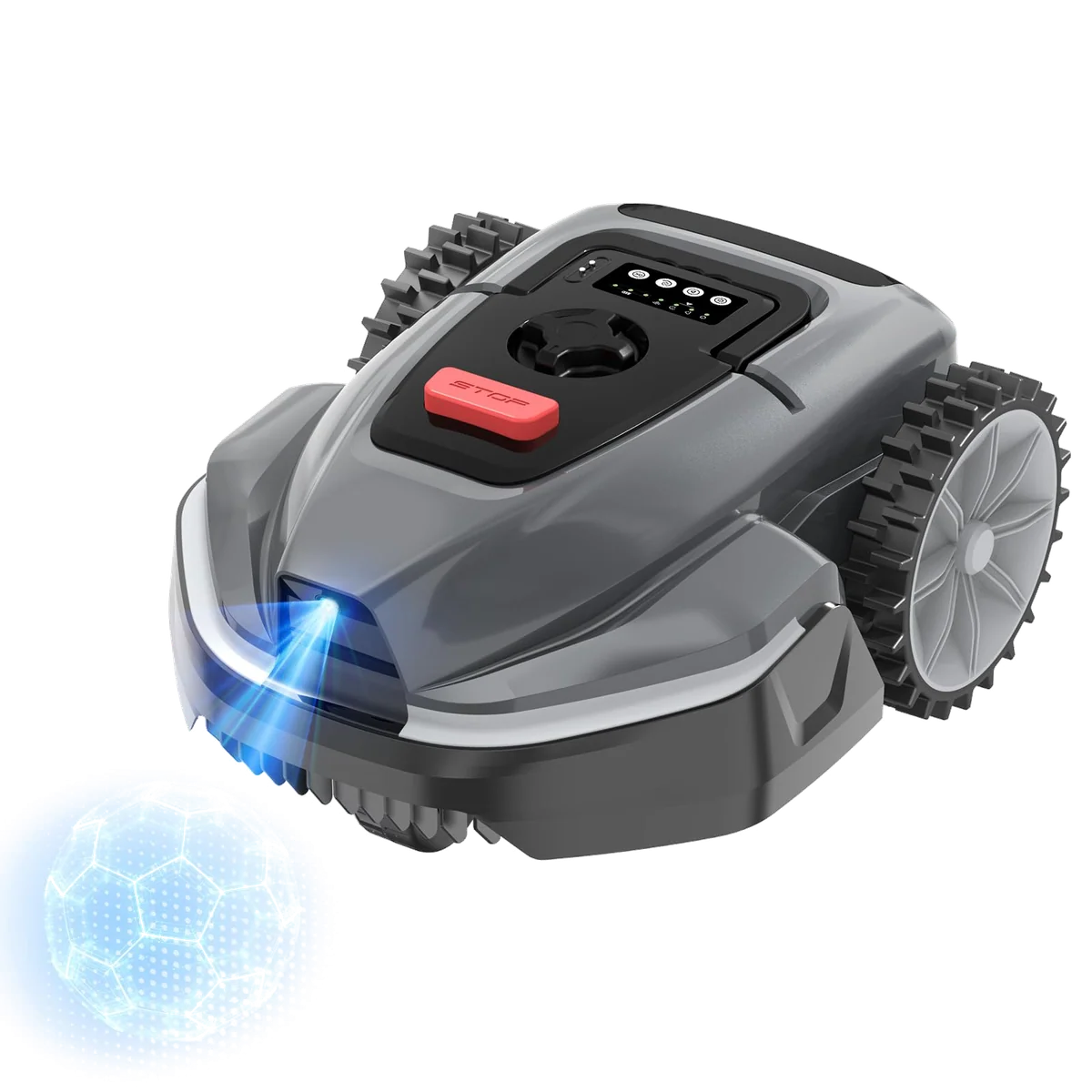
App control, obstacle sensing, a tiny-lawn rating, and a low-cost proposition are appealing, but none establishes how the mower maps, contains itself, charges, or completes a lawn.
The listing calls the same product both YARDCARE and LEBOSBO V3 while omitting runtime, height range, slope, navigation pattern, dock behavior, boundary logic, and meaningful owner evidence.
The included magnetic strip is a physical boundary aid even though it is not a powered perimeter wire. Confirm the manufacturer, exact manual, outer-boundary method, charging system, battery, blades, and app connection before treating this ASIN as an established product.
35. YARDCARE V100 — The YARDCARE V100 is a vision-guided tiny-lawn helper rather than a fully autonomous mower.
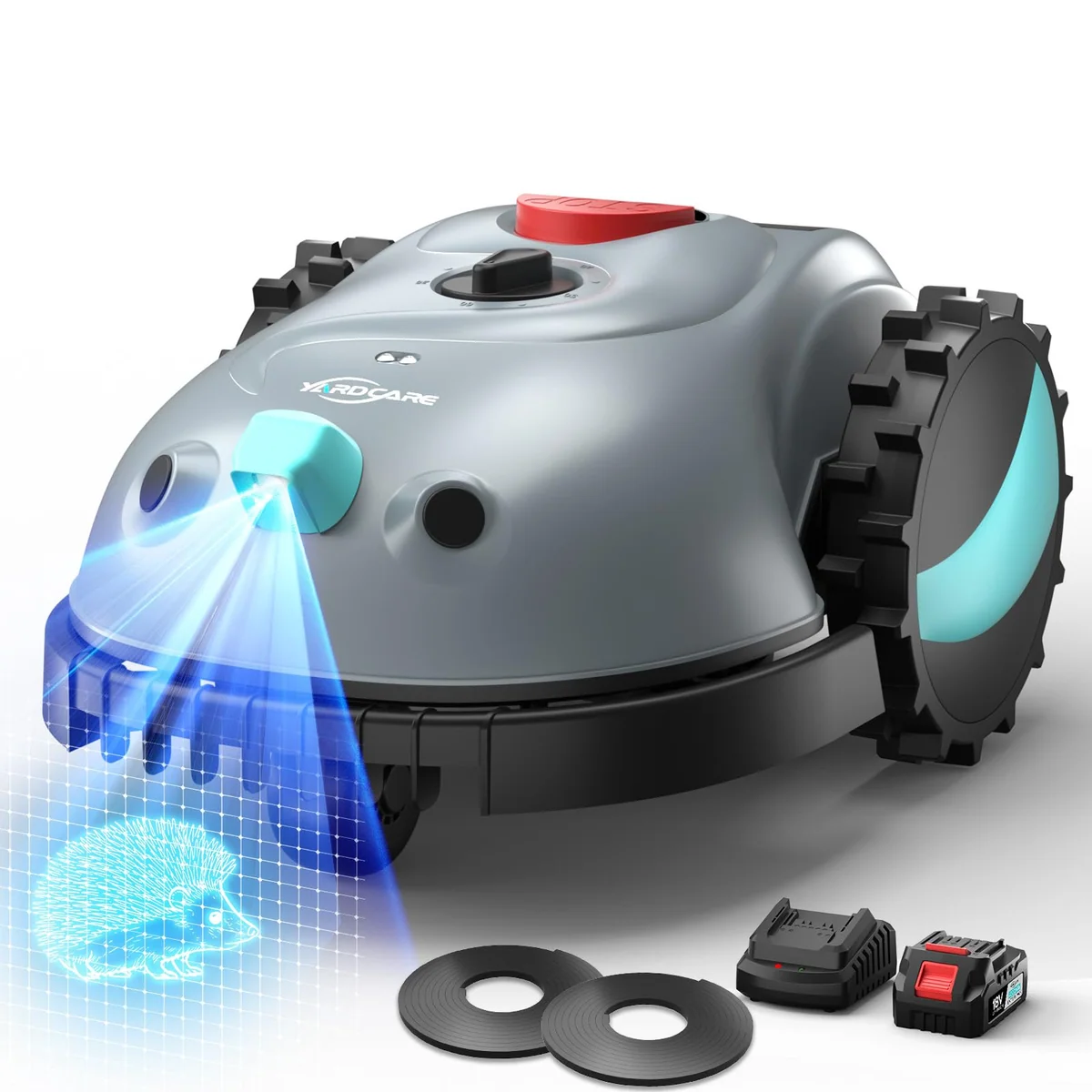
It can quietly reduce push-mowing effort on roughly 1,076 square feet of short, dry, clearly enclosed grass without an app, RTK antenna, charging dock, or buried powered cable.
The owner still deploys, retrieves, and externally charges it, while random coverage, daylight dependence, uncertain magnetic-strip support, and a four-to-eight-inch edge margin leave substantial responsibility behind.
Treat 1,600 square feet as a favorable-condition ceiling, and give tall grass a conventional first cut because growth above roughly 2.6 inches may be treated as an obstacle. Amazon and the maker conflict over magnetic-strip compatibility, so an unsafe or ambiguous boundary must not depend on that feature until the exact revision is confirmed.
Our #1 Pick: Navimow X430
Check Price on AmazonNavigation wins attention, but the chassis decides whether the mower comes home
Smart Lawn Bots ranks the complete system rather than the grandest sensor claim. Positioning must remain stable in the yard, the body must cross its transitions without digging, the deck must finish the area in a realistic schedule, and the software must recover from charging without turning a routine mow into an outdoor support session.
Exact-model identity matters just as much. Several retail pages combine sibling models, reuse reviews from different capacities, or retain stale catalogue names. A wide Pro deck cannot be assigned to a narrow standard mower, an AWD comment cannot convert a rear-drive model, and an optional trimmer cannot be treated as included hardware.
| Navigation approach | Best setting | Installation reality | Unsolved problem |
|---|---|---|---|
| Onboard LiDAR and vision | Trees, walls, eaves, and poor satellite reception | No RTK mast, but the dock and map still need careful placement | Traction, soft ground, borders, and narrow deck speed |
| Local RTK and vision | Open lawns with stable sky exposure | A powered fixed reference station and cable need a suitable site | Covered side yards, reflected signals, and rough transitions |
| Network or cloud RTK | Properties where the owner wants no local antenna | Connectivity, account services, correction coverage, and firmware become infrastructure | Service continuity, app recovery, and feature terms |
| Camera-only vision | Smooth lawns with obvious grass and hardscape borders | Little physical installation, but daylight and legible turf become essential | Bare soil, leaves, ambiguous property lines, darkness, and ruts |
| Drop-and-mow optical guidance | Tiny enclosed patches where simplicity matters most | No saved map or dock, so the owner handles every deployment and charge | Scheduled autonomy, efficient coverage, and dependable open boundaries |
A maximum grade is not a promise about a wet cross-slope.
Percentage grade and angle are different measurements. An 84 percent grade is about 40 degrees, 80 percent is about 38.7 degrees, 50 percent is about 27 degrees, and 45 percent is about 24 degrees. Those figures usually describe a favorable straight climb on firm dry turf. Turning across a bank, descending on loose needles, or crossing saturated clay can fail far earlier.
The first week is a commissioning period.
A meaningful return-window trial includes every zone, route, gate, narrow passage, dock approach, recharge, resume, rain interruption, strong-shadow transition, and risky edge. Preserve the packaging until the mower has repeated the whole cycle without intervention. A flawless pass across the open center of the lawn proves almost nothing.
Choose the mower by the hardest ten feet of the yard
The smooth center is where every robot looks competent. The decision lives beside the house, beneath the oak, across the damp swale, through the gate, around the pond, and on the final approach to the charger. Walk that route before comparing product badges.
Measure the grass and leave capacity in reserve.
Exclude the house, driveway, beds, patios, and nonmowable ground from the area calculation, then leave enough headroom for obstacles and charging. Smart Lawn Bots explains what mower acreage ratings actually mean because the label is a calendar capacity, not a one-battery promise.
Make sure every scheduled zone has a route to the dock.
A mower cannot autonomously cross steps, a locked gate, a deep gravel break, or a route narrower than its body and turning clearance. Multiple saved zones are useful only when the machine can physically reach them, as the guide to robot mowers and disconnected lawn areas explains.
Choose blocked-sky performance before app features.
A local or cloud RTK mower is attractive on an open lawn, but trees and buildings can turn the side passage into a positioning dead zone. Onboard LiDAR is the safer starting point for those properties, and the dedicated roundup of mowers for trees, buildings, and poor satellite reception narrows that choice further.
Separate climbing ability from ground preservation.
AWD helps a robot leave hollows and climb banks, but a heavy four-wheel-drive mower can also dig into wet or sandy turf. Steerable front wheels are generally gentler than skid turns, multipoint turns help without changing the underlying chassis, and hardstanding near the dock reduces repeated wear.
Judge the border by its geometry.
Flush paving lets wheels overlap the edge and can leave an almost complete cut. Walls, fences, trunks, raised beds, curbs, and inside corners force the blade inward. Even powered edge trimmers cannot safely reach every shape, so compare the remaining chore rather than accepting “zero edge” as a literal result.
Treat water, roads, steps, and drops as hazards.
Obstacle cameras and virtual lines are not fall protection. Use conservative setbacks and physical separation where a mapping error could put the mower in a pond, pool, gutter, road, or lower terrace. The same caution applies to rear swing, which may extend beyond the point sensed at the front.
The chores that remain after the robot arrives
A good mower replaces the long walk behind a conventional machine, not lawn ownership. Razor blades need inspection and replacement, wet grass packs around decks and wheels, fallen branches must be collected, maps sometimes need correcting, and borders still need a trimmer. If those remaining jobs sound unreasonable, the category is not ready to deliver the experience being imagined.
Night mowing solves a scheduling problem but creates another one. Camera-only machines need daylight, some vision-assisted mowers stop at dusk, and LiDAR positioning does not guarantee equal nighttime object recognition. Quiet operation also says nothing about wildlife risk, while powered edge trimmers are substantially louder than the main cutting disc. Daytime mowing on a cleared lawn remains the prudent default.
Water-resistance ratings protect electronics within stated conditions; they do not make pressure washing sensible or improve traction on saturated soil. Wet grass also increases rutting, wheel slip, clipping buildup, and the chance that a mower crosses a slope rather than holding its line. The guide to rain, wet grass, and nighttime mowing covers those trade-offs in detail.
Finally, inspect the ownership path rather than only the machine. Blades are easy to replace on most models, but batteries, drive assemblies, docks, power supplies, sensors, and repairs vary sharply by brand. A removable retail battery is a genuine advantage; a long warranty matters only when a seller, dealer, or manufacturer can diagnose the mower and return it to work before the grass wins.
The final cut
The Segway Navimow X430 remains the best overall wire-free mower because its wide deck, tall cutting range, steering, suspension, and four-wheel drive improve the work rather than merely the specification sheet. Buy the LUBA 3 AWD 5000 or DREAME A3 AWD Pro 3500 when dense cover and severe terrain justify more complicated ownership, choose an onboard-LiDAR compact model for a shaded small lawn, and avoid paying for acreage that the yard does not need.
Our Top Pick
The Navimow X430 earns the top spot. The Segway Navimow X430 is the best overall choice for a large, difficult lawn.
Compare Top Picks
Sources (164)
- Amazon listings and customer reviews
- Owner reports across r/roboticLawnmowers, r/MammotionTechnology, r/automower and 39 more threads
- Owner and reviewer video, 344 channels
- Walmart listing
- Target listing
- Costco listing
- Pcworld — Article — www.pcworld.com
- Toptenreviews — Article — www.toptenreviews.com
- Easylawnmowing — Article — easylawnmowing.co.uk
- Mammotion — Article — us.mammotion.com
- Thetechnologyman — Article — thetechnologyman.com
- Easylawnmowing — Article — www.easylawnmowing.com
- Homedepot — Article — www.homedepot.com
- Mammotion — Article — mammotion.com
- Carplaylife — Article — www.carplaylife.com
- Freshlycharged — Article — freshlycharged.com
- Androidauthority — Article — www.androidauthority.com
- T3 — Article — www.t3.com
- Facebook — Article — www.facebook.com
- Smarthomejunkie — Article — www.smarthomejunkie.net
- Iheart — Article — rocketerie.iheart.com
- Techradar — Article — www.techradar.com
- Cnet — Article — www.cnet.com
- Robomowlab — Article — robomowlab.com
- Bobvila — Article — www.bobvila.com
- Eftm — Article — eftm.com
- ECOVACS — Article — www.ecovacs.com
- Au — Article — www.harveynorman.com.au
- Pcmag — Article — www.pcmag.com
- Bestbuy — Article — www.bestbuy.com
- Thespruce — Article — www.thespruce.com
- Pcmag — Article — uk.pcmag.com
- 9to5google — Article — 9to5google.com
- Mensjournal — Article — www.mensjournal.com
- Tomsguide — Article — www.tomsguide.com
- Consumerreports — Article — www.consumerreports.org
- Lowes — Article — www.lowes.com
- Robotmowerlab — Article — robotmowerlab.com
- Forbes — Article — www.forbes.com
- Lifehacker — Article — lifehacker.com
- Makeuseof — Article — www.makeuseof.com
- Navimow — Article — navimow.com
- Segway — Article — navimow.segway.com
- Site — Article — segway-navimow.my.site.com
- Propartsdirect — Article — www.propartsdirect.net
- Tech — Article — us.mova.tech
- Slashgear — Article — www.slashgear.com
- Newatlas — Article — newatlas.com
- Tech — Article — au.mova.tech
- at — Article — www.galaxus.at
- Basic Tutorials — Article — basic-tutorials.com
- Appleinsider — Article — appleinsider.com
- Notebookcheck — Article — www.notebookcheck.net
- Maison Et Domotique — Article — www.maison-et-domotique.com
- Au — Article — www.gadgetguy.com.au
- MOVA Tech — Article — us.forum.mova-tech.com
- Au — Article — www.techguide.com.au
- Wellbots — Article — www.wellbots.com
- Nytimes — Article — www.nytimes.com
- Novabot — Article — novabot.com
- Techiwant — Article — techiwant.com
- Samsclub — Article — www.samsclub.com
- Heyupnow — Article — community.heyupnow.com
- Tech — Article — uk.mova.tech
- Robocleaners — Article — www.robocleaners.com
- Mowscout — Article — mowscout.com
- Trustpilot — Article — www.trustpilot.com
- Trustpilot — Article — au.trustpilot.com
- Mammotion — Article — eu.mammotion.com
- Mammotion — Article — uk.mammotion.com
- Therobotmower — Article — therobotmower.co.uk
- Trustpilot — Article — uk.trustpilot.com
- Au — Article — robotlawnmowers.com.au
- Lawncraftsupply — Article — lawncraftsupply.com
- WORX — Article — www.worx.com
- Upzy — Article — www.upzy.com
- Reviewed — Article — www.reviewed.com
- Trustedreviews — Article — www.trustedreviews.com
- Cleva — Article — us.cleva.com
- Bestutahrealestate — Article — bestutahrealestate.com
- Cleva Uk — Article — www.cleva-uk.com
- Expertreviews — Article — www.expertreviews.co.uk
- Cleva — Article — eu.cleva.com
- Currys — Article — www.currys.co.uk
- Mowerbotlab — Article — mowerbotlab.com
- Gardentool360 — Article — gardentool360.co.uk
- Ukgardenreviews — Article — ukgardenreviews.com
- Gardenersworld — Article — tollbit.gardenersworld.com
- Mowingmagic — Article — mowingmagic.com
- Smart Dots — Article — www.smart-dots.com
- Cnygreenteam — Article — cnygreenteam.com
- Trustpilot — Article — ie.trustpilot.com
- Homeandgardenselect — Article — homeandgardenselect.com
- Yarbo — Article — www.yarbo.com
- Eu — Article — www.letemsvetemapplem.eu
- Smarthomecompared — Article — smarthomecompared.com
- Smarthomeexplorer — Article — www.smarthomeexplorer.com
- Hunker — Article — www.hunker.com
- Shopsunseekertech — Article — shopsunseekertech.com
- Warehouserunner — Article — app.warehouserunner.com
- Electricrevolutionreviews — Article — electricrevolutionreviews.com
- Sunseekertech — Article — sunseekertech.com
- Sunseekerelite — Article — sunseekerelite.com
- Hedgecombers — Article — hedgecombers.com
- Bestrobovacuums — Article — www.bestrobovacuums.com
- Chewy — Article — www.chewy.com
- eufy — Article — www.eufy.com
- Substack — Article — robovacinsights.substack.com
- eufy — Article — service.eufy.com
- Countryliving — Article — www.countryliving.com
- Rtings — Article — www.rtings.com
- Vacuumwars — Article — vacuumwars.com
- Younghouselove — Article — www.younghouselove.com
- Womanandhome — Article — www.womanandhome.com
- Interlightus — Article — www.interlightus.com
- Coredy — Article — www.coredy.com
- Moderncastle — Article — moderncastle.com
- Thecarpentersdaughter — Article — thecarpentersdaughter.co.uk
- Lbtechreviews — Article — www.lbtechreviews.com
- Zdnet — Article — www.zdnet.com
- Amgardaseeblick — Article — amgardaseeblick.com
- Pistonheads — Article — www.pistonheads.com
- Ycombinator — Article — news.ycombinator.com
- Theverge — Article — www.theverge.com
- Ai — Article — www.robotmower.ai
- Dreamhomeplace — Article — dreamhomeplace.com
- Ibisik — Article — www.ibisik.com
- Requiemforadream — Article — www.requiemforadream.com
- Au — Article — segway.com.au
- Au — Article — roboticmower.com.au
- Techadvisor — Article — www.techadvisor.com
- Tv — Article — www.stuff.tv
- Outdoor Usa — Article — outdoor-usa.com
- Protoolreviews — Article — www.protoolreviews.com
- Homebuilding — Article — www.homebuilding.co.uk
- Gizmodo — Article — gizmodo.com
- Suncolawns — Article — shop.suncolawns.com
- Smartyardnw — Article — smartyardnw.com
- the Ambient — Article — www.the-ambient.com
- Outdoorica — Article — outdoorica.com
- Dreametech — Article — yardcare.dreametech.com
- Ign — Article — www.ign.com
- Glroboticsusa — Article — www.glroboticsusa.com
- Gardenersworld — Article — www.gardenersworld.com
- Mammotion — Article — ca.mammotion.com
- Fredshed — Article — www.fredshed.co.uk
- Yarbo — Article — forum.yarbo.com
- Yarboreview — Article — yarboreview.com
- Smarthomescene — Article — smarthomescene.com
- HOOKII — Article — hookii.com
- Tractorsupply — Article — www.tractorsupply.com
- Substack — Article — jjtechish.substack.com
- Smarthomeassistent — Article — www.smarthomeassistent.de
- Mein Gartenexperte — Article — www.mein-gartenexperte.de
- Techreviewer — Article — www.techreviewer.de
- Fr — Article — maniaques.fr
- Basic Tutorials — Article — basic-tutorials.de
- Frandroid — Article — www.frandroid.com
- Appgefahren — Article — www.appgefahren.de
- Wired — Article — www.wired.com
- Pwcparts — Article — pwcparts.com
- Familyhandyman — Article — www.familyhandyman.com
- Sitejabber — Article — www.sitejabber.com
- Yardcareinc — Article — yardcareinc.com