The LawnMaster OcuMow 200 is simple because it leaves half the job to you
Buy the OcuMow 200 only for a tiny, secure, crisply bordered lawn when no dock and no app matter more than automatic charging; open boundaries, patchy grass, ponds or the expectation of set-and-forget mowing should end the search here.
Buy the lawn match, not the promise
The LawnMaster OcuMow 200 can be liberating on a very small, enclosed patch of established grass. It removes the pushing, fuel, outdoor electrics, account setup and perimeter-wire trenching while remaining light enough to store indoors. Its cutting result can be excellent when repeated random passes have enough time to do their work.
That success depends on a lawn already shaped around the mower’s limitations. The borders must be unmistakable, the grass kept short, the ground reasonably smooth and the dangerous edges physically protected. Someone must still carry 13.4 pounds, handle the battery, clear hazards, retrieve the mower and trim the perimeter.
Smart Lawn Bots recommends it for a secure courtyard-style lawn whose owner sees manual deployment as the acceptable price of radical simplicity. Anyone with an open, irregular or hazardous boundary should choose a mower that creates and remembers a map, because here the lawn itself is the map.
The lawn is part of the machine
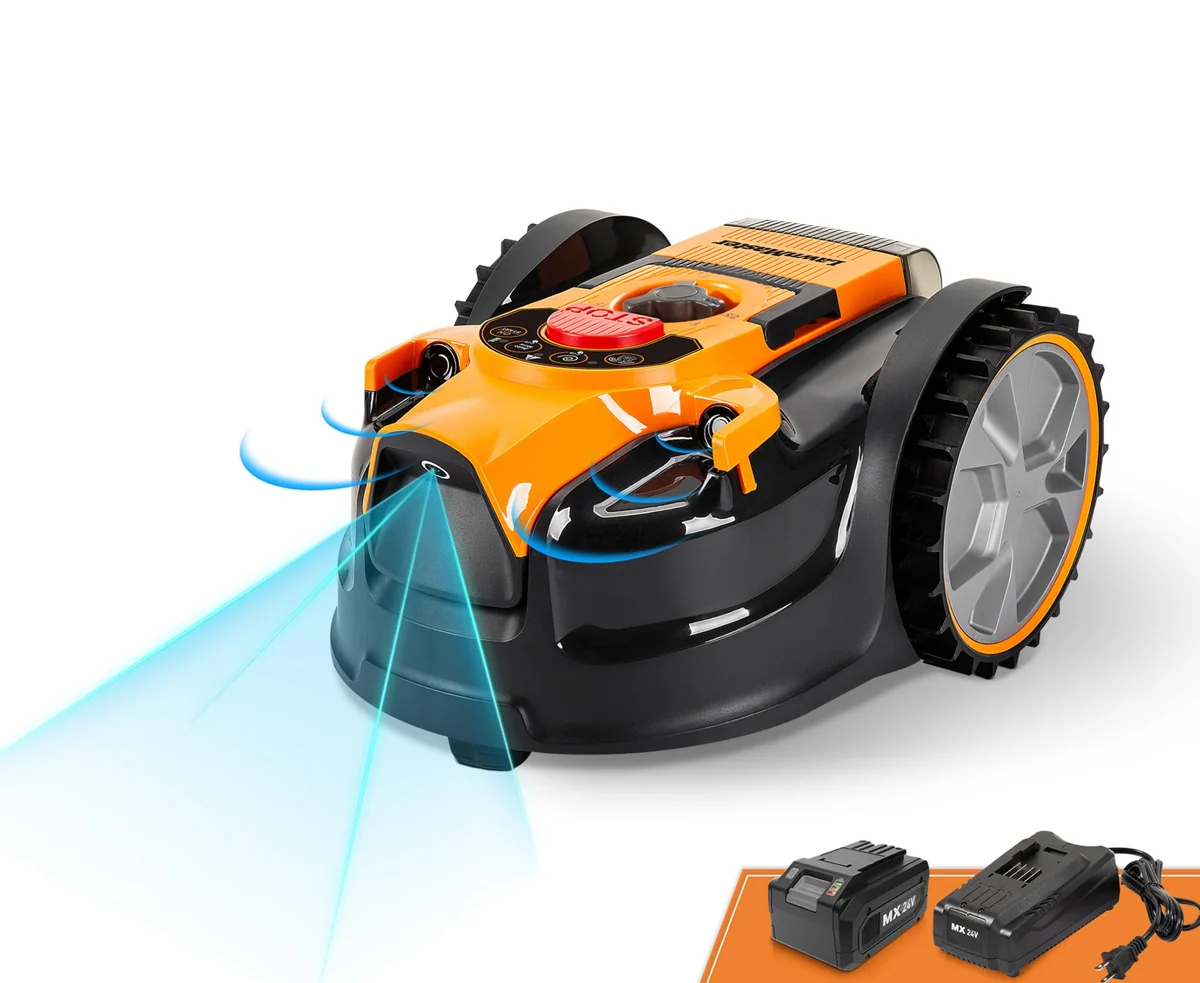
The LawnMaster OcuMow 200 Series VBRM601YCM is easiest to understand as a cordless mower that drives itself. Charge the removable battery indoors, carry the mower onto the grass, start it, and let it wander. When the session ends, somebody still has to find it, bring it back inside and recharge it.
That is not the routine promised by most robot mowers. There is no charging station, weekly schedule, app, Wi-Fi connection, lawn map or automatic return home. The lack of infrastructure is the appeal, but it also draws the limit of the automation: the OcuMow handles pushing and steering, not deployment, charging, retrieval or edge trimming.
This distinction also separates the reviewed mower from the similarly named OcuMow R1600, OcuMow 18 and newer AD or 400 Series machines. Those names appear around docked, connected or more systematic models. B0CX91H585 is the original orange, removable-battery 200 Series mower, and none of those sibling features should be assumed here.
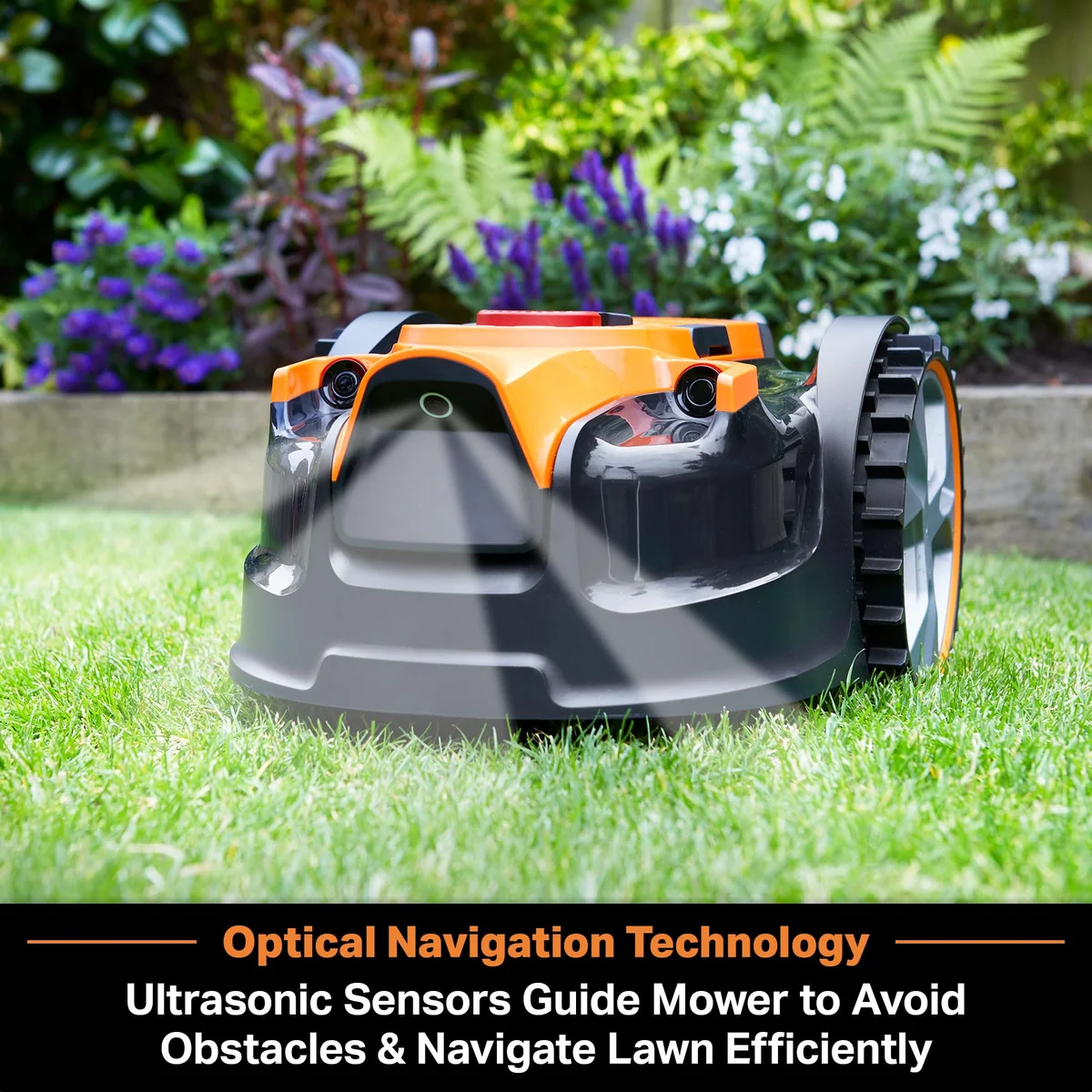
Its camera does not memorize a boundary. It looks for the difference between grass and whatever surrounds it, while ultrasonic sensors watch for sufficiently substantial objects. A fence, raised edge, broad paved path or clean gravel border can make that system look effortless. Grass fading into a neighbor’s grass, weeds, bare soil, low planting or a narrow driveway can make the same mower look lost.
The deciding walk around the yard
Trace the full perimeter before buying. At every foot, ask what the camera will see and what happens if it gets that judgment wrong. A mistaken turn beside a flower bed is annoying; the same turn beside a road, pond, woods or drop-off makes optical recognition an unacceptable last line of defense.
Key Specifications
No dock is both the luxury and the chore
For a renter, a front lawn exposed to theft or a home without a convenient outdoor outlet, indoor charging is a meaningful advantage. Nothing permanent has to sit beside the grass, and a 13.4-pound mower with a carry handle is easier to move between small lawn sections than a large installed robot. It also avoids accounts, cloud services, subscriptions and app pairing.
The local controls are simple once the startup sequence becomes familiar: install the battery and safety key, allow the camera check to finish, select a mode and start. A large STOP button, lift shutoff and removable key provide useful physical safeguards. The key deserves a dedicated storage place because it is essential to operation and has proved harder to replace than ordinary consumables.
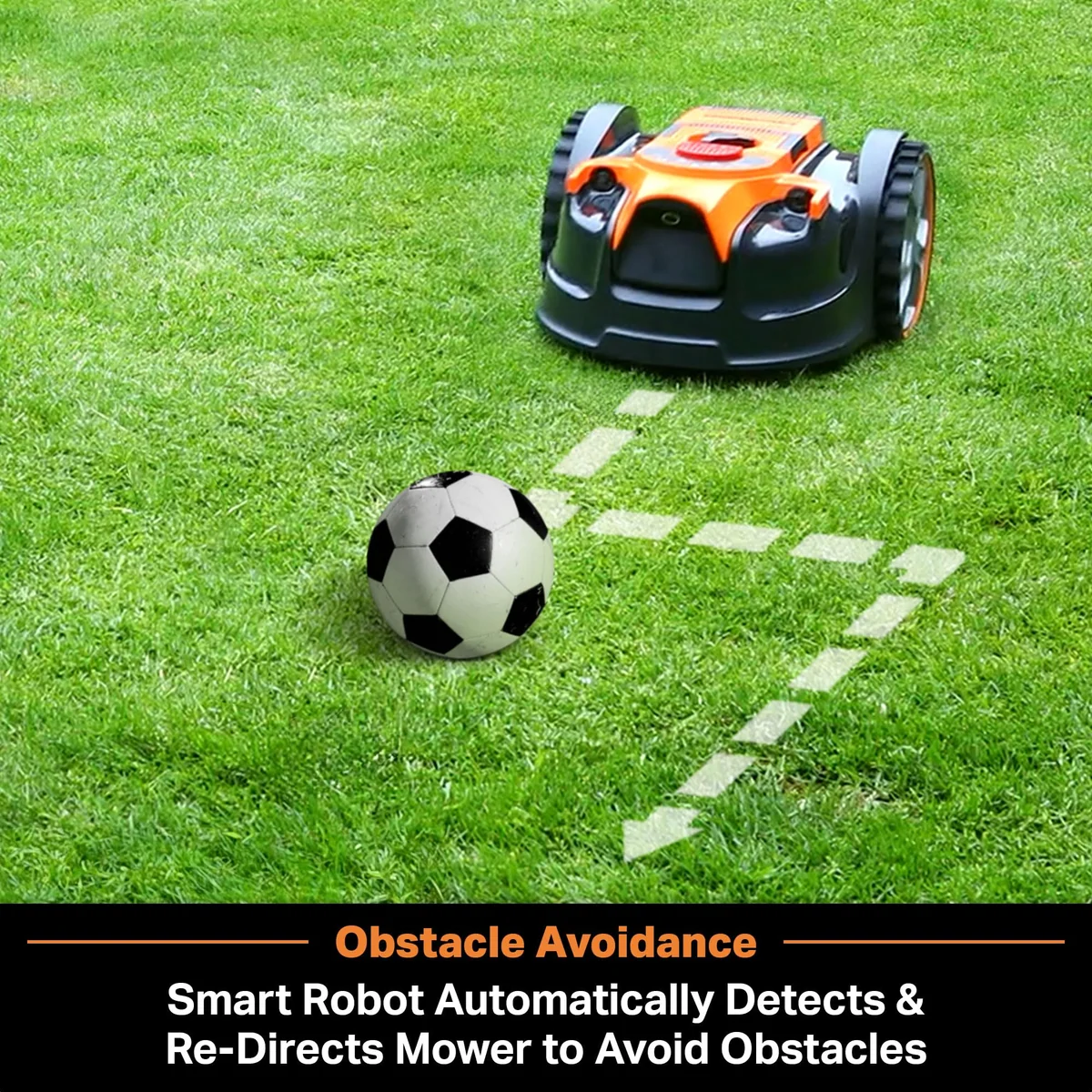
Obstacle avoidance works best on upright, solid objects. The two ultrasonic sensors can redirect the mower around furniture, fencing and people, but the advertised six-inch detection threshold should not be read as protection from everything six inches wide. Dog waste, sticks, stones, low toys, hoses and shallow garden hardware still belong off the lawn before every session.
The mower is quiet enough to disappear into normal garden sound, yet it is not a night machine. The camera requires daylight, and the mower should be run in dry conditions rather than treated as an outdoor appliance that can wait through changing weather. IPX4 resistance does not supply a rain sensor or somewhere to retreat.
Strengths & Limitations
Strengths
- No app, dock, antenna or powered perimeter installation is required on a clearly bordered lawn.
- The removable battery and carry handle make indoor charging and storage practical.
- The cutting system can leave a very even finish after enough repeated passes.
- Quiet operation and strong rear-wheel torque suit frequent daytime maintenance.
Limitations
- Every session still requires manual placement, startup, retrieval and charging.
- Random navigation can leave missed tufts and offers no predictable completion time.
- Optical containment can fail where grass edges are ambiguous or consequences are serious.
- A noticeable perimeter remains for manual trimming, and rough slopes can expose chassis instability.
- Past parts shortages and support complaints weaken confidence beyond the warranty period.


It cuts cleanly, but coverage is a lottery
The three pivoting blades do a respectable maintenance cut wherever the central 6.3-inch disc passes. The harder question is whether that narrow disc will pass over every blade of grass before the battery expires. OcuMow travels in straight segments, turns when it encounters a boundary or obstacle, then heads away in another effectively random direction. It cannot tell which ground is finished.
On a compact rectangular lawn, several hours of crisscrossing can produce an impressively even result. The same random route can revisit one corner repeatedly while leaving isolated tufts elsewhere. Frequent sessions eventually compensate, and Spot mode spirals outward from an obvious missed patch, but neither behavior provides the certainty of a mapped mower working in planned lanes.
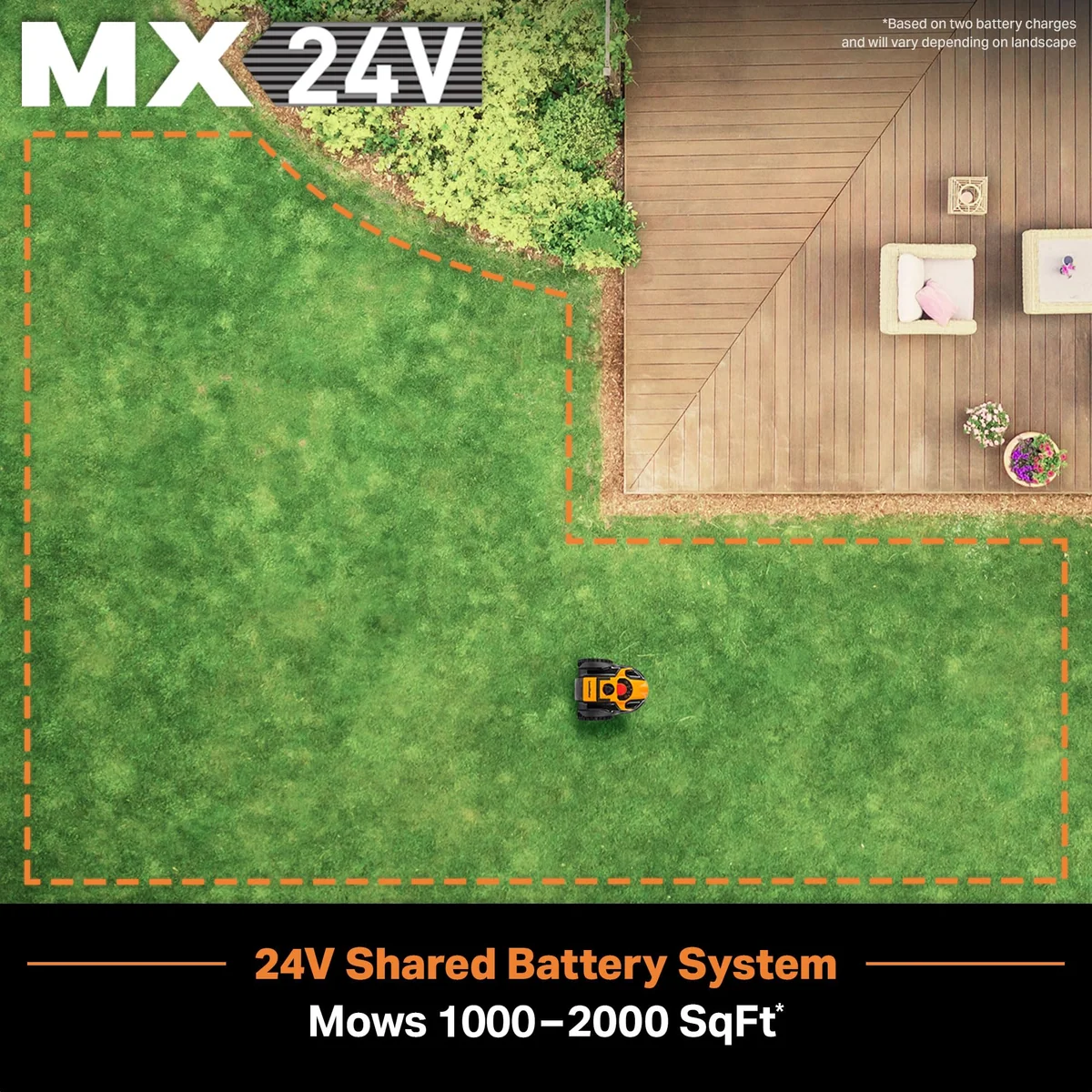
The published three-hour runtime is an upper limit, not a promise of uniform completion. Real sessions range lower as thick grass, slopes, repeated turns and recovery maneuvers increase the load. Although the listing promotes lawns up to 2,000 square feet, it also says that covering the upper figure requires additional charging. Smart Lawn Bots treats 1,000 square feet as the honest one-battery planning limit.
Short grass is not optional
This is a maintenance mower rather than an overgrowth rescue machine. Long grass can burden the small cutting system or appear to the camera as an obstacle, and random coverage gives tall missed patches time to become more troublesome. Bring an overgrown lawn down with a conventional mower first, then let OcuMow maintain it once or twice a week.
The fine clippings fall back into the lawn instead of entering a collection box. That is unobtrusive when the machine removes a little growth frequently. It is much less attractive when the lawn has been neglected and the mower is asked to process a heavy cut.
Wire-free is not boundary-free
The supplied magnetic strip can close a weak edge or protect a local no-go area without trenching or an outdoor power supply. Detection is convincing when the strip is laid and secured properly. The problem is scale: roughly 30 feet may protect one flower bed or open side, but it will not economically redesign a long, irregular or multi-zone perimeter.
More importantly, the camera is not fail-safe containment. Reports include successful recognition of paving, mulch, gravel and fences, but also escapes across paths, through shrubs and even into a street. Watch several complete early sessions and use a hard barrier or magnetic strip anywhere a mistake would have serious consequences.
The edge never gets finished
LawnMaster says the mower normally stops about four to eight inches from the boundary, and difficult visual edges can produce a wider strip. There is no orderly perimeter lap or offset cutting disc to clean that margin. A string trimmer remains part of ownership, which matters especially for anyone considering OcuMow because pushing a conventional mower is physically difficult.
Torque does not cure rough ground
The deep-tread rear wheels have enough drive to climb a smooth 35% grade and handle ordinary bumps. That does not make the chassis an all-terrain machine. Divots, drain covers, abrupt transitions and cross-slopes can lift a wheel, trap the mower or tip it over, so holes should be filled before the first run and slopes ending at unsafe boundaries should be physically secured.
Easy setup or easy ownership
OcuMow offers unusually easy setup, but recurring ownership is more involved than it first appears. A self-charging mapping robot demands more work at the beginning and much less before each later cut. This LawnMaster reverses that bargain.
| Decision | OcuMow 200 | Docked mapping robot |
|---|---|---|
| Initial setup | Charge, inspect borders and place local magnetic strip | Site a dock, establish boundaries and configure a map |
| Each session | Carry out, start, retrieve and recharge | Leaves and returns to its dock automatically |
| Coverage | Random passes with occasional missed tufts | Planned lanes with visible progress |
| Best boundary | Secure lawn with obvious physical or visual edges | Virtual map for more complicated shapes and zones |
The OcuMow beats a more elaborate robot when an outdoor dock is impossible, connected features are unwanted or the mower needs to come inside after every session. Buyers who mainly want lawn care to happen while they are away should instead consider a mapped, self-charging model. The Segway Navimow i110N review covers the stronger alternative for virtual boundaries, app control and multi-zone management on a small lawn.
That makes value intensely personal. Paying for features deliberately removed would be foolish if no app and no dock are the reason for shopping here. Paying for a robot and still resenting every battery change, rescue and trimming session would be equally foolish. The broader small-lawn mower guide separates machines built for this narrow drop-and-mow role from models offering genuine weekly autonomy.
The small parts decide the second year
The ownership record spans an OcuMow still working strongly after nearly two years and another that failed shortly after the two-year warranty ended. That is too little evidence for a lifespan estimate, but enough to reject any assumption that a simple feature set guarantees simple support.
Replacement blades are currently listed by LawnMaster, although owners have encountered previous stock gaps and unanswered requests. Blade life depends heavily on what the mower strikes: a clean courtyard lawn may preserve a set for many months, while stones and woody debris can ruin them quickly. Inspect the pivoting blades and underside regularly, keep the camera and sensors clean, and replace damaged blades as a balanced set.
The more worrying ownership risk is a proprietary part that stops the whole machine. A lost safety key has already left an otherwise usable mower idle, and support complaints make the two-year warranty less reassuring than the number suggests. Confirm the availability of blades, battery, charger and safety key before buying, then keep the key with the charger rather than loose in a shed drawer.
Sources (16)
- Amazon listings and customer reviews — Lawnmaster Ocumow 200 Series
- Owner and reviewer video, 11 channels
- Walmart listing
- Easylawnmowing — Article — easylawnmowing.co.uk
- Trustedreviews — Article — www.trustedreviews.com
- Cleva — Article — us.cleva.com
- Bestutahrealestate — Article — bestutahrealestate.com
- Cleva Uk — Article — www.cleva-uk.com
- Facebook — Article — www.facebook.com
- Expertreviews — Article — www.expertreviews.co.uk
- Cleva — Article — eu.cleva.com
- Currys — Article — www.currys.co.uk
- Mowerbotlab — Article — mowerbotlab.com
- Gardentool360 — Article — gardentool360.co.uk
- Ukgardenreviews — Article — ukgardenreviews.com
- Gardenersworld — Article — tollbit.gardenersworld.com