One robot mower can handle several lawn zones, but a map cannot open a gate
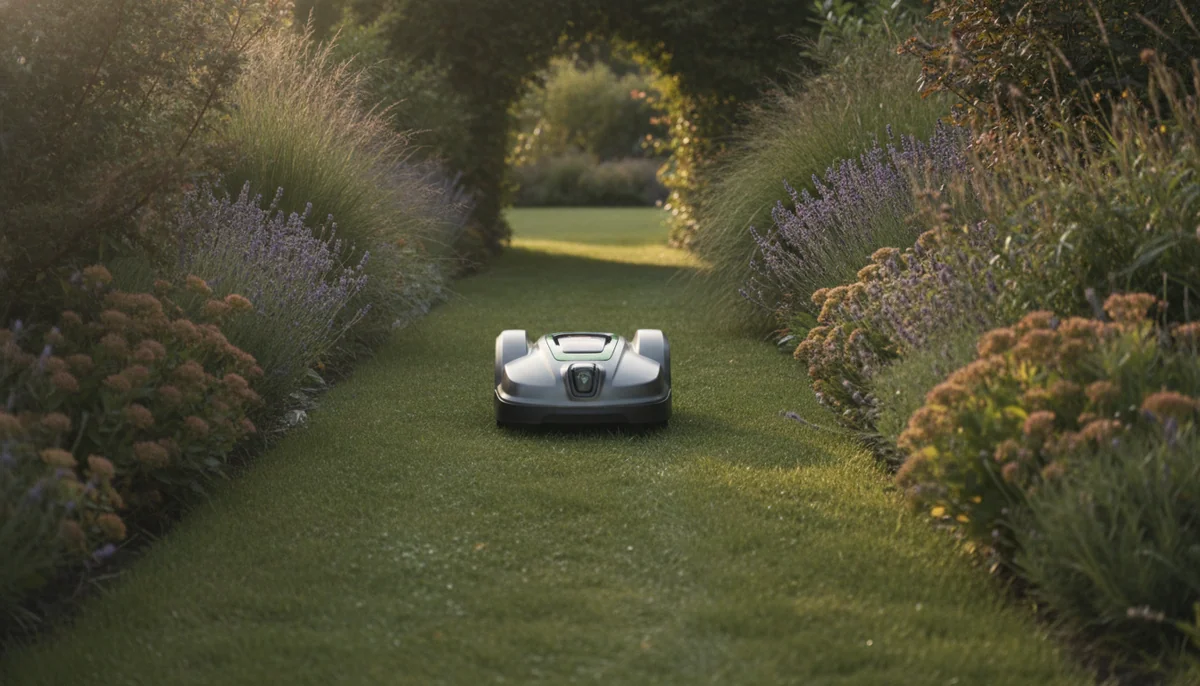
A robot mower can remember several work areas, give each one a schedule, and travel between them without cutting the driveway or path under its wheels. That is genuine multi-zone mowing. It can maintain the back lawn on Monday, follow a mapped corridor along the house, cut the front on Tuesday, and return to the same charger after both jobs.
Disconnected lawns are different. The app may show several colored shapes, but the machine still needs a physical journey from its dock to every shape. Carrying a mower over steps or through a locked gate often breaks localization, leaves it searching for an unreachable charger, or turns automatic mowing into a manual delivery round. The number of zones advertised on the box does not solve that problem.
The useful buying question is therefore not how many maps a mower stores. Trace the route from the charging contacts to the furthest blade of grass. If the robot can drive the entire route safely in both directions, one mower may do the job. If it cannot, the lawn is disconnected in the only sense that matters.
A zone is a schedule; a channel is the road
A mowing zone is an area with its own instructions. Depending on the mower, those instructions can include cutting height, stripe direction, number of passes, edge treatment, speed, and days of the week. Dividing one large lawn into smaller zones can also improve reliability because the robot receives a clear, finishable task instead of reconsidering an enormous map for hours.
A channel, path, or corridor connects those zones. It can cross level paving without mowing it, pass through a side yard, or follow a narrow strip between the house and a bed. The route must be wide enough for the mower’s body and turning behavior, firm enough for its wheels, free of steps, and available whenever the schedule runs. A gate that is open during mapping but locked every afternoon is not a channel.
| Property layout | Can one mower handle it? | What makes it work |
|---|---|---|
| Front and rear grass joined by a level side passage | Usually yes | Separate zones plus a mapped travel channel to one dock |
| Two lawns divided by a driveway or sidewalk | Often yes | A safe crossing away from vehicles, curbs, and loose stones |
| Lawns divided by a gate that remains open | Potentially | Enough gate clearance and dependable access during every run |
| Lawns divided by a locked gate, steps, or retaining wall | Not autonomously | Human carrying, another dock, property changes, or a second mower |
| A detached patch across a road | No sensible autonomous route | Manual mowing or a mower stationed on that side |
Driveways need particular restraint. A robot may be physically capable of crossing one, but that does not make an active vehicle route safe. Parked cars can block the return journey, tires can meet a low mower that a driver cannot see, and a delivery van can arrive after the machine has left its dock. A quiet residential footpath is a plausible connector; a road or busy driveway is not.
The route back matters as much as the route out. A mower with 20 zones is useless if a bush, drainpipe, wet ramp, or badly placed dock blocks its return at low battery. Test the channel from both directions, then test it again during automatic recharge and resumption. Manual driving proves only that the wheels fit.
The strongest one-mower choices solve different yards
The Mammotion LUBA Mini 2 1500H is the best all-round choice for awkward connected zones
The LUBA Mini 2 1500H combines up to 20 zones with mapped channels, LiDAR navigation, dual cameras, and four-wheel drive. That package is unusually useful when a property includes a front lawn, a rear bank, root-crossed side grass, and paving between them. It does not need a buried boundary wire or a separate RTK antenna, and its traction gives it more authority at imperfect transitions than a light rear-wheel-drive mower.
Its DropMow mode is also the most useful concession to a genuinely detached patch. The mower can be placed in an unmapped area for a temporary job without saving a permanent zone. That still requires carrying it out and retrieving it afterward, so it is a convenience for an occasional strip rather than autonomous multi-lawn management. The remaining drawbacks are uneven app behavior, slow coverage near the 0.37-acre ceiling, and grass left beside raised borders.
The Navimow i215 is the better fit when tree cover is the main problem
The Navimow i215 can manage up to 20 zones without an RTK antenna, using LiDAR and vision to orient itself among fences, trees, buildings, and beds. That makes it persuasive for a structured property where satellite reception is poor but front, side, and rear lawns are joined. Dividing the job into smaller zones can improve completion, and separate connector routes can keep the trip to the charger away from steps or awkward curbs.
Its two driven rear wheels are the limit. Ruts, thick turf, wet ramps, and sideways travel on a slope can stop it even when the map is accurate. Connector routes and docking have also been inconsistent enough that every zone needs a full rehearsal before scheduling. Choose the i215 for obstructed sky on firm ground, not because “off-road wheels” sound like AWD.
The Navimow X430 is the large connected-property answer
An acre of grass needs more than a long list of zones. It needs enough deck width and traction to complete them. The Navimow X430 brings a 17-inch dual-disc cut, four-wheel drive, suspension, steerable front wheels, and a one-acre mapped-area rating. It is the strongest option here for a large property where banks, roots, and grass-to-driveway transitions sit between otherwise connected mowing areas.
Measure the infrastructure before admiring the chassis. The X430 is 24 inches wide, the dock needs a positioning-friendly powered location, and narrow travel channels can wear under repeated traffic. A normal closed gate stops it. Navimow offers a compatible electronic MowGate, but that is separate property hardware rather than a feature hidden inside the app. Setup can also demand dock moves, map changes, and a restart after firmware installation.
Smooth lawns need less mower, but not less access
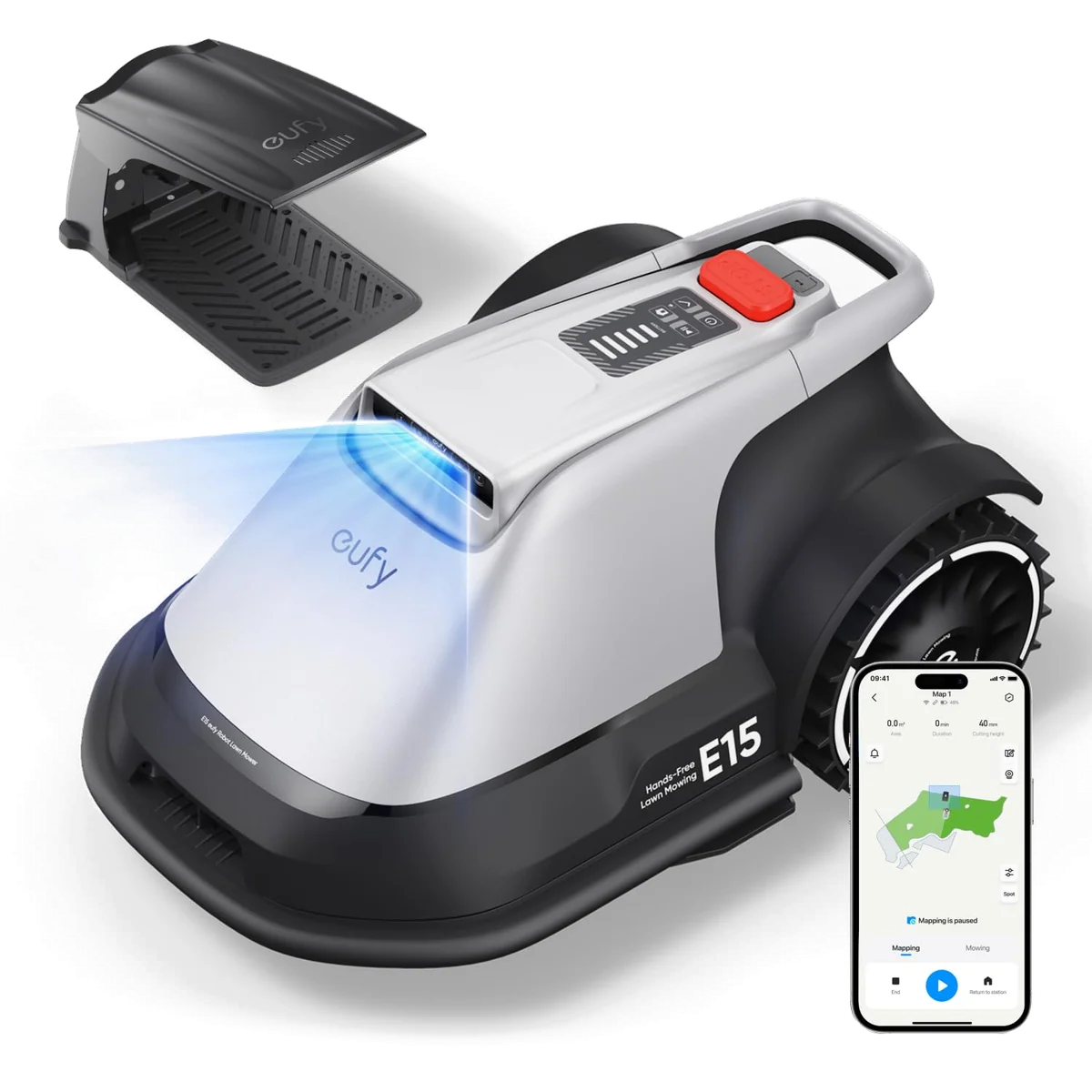
The eufy E15 and E18 make connected zones exceptionally easy to map
The eufy E15 and E18 use cameras instead of perimeter wire or RTK equipment. On smooth grass with visible edges, automatic mapping is unusually approachable, and the app can divide the result into zones, draw no-go areas, and create routes across level paving. The E15 supports about 0.2 acre, while the E18 raises the mapped-area allowance to 0.3 acre without adding a wider deck, larger battery, or tougher chassis.
Neither mower is a solution for detached lawns. The route to every zone must remain traversable, and a closed gate turns the owner into an attendant. Carrying an E18 to an isolated front lawn can leave it looking for the dock rather than beginning an independent task. Damp grass, holes, rough transitions, and ambiguous grass-to-grass boundaries create further trouble, so these are excellent multi-zone mowers only when the property is already orderly.
Choose the E15 instead when the same favorable layout stays comfortably below 0.2 acre. Paying for the E18 buys map capacity rather than better traction or faster mowing, which is why the full E15 and E18 comparison turns mainly on actual grass area.
The ANTHBOT M5 is the value choice for small lawns under open sky
The ANTHBOT M5 can store up to 20 zones, create connecting paths, and return to charge before resuming. It is a credible option for roughly 1/8 acre when a path divides the front lawn or a narrow side section needs its own schedule. Systematic cutting, app-controlled height, and quiet operation make the central mowing job feel far more mature than the budget position suggests.
The RTK reference station needs a stable view of open sky, and the standard M5 should not be confused with a separate LiDAR version. Walls, dense canopy, difficult hills, rough ground, and raised edges all weaken the case. Its favorable zone count cannot compensate for a blocked satellite installation or a path the chassis cannot traverse.
Some multi-zone claims deserve more skepticism
The ECOVACS GOAT O1000 LiDAR PRO is a capable quarter-acre mower for connected shaded lawns, while the A2000 LiDAR PRO adds a wider deck and half-acre capacity. Both can use zones and paths without an RTK antenna. The larger A2000 has also merged closely adjoining front and rear areas across a fence, then refused the real connecting path because its software believed a route already existed. That failure is precisely why a feature count cannot substitute for editable mapping. The O1000 and A2000 comparison explains when the wider mower is worth accepting.
The HOOKII Neomow X2 SE can maintain several areas beneath trees, but inconsistent docking, route recovery, software, and traction make it difficult to trust across an unattended property. Automatic mapping may also depend on a separately specified vision module. Its LiDAR premise is strong; its autonomy is not settled enough for this job.
The ANTHBOT Genie600 and M9 advertise generous zone counts, yet neither has enough established performance evidence to become the answer to a complicated yard. The Genie600 leaves basic route, battery, terrain, and map behavior unresolved, while the M9 combines a 3.2-star captured rating with unanswered NRTK, weather, parts, and warranty questions. A difficult property is the wrong place to discover what “20+” or “30 zones” means in practice.
The BESTMOW T100 claims ten zones and 1.5 acres, but it leaves too many fundamentals unpublished and gives conflicting slope limits. Yarbo reaches much further, with a multi-acre ceiling and a tracked chassis, yet it requires manual mapping, substantial positioning infrastructure, and tolerance for documented hardware, support, and security concerns. Smart Lawn Bots does not recommend either as the only mower merely because its map can contain a large property.
Walk the route before choosing the robot
- Measure actual grass. Acreage ratings apply to mapped mowing area, not the entire parcel, and several zones still add up to one capacity limit.
- Measure the narrowest opening. Include comfortable side clearance, turning room, gate hardware, plants that lean into the route, and the mower’s rear swing.
- Inspect the surface. A level path, firm sidewalk, or close-cut grass corridor is useful; steps, loose gravel, deep mulch, curbs, mud, and vehicle traffic are not.
- Decide when the gate stays open. If security, pets, or children require it to remain closed, budget for an automated gate, another dock where supported, a second mower, or manual work.
- Map the return journey. Low battery, rain, and job completion all send the mower home, so a one-way route is no route at all.
- Test recharge and resume. Watch a complete job that includes docking, charging, returning to the correct zone, and finishing where the mower stopped.
- Protect irreversible hazards. Roads, pools, retaining drops, stairs, and water need generous exclusions or physical barriers rather than confidence in automatic mapping.
If every item survives that inspection, one mower can remove most routine cutting across a surprisingly complicated property. If the route fails, buy for the lawn you actually have rather than the map the app can draw. The broader guide to RTK, LiDAR, and camera navigation can then settle which positioning system fits the surroundings, while the guide to robot-mower acreage ratings prevents several zones from quietly overwhelming one machine.
Frequently Asked Questions
Can one robot mower cut separate front and back lawns?
Yes, provided it can drive safely between both lawns and return to its charging station without encountering steps, a closed gate, traffic, or unsuitable ground.
Can I carry a robot mower to a disconnected lawn?
Sometimes, but many models lose localization or search for an unreachable dock, while a temporary mode such as Mammotion’s DropMow is better suited to an occasional carried job.
Does a mower with 20 zones support 20 disconnected lawns?
No, the zone count describes software organization rather than physical access, and every autonomous zone still needs a compatible route to a charger.
Can a robot mower cross a driveway between zones?
It can cross level paving through a mapped channel when the route is free of curbs and vehicles, but a driveway used by traffic is not a sensible autonomous connector.
Will a second charging station solve disconnected lawns?
A second station may help on models that explicitly support another base and map, but compatibility must be confirmed because many mowers bind localization and charging to one installation.
What is the best robot mower for several connected lawn areas?
The LUBA Mini 2 1500H is the strongest all-round choice for rough or sloped connected zones, while the Navimow i215 better suits firm tree-covered ground and the X430 suits a difficult acre.
Sources (107)
- Amazon listings and customer reviews
- Owner reports across r/RobotVacuums, r/eufyS1Pro, r/eufy and 31 more threads
- Owner and reviewer video, 201 channels
- Walmart listing
- Facebook — Article — www.facebook.com
- Hedgecombers — Article — hedgecombers.com
- Bestrobovacuums — Article — www.bestrobovacuums.com
- Chewy — Article — www.chewy.com
- eufy — Article — www.eufy.com
- Substack — Article — robovacinsights.substack.com
- eufy — Article — service.eufy.com
- Countryliving — Article — www.countryliving.com
- Rtings — Article — www.rtings.com
- Vacuumwars — Article — vacuumwars.com
- Younghouselove — Article — www.younghouselove.com
- Womanandhome — Article — www.womanandhome.com
- Interlightus — Article — www.interlightus.com
- Coredy — Article — www.coredy.com
- Moderncastle — Article — moderncastle.com
- Thecarpentersdaughter — Article — thecarpentersdaughter.co.uk
- Techradar — Article — www.techradar.com
- Trustedreviews — Article — www.trustedreviews.com
- Lbtechreviews — Article — www.lbtechreviews.com
- Tomsguide — Article — www.tomsguide.com
- Pcmag — Article — www.pcmag.com
- Zdnet — Article — www.zdnet.com
- Trustpilot — Article — uk.trustpilot.com
- Amgardaseeblick — Article — amgardaseeblick.com
- Pistonheads — Article — www.pistonheads.com
- Bestbuy — Article — www.bestbuy.com
- Ycombinator — Article — news.ycombinator.com
- Mammotion — Article — us.mammotion.com
- Trustpilot — Article — www.trustpilot.com
- Pcworld — Article — www.pcworld.com
- Toptenreviews — Article — www.toptenreviews.com
- Trustpilot — Article — au.trustpilot.com
- Mammotion — Article — eu.mammotion.com
- Mammotion — Article — uk.mammotion.com
- Easylawnmowing — Article — www.easylawnmowing.com
- Easylawnmowing — Article — easylawnmowing.co.uk
- Therobotmower — Article — therobotmower.co.uk
- Androidauthority — Article — www.androidauthority.com
- Freshlycharged — Article — freshlycharged.com
- Au — Article — robotlawnmowers.com.au
- Nytimes — Article — www.nytimes.com
- Cnet — Article — www.cnet.com
- Consumerreports — Article — www.consumerreports.org
- Expertreviews — Article — www.expertreviews.co.uk
- Gardenersworld — Article — www.gardenersworld.com
- Smarthomescene — Article — smarthomescene.com
- HOOKII — Article — hookii.com
- Mammotion — Article — ca.mammotion.com
- Tractorsupply — Article — www.tractorsupply.com
- Substack — Article — jjtechish.substack.com
- Basic Tutorials — Article — basic-tutorials.com
- Smarthomeassistent — Article — www.smarthomeassistent.de
- Mein Gartenexperte — Article — www.mein-gartenexperte.de
- Techreviewer — Article — www.techreviewer.de
- Mowingmagic — Article — mowingmagic.com
- Fr — Article — maniaques.fr
- Basic Tutorials — Article — basic-tutorials.de
- Frandroid — Article — www.frandroid.com
- Appgefahren — Article — www.appgefahren.de
- Yarbo — Article — www.yarbo.com
- Lowes — Article — www.lowes.com
- Fredshed — Article — www.fredshed.co.uk
- Tv — Article — www.stuff.tv
- Yarbo — Article — forum.yarbo.com
- Yarboreview — Article — yarboreview.com
- Segway — Article — navimow.segway.com
- Navimow — Article — navimow.com
- Au — Article — segway.com.au
- Lifehacker — Article — lifehacker.com
- Theverge — Article — www.theverge.com
- Maison Et Domotique — Article — www.maison-et-domotique.com
- Au — Article — roboticmower.com.au
- Techadvisor — Article — www.techadvisor.com
- Homedepot — Article — www.homedepot.com
- Cnygreenteam — Article — cnygreenteam.com
- Outdoor Usa — Article — outdoor-usa.com
- Protoolreviews — Article — www.protoolreviews.com
- Homebuilding — Article — www.homebuilding.co.uk
- Gizmodo — Article — gizmodo.com
- Suncolawns — Article — shop.suncolawns.com
- Smartyardnw — Article — smartyardnw.com
- the Ambient — Article — www.the-ambient.com
- Outdoorica — Article — outdoorica.com
- T3 — Article — www.t3.com
- Notebookcheck — Article — www.notebookcheck.net
- Smart Dots — Article — www.smart-dots.com
- Trustpilot — Article — ie.trustpilot.com
- Homeandgardenselect — Article — homeandgardenselect.com
- Eu — Article — www.letemsvetemapplem.eu
- Robomowlab — Article — robomowlab.com
- Bobvila — Article — www.bobvila.com
- Eftm — Article — eftm.com
- ECOVACS — Article — www.ecovacs.com
- Au — Article — www.harveynorman.com.au
- Thespruce — Article — www.thespruce.com
- Pcmag — Article — uk.pcmag.com
- 9to5google — Article — 9to5google.com
- Mensjournal — Article — www.mensjournal.com
- Lawncraftsupply — Article — lawncraftsupply.com
- Smarthomecompared — Article — smarthomecompared.com
- Smarthomeexplorer — Article — www.smarthomeexplorer.com
- Mowscout — Article — www.mowscout.com
- Hunker — Article — www.hunker.com