A robot mower can climb the hill, but the turn decides whether it belongs there
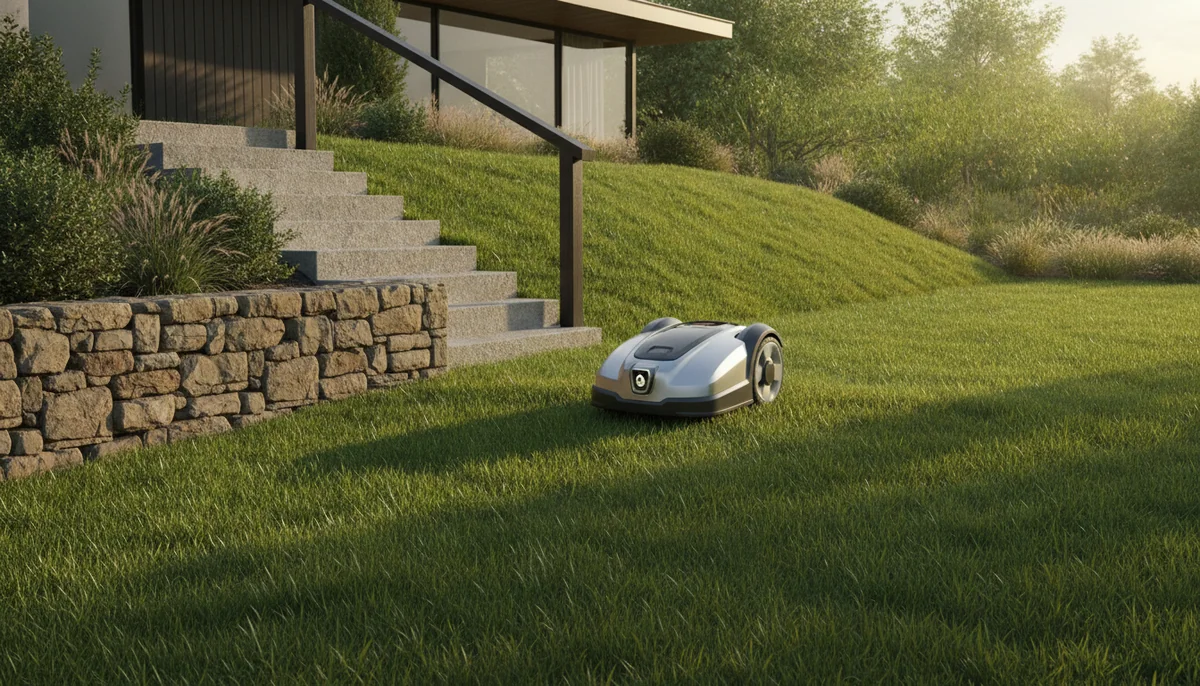
The easy photograph is a robot driving straight up a clean green bank. The useful question is what happens at the top, where it must turn across the incline, settle its weight, avoid tearing the grass, and find a safe route back down. That is where an impressive climbing specification can dissolve into wheelspin, sideways drift, or a notification asking for rescue.
Uneven ground is often harder than the hill itself. A broad 15-degree incline on established dry turf may be routine, while an almost level lawn with a sprinkler hollow, exposed root, soft drainage seam, or grass-to-paving lip can stop a low chassis every afternoon. Judge the property by its hardest recurring five feet, not its average slope.
The percentage on the box is not an angle
Mower listings regularly mix percentage grade and degrees in ways that make a bank sound steeper than it is. Percentage grade is rise divided by horizontal run, multiplied by 100. A 45% grade is about 24 degrees, not 45 degrees; an 80% grade is about 39 degrees.
| Grade | Approximate angle | What the number should mean to a buyer |
|---|---|---|
| 30% | 16.7° | A modest maximum that still assumes decent grip and clean transitions. |
| 45% | 24.2° | A serious incline, but not evidence of AWD or rough-ground ability. |
| 70% | 35.0° | Specialist territory where turning, stopping, and recovery matter enormously. |
| 80% | 38.7° | A favorable-condition ceiling, not a comfortable whole-lawn target. |
| 84% | 40.0° | An extreme claim that needs substantial operating margin. |
| 100% | 45.0° | A one-foot rise for every foot of horizontal run. |
Smart Lawn Bots treats every maximum slope rating as a ceiling reached under favorable conditions, not as the slope a mower should face throughout its working life.
Leave room for dew, worn tires, weak turf, leaves, loose soil, sidehill drift, and imperfect approach angles. If the steepest part of the lawn exactly matches the published maximum, the mower has no useful reserve.
The climb is only one movement in the job
Turning exposes the chassis
Straight uphill and downhill travel usually gives the driven wheels their cleanest task. Long cross-slope passes shift weight downhill and invite sliding; tight turns ask the wheels to climb, steer, and resist gravity at once. A mower can conquer the face of a bank, then dig a bald patch while rotating at its edge.
Directional zones matter on a serious incline. Routes that follow the fall line, or cross it diagonally where the mower remains stable, are preferable to repeated horizontal lanes. Random-navigation machines cannot enforce that strategy, which makes even a torquey little mower a poor choice for a consequential slope.
Small holes beat sophisticated navigation
Rear-wheel-drive robots commonly trail or push passive front casters. Those casters can fall into divots, catch thick runners, bounce over a drain cover, or lodge against a curb lip while the powered wheels continue digging. Low bodywork can also high-center on roots and abrupt crests.
This is why LiDAR, RTK, and cameras should not be confused with terrain hardware. Navigation answers “Where am I?” Traction answers “Can I leave?” The distinction is central to choosing among RTK, LiDAR, and camera-based mowers, especially beneath trees or beside tall buildings.
Wet grass changes the answer
Weather resistance keeps water away from electronics; it does not keep tires attached to the lawn. Dew and rain reduce grip, pack clippings into the deck, fill tread, and make the surface easier to rut. Extra driven wheels help the mower keep moving, but a heavy AWD machine can do more damage once the soil begins to yield.
The sixth week matters more than the showroom climb. A route that succeeds in afternoon sunshine may fail after irrigation, while the repeated turn in front of the dock slowly becomes bare soil. Delay difficult mowing until the surface is firm and place the charger on a level, durable approach when possible.
A dangerous runout changes the standard
A mower stuck in the middle of the lawn is irritating. A mower sliding toward a road, pond, retaining wall, staircase, ditch, or pool is a different problem. Obstacle recognition is not cliff protection, and a virtual line is not a physical barrier.
Keep a generous setback, manually verify the boundary, and install physical protection wherever a small mapping or traction error has serious consequences. Some machines permit much less slope at a virtual boundary than inside the mowing area. The ECOVACS GOAT O1000 models, for example, claim a 45% work-area grade but only 17% at the boundary.
Choose the drive system before the navigation system
| Mower class | Best fit | Honest limitation |
|---|---|---|
| 2WD robot | Smooth, firm, dry, modest slopes with clean transitions. | Casters, lateral drift, damp turns, and small depressions expose it quickly. |
| AWD or 4WD robot | Recurring inclines, roots, ruts, thick turf, and abrupt transitions. | More weight and aggressive turning can scar soft, wet, or sandy grass. |
| Tracked autonomous mower | Large, rough, open acreage where grip matters more than finish. | Weight, pivot damage, worn travel lanes, and difficult recovery remain substantial. |
| Remote-control slope mower | Dangerous banks, tall grass, and terrain that needs an operator watching every pass. | It reduces physical exposure but returns none of the operator’s mowing time. |
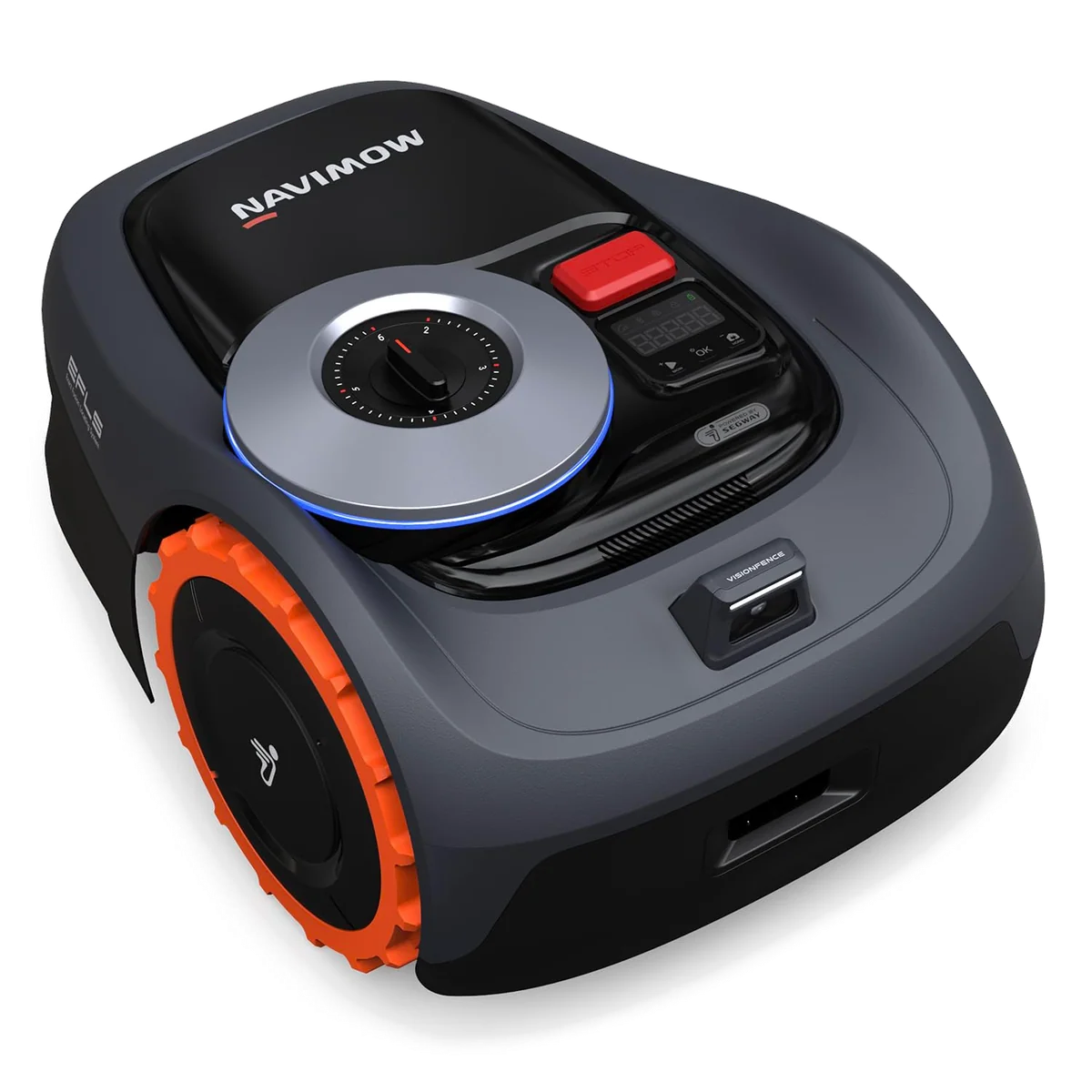
Capable 2WD robots are not useless on hills. The Segway Navimow i110N can suit a smooth, modest, open-sky lawn, but its 30% work-area maximum falls to 10% at a boundary and its low body and casters remain vulnerable to ruts and thick turf. Its useful trick is directional control: changing lane orientation can make the mower cross a groove instead of following a wheel into it. That does not turn it into an all-terrain machine, and buyers whose lawn is defined by damp grades or broken ground should move to AWD; the full Navimow i110N review explains the trade.
The same warning applies to ostensibly tougher 2WD machines. The MOVA LiDAX Ultra 1000 claims a 45% grade and maps well without an RTK antenna, yet passive front casters and rear drive can struggle on soft turns, sidewalk ruts, runners, and eroded seams. The Sunseeker S4 and Navimow i215 LiDAR are better viewed as moderate-slope choices whose navigation works beneath trees, not as substitutes for four driven wheels. The eufy E15 and E18 belong on smoother ground still.
The autonomous hill machines worth shortlisting
Segway Navimow X430 is the balanced large-yard choice
For a large, steep residential lawn, the Navimow X430 offers the most convincing balance of traction, coverage, and turf manners. Four driven wheels, suspension, steerable front wheels, a 17-inch dual-disc deck, and a claimed 84% maximum give it real mechanical authority over roots and difficult transitions. Steering rather than routinely skid-turning makes it the better default where the lawn is too valuable to treat like a test track.
Its drawback is that capable hardware still depends on successful dock positioning, mapping, firmware, and Network RTK behavior. The 24-inch body also needs measured gates and corridors, and an immobilized machine is not pleasant to retrieve from the bottom of a property. Read the Navimow X430 review before treating the slope claim as a promise.
Mammotion LUBA 3 AWD has the grip, but its turns cost grass
The LUBA 3 AWD family is the traction specialist for firm, rooty, rutted ground beneath trees and beside buildings. Its four-wheel drive, suspension, LiDAR-assisted navigation, claimed 80% maximum, and roughly two-inch obstacle-crossing claim align with strong reports from difficult properties. The 3000H suits higher-cut turf on up to 0.75 acre, while the standard-height 5000 extends managed area to 1.25 acres.
Fixed-wheel turns are the price. On wet, sandy, thin, or pine-needle-covered turf, repeated pivots can scrub the surface or spin into a hole, particularly near the dock. App, firmware, and support experiences are also less settled than the chassis deserves. Compare the exact variants rather than buying the family name alone, starting with the LUBA 3 3000H and 5000H comparison.
DREAME A3 AWD is the wooded-slope specialist
The DREAME A3 AWD line makes the strongest case where steep ground and blocked satellite views arrive together. Onboard LiDAR removes the external RTK antenna, while four driven wheels and articulated hardware give the mower a credible route over roots, hard thresholds, and firm slopes in the low-30-degree range. The full 80% claim remains a maximum, not an instruction to map every 38.7-degree contour.
Weight is the honest drawback. The A3 AWD Pro 3500 weighs more than 50 pounds, and its driven wheels can excavate wet, loose, sandy, or thin ground while turning. Mapping irregular beds can also take several attempts, and the low EdgeMaster pass can scalp taller or crowned borders. The DREAME A3 AWD Pro 3500 review is the next read for a large wooded hill, while the standard A3 AWD 1000 is the narrower quarter-acre option.
WORX WR344 has excellent feet and a frustratingly small mouth
The WORX WR344 combines genuine 4WD, an articulated chassis, and steerable front wheels in a machine that can keep contact over roots, ruts, raised lips, and very steep firm ground. Its chassis is kinder to turf than a tank-turning platform, which gives it a real place on connected, awkward lawns.
The 8.7-inch cutting disc is extremely narrow for a mower rated to manage an acre, so difficult terrain may be conquered slowly over many short sessions. Cloud activation and navigation software have also prevented some owners from reaching the mowing stage at all. The WORX WR344 review makes the case without pretending it is appliance-simple.
When remote control is the more honest answer
An autonomous robot is designed to maintain short grass, dock itself, recharge, and continue. It is not a brush cutter. If the bank carries waist-high weeds, woody growth, loose debris, or terrain where a mapping error would be dangerous, the correct machine may require an operator.
The Mowrator S1 4WD is the coherent choice for maintained grass on a serious bank. Its four driven wheels, 21-inch conventional blade, and claimed 75% grade give it much more cutting authority than a domestic maintenance robot. The limitation is categorical rather than minor: someone must steer every pass, and recovering a powerless machine weighing more than 100 pounds requires a plan. Its full review covers the slope behavior and turn-control concerns.
The tracked AIWEIYA AWY-550 goes farther into pasture, thistle, and rough hillside work, but it is closer to compact machinery than lawn automation. Tracks grip strongly and also tear finished turf; the roughly 300-pound machine brings serious recovery, fuel, reliability, documentation, and parts concerns. Buyers choosing between these categories should start with the autonomous and remote-control mower trade-offs, not with whichever listing advertises the largest angle.
Walk the lawn before asking an app to map it
- Measure the steepest sustained section. Record whether the result is percentage grade or degrees, then repeat the measurement on the route to the charger.
- Mark every turn. The crest, base, sidehill corners, zone entrances, and dock approach are more revealing than the easiest straight climb.
- Inspect the surface when damp. Look for soft shoulders, wheelspin marks, exposed runners, leaves, sand, drainage seams, and thin grass that disappears after a few aggressive turns.
- Fix the small geometry. Fill holes, level sprinkler recesses, smooth grass-to-paving humps, bridge harmless lips, and remove roots or debris that can catch the chassis.
- Reset tall growth conventionally. Robot mower blades maintain grass through frequent light cuts; they do not provide the lift or clearing power of a full mower deck.
- Map with margin. Keep the mower well away from water, traffic, drops, steps, and retaining edges, then add a physical barrier wherever leaving the lawn would be dangerous.
- Watch complete cycles. Supervise uphill, downhill, cross-slope, turning, docking, recharge, and resume behavior in each zone before retiring the conventional mower.
The right robot can remove most of the weekly labor from a hilly lawn, but the purchase succeeds when the property is treated as a route rather than a single slope number. Buy enough drivetrain, preserve traction with sensible scheduling, repair the few places that repeatedly catch wheels, and accept that the borders will still need a trimmer. If a standard 2WD mower already looks marginal on paper, it is the wrong mower before the first drop of dew lands.
Frequently Asked Questions
Can a two-wheel-drive robot mower handle a hill?
Yes, a capable 2WD mower can maintain a smooth, firm, dry, modest incline, but persistent moisture, ruts, thick turf, abrupt transitions, and difficult turns justify moving to AWD.
Does an 80% slope rating mean the mower can climb 80 degrees?
No, an 80% grade is about 38.7 degrees, and even that figure should be treated as a favorable-condition maximum rather than a comfortable operating target.
Does LiDAR make a robot mower better on rough ground?
LiDAR improves positioning beneath trees and beside buildings, but tires, driven wheels, suspension, clearance, steering, and surface condition determine whether the mower can physically cross the ground.
Can a robotic mower cut a wet hillside?
Some machines can move on wet slopes, but routine wet mowing raises the risk of sliding, clogged decks, wheelspin, rutting, turf damage, and a stranded mower.
Should a robot mow sideways across a steep bank?
Long cross-slope passes are usually less stable than uphill, downhill, or carefully chosen diagonal routes, so a serious hill favors a mower with directional zone controls.
Will a robot mower level an uneven lawn?
No, frequent multidirectional cutting may make mild unevenness look less obvious, but holes, roots, ruts, soft seams, and raised lips still need repair or deliberate exclusion.
Sources (168)
- Amazon listings and customer reviews
- Owner reports across r/MowratorOfficial, r/automower, r/rctoys and 51 more threads
- Owner and reviewer video, 365 channels
- Walmart listing
- Costco listing
- Target listing
- Toptenreviews — Article — www.toptenreviews.com
- Pcworld — Article — www.pcworld.com
- Homedepot — Article — www.homedepot.com
- Lowes — Article — www.lowes.com
- Robotmowerlab — Article — robotmowerlab.com
- Forbes — Article — www.forbes.com
- Lifehacker — Article — lifehacker.com
- Makeuseof — Article — www.makeuseof.com
- Navimow — Article — navimow.com
- Segway — Article — navimow.segway.com
- Tomsguide — Article — www.tomsguide.com
- Site — Article — segway-navimow.my.site.com
- Consumerreports — Article — www.consumerreports.org
- Propartsdirect — Article — www.propartsdirect.net
- Facebook — Article — www.facebook.com
- Easylawnmowing — Article — easylawnmowing.co.uk
- Trustedreviews — Article — www.trustedreviews.com
- Cleva — Article — us.cleva.com
- Bestutahrealestate — Article — bestutahrealestate.com
- Cleva Uk — Article — www.cleva-uk.com
- Expertreviews — Article — www.expertreviews.co.uk
- Cleva — Article — eu.cleva.com
- Currys — Article — www.currys.co.uk
- Mowerbotlab — Article — mowerbotlab.com
- Gardentool360 — Article — gardentool360.co.uk
- Ukgardenreviews — Article — ukgardenreviews.com
- Gardenersworld — Article — tollbit.gardenersworld.com
- Freshlycharged — Article — freshlycharged.com
- Mowrator — Article — mowrator.com
- Trustpilot — Article — www.trustpilot.com
- Pcmag — Article — www.pcmag.com
- Reviews — Article — www.reviews.org
- Wellbots — Article — www.wellbots.com
- Myprosandcons — Article — mowrator.myprosandcons.com
- Mowingmagic — Article — mowingmagic.com
- Hedgecombers — Article — hedgecombers.com
- Bestrobovacuums — Article — www.bestrobovacuums.com
- Chewy — Article — www.chewy.com
- eufy — Article — www.eufy.com
- Substack — Article — robovacinsights.substack.com
- eufy — Article — service.eufy.com
- Countryliving — Article — www.countryliving.com
- Rtings — Article — www.rtings.com
- Vacuumwars — Article — vacuumwars.com
- Younghouselove — Article — www.younghouselove.com
- Womanandhome — Article — www.womanandhome.com
- Interlightus — Article — www.interlightus.com
- Coredy — Article — www.coredy.com
- Moderncastle — Article — moderncastle.com
- Thecarpentersdaughter — Article — thecarpentersdaughter.co.uk
- Techradar — Article — www.techradar.com
- Lbtechreviews — Article — www.lbtechreviews.com
- Zdnet — Article — www.zdnet.com
- Trustpilot — Article — uk.trustpilot.com
- Amgardaseeblick — Article — amgardaseeblick.com
- Pistonheads — Article — www.pistonheads.com
- Bestbuy — Article — www.bestbuy.com
- Ycombinator — Article — news.ycombinator.com
- Mammotion — Article — us.mammotion.com
- Trustpilot — Article — au.trustpilot.com
- Mammotion — Article — eu.mammotion.com
- Mammotion — Article — uk.mammotion.com
- Easylawnmowing — Article — www.easylawnmowing.com
- Therobotmower — Article — therobotmower.co.uk
- Androidauthority — Article — www.androidauthority.com
- Au — Article — robotlawnmowers.com.au
- Nytimes — Article — www.nytimes.com
- Cnet — Article — www.cnet.com
- Gardenersworld — Article — www.gardenersworld.com
- Smarthomescene — Article — smarthomescene.com
- HOOKII — Article — hookii.com
- Mammotion — Article — ca.mammotion.com
- Tractorsupply — Article — www.tractorsupply.com
- Substack — Article — jjtechish.substack.com
- Basic Tutorials — Article — basic-tutorials.com
- Smarthomeassistent — Article — www.smarthomeassistent.de
- Mein Gartenexperte — Article — www.mein-gartenexperte.de
- Techreviewer — Article — www.techreviewer.de
- Fr — Article — maniaques.fr
- Basic Tutorials — Article — basic-tutorials.de
- Frandroid — Article — www.frandroid.com
- Appgefahren — Article — www.appgefahren.de
- Yarbo — Article — www.yarbo.com
- Fredshed — Article — www.fredshed.co.uk
- Tv — Article — www.stuff.tv
- Yarbo — Article — forum.yarbo.com
- Yarboreview — Article — yarboreview.com
- Tech — Article — us.mova.tech
- Slashgear — Article — www.slashgear.com
- Newatlas — Article — newatlas.com
- Tech — Article — au.mova.tech
- at — Article — www.galaxus.at
- Appleinsider — Article — appleinsider.com
- Notebookcheck — Article — www.notebookcheck.net
- Maison Et Domotique — Article — www.maison-et-domotique.com
- Au — Article — www.gadgetguy.com.au
- MOVA Tech — Article — us.forum.mova-tech.com
- Au — Article — www.techguide.com.au
- Novabot — Article — novabot.com
- Techiwant — Article — techiwant.com
- Samsclub — Article — www.samsclub.com
- Heyupnow — Article — community.heyupnow.com
- T3 — Article — www.t3.com
- Tech — Article — uk.mova.tech
- Robocleaners — Article — www.robocleaners.com
- Mowscout — Article — mowscout.com
- Wired — Article — www.wired.com
- Shopsunseekertech — Article — shopsunseekertech.com
- Warehouserunner — Article — app.warehouserunner.com
- Electricrevolutionreviews — Article — electricrevolutionreviews.com
- Sunseekertech — Article — sunseekertech.com
- Sunseekerelite — Article — sunseekerelite.com
- Bobvila — Article — www.bobvila.com
- Au — Article — segway.com.au
- Theverge — Article — www.theverge.com
- Au — Article — roboticmower.com.au
- Techadvisor — Article — www.techadvisor.com
- Cnygreenteam — Article — cnygreenteam.com
- Outdoor Usa — Article — outdoor-usa.com
- Protoolreviews — Article — www.protoolreviews.com
- Homebuilding — Article — www.homebuilding.co.uk
- Gizmodo — Article — gizmodo.com
- Suncolawns — Article — shop.suncolawns.com
- Smartyardnw — Article — smartyardnw.com
- the Ambient — Article — www.the-ambient.com
- Outdoorica — Article — outdoorica.com
- Smart Dots — Article — www.smart-dots.com
- Trustpilot — Article — ie.trustpilot.com
- Homeandgardenselect — Article — homeandgardenselect.com
- Eu — Article — www.letemsvetemapplem.eu
- Robomowlab — Article — robomowlab.com
- Eftm — Article — eftm.com
- ECOVACS — Article — www.ecovacs.com
- Au — Article — www.harveynorman.com.au
- Thespruce — Article — www.thespruce.com
- Pcmag — Article — uk.pcmag.com
- 9to5google — Article — 9to5google.com
- Mensjournal — Article — www.mensjournal.com
- Lawncraftsupply — Article — lawncraftsupply.com
- Smarthomecompared — Article — smarthomecompared.com
- Smarthomeexplorer — Article — www.smarthomeexplorer.com
- Hunker — Article — www.hunker.com
- Thetechnologyman — Article — thetechnologyman.com
- Mammotion — Article — mammotion.com
- Carplaylife — Article — www.carplaylife.com
- Smarthomejunkie — Article — www.smarthomejunkie.net
- Iheart — Article — rocketerie.iheart.com
- WORX — Article — www.worx.com
- Upzy — Article — www.upzy.com
- Reviewed — Article — www.reviewed.com
- Ai — Article — www.robotmower.ai
- Dreamhomeplace — Article — dreamhomeplace.com
- Ibisik — Article — www.ibisik.com
- Requiemforadream — Article — www.requiemforadream.com
- Renovationrated — Article — renovationrated.com
- Dreametech — Article — yardcare.dreametech.com
- Ign — Article — www.ign.com
- Glroboticsusa — Article — www.glroboticsusa.com
- Pwcparts — Article — pwcparts.com
- Familyhandyman — Article — www.familyhandyman.com
- Sitejabber — Article — www.sitejabber.com
- Yardcareinc — Article — yardcareinc.com