The eufy E15 solves robot-mower setup, not difficult lawns
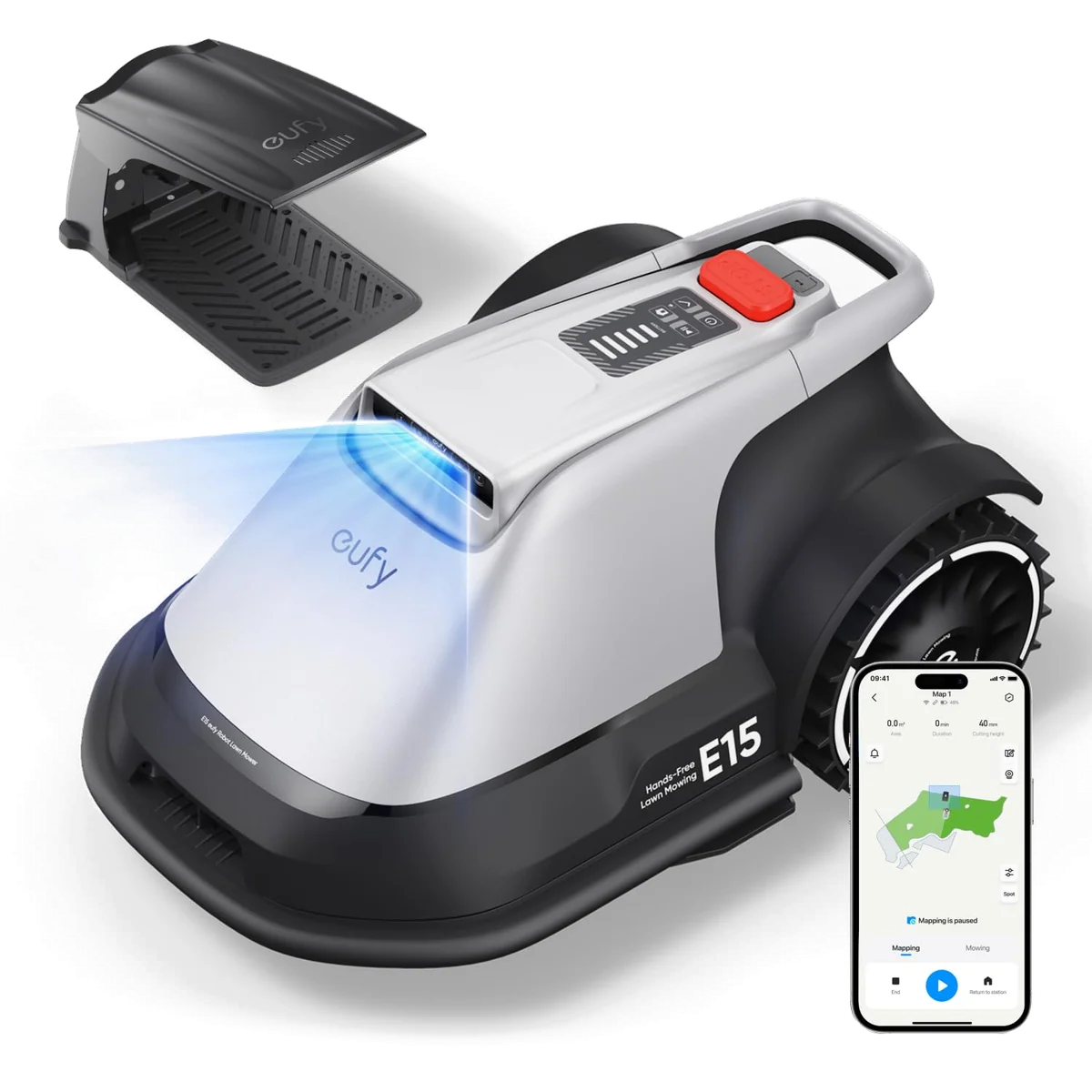
Buy the eufy E15 for a small, dry, connected, orderly lawn, but choose something tougher if the yard is uneven, steep, visually ambiguous, or split by closed gates.
Smart Lawn Bots’ verdict
The eufy E15 is one of the most approachable robot mowers for someone who wants neither a buried wire nor an RTK antenna. Its mapping can be excellent, its app is unusually understandable, its cut is neat, and its quiet routine can remove most of the weekly mowing from a compatible yard.
Compatibility is the whole verdict. Buy it for a dry, smooth, connected lawn well below 0.2 acre, with short supported grass and boundaries a camera can plainly see. Walk away if the yard has persistent dew, rough transitions, closed gates, roadside drops, significant slopes, St. Augustine, dense Zoysia, or an expectation of finished edges without manual trimming. The E15 does not turn a difficult yard into an easy one; it makes an already orderly lawn exceptionally easy to maintain.
Strengths
Weaknesses
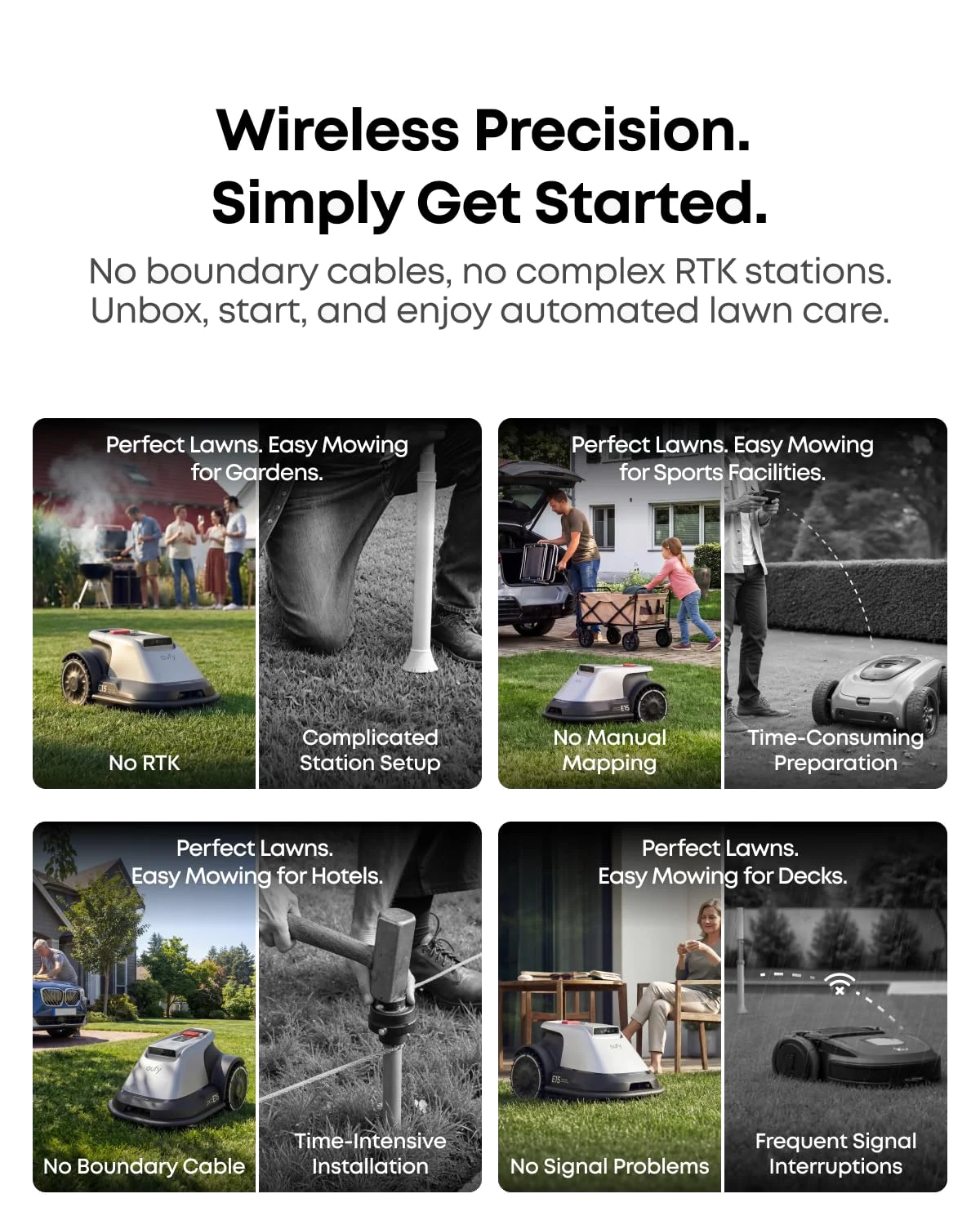
The eufy E15 behaves like a robot vacuum moved outdoors. Place its roofed charging base, pair the mower with the app, and let two cameras discover the lawn. There is no perimeter cable to bury and no RTK antenna demanding a patch of open sky. On uniform grass with obvious borders, that approach works remarkably well: the map appears without a guided perimeter lap, the mower lays down orderly parallel passes, and routine cutting becomes a scheduled background job.
The catch is that the lawn becomes part of the navigation system. Sparse grass, flowers, leaves, bare soil, an open boundary shared with a neighbor, or turf ending at a curb can all change what the cameras think they see. The E15 can correct many mistakes with virtual walls, no-go areas, must-mow areas, zones, and connecting paths, but those corrections belong to the owner. Automatic mapping removes installation work; it does not remove judgment.
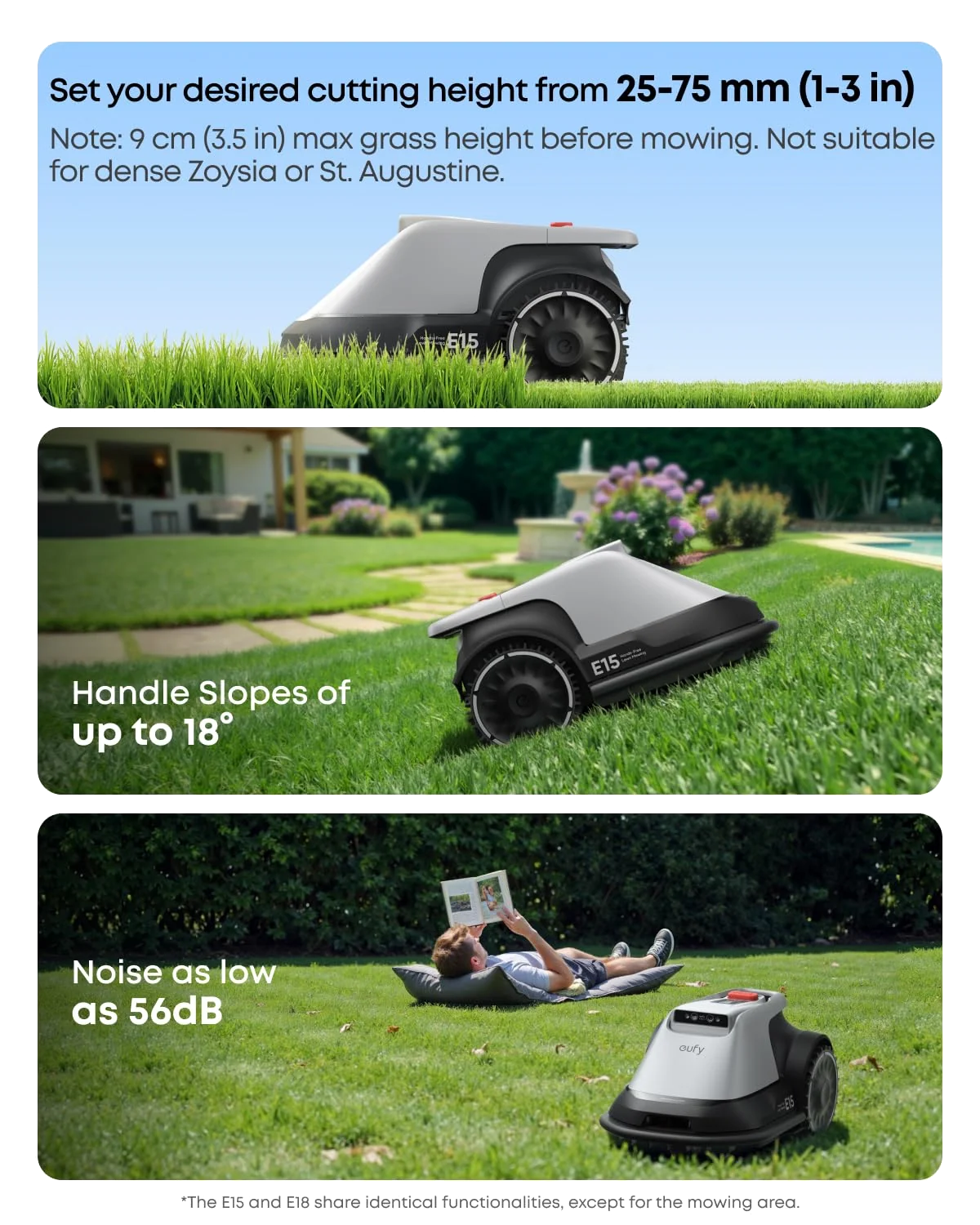
The chassis imposes a harder limit. This is a rear-wheel-drive mower with a swiveling front caster, not an all-terrain machine. It has worked without drama on suitable lawns, yet direct E15 use also shows the front grounding on modest undulations, the rear wheels slipping on damp grass, and the mower repeatedly entering a shallow depression. Eufy’s own requirement that terrain variation stay below 1.2 inches deserves more attention than the prominent 18° slope figure.
Key Specifications
Automatic mapping is excellent when the lawn gives it a fair chance
Hands-on setup can take only minutes, although mapping the lawn itself takes longer. Small, straightforward yards have been mapped in well under an hour, while Eufy allows three to four hours for a standard maximum-size lawn and longer for complicated ground. That is still easier than installing wire or positioning an RTK reference station because the robot, not the owner, does the perimeter work.
Good results start before the mapping button is pressed. The grass needs an ordinary first cut below 3.5 inches, boundaries should be trimmed into view, holes need filling, and temporary clutter should be removed. Eufy specifically excludes St. Augustine and dense Zoysia, so owners of either grass type should stop there rather than hope a software update will change a mechanical compatibility limit.
A neat fenced rectangle can produce a nearly flawless map. A less legible lawn may need repair in the app. Longer or yellow grass has been excluded as though it were an obstacle, scrubby ground has been included by mistake, flowers have been treated as a border, and hardstanding has occasionally been mistaken for lawn. Must-mow regions can reclaim valid turf, while no-go zones can protect beds and repeat sticking points.
An unfenced boundary adjoining identical grass is especially revealing. The E15 cannot infer where one property ends, so the owner must draw a conservative virtual limit and watch the first runs. It can stay out of the neighboring lawn once that limit is defined, but “automatic” does not mean the cameras understand legal ownership.
Multiple zones still need a physical route
The app can divide a mapped lawn, schedule zones, and teach the mower a route across level paving. That is useful for connected front, side, and rear sections. It does not make the E15 portable between unrelated patches. Carrying it over steps or through a fence can leave it unable to localize, and each base supports one map.
A gate must remain open whenever the mower needs to pass. If pets or security make that impossible, the owner becomes a gate attendant or needs a separate approved base-and-map arrangement. Before buying, trace an uninterrupted driveable route from the dock to every blade of grass; the nominal acreage is irrelevant if the robot cannot reach half of it.
Strengths & Limitations
Strengths
- Automatic camera mapping removes both perimeter-wire installation and RTK antenna placement.
- The mower produces clean parallel cuts with app-controlled height, direction, and spacing.
- Quiet operation, automatic docking, and frequent scheduling can remove most routine mowing labor.
- No-go areas, must-mow regions, zones, and pathways provide useful tools for correcting the first map.
- The included roofed base protects the mower while it charges.
Limitations
- Damp grass, small undulations, holes, and soft ground can defeat the 2WD chassis.
- Camera navigation depends on daylight and can misread sparse grass, flowers, leaves, or ambiguous boundaries.
- Closed gates and disconnected lawns undermine autonomous multi-zone operation.
- Fences, walls, curbs, and many flush borders still require manual trimming.
- Battery replacement, major spare parts, and post-warranty repair options are not clearly established.
The cut is better than the journey
When the E15 reaches valid turf, its three small pivoting blades produce a clean, even finish. The 8-inch disc is narrow, but systematic parallel lanes look deliberate rather than random. Direction can be changed between sessions to reduce repeated wheel tracks, and the app exposes useful controls for height, path angle, spacing, edge margin, travel speed, and blade speed.
This is a maintenance mower, not an overgrowth-clearing machine. It removes small amounts frequently and leaves the fine clippings to decompose rather than collecting them in a bag. Daily or every-other-day mowing is where the concept makes sense: an occasional missed strand disappears into the next pass, while the lawn stays consistently short without a weekly push-mower session.
Coverage is methodical but not infallible. The E15 has completed simple lawns without getting lost or missing visible strips, yet other runs have repeated previously cut ground, spun while reconsidering a route, omitted longer patches, or stopped after losing its position. Map quality, ground condition, and firmware behavior all affect whether those quirks remain amusing or demand a rescue.
Maximum area does not mean one-charge coverage
The E15 runs for about 90–110 minutes, then requires roughly the same time to recharge. Its official per-charge coverage is about 100–150m², so an 800m² lawn near the mapping ceiling necessarily takes several mowing and charging cycles. Automatic return and resume make that workable, but the job may extend across more than one day.
Camera navigation also confines work to useful daylight. The mower recalls itself in low light and generally works from around half an hour after sunrise until half an hour before sunset. Its headlight does not turn it into a night mower. That restriction is welcome for nocturnal wildlife but reduces the time available for a large lawn, particularly when charging pauses and rainy weather consume the same window.
Wet grass and rough ground are the real enemies
The rain sensor can send the E15 home and delay its restart, while the mower and base carry IPX6 ratings. Weather resistance does not create traction. Damp turf and morning dew have caused wheel slip and grass buildup around the cutting disc, even on otherwise flat lawns. Scheduling after the grass dries is more important than relying on the rain sensor alone.
A brief dry climb near the rated limit says little about months of autonomous mowing. A smooth slope may be manageable, while a much gentler bank with soft soil, lateral camber, ruts, or roots can stop the 2WD chassis. Buyers should treat 18° as a ceiling under favorable conditions, not a target.
Obstacle avoidance is good at objects, less good at ground-level surprises
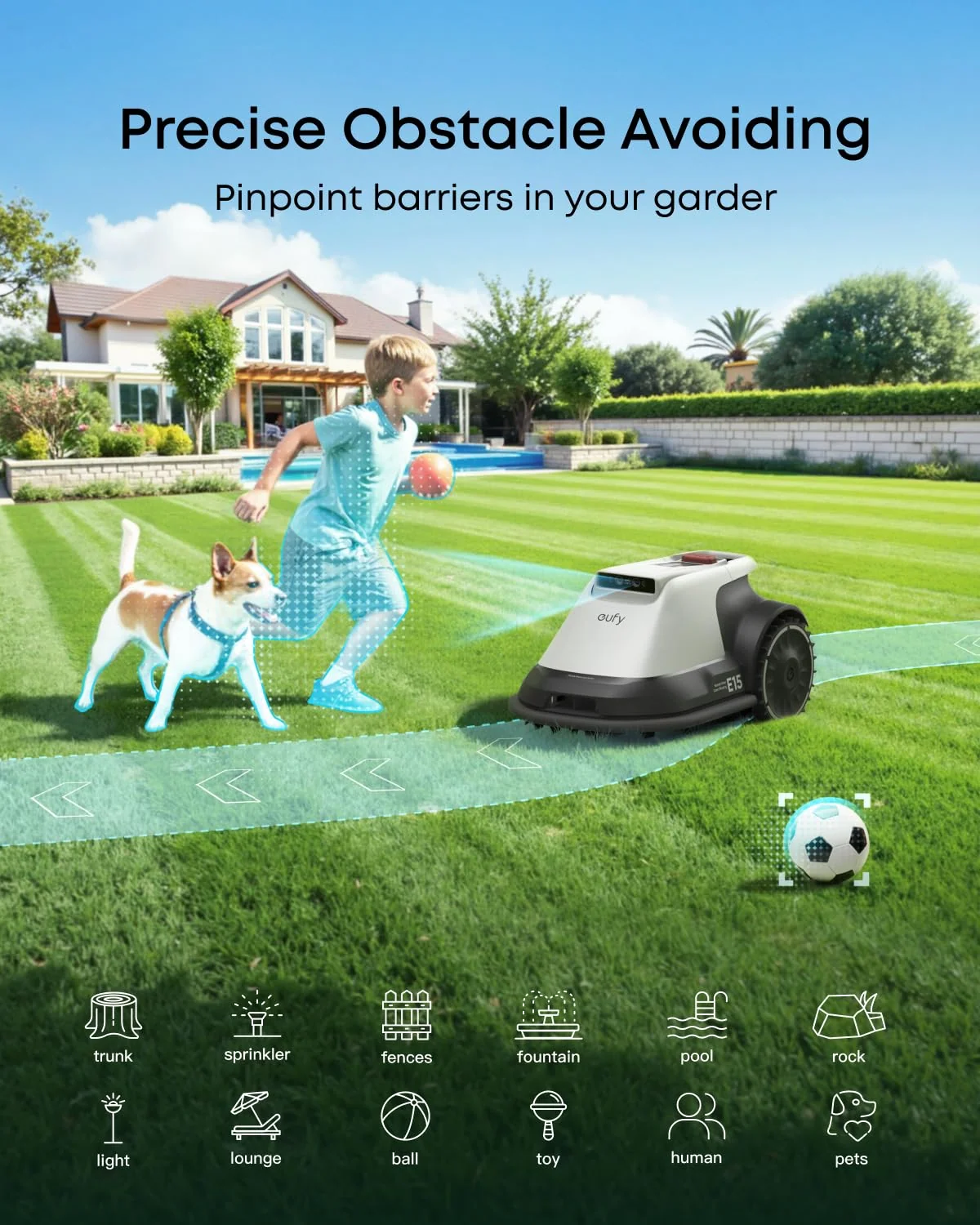
The cameras reliably recognize many conspicuous obstacles, including trees, furniture, and toys around tennis-ball size. The mower also stops its blades when lifted or tilted. Small, low, or ambiguous hazards are a different category: a table-tennis ball was driven over, a shallow dog-dug hole trapped the chassis, and emerging flowers beside indistinct grass were cut until a boundary was added.
Clear toys, hoses, stones, branches, and pet waste before every run, and keep children and animals away while the blades are moving. Obstacle avoidance is valuable, but it is not supervision or a safety guarantee.
Edge mode does not retire the string trimmer
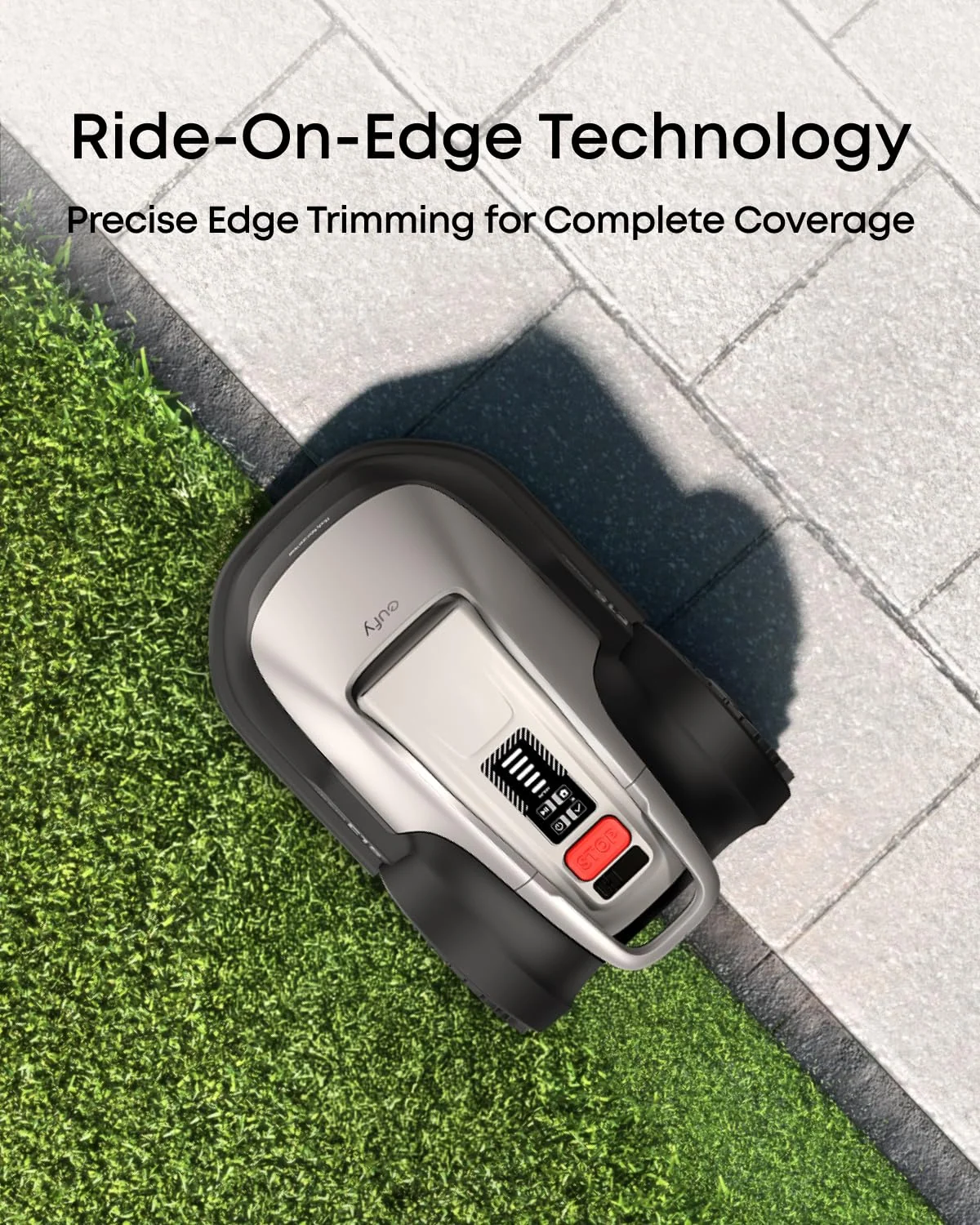
The E15 can overlap a level grass-to-paving transition when there is room for its body to ride across it. Against a fence, wall, raised bed, curb, tree surround, or drop, the inset disc leaves a strip behind. Eufy allows for as much as four inches beside walls, and direct use has shown misses even along some flush paths.
Increasing edge overlap can narrow that strip, but it can also send a wheel over a curb or into a bed. Leaves bridging a curb make the visual boundary harder to read. The sensible setting near a drop is conservative, even though that means finishing with a trimmer.
The easiest mower to install is not automatically the easiest mower to own
The E15 earns its keep by returning hours of routine mowing, not by outperforming a conventional mower on speed or edge finish. A suitable yard can be reduced to occasional trimming, underside cleaning, blade changes, and a quick pre-run sweep for hazards. An unsuitable yard merely exchanges pushing a mower for editing maps, opening gates, cleaning wet clippings, and rescuing a robot.
Against the Segway Navimow i110N, the E15 has the cleaner installation for a flat lawn where trees or buildings make RTK antenna placement unattractive. Its cameras do not need satellite correction to hold a mowing lane. The trade is greater dependence on daylight, visible grass texture, and clear boundaries.
On ground where traction is the concern, the E15 loses the argument. A LiDAR mower with a higher terrain rating, such as the MOVA LiDAX Ultra 1000, is the more credible direction for slopes and visually inconsistent borders. No navigation system repairs holes or mud, but the E15’s 2WD chassis and strict terrain tolerance leave it little reserve.
The E15 and E18 comparison is mostly about permitted lawn area, not a tougher machine. Both carry the same 93.24Wh battery, 90–110-minute working time, cutting system, height range, and stated slope limit; the E18 raises the mapped-lawn allowance from 0.2 to 0.3 acre. Choose the E15 only with comfortable area headroom, because the larger sibling does not cure damp grass, rough terrain, divided lawns, or weak edges.
Consumables are simple, but the repair story is still too vague
Routine blade service is straightforward. Three small blades attach to the central disc with individual screws, and replacement blade sets and a replacement disc have been documented. The cameras, wheels, rain sensor, charging contacts, and underside also need to stay clean because dirt can affect both navigation and cutting.
The more important ownership questions concern the expensive parts. The available E15 record does not establish a dependable retail supply of replacement batteries, drive assemblies, camera modules, charging bases, or power supplies, nor does it establish whether the traction battery is intended for owner replacement. Broader eufy support history is mixed: warranty cases can end generously, but owners of other robots have sometimes received a whole-unit exchange when a small part was unavailable.
That is not evidence that E15 batteries fail early or that mower parts are unavailable. It is a reason to verify the regional warranty, battery procedure, dock availability, and post-warranty repair route before committing. A four-figure outdoor appliance needs a better answer than “buy another robot” when a wheel, charger, or battery eventually wears out.
Frequently Asked Questions
Does the eufy E15 need a perimeter wire or RTK antenna?
No, it maps and navigates with stereo cameras, although it still needs a powered charging base and app connectivity for setup and remote features.
Can the E15 mow at night?
No, its camera navigation requires sufficient daylight and recalls the mower around low-light conditions.
Does the E15 collect grass clippings?
No, it repeatedly trims small amounts and leaves the fine clippings on the lawn as mulch.
Can it mow separate front and back lawns?
It can manage multiple zones only when it has a continuous traversable route to them, while disconnected areas may require another base and map.
Will it cut right against a fence or wall?
No, the inset cutting disc leaves an uncut margin beside raised boundaries, so a string trimmer remains necessary.
Are replacement blades and batteries available for the E15?
Replacement blades and a cutting disc have been documented, but the evidence does not establish dependable battery availability or owner replacement.
Sources (31)
- Amazon listings and customer reviews — Eufy E15 Robot Lawn
- Owner reports across r/RobotVacuums, r/eufyS1Pro, r/eufy and 9 more threads
- Owner and reviewer video, 20 channels
- Walmart listing
- Facebook — Article — www.facebook.com
- Hedgecombers — Article — hedgecombers.com
- Bestrobovacuums — Article — www.bestrobovacuums.com
- Chewy — Article — www.chewy.com
- eufy — Article — www.eufy.com
- Substack — Article — robovacinsights.substack.com
- eufy — Article — service.eufy.com
- Countryliving — Article — www.countryliving.com
- Rtings — Article — www.rtings.com
- Vacuumwars — Article — vacuumwars.com
- Younghouselove — Article — www.younghouselove.com
- Womanandhome — Article — www.womanandhome.com
- Interlightus — Article — www.interlightus.com
- Coredy — Article — www.coredy.com
- Moderncastle — Article — moderncastle.com
- Thecarpentersdaughter — Article — thecarpentersdaughter.co.uk
- Techradar — Article — www.techradar.com
- Trustedreviews — Article — www.trustedreviews.com
- Lbtechreviews — Article — www.lbtechreviews.com
- Tomsguide — Article — www.tomsguide.com
- Pcmag — Article — www.pcmag.com
- Zdnet — Article — www.zdnet.com
- Trustpilot — Article — uk.trustpilot.com
- Amgardaseeblick — Article — amgardaseeblick.com
- Pistonheads — Article — www.pistonheads.com
- Bestbuy — Article — www.bestbuy.com
- Ycombinator — Article — news.ycombinator.com