The eufy E18 is brilliant until the lawn stops cooperating
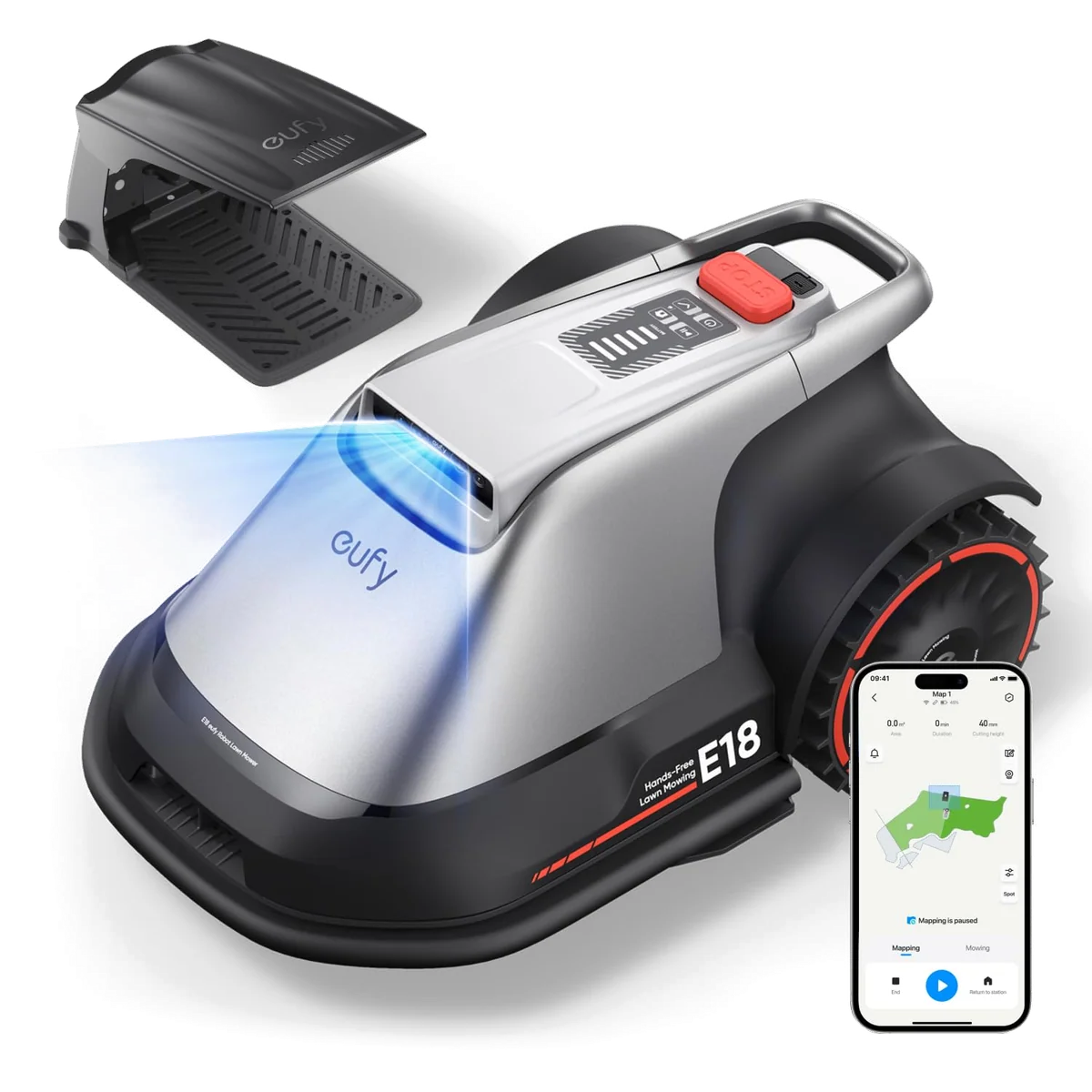
Buy the eufy E18 for a smooth, connected lawn where trees make RTK awkward, but walk away if the mower must cross steps, cope with ruts, cut after dark, or manage St. Augustine or dense Zoysia.
A lawn-fit decision, not a gadget decision
Buy the E18 when every mowing zone has a drivable route to the dock, the turf is short and supported, the surface is mostly smooth, and daylight provides enough time for the narrow deck to finish. In that setting, automatic mapping, excellent obstacle recognition, quiet operation and orderly cutting deliver one of the most convincing versions of low-effort robot mowing.
Skip it when the lawn is fragmented, rutted, frequently overgrown, edged by walls or dependent on overnight schedules. The E18 is genuinely smart about what it can see, but the best camera in the yard cannot flatten a hole, open a gate or make twelve hours of daylight arrive any faster.
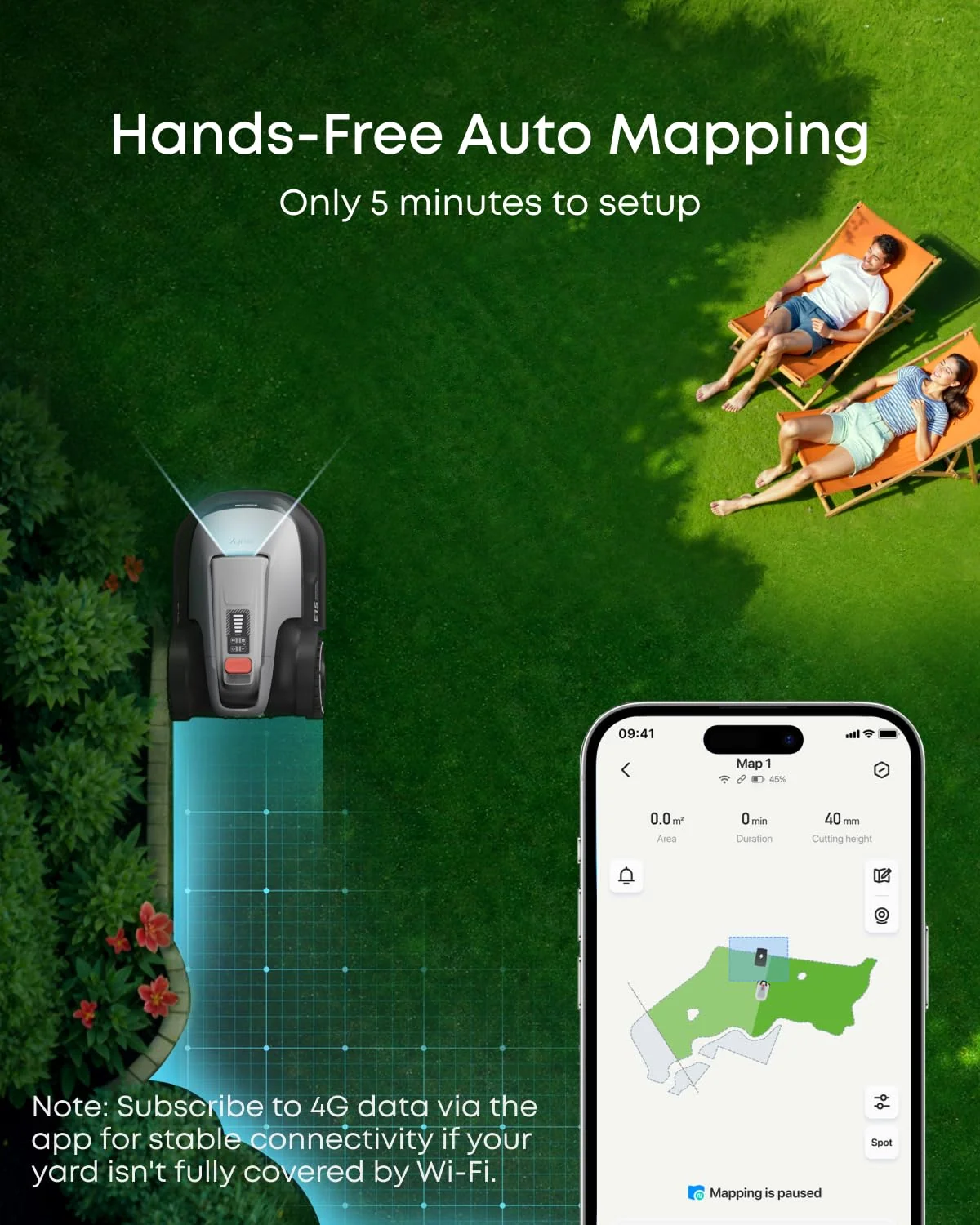
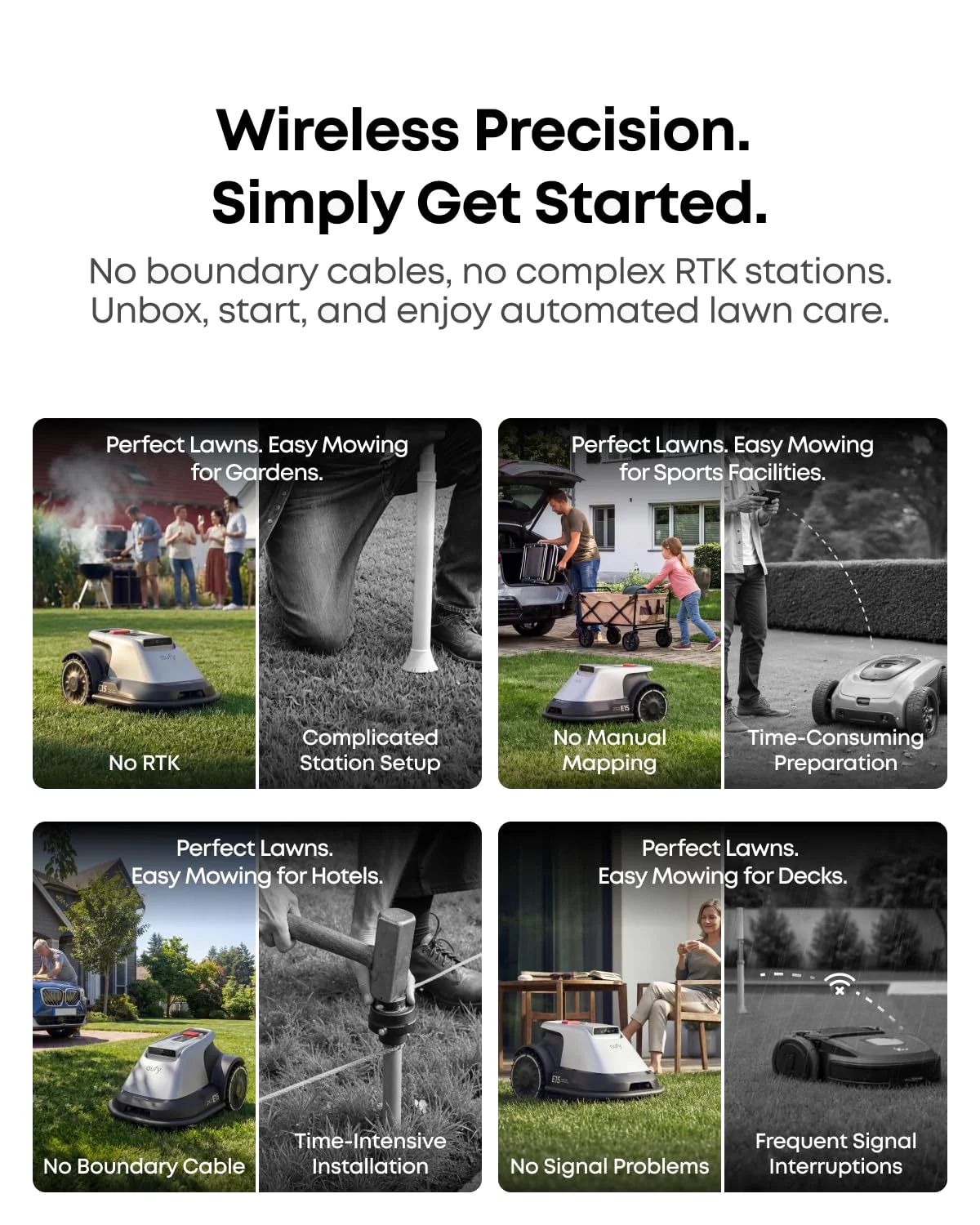
Most wire-free robot mowers move the installation problem rather than remove it. The buried cable disappears, but an RTK antenna takes its place and demands power, careful positioning and a useful view of the sky. The E18 does neither. Its cameras find the grass, follow a recognizable boundary and build the map without being driven around the entire perimeter.
That makes the E18 unusually persuasive beside trees, walls and narrow side yards where satellite reception can become the weakest part of an RTK mower. The dock still needs power, and the mower still requires 2.4 GHz Wi-Fi for setup, but the base can sit in a constrained location without serving as a satellite reference station. GPS remains onboard for anti-theft tracking; it simply is not the mowing-navigation system.
Easy setup is real, but five minutes is not the whole job
Placing the dock, connecting the app and joining Wi-Fi can take about ten minutes. Automatic mapping comes next, and its duration depends heavily on the lawn: 15–20 minutes on one small yard, 45 minutes on another, and more than two hours for a 2,700 sq ft zone. Calling that process hands-free is fair because the mower traces the boundary itself, but calling the lawn ready in five minutes is not.
The first mowing runs are the final part of installation. A recessed sprinkler, utility cover, paver gap or fence-edge hollow can stop the chassis even when the camera understands the scene perfectly. Those spots need soil, a raised fixture, extra boundary clearance or a virtual no-go zone. The E18 removes cable laying and antenna placement; it does not remove the need to robot-proof an imperfect lawn.
Key Specifications
The camera is the reason to buy it
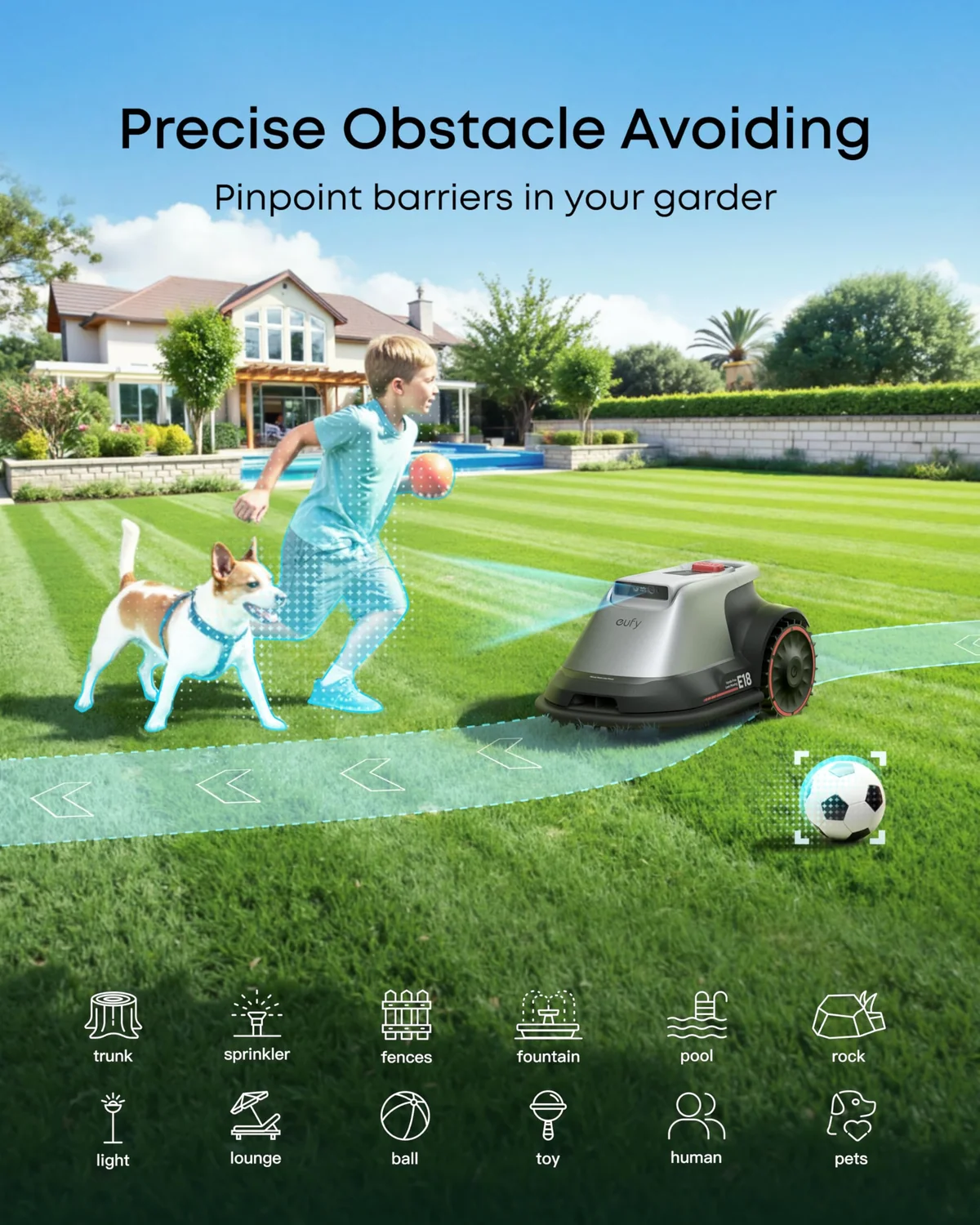
Obstacle avoidance is the E18’s standout ability. Dogs, toys, cones, sunglasses and small garden objects were recognized and steered around rather than treated as things to bump before turning. Temporary obstructions do not necessarily become permanent bald patches either, because the mower can return after the object moves and finish the missed strip.
That behavior makes sense in a family yard where the grass is rarely cleared with military discipline. It does not make the blades safe to run around unattended children, wildlife, cords or tiny objects, and a camera’s pool detection should never replace a physical safety barrier. This is excellent avoidance, not permission to abandon ordinary mower precautions.
The app exposes more than a start button. It can divide a map into zones, assign schedules, change cutting direction, adjust edge clearance, draw no-go areas, show progress, delay the restart after rain and remotely drive the mower. The available evidence supports remote driving, but not blade-powered manual touch-up mowing from the phone.
Multi-zone means connected zones
The E18 can manage several lawn areas when it can drive between them and return to a charging station. A traversable driveway or corridor works; steps, rock beds and closed gates do not. When carried to a disconnected front lawn, the mower searched for the unreachable dock instead of treating the area as an independent job. A second supported charging station may solve that layout, but it adds hardware, power and cost to a feature that sounds complete on the box.
Large connected lawns also benefit from being divided into smaller working zones. One enormous map encourages wandering and repeated reorientation, while zones of roughly 1,500–2,500 sq ft give the mower a clearer task. The app makes that correction possible, although the owner still has to recognize that the original map is inefficient.
The 0.3-acre badge describes capacity, not speed
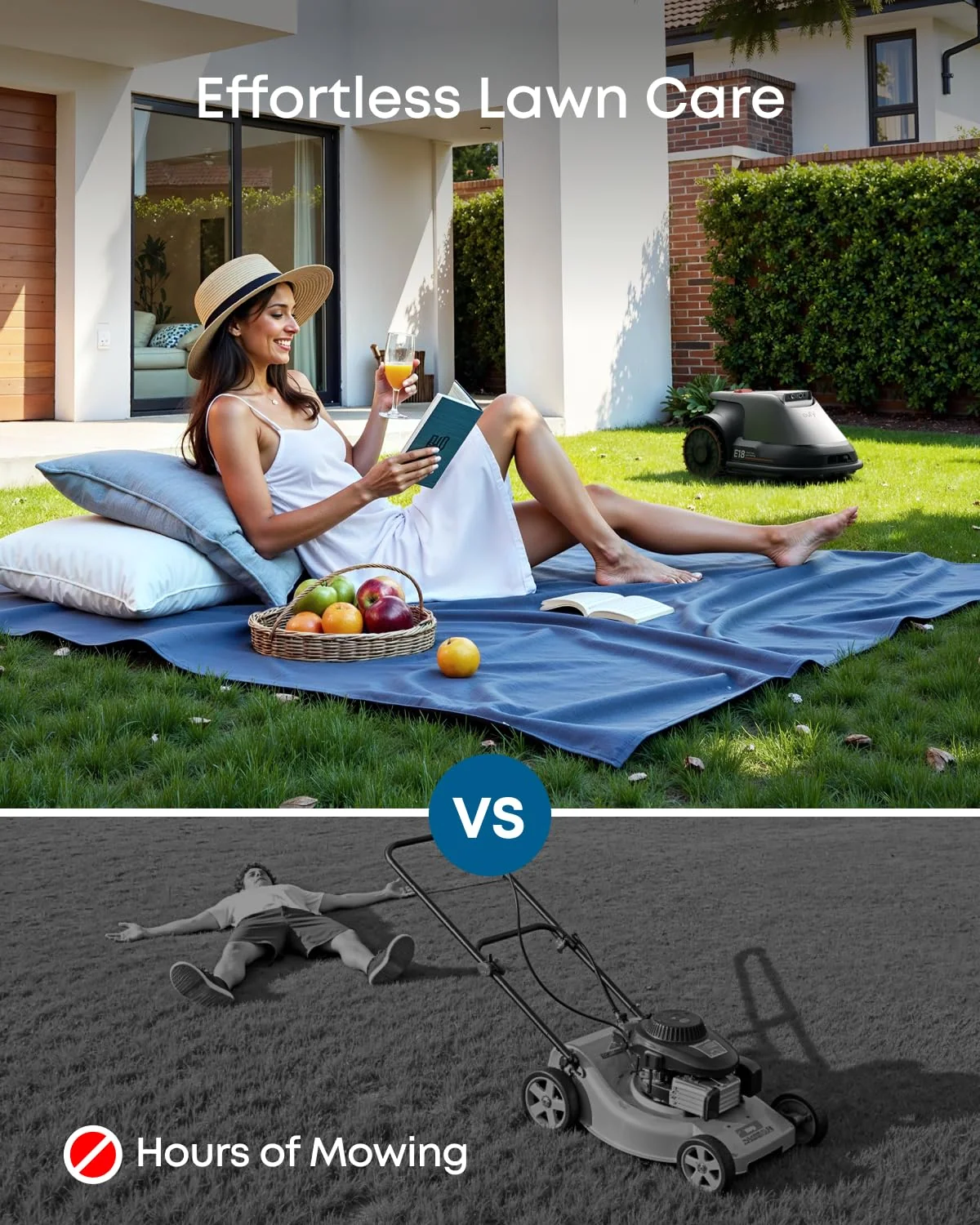
On maintained grass, the E18 cuts clean parallel lanes and leaves convincing stripes. Its three pivoting blades sit on a narrow 8-inch disc, so it takes far longer than a conventional mower to cover the same ground. That is acceptable while the machine works alone, but it matters near the maximum acreage because vision navigation also limits the working day to usable light.
A complex 3,731 sq ft area took just under four hours, including a recharge, which works out to roughly 930 sq ft per elapsed hour. A separate quarter-acre result landed near 12 hours. Smart Lawn Bots therefore treats 13,000 sq ft as a credible upper management ceiling on a favorable property, not a promise of a quick session or one-charge coverage.
Expected runtime is about 70–90 minutes, with roughly 90 minutes needed to recharge. The mower docks and resumes without help, so battery size creates waiting rather than another chore. E18 and E15 are reported to share the same battery, which means the larger model buys map capacity rather than greater speed or endurance.
It likes short grass and continuous ground
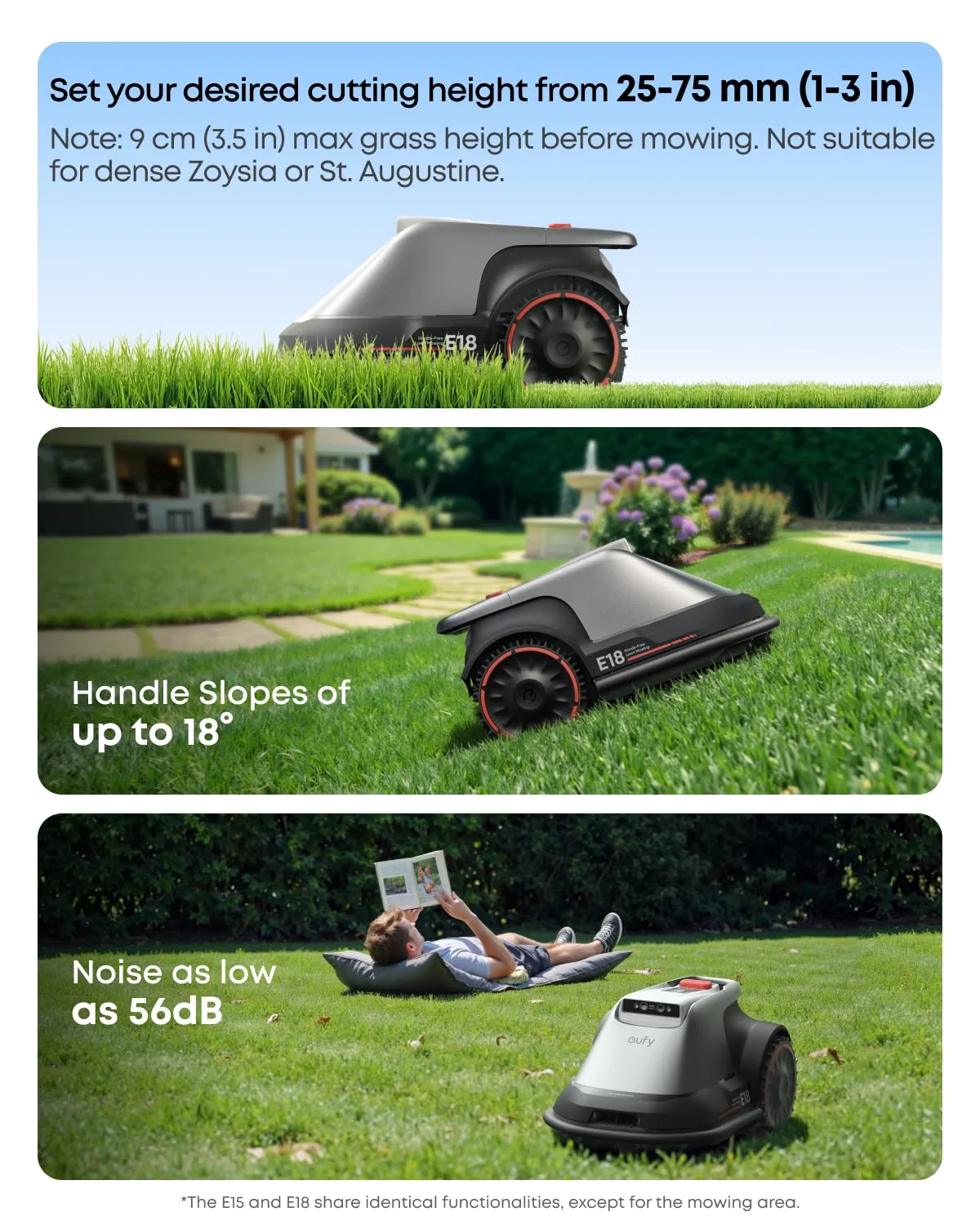
The E18 is a maintenance mower. Grass should begin below 3.5 inches, and the product record explicitly excludes St. Augustine and dense Zoysia. Frequent passes remove small clippings that fall back into the turf; an overgrown or unusually dense lawn should be brought under control before the robot takes over.
Traction is better than the official number first suggests. Clean demonstration slopes around 20–26 degrees were climbed successfully, but the supported ceiling remains 18 degrees. A straight ascent on firm grass says little about wet turns, drop-offs or warranty expectations, so the filmed headroom is reassuring rather than permission to redesign the specification.
Small depressions are more troublesome than smooth hills. A few inches around a sprinkler, utility cover or paver can strand a wheel, and increasing the boundary offset to avoid the hazard leaves more grass for a string trimmer. The centered cutting disc has the same physical limitation at walls, raised curbs and fence bases. Flush hard borders can produce good edge coverage because a wheel can ride over them, but vertical boundaries still leave a final strip.
At under 56 dB, the E18 is quiet enough to disappear into ordinary garden noise. The joke is that its best nighttime feature cannot be used at night: when the light becomes insufficient, the vision system sends the mower home. Rain causes the same retreat, with a configurable delay before work resumes.
Choose the lawn, then choose the model
The E18 earns its premium position by deleting the two most aggravating installation jobs, not by cutting wider, climbing extreme terrain or carrying a larger battery. That trade is worthwhile when an RTK station would struggle beside buildings or tree cover and the grass itself is smooth, connected and clearly bounded. Buyers with an open-sky lawn should compare the convenience against the broader field of wire-free robotic mowers rather than paying for vision merely because it sounds newer.
Within eufy’s range, the dividing line is area. The E18 decisively beats the E15 when the mapped grass exceeds the E15’s approximate 8,500 sq ft limit, because the smaller model cannot accept the whole job. Below that line, the E18 brings no established advantage in cutting width, runtime, slope rating or obstacle avoidance, so the E15-versus-E18 comparison should come down to required capacity and the offers available when buying.
For a lawn that genuinely exceeds the E18’s 18-degree supported slope or needs a cut above 3 inches, the MOVA LiDAX Ultra 1000 is the stronger specification fit, with a 45% slope rating and a 1.2–3.9-inch cutting range. The E18 remains the cleaner choice for the buyer whose priority is automatic camera mapping and unusually convincing object avoidance on gentler ground.
The unanswered question is what happens after the warranty
Replacement razor blades are included, routine cleaning is straightforward, GPS tracking may help locate a removed mower, and the listed warranty lasts 24 months. The record does not establish whether an owner can buy an E18 battery, wheel module, camera assembly, charging contacts or replacement base, nor whether the battery is intended for owner replacement.
That uncertainty matters on an expensive outdoor machine expected to work for years. Before buying, ask eufy which mower-specific assemblies are sold separately and how long it intends to stock them. Indoor eufy products do not prove the E18 will be difficult to repair, but the brand name alone is not evidence of a mature mower-parts network.
Frequently Asked Questions
Does the eufy E18 need a perimeter wire or RTK antenna?
No, its cameras navigate and map the grass without a buried boundary wire or RTK reference station.
Can the eufy E18 mow separate front and back lawns?
It can manage multiple zones only when it can drive from each zone to a charging station, so steps, rock beds and closed gates may require another base.
Can the eufy E18 mow at night?
No, it returns to the charging station when there is not enough light for its vision-navigation system.
Can the app remotely control the mower?
The app can remotely drive the E18, but the available evidence does not confirm blade-powered manual mowing from the remote controls.
Can the eufy E18 battery be replaced?
The supplied product record does not establish whether an E18 replacement battery is sold or whether owners can install one themselves.
Sources (6)
- Amazon listings and customer reviews — Eufy E18 Robot Lawn
- Owner reports across r/eufy, r/ExclusivelyPumping, r/RobotVacuums threads
- Owner and reviewer video, 24 channels
- Facebook — Article — www.facebook.com
- Hedgecombers — Article — hedgecombers.com
- Bestrobovacuums — Article — www.bestrobovacuums.com