The Mowrator S1 is the remote mower to trust when the hill stops being ordinary
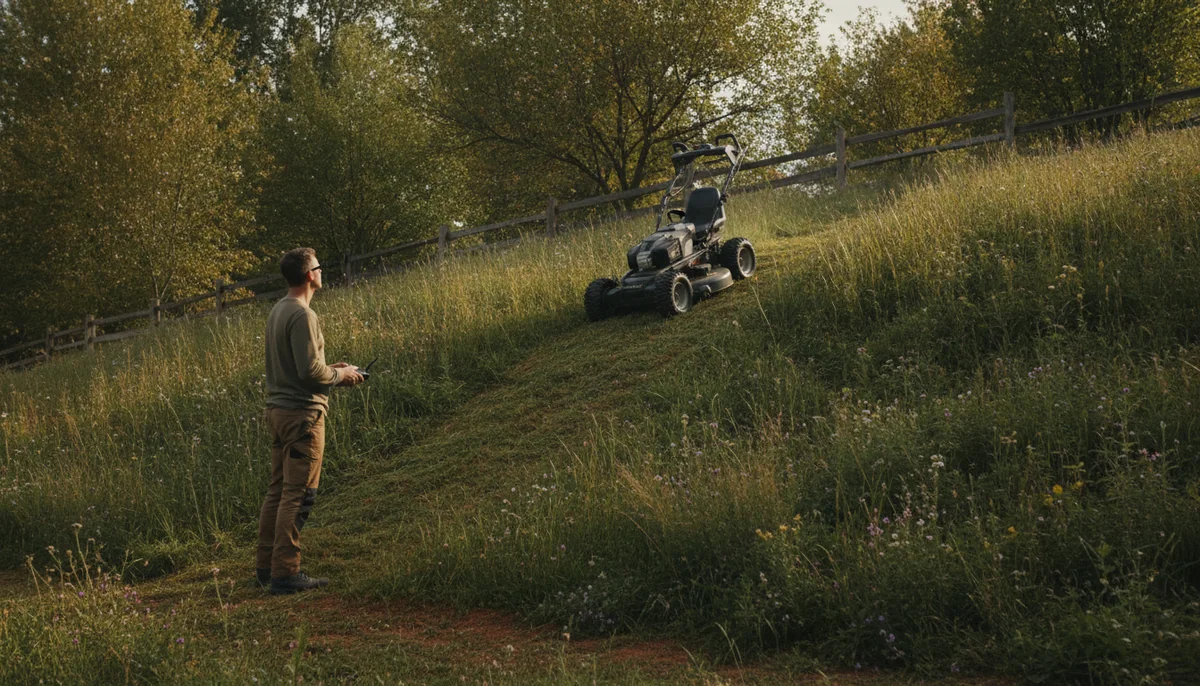
Remote control changes the safest place to stand, not who is doing the mowing. Every machine here needs a person holding the controller, watching the deck and choosing every pass. None maps the yard, follows a schedule, returns to a charger or quietly handles Tuesday’s grass while its owner is elsewhere.
That makes this a different buying decision from choosing an autonomous robot. A remote mower earns its bulk when walking behind a deck is punishing, a rider feels unstable or an overgrown bank defeats the small pivoting blades beneath a maintenance robot. On flat, open grass, it is usually an expensive way to keep doing the whole job yourself.
The Mowrator S1 4WD wins because it is the most coherent lawn mower in this group. Its 21-inch full-size blade, four driven wheels, removable battery and familiar mulching, bagging and rear-discharge options fit maintained grass better than the crawler machines do. It still needs continuous steering, can scour turf during tight turns and may weigh more than one person can recover, but those are defined compromises rather than unanswered questions about fuel systems, replacement parts or basic braking behavior.
The tracked machines have a reason to exist. Tracks can crawl through coarse grass and broken ground while the operator remains off the bank, and the largest flail model can attack vegetation the Mowrator should never be asked to swallow. The trouble begins when marketplace listings call such machinery robotic, promise extreme slope angles without explaining the conditions and leave the buyer to discover whether support extends beyond an email address.
If the goal is autonomous maintenance rather than direct control, stop here and use our guide to the best robotic mowers for steep and uneven lawns. The practical differences in attention, terrain and safety are also laid out in our explanation of remote-control versus autonomous lawn mowers.
Measure the hill, then plan for the machine that stops on it
A slope rating is not a description of the whole yard. A 75% grade is about 37 degrees, while a 100% grade is 45 degrees; neither number says whether the surface is wet, loose, rutted, root-covered or hidden beneath waist-high weeds. It also says nothing about the turn at the top, the ditch at the bottom or the route needed to bring a powerless mower home.
Use an inclinometer or a phone tool to check the steepest sustained section instead of judging it from the driveway. Walk the route before mowing and remove wire, rope, stones, branches, irrigation hardware and anything a full-size blade or flail could throw. Straight climbs and descents generally preserve more traction than aggressive side-hill turns, but the exact machine manual must govern direction because engine lubrication, weight distribution and braking designs differ.
Choose wheels for lawn finish.
The Mowrator’s four-wheel-drive chassis and conventional blade are better suited to maintained grass, provided the operator uses rolling turns rather than spinning in place.
Choose tracks for rough access.
A crawler spreads its weight and can find grip on broken ground, but abrupt steering can rake the surface and leave a carefully kept lawn looking worse after it is shorter.
Choose a flail only for established growth.
A flail earns its complexity in dense weeds and scrub, while ordinary weekly grass rarely justifies its rough finish, projectile risk, access demands and maintenance burden.
Choose autonomy when attention is the real cost.
If the yard can support mapping and frequent light cuts, a model from our robotic mower shortlist returns time that every remote machine here continues to consume.
Recovery equipment belongs in the buying decision
A stalled remote mower may be too heavy to push uphill, too wide to pass through the nearest gate and too awkward to lift without injury. Before the first cut, identify a drivable escape route and decide whether a second person, rated ramps, a winch, a trailer or a tractor will be required. Never enter a rollback path or approach a jammed deck until the engine, drive system, controller and blade are isolated and the chassis is physically secured.
Support matters for the same reason. Ask for the exact engine, controller, battery, charger, starter, belt, blade, track and drive-motor part numbers before ordering a crawler. Get the warranty term, freight responsibility, return address and failed-machine procedure in writing. A prompt email does not solve a mower stranded below the house if the sender cannot identify the component it needs.
The answer for most ordinary yards is still no
A remote mower can reduce exposure to unstable footing, heat, insects, vibration and physical strain, which is a meaningful benefit rather than a novelty. It does not eliminate mowing time. If the lawn is accessible to a conventional mower, or suitable for an autonomous one, the weight and complexity of these machines solve a problem the property does not have.
For the difficult maintained bank that does justify one, Smart Lawn Bots would buy the Mowrator S1 4WD. The Infront is the tracked alternative when taller, rougher grass matters more than speed and finish. The AWY-550 is reserved for mechanically equipped owners willing to accept a sharper reliability risk, while the AWY-1000S belongs on open brushy land rather than a residential lawn.
Six machines, but only one easy recommendation
The Mowrator S1 4WD is the best choice for maintained hills.
Its four driven wheels, 21-inch conventional blade and three clipping modes make it the closest thing here to a proper residential mower that can be driven from safer ground.
It never steers, docks or charges itself, and its heavy skid-steer chassis can tear damp turf or become a serious recovery problem at the bottom of a bank.
The S1 makes sense when the grass still looks like a lawn but the land beneath it has become hostile. Its standard 4WD configuration is rated for a 75% grade, equivalent to about 37 degrees, and the evidence behind its climbing ability is stronger than the bare seller claims attached to the lesser-known crawler machines. It works best traveling straight up and down; wet grass, loose soil and turns across a steep face can still use up its traction.
The full-width metal blade is another decisive advantage. It can take a substantial first cut through tall grass and weeds, then mulch, bag or rear-discharge like a conventional mower. An autonomous machine designed for frequent trimming is easier to overwhelm, while a flail mower leaves a rougher result than most homeowners want.
There is no pretending the S1 gives the weekend back. The operator must preserve line of sight, judge overlap and work around sensor stops throughout the cut. Tight zero-radius turns may spin or scrub the grass, and remote-range or support failures have occurred. The 12Ah battery is advertised for up to 1.5 hours or 0.75 acre in ideal conditions, but slopes, thick growth and repeated passes can reduce both figures. Read the full Mowrator S1 4WD review before deciding whether its weight and continuous supervision fit the property.
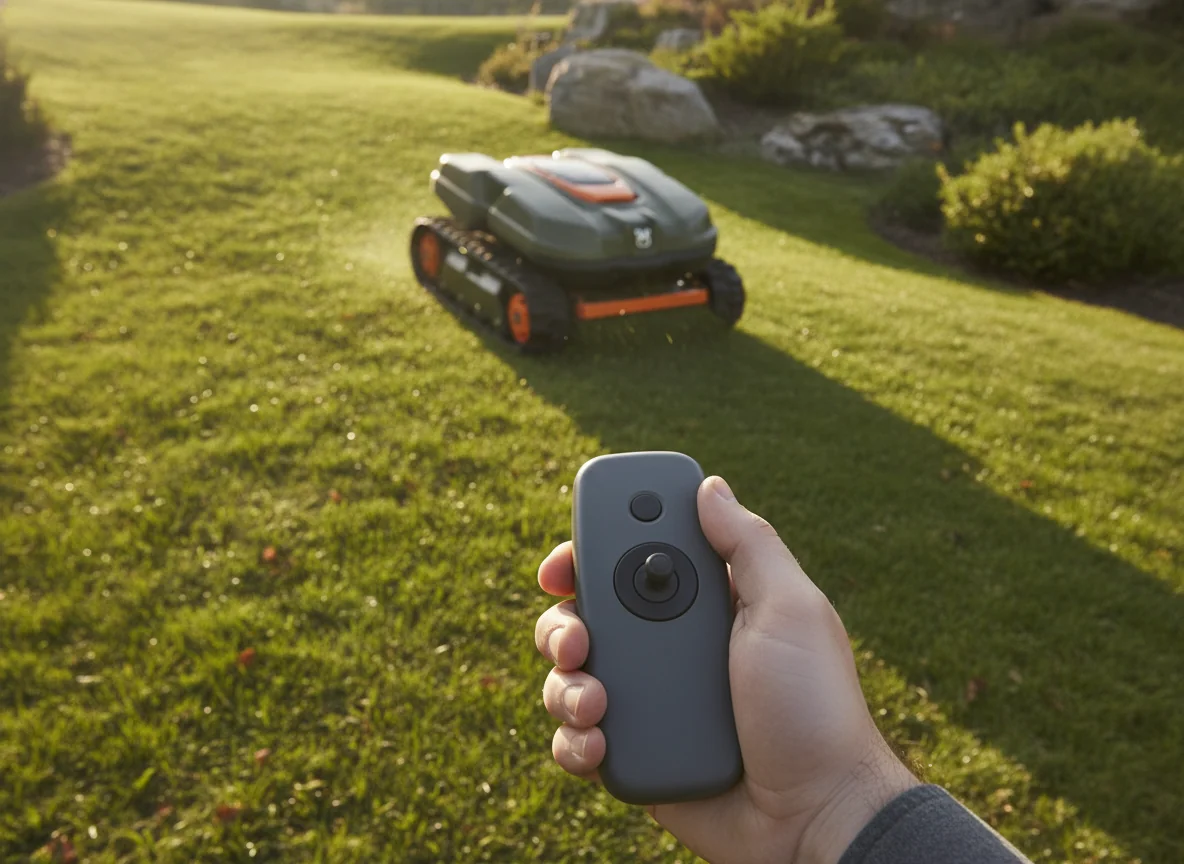
The Infront is the strongest lower-ranked alternative for tall grass and tracked traction.
Its 225cc hybrid powertrain, roughly 20-inch deck and crawler tracks form a convincing package for banks, rough areas and growth that would punish a light maintenance robot.
It is slow, tight turns require practice, and reports of fuel starvation, short refueling intervals, heat and early rust make ownership less settled than the cutting performance.
The Infront belongs on a difficult half acre where standing on the bank is the problem. Owners describe it climbing and traversing steep sections, pushing through grass left untouched for years and finishing acreage faster than a person with a push mower or string trimmer. Remote start and remotely adjustable deck height reduce the number of approaches to a running machine, while the tracked chassis supplies the grip that ordinary wheels lack.
Its pace is closer to a relaxed walk than a ride-on mower. Perspective also matters: steering from a porch can make the previous pass difficult to judge, so the operator may leave strips until a workable sightline and turning pattern become familiar. Pivoting too aggressively can scar the yard, which makes this a better fit for utility grass than a carefully striped lawn.
The machinery appears more convincing than the finish around it. Owners have reported a hot-running engine, deck paint bubbling into rust, missing controller instructions and fuel trouble on very steep ground. The tank may also require a second fill on larger areas. This is a plausible hillside tool for someone comfortable checking fasteners, fuel behavior and corrosion, not a polished appliance to roll from the crate and forget.
The AIWEIYA AWY-550 is capable enough to tempt the wrong buyer.
The tracked AWY-550 can replace exhausting manual trimming on steep acreage, and its remotely adjustable deck is genuinely useful when rough growth changes across the property.
Serious reports of fuel leakage, failed crawlers, water-damaged electronics, dead controllers, batteries and starters make a disabled 300-pound machine the central ownership risk.
The AWY-550 can be transformative on a mountain lot, thistle-covered pasture or front bank where cleats and a string trimmer were previously part of the routine. Its crawler tracks find purchase, its swinging blades handle moderate brush and the operator can stay away from the worst footing. That is real physical relief, especially for someone trying to retain independence on land that can no longer be managed on foot.
It is also the clearest example of why cutting ability cannot settle this ranking. Two otherwise satisfied owners report only about 15 to 20 minutes from the small fuel tank while working on hills. Tight turns can tear ordinary turf, the instructions may not explain even the hidden switch needed to activate the remote, and there is no dependable local repair path established by the available record.
A breakdown here is not a minor interruption. A failed track or controller can leave the machine where it cannot be pushed, lifted or safely dragged by one person. The right owner already has ramps, a winch, a trailer and the skill to identify a carburetor, starter or electrical fault. Everyone else should treat the AWY-550’s low ranking as a warning, not a bargain opportunity. The full AIWEIYA AWY-550 review explains the reliability cases, and our Mowrator S1 versus AWY-550 comparison resolves the choice between them.
The AIWEIYA AWY-550S is a snow-plow bundle without enough evidence behind it.
The included plow makes this crawler interesting for a buyer who wants one remotely driven chassis for steep mowing and light seasonal clearing.
The listing supplies no retained owner accounts to establish how this exact bundle cuts, climbs, plows, stops or holds up after delivery.
The AWY-550S resembles the same basic proposition as the AWY-550: a gasoline cutting engine, electric crawler drive, remote deck adjustment and the ability to rotate in its own footprint. Its distinguishing attraction is the snow-plow attachment. For a property with a bank in summer and a short private route in winter, consolidating those jobs onto one remote chassis sounds efficient.
That promise remains almost entirely a promise. The available record contains a small aggregate rating but no retained written reviews for this exact ASIN, so it does not establish plow installation, actuator quality, snow depth, traction on ice or whether the mower’s support path improves on the closely related model. The AWY-550 record includes delayed, missing and incorrectly supplied plow hardware, which is not proof that this bundle will have the same problem but is ample reason to demand a complete packing list before shipment.
Do not buy this version merely because the attachment appears to make it better value. Get the exact model, shipped weight, plow components, controller instructions, warranty terms and replacement-part numbers in writing. Until owners establish that the package works as delivered, the Mowrator remains the safer lawn choice and a dedicated snow tool remains the cleaner winter decision.
The SYKEND tank-style mower asks buyers to believe a contradictory listing.
Its 9-horsepower engine, 22-inch cutting width and wide crawler tracks describe a useful rough-ground mower for farms, banks and vegetation beyond a conventional lawn.
The slope figures conflict within the seller’s own description, and no owner ratings or retained reviews verify its control, braking, finish, reliability or support.
On paper, the SYKEND sits between the narrower tracked mowers and the large AIWEIYA flail. It offers remote start and stop, two manganese-steel blades, adjustable cutting height and long claimed control range. A 22-inch deck could cover rough grass efficiently without bringing the width and access problems of a one-metre commercial crawler.
The slope story is not credible enough to rank it higher. One bullet claims a 60-degree climbing capability, while the same listing description includes specifications for 30, 45 and 50 degrees across what appear to be several configurations. It also wanders into unrelated mini-excavator and power-tool copy. A mower intended for dangerous ground needs an exact manual and exact limits, not a catalogue assembled from several machines.
There is no customer evidence here to reconcile those claims or reveal what happens when the signal drops, the track slips or the engine is loaded on a descent. Until SYKEND identifies the precise configuration, braking method, fail-safe behavior, operating weight and parts route, this is not a sensible first remote mower. Extreme terrain is the last place to beta-test ambiguous specifications.
The AIWEIYA AWY-1000S is the specialist pick for brush, not lawns.
Its 459cc engine and 39.4-inch flail head give it the strongest case here for knocking down dense weeds, scrub and neglected growth on open rough land.
Its mass, aggressive cutting head and unverified parts, braking, signal-loss and service arrangements turn every breakdown or control fault into a heavy-equipment problem.
The AWY-1000S solves a different job from the winner. Its flails are intended to beat established vegetation into smaller debris, while crawler tracks carry the head over broken ground and electric motors handle propulsion. On an overgrown drainage channel, orchard row or broad neglected bank, that architecture can do work that would choke a maintenance robot and exceed what should be fed into the Mowrator’s conventional blade.
The trade is finish and restraint. A flail mower leaves a rougher surface, carries greater projectile risk and needs a much larger exclusion zone around windows, vehicles, roads, people and animals. Tracks and turning mass can damage good turf. The 39.4-inch head also demands wide gates, suitable unloading equipment and space to approach obstacles without catching the cutting assembly.
Most importantly, climbing is not the same as safe slope operation. The machine must stop, hold, descend and react predictably to a lost signal as well as pull itself uphill. The available material does not establish those behaviors for this exact listing, nor does it establish a North American repair network or complete parts catalogue. Buy it only as specialist vegetation-clearing machinery after the seller provides exact braking, fail-safe, recovery and parts information. For maintained grass, the Mowrator beats it decisively.
Frequently Asked Questions
Are remote-control lawn mowers autonomous robots?
No, the operator must watch and steer every pass because these machines do not map the lawn, follow schedules, dock or recharge themselves.
Which remote mower is best for maintained grass on a steep hill?
The Mowrator S1 4WD is the strongest choice because its four-wheel drive, conventional 21-inch blade and clipping options suit lawn care better than heavy crawler tracks or a flail head.
Can a remote mower safely handle its advertised maximum slope?
A published angle is only an upper claim because moisture, loose soil, hidden holes, vegetation, turning, braking and the recovery route can make a shallower bank unsafe.
Do crawler tracks damage grass?
They can tear, scuff or compress turf during abrupt turns, especially on damp ground or a lawn maintained for a clean striped finish.
When is a remote flail mower the better choice?
A remote flail mower makes sense for open land with dense weeds, scrub or neglected growth that exceeds the intended work of a conventional lawn blade.
Is an AIWEIYA remote mower powered by artificial intelligence?
No, AIWEIYA is the brand name and the covered machines require direct radio control rather than AI mapping, obstacle recognition or autonomous route planning.
What should be prepared before mowing a dangerous bank?
Measure the grade, clear hidden debris, establish an exclusion zone, confirm the manual’s travel directions and arrange a safe recovery method before sending the machine downhill.
Our Top Recommendation
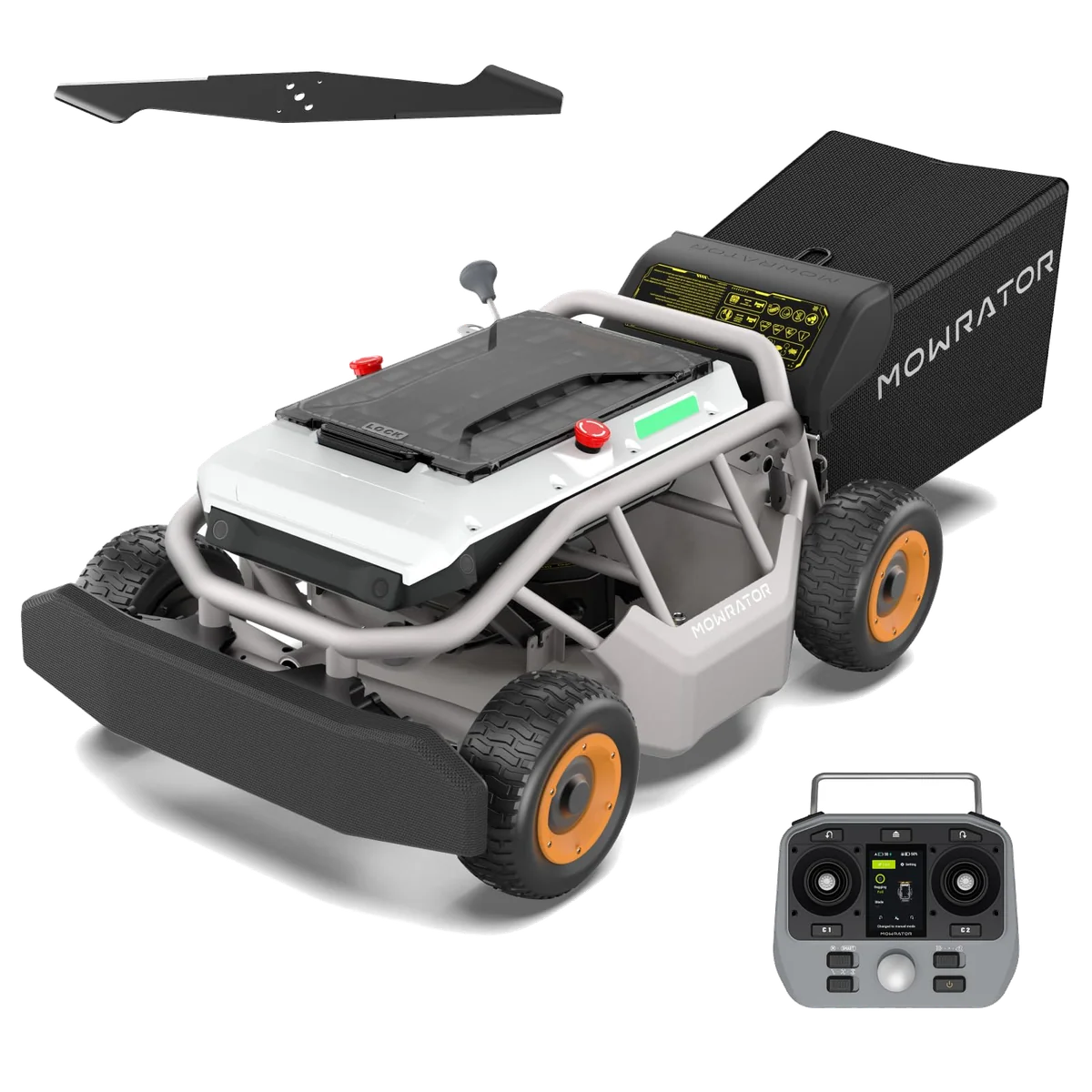
Based on our research, the Mowrator S1 4wd is our top pick — remote control for steep hills.
Sources (14)
- Amazon listings and customer reviews
- Owner reports across r/tech_news_and_gadgets, r/dapsCA, r/Sino and 17 more threads
- Owner and reviewer video, 32 channels
- Freshlycharged — Article — freshlycharged.com
- Mowrator — Article — mowrator.com
- Trustpilot — Article — www.trustpilot.com
- Pcmag — Article — www.pcmag.com
- Pcworld — Article — www.pcworld.com
- Reviews — Article — www.reviews.org
- Wellbots — Article — www.wellbots.com
- Facebook — Article — www.facebook.com
- Myprosandcons — Article — mowrator.myprosandcons.com
- Tomsguide — Article — www.tomsguide.com
- Mowingmagic — Article — mowingmagic.com