A robot mower saves time; a remote mower saves you from the hill.
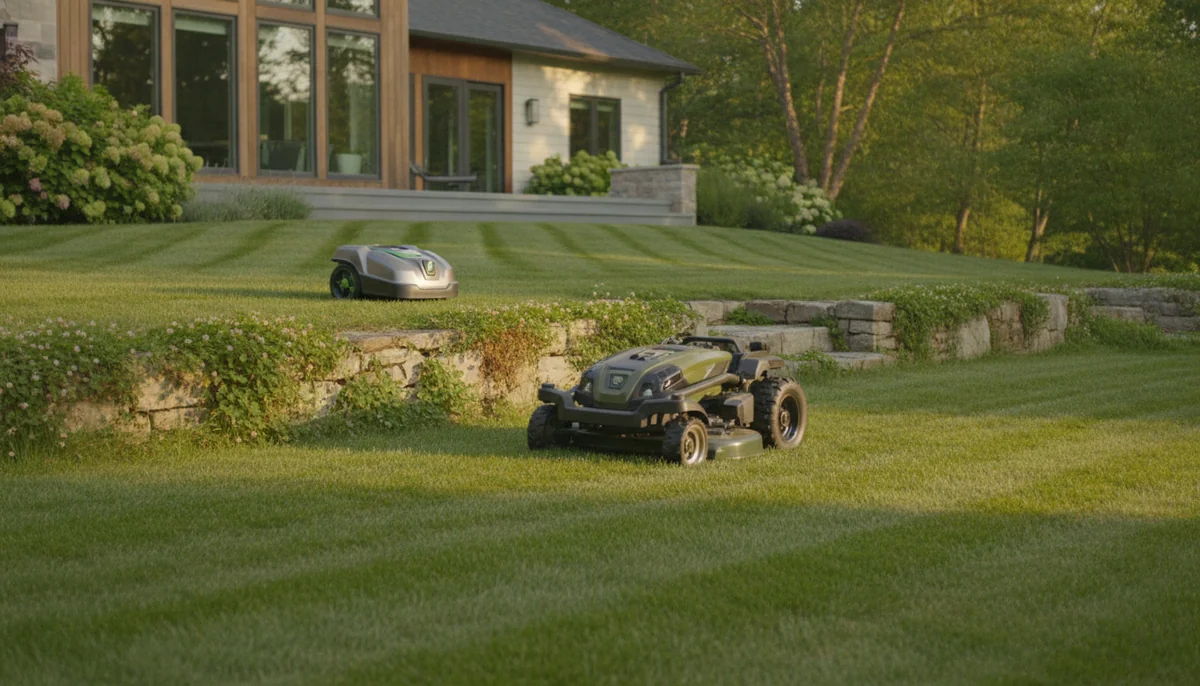
A robotic lawn mower and a remote-control lawn mower may share a low profile, electric drive and an Amazon category, but they solve opposite problems. A robot removes the operator from the schedule. A remote mower removes the operator from the machine while leaving that person responsible for every pass, turn and stop.
That distinction becomes obvious on Saturday morning. The Segway Navimow i110N or eufy E15 can leave its dock, maintain short grass, recharge and continue while the house gets on with something else. The Mowrator S1 and AIWEIYA AWY-550 wait motionless until somebody picks up a controller, then demand a clear view and constant attention until the cutting is finished.
The remote machine is not the lesser technology when the ground is dangerous. Standing safely above a ditch while a full-width deck works below is a meaningful improvement over wrestling a push mower across the face. It is merely the wrong trade on an ordinary lawn, where steering from the porch consumes the same afternoon that an autonomous mower was bought to return.
The machine should match the burden you want removed
| Buying question | Autonomous robot | Remote-control mower |
|---|---|---|
| What does it save? | Recurring mowing time on a compatible, maintained lawn | Walking, pushing, vibration and exposure on difficult ground |
| Who steers? | The navigation system follows a map, visual boundary or planned route | The operator drives every pass with a handheld controller |
| What can it cut? | Small, frequent increments of established grass | Taller, denser growth with a conventional or brush-style cutting system |
| What terrain suits it? | Smooth ground within the chassis, traction and navigation limits | Banks, ditches, rough verges and areas needing judgment in real time |
| What remains manual? | Setup, hazard clearing, edge trimming, cleaning and occasional rescue | Deployment, steering, overlap, refueling or charging, retrieval and cleaning |
| What is the central risk? | Navigation or traction fails while the mower is working without close attention | A heavy, powerful cutting machine reaches trouble despite the operator watching |
Most suburban buyers are trying to stop mowing, not change the control interface. That makes a mapped, self-charging robot the default. The decision turns toward remote control only when the property contains ground that a maintenance robot cannot safely traverse or growth that its small pivoting blades cannot reduce.
Autonomy starts after the lawn has been made compatible
Robot mowers work by removing very little grass very often. They do not generate the lift, blade speed or broad one-pass finish of a conventional deck. Bring the lawn down to the intended height first, clear low hazards, define the places the mower must not enter and allow frequent cycles to catch upright blades from different directions. The reward is not a heroic cut. It is grass that stops looking overdue.
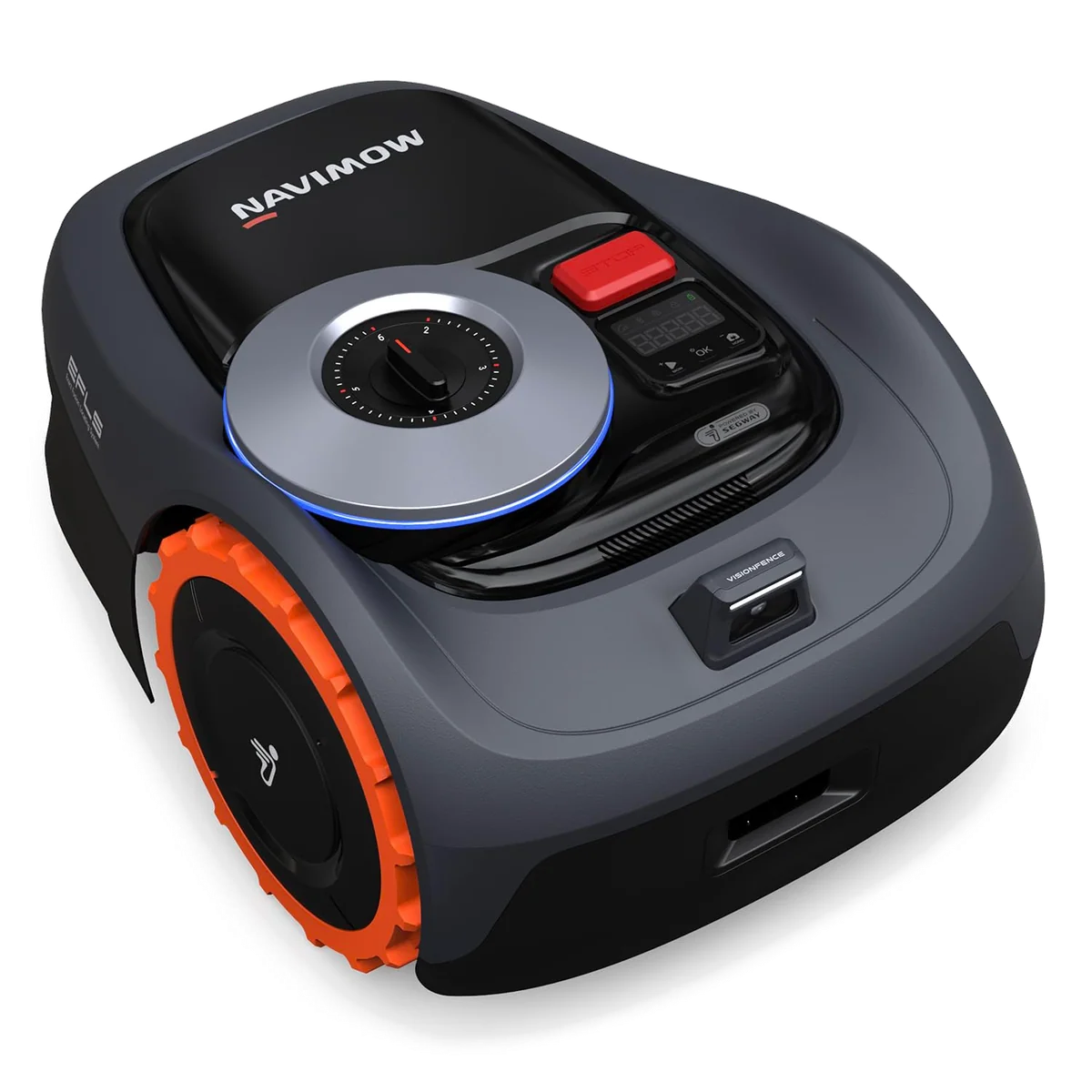
The Segway Navimow i110N is the strongest all-round autonomous choice among the five machines here. Its RTK and camera system supports virtual boundaries, planned rows, multiple zones, automatic charging and quiet maintenance for up to a rated quarter acre. On firm, mostly level turf with useful sky exposure, it can replace hours of recurring pushing with occasional edging and map refinement.
Its drawback is mechanical rather than glamorous. Small wheels, low bodywork and two-wheel drive can become trapped by ruts, thick turf, wet slopes, exposed roots and abrupt transitions. The GNSS antenna also needs a credible view of the sky, and software changes can alter positioning behavior after the lawn seemed settled. The full Navimow i110N review is the next stop for a buyer whose lawn is smooth enough to meet those conditions.
The eufy E15 removes the antenna from the installation. Stereo cameras map and navigate a small lawn without a perimeter wire or RTK reference station, making it attractive beside trees or buildings where satellite positioning would be awkward. Its automatic mapping, understandable app and systematic parallel cutting make the first day unusually approachable.
Camera-only navigation shifts the burden onto the appearance of the lawn. Sparse grass, leaves, flowers, bare ground and an open boundary adjoining identical turf can confuse the map, while daylight limits the working window. Its two-wheel-drive chassis also slips on damp grass and grounds on surprisingly modest undulations. Choose it for a dry, smooth, connected lawn with obvious edges, then read the eufy E15 review before assuming simple setup means broad terrain tolerance.
The LawnMaster OcuMow 200 sits between a cordless mower and a true autonomous robot. It recognizes grass optically and drives itself in random lines, but it has no map, dock, schedule or automatic recharge. Somebody carries it outside, starts it, retrieves it and removes the battery after every session.
That stripped-back arrangement is defensible for a tiny, secure courtyard lawn where an outdoor dock, app or account is unwelcome. It is not set-and-forget lawn care. Random coverage can leave tufts behind, optical containment can fail at ambiguous edges and several inches of perimeter remain for a trimmer. Roads, ponds, neighboring grass and drops demand a physical barrier rather than faith in the camera. The OcuMow 200 review explains why its effortless installation creates a recurring manual routine.
A remote mower moves the danger, not the responsibility
Remote operation changes the safety calculation on a steep bank. The operator can stand on stable ground instead of following a deck across loose soil, breathing dust or balancing above a ditch. Direct control also lets the machine attack tall grass in deliberate passes, reverse into stubborn growth and choose a route that no autonomous planner should attempt.
None of that makes the cutting machine harmless. Remote mowers use larger blades, carry far more mass and can climb with enough force to damage fencing or turf. Ultrasonic sensors, bumpers, tilt shutoffs and emergency stops add useful layers, but the operator still needs an unobstructed view, a clear exclusion area and a recovery plan. Children, pets and bystanders should never share the work zone.
The Mowrator S1 4WD is the remote mower to buy when the problem is genuinely difficult ground. Four driven wheels, a 21-inch metal blade and a credible 37-degree slope rating let it work across banks that can stop smaller robots or make conventional mowing feel reckless. It mulches, bags or rear-discharges, and the operator stays clear of deck vibration, insects and unstable footing.
The honest cost is an entire session at the controller. The S1 does not map, schedule, dock or recharge itself, while skid steering can tear damp turf during tight turns. Its roughly 115-to-135-pound operating mass also turns a dead battery, ditch or inaccessible step into a recovery problem. For a dangerous bank those compromises can be worthwhile; for flat grass they are absurd. The Mowrator S1 4WD review covers the terrain, runtime and handling risks in full.
The AIWEIYA AWY-550 pushes farther toward specialist slope machinery. Its crawler tracks and gasoline-electric powertrain can cut steep pasture, thistle and moderate brush while the operator stands away from the face. Owners describe substantial relief from punishing hillside trimming, and remote deck-height adjustment is genuinely useful when the growth changes across the property.
Smart Lawn Bots does not recommend accepting its ownership risk merely to gain that capability. Reported problems span fuel leakage, an immobile crawler, water-damaged electronics, failed controllers, failed batteries and a starter that proved difficult to source. Its small fuel tank has also produced repeated reports of roughly 15-to-20-minute stints. A failure can strand about 300 pounds at the bottom of the very hill it was bought to tame. The AIWEIYA AWY-550 review is essential reading for the mechanically equipped buyer still considering that gamble.
Safety is a system, not a sensor count
An autonomous mower reduces human exposure to noise, pushing and heat, but it operates without a hand continuously on the controls. Its small pivoting blades, lift shutoff and obstacle recognition reduce risk rather than abolish it. Toys, cables, stones, low branches and pet waste still need clearing, and a virtual boundary beside a road, pond or drop deserves conservative placement and supervised early runs.
A remote mower keeps human judgment in the loop but gives that judgment a much heavier machine to manage. Distance can protect the operator from a rollover or unstable footing, yet it also makes wheel tracks, small obstacles and deck position harder to read. Disabling a nuisance sensor to enter tall growth transfers the collision decision directly to the person holding the remote.
The safest choice is therefore property-specific. A small robot on a smooth enclosed lawn is safer and less demanding than a tracked mower driven for convenience. A remote 4WD mower can be the safer machine on a severe bank because the operator no longer has to stand where a slip or rollover begins. The broader guides to robot mower safety around people, pets and wildlife and remote mowers for steep and rough ground address those two environments separately.
Terrain should make the final decision
Smooth, open lawn
Buy the Navimow i110N if the antenna can see enough sky and the lawn is maintained frequently, because its mapping and automatic charging return more time than remote steering ever could.
Smooth lawn with awkward satellite reception
Buy the eufy E15 when the grass, borders and route between zones are visually clear, but reject it for persistent dampness, rough transitions or closed gates.
Tiny enclosed patch without outdoor power
Consider the OcuMow 200 only if carrying and charging it after every session is preferable to installing a dock, and physically secure every consequential boundary.
Dangerous bank or rough verge
Buy the Mowrator S1 4WD when direct control and a full-width blade justify its weight, continuous supervision and potential turf scuffing.
Extreme tracked-mower assignment
Skip the AIWEIYA AWY-550 unless the terrain benefit outweighs weak documentation, uncertain parts support and the need to recover a disabled 300-pound machine.
Steep lawn that still permits autonomy
Do not assume remote control is the only answer, because an AWD robot such as the Mammotion LUBA 3 AWD 5000H can return the owner’s time when the grass is established and the property can be mapped safely.
The cleanest rule is also the least exciting: buy autonomy unless the ground itself makes autonomy the wrong tool. A remote mower earns its place by keeping a body off dangerous terrain, not by looking like a robot in a product photograph.
Frequently Asked Questions
Is a remote-control lawn mower autonomous?
No, it requires an operator to steer throughout the job and does not normally map, schedule, dock or recharge itself.
Which type is better for a normal suburban lawn?
A self-charging robotic mower is usually better because it removes recurring mowing time instead of replacing walking with continuous remote steering.
Which type handles tall grass and rough growth better?
A remote mower with a conventional or brush-style blade generally handles heavier growth better than a robot designed to shave small amounts frequently.
Is a remote mower safer on steep hills?
It can be safer for the operator by keeping that person on stable ground, although the machine still requires clear sightlines, an exclusion area and a recovery plan.
Can an autonomous robot mower handle steep slopes?
Some AWD robots can manage substantial grades, but traction, surface moisture, cross-slope travel, boundary placement and ground roughness matter more than the headline angle alone.
Do either type eliminate edge trimming?
No, walls, fences, raised beds, curbs and unsafe drops commonly leave a strip that still needs a string trimmer.
Does obstacle detection make unattended mowing completely safe?
No, low or visually ambiguous hazards can escape detection, so the lawn still needs clearing and consequential boundaries need conservative setup.
Sources (62)
- Amazon listings and customer reviews
- Owner reports across r/MowratorOfficial, r/automower, r/rctoys and 20 more threads
- Owner and reviewer video, 64 channels
- Walmart listing
- Toptenreviews — Article — www.toptenreviews.com
- Pcworld — Article — www.pcworld.com
- Homedepot — Article — www.homedepot.com
- Lowes — Article — www.lowes.com
- Robotmowerlab — Article — robotmowerlab.com
- Forbes — Article — www.forbes.com
- Lifehacker — Article — lifehacker.com
- Makeuseof — Article — www.makeuseof.com
- Navimow — Article — navimow.com
- Segway — Article — navimow.segway.com
- Tomsguide — Article — www.tomsguide.com
- Site — Article — segway-navimow.my.site.com
- Consumerreports — Article — www.consumerreports.org
- Propartsdirect — Article — www.propartsdirect.net
- Facebook — Article — www.facebook.com
- Easylawnmowing — Article — easylawnmowing.co.uk
- Trustedreviews — Article — www.trustedreviews.com
- Cleva — Article — us.cleva.com
- Bestutahrealestate — Article — bestutahrealestate.com
- Cleva Uk — Article — www.cleva-uk.com
- Expertreviews — Article — www.expertreviews.co.uk
- Cleva — Article — eu.cleva.com
- Currys — Article — www.currys.co.uk
- Mowerbotlab — Article — mowerbotlab.com
- Gardentool360 — Article — gardentool360.co.uk
- Ukgardenreviews — Article — ukgardenreviews.com
- Gardenersworld — Article — tollbit.gardenersworld.com
- Freshlycharged — Article — freshlycharged.com
- Mowrator — Article — mowrator.com
- Trustpilot — Article — www.trustpilot.com
- Pcmag — Article — www.pcmag.com
- Reviews — Article — www.reviews.org
- Wellbots — Article — www.wellbots.com
- Myprosandcons — Article — mowrator.myprosandcons.com
- Mowingmagic — Article — mowingmagic.com
- Hedgecombers — Article — hedgecombers.com
- Bestrobovacuums — Article — www.bestrobovacuums.com
- Chewy — Article — www.chewy.com
- eufy — Article — www.eufy.com
- Substack — Article — robovacinsights.substack.com
- eufy — Article — service.eufy.com
- Countryliving — Article — www.countryliving.com
- Rtings — Article — www.rtings.com
- Vacuumwars — Article — vacuumwars.com
- Younghouselove — Article — www.younghouselove.com
- Womanandhome — Article — www.womanandhome.com
- Interlightus — Article — www.interlightus.com
- Coredy — Article — www.coredy.com
- Moderncastle — Article — moderncastle.com
- Thecarpentersdaughter — Article — thecarpentersdaughter.co.uk
- Techradar — Article — www.techradar.com
- Lbtechreviews — Article — www.lbtechreviews.com
- Zdnet — Article — www.zdnet.com
- Trustpilot — Article — uk.trustpilot.com
- Amgardaseeblick — Article — amgardaseeblick.com
- Pistonheads — Article — www.pistonheads.com
- Bestbuy — Article — www.bestbuy.com
- Ycombinator — Article — news.ycombinator.com