RTK wins in open sky, LiDAR wins under trees, and cameras win only on tidy lawns
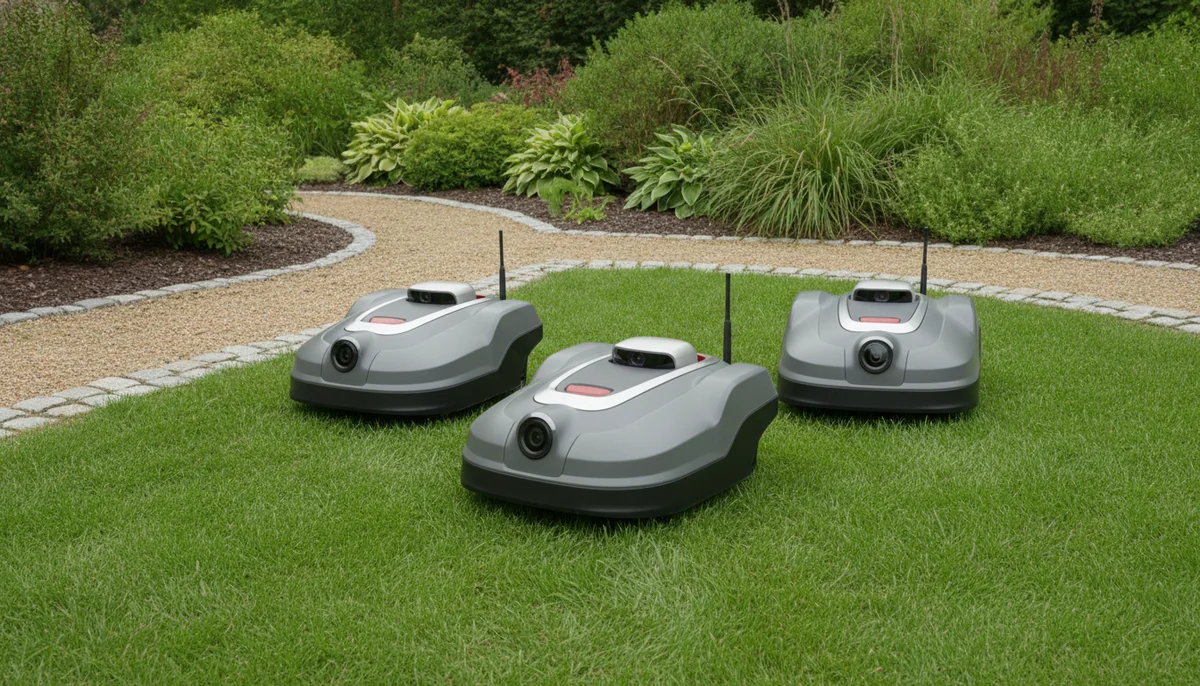
Robot-mower navigation is not a contest to find the most advanced acronym. It is a property-matching problem. RTK can hold beautifully straight lanes across an open lawn, yet struggle when trees, walls, or a roofline obstruct the sky. LiDAR turns those same trees and walls into landmarks, but may have less to read in a broad, featureless field. Camera vision removes both the antenna and rotating laser, although the lawn must remain visible enough for the mower to understand it.
The sales pitch usually stops at mapping. The lawn does not. A mower still has to cross damp turf, turn on a slope, climb a paving lip, avoid a drop, reach every zone, find its charging contacts, and leave enough daylight to complete the schedule. Precise positioning attached to weak traction merely tells the robot exactly where it became stuck.
| System | Best setting | Main drawback | Starting point |
|---|---|---|---|
| RTK plus vision | Open lawns with a stable antenna location and clear satellite reception | Trees, buildings, reflective walls, and antenna placement can undermine the map | ANTHBOT M5 for a small lawn or Navimow X430 for a difficult acre |
| Onboard LiDAR plus vision | Enclosed lawns beneath trees, beside buildings, or under eaves | Software, sparse landmarks, dirty sensors, rain, and rough terrain can still interrupt autonomy | Sunseeker S4 for a quarter acre or LUBA Mini 2 1500H for steep ground |
| Camera-only vision | Smooth, connected turf with short grass, clear edges, and plenty of daylight | Shadows, leaves, sparse grass, vague boundaries, darkness, and surface defects become navigation problems | eufy E15 below 0.2 acre or E18 below 0.3 acre |
For most compact yards with mature trees, Smart Lawn Bots would start with LiDAR. For an open rectangle, RTK remains the more economical and entirely sensible choice. Pure vision earns the narrowest recommendation because its wonderfully easy setup asks the grass itself to stay legible.
Choose the failure you can prevent
Stand at the proposed charging location and look outward. If most of the sky is visible and a powered reference station can remain fixed, RTK has a fair chance. If branches, buildings, eaves, or narrow side passages dominate the view, onboard LiDAR removes an installation variable that software cannot wish away. If the lawn looks like a clean green island surrounded by paving, fencing, or beds, camera-only mapping may be the easiest route of all.
Then walk the ground instead of looking above it. Press a heel into the dampest area, cross the steepest line sideways, inspect every rut beside the sidewalk, and measure each gate. These details decide whether rear-wheel drive is enough, whether AWD is worth paying for, and whether a supposedly multi-zone mower can reach the second lawn without somebody opening a gate or carrying it.
RTK is excellent when the sky cooperates
RTK uses satellite positioning corrected by a local reference station or a network correction service. Its advantage is repeatable position across open ground, which supports virtual boundaries, orderly stripes, efficient routes, and editable zones without burying perimeter wire. Grass color, morning shadow, and a row of fallen leaves do not determine where the mower believes the boundary lies.
The reference is also the weakness. A pole or antenna needs power, stable mounting, and a broad view of the sky. Dense canopy, close buildings, eaves, and reflected signals can reduce accuracy or dictate an absurd dock location. Vision helps an RTK mower recognize objects and bridge brief uncertainty, but the presence of cameras does not automatically make it satellite-independent.
LiDAR prefers the yards that frustrate RTK
LiDAR measures the physical surroundings from the mower. Fences, trunks, walls, beds, and buildings create a local three-dimensional scene, so the robot can navigate beneath tree cover without asking an antenna to see through branches. It can also localize in low light, although camera-assisted object recognition remains more useful in daylight.
This makes LiDAR the strongest default for an enclosed residential yard. It is not universally superior. A vast open lawn may offer fewer stable features, sensor glass must stay clean, and heavy rain or fog can interfere with ranging. More importantly, LiDAR does not supply traction, cliff detection, a wider deck, or competent map editing. Several otherwise persuasive LiDAR mowers are let down by docking errors, caster wheels, restrictive apps, or poor recovery after an obstacle stops them.
Camera vision is simple because the lawn does part of the work
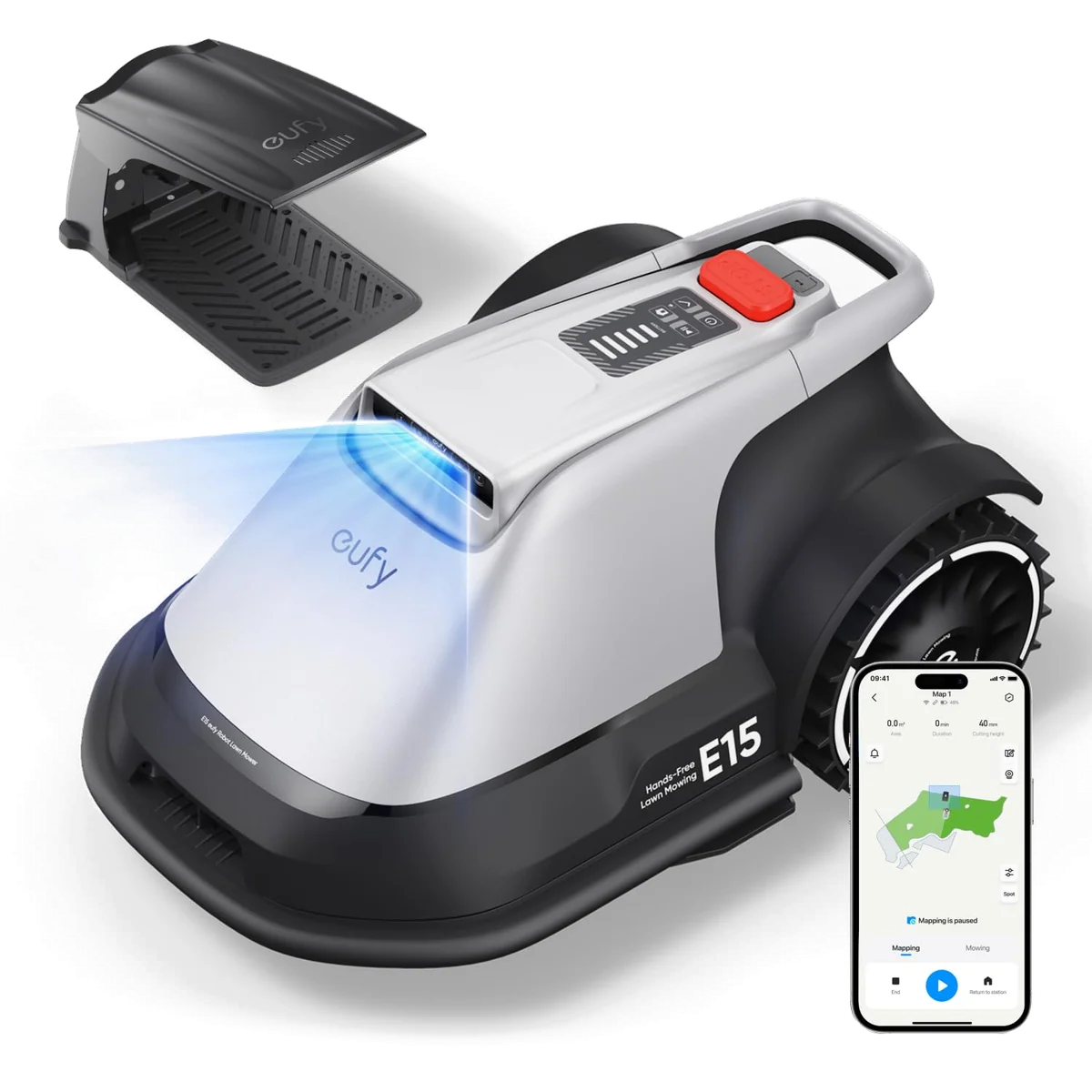
A camera-only mower can remove the perimeter wire and RTK station at once. The eufy E15 and E18 use stereo cameras to identify grass, trace visible boundaries, map automatically, avoid conspicuous objects, and follow systematic lanes. On a neat lawn, setup feels closer to placing a robot vacuum than commissioning outdoor positioning equipment.
The simplicity is conditional. Yellow grass may resemble an exclusion, bare soil may resemble a continuation, flowers can become a boundary, and an unfenced sheet of grass shared with a neighbor contains no visible property line. Low light ends the working day. Damp grass, shallow depressions, and rough transitions also expose the light rear-drive chassis even when the cameras understand the scene perfectly.
That is why the eufy E15 and E18 decision is mostly about mapped area rather than greater physical ability. The E18 accepts more lawn, but it does not gain a wider deck, stronger traction, nighttime navigation, or immunity to ambiguous borders.
Sensor choice cannot rescue the wrong machine
Navigation tells a mower where to go; the chassis determines whether it gets there. The clearest example is a smooth hill versus a shallow rut. A rear-wheel-drive mower may climb the impressive-looking hill in a straight line, then beach its front caster beside a sprinkler on nearly level ground. Cross-slope travel can also make a machine slide at a gentler angle than its advertised straight-climbing maximum.
Deck width and battery behavior matter next. A seven-inch mower can maintain a quarter acre through repeated cutting and charging, but it will spend much more of the day outside than a machine with two wide discs. Acreage ratings describe how much grass the robot can manage across a schedule, not what it completes on one charge; the distinction is explained in our guide to robot mower acreage ratings.
Edges remain stubborn across all three systems. A virtual boundary can be accurate to centimeters while the cutting disc sits several inches inside the body. Flush paving lets a wheel overlap and brings the blades closer, whereas fences, walls, raised beds, curbs, and drops leave a strip for the string trimmer. ECOVACS improves the problem with a separate side trimmer, but even that mechanism cannot reach every inside corner or safely brush every fence post.
The mowers that make each system worth choosing
For a small, open lawn: ANTHBOT M5
The ANTHBOT M5 makes RTK mowing credible without asking a small-yard owner to buy large-property hardware. It maps virtual boundaries, follows systematic lanes, manages zones, changes cutting height in the app, and returns to charge. Its honest limits are equally clear: the antenna needs open sky, the standard M5 is not the separate LiDAR variant, rough hills produce mixed outcomes, and its inset disc leaves a fringe beside vertical borders.
For the easiest setup on orderly turf: eufy E15 or E18
The eufy E15 is the cleaner fit below 0.2 acre, while the E18 raises mapped capacity to 0.3 acre. Both are persuasive where trees make antenna placement awkward but the lawn remains smooth, dry, connected, short, and clearly bounded. Neither suits St. Augustine or dense Zoysia, neither should be expected to work after dark, and both can turn holes, damp grass, or closed gates into owner jobs.
For a shaded quarter acre: Sunseeker S4
The Sunseeker S4 is the clearest small-yard LiDAR recommendation. Trees and nearby buildings give its onboard sensor useful structure rather than blocking an RTK reference, and the mower produces neat systematic lanes without a pole in the yard. Its seven-inch deck is slow, raised borders need trimming, abrupt humps can stop the rear-drive chassis, and there is no native GPS or cellular safety net away from Wi-Fi.
For medium lawns where edging matters: ECOVACS GOAT A2000 LiDAR PRO
The GOAT A2000 LiDAR PRO combines satellite-free navigation with a wider dual-disc deck and a real side-mounted trimmer. On a clearly bounded, reasonably smooth lawn, it can remove more finishing work than a mower whose only edge feature is a route near the perimeter. Its short mowing shifts require frequent charging, its front casters dislike rough grades, and restrictive map correction can make closely separated or fenced zones needlessly difficult.
For steep, broken ground under trees: Mammotion LUBA Mini 2 1500H
The LUBA Mini 2 1500H is what happens when LiDAR navigation receives a chassis worthy of it. Four-wheel drive, suspension, and a short body give it authority over banks, roots, dips, and transitions that stop lighter machines. The price of that capability is slower coverage near its 0.37-acre limit, possible turf scrubbing during tight turns, unfinished raised edges, and an ownership experience in which app behavior and support are less settled than the hardware.
For an open, difficult acre: Segway Navimow X430
The Navimow X430 is the strongest argument for premium RTK-led mowing. Its 17-inch dual-disc deck, four-wheel drive, suspension, steerable front wheels, and four-inch maximum height address the throughput and terrain weaknesses of compact robots. It still needs a viable powered dock and dependable positioning, leaves trimming around hard borders, and carries one serious report of an uncontrolled height drop that scalped grass and scraped paving.
Several ambitious alternatives need more proof
The ANTHBOT Genie600 has the right hybrid idea, pairing full-band RTK with four cameras, but its cut quality, runtime, edge behavior, antenna requirements, parts supply, and real performance beneath trees remain unresolved. The ANTHBOT M9 adds NRTK, automatic mapping, and thirty zones, yet a weak satisfaction signal and missing ownership details make it another early-adopter purchase rather than a dependable recommendation.
The BESTMOW T100 promises 1.5-acre capacity, four cameras, RTK, and a four-inch maximum cut, but its listing conflicts over the slope limit and omits too much about the deck, battery, warranty, weather protection, and service. Yarbo reaches much farther with tracks and a modular multi-season platform, though repeated hardware failures, demanding commissioning, downtime risk, and unresolved remote-access concerns mean it should not be the only mower on a large property.
The HOOKII Neomow X2 SE demonstrates why a good sensor cannot carry an immature platform. Its LiDAR premise suits tree-covered lawns, and some owners obtain excellent large-area results, but missed lanes, failed docking, traction trouble, frequent firmware work, uncertain cellular terms, and a reported wheel-retention failure prevent a general recommendation.
The Navimow i215 is more persuasive for an enclosed lawn up to 0.37 acre, especially when trees rule out RTK and the ground is firm. It loses to the Sunseeker S4 on simplicity, to the LUBA Mini 2 on terrain, and to the X430 on throughput, but it remains a reasonable middle choice for buyers willing to refine zones and test every dock route; the i215 and X430 comparison separates those jobs directly.
Audit the yard before comparing prices
- Measure only mowable grass. House, driveway, beds, woodland, and water do not belong in the acreage calculation.
- Find the worst sky view. Inspect the dock, boundaries, and connecting passages rather than judging satellite visibility from the center of the lawn.
- Walk every transition. A one-inch lip, soft rut, exposed root, or damp side slope can matter more than the advertised maximum grade.
- Trace the route home. Every zone needs a safe, driveable connection to the charger, and a virtual path cannot open a closed gate.
- Classify each edge. Flush paving is robot-friendly, while walls, drops, curbs, fences, and tight corners preserve manual trimming.
- Plan for the sixth week. Confirm blades, batteries, app connectivity, subscriptions, warranty handling, major parts, and somebody able to rescue the mower.
A compatible robot mower does work. It replaces the repeated central-lawn cut with quiet, frequent maintenance and leaves tiny clippings behind as mulch. It does not collect leaves, reclaim serious overgrowth, make toys safe, repair holes, or eliminate every edge. Buyers deciding whether that remaining work is acceptable can continue with our guide to whether robotic mowing is worth the trade.
The final choice is not between three fashionable technologies. It is between three kinds of dependence. RTK depends on the sky, LiDAR depends on a readable physical scene, and camera vision depends on visible turf and boundaries. Pick the dependency your property can satisfy, then buy enough traction, capacity, and support to keep the mower moving after the first impressive map has disappeared from the phone.
Frequently Asked Questions
Is LiDAR better than RTK for a robot lawn mower?
LiDAR is usually better beneath trees and beside buildings, while RTK is often the simpler and more economical choice across open lawns with reliable satellite reception.
Can an RTK mower work under trees?
It may work under partial canopy with help from cameras or inertial navigation, but dense cover and nearby structures can still interrupt the satellite correction on which its map depends.
Does a LiDAR mower need GPS or an antenna?
LiDAR can handle mowing navigation without a local RTK antenna, although some models retain GPS or cellular hardware for tracking, theft alerts, and remote access.
Can a camera-only robot mower work at night?
Camera-only models such as the eufy E15 and E18 require useful daylight and return to the charging station when the scene becomes too dark.
Which navigation system is best for a yard with trees?
Onboard LiDAR with camera assistance is the safest starting point because trunks, fences, and buildings become local landmarks instead of obstructions between the mower and the sky.
Which system is best for a large open lawn?
RTK paired with a wide deck and suitable terrain hardware is generally the strongest fit because open sky favors satellite positioning and large areas reward efficient systematic lanes.
Does better navigation eliminate edge trimming?
No, edge performance depends mainly on blade placement, border geometry, and whether the chassis can overlap paving safely.
Is RTK plus vision always better than either system alone?
No, hybrid sensing adds useful redundancy only when the software combines it well and the chassis, dock, map editor, and support system are equally competent.
Sources (113)
- Amazon listings and customer reviews
- Owner reports across r/RobotVacuums, r/eufyS1Pro, r/eufy and 32 more threads
- Owner and reviewer video, 220 channels
- Walmart listing
- Costco listing
- Facebook — Article — www.facebook.com
- Hedgecombers — Article — hedgecombers.com
- Bestrobovacuums — Article — www.bestrobovacuums.com
- Chewy — Article — www.chewy.com
- eufy — Article — www.eufy.com
- Substack — Article — robovacinsights.substack.com
- eufy — Article — service.eufy.com
- Countryliving — Article — www.countryliving.com
- Rtings — Article — www.rtings.com
- Vacuumwars — Article — vacuumwars.com
- Younghouselove — Article — www.younghouselove.com
- Womanandhome — Article — www.womanandhome.com
- Interlightus — Article — www.interlightus.com
- Coredy — Article — www.coredy.com
- Moderncastle — Article — moderncastle.com
- Thecarpentersdaughter — Article — thecarpentersdaughter.co.uk
- Techradar — Article — www.techradar.com
- Trustedreviews — Article — www.trustedreviews.com
- Lbtechreviews — Article — www.lbtechreviews.com
- Tomsguide — Article — www.tomsguide.com
- Pcmag — Article — www.pcmag.com
- Zdnet — Article — www.zdnet.com
- Trustpilot — Article — uk.trustpilot.com
- Amgardaseeblick — Article — amgardaseeblick.com
- Pistonheads — Article — www.pistonheads.com
- Bestbuy — Article — www.bestbuy.com
- Ycombinator — Article — news.ycombinator.com
- Mammotion — Article — us.mammotion.com
- Trustpilot — Article — www.trustpilot.com
- Pcworld — Article — www.pcworld.com
- Toptenreviews — Article — www.toptenreviews.com
- Trustpilot — Article — au.trustpilot.com
- Mammotion — Article — eu.mammotion.com
- Mammotion — Article — uk.mammotion.com
- Easylawnmowing — Article — www.easylawnmowing.com
- Easylawnmowing — Article — easylawnmowing.co.uk
- Therobotmower — Article — therobotmower.co.uk
- Androidauthority — Article — www.androidauthority.com
- Freshlycharged — Article — freshlycharged.com
- Au — Article — robotlawnmowers.com.au
- Nytimes — Article — www.nytimes.com
- Cnet — Article — www.cnet.com
- Consumerreports — Article — www.consumerreports.org
- Expertreviews — Article — www.expertreviews.co.uk
- Gardenersworld — Article — www.gardenersworld.com
- Smarthomescene — Article — smarthomescene.com
- HOOKII — Article — hookii.com
- Mammotion — Article — ca.mammotion.com
- Tractorsupply — Article — www.tractorsupply.com
- Substack — Article — jjtechish.substack.com
- Basic Tutorials — Article — basic-tutorials.com
- Smarthomeassistent — Article — www.smarthomeassistent.de
- Mein Gartenexperte — Article — www.mein-gartenexperte.de
- Techreviewer — Article — www.techreviewer.de
- Mowingmagic — Article — mowingmagic.com
- Fr — Article — maniaques.fr
- Basic Tutorials — Article — basic-tutorials.de
- Frandroid — Article — www.frandroid.com
- Appgefahren — Article — www.appgefahren.de
- Yarbo — Article — www.yarbo.com
- Lowes — Article — www.lowes.com
- Fredshed — Article — www.fredshed.co.uk
- Tv — Article — www.stuff.tv
- Yarbo — Article — forum.yarbo.com
- Yarboreview — Article — yarboreview.com
- Shopsunseekertech — Article — shopsunseekertech.com
- T3 — Article — www.t3.com
- Warehouserunner — Article — app.warehouserunner.com
- Electricrevolutionreviews — Article — electricrevolutionreviews.com
- Sunseekertech — Article — sunseekertech.com
- Sunseekerelite — Article — sunseekerelite.com
- Bobvila — Article — www.bobvila.com
- Segway — Article — navimow.segway.com
- Navimow — Article — navimow.com
- Au — Article — segway.com.au
- Lifehacker — Article — lifehacker.com
- Theverge — Article — www.theverge.com
- Maison Et Domotique — Article — www.maison-et-domotique.com
- Au — Article — roboticmower.com.au
- Techadvisor — Article — www.techadvisor.com
- Homedepot — Article — www.homedepot.com
- Cnygreenteam — Article — cnygreenteam.com
- Outdoor Usa — Article — outdoor-usa.com
- Protoolreviews — Article — www.protoolreviews.com
- Homebuilding — Article — www.homebuilding.co.uk
- Gizmodo — Article — gizmodo.com
- Suncolawns — Article — shop.suncolawns.com
- Smartyardnw — Article — smartyardnw.com
- the Ambient — Article — www.the-ambient.com
- Outdoorica — Article — outdoorica.com
- Notebookcheck — Article — www.notebookcheck.net
- Smart Dots — Article — www.smart-dots.com
- Trustpilot — Article — ie.trustpilot.com
- Homeandgardenselect — Article — homeandgardenselect.com
- Eu — Article — www.letemsvetemapplem.eu
- Robomowlab — Article — robomowlab.com
- Eftm — Article — eftm.com
- ECOVACS — Article — www.ecovacs.com
- Au — Article — www.harveynorman.com.au
- Thespruce — Article — www.thespruce.com
- Pcmag — Article — uk.pcmag.com
- 9to5google — Article — 9to5google.com
- Mensjournal — Article — www.mensjournal.com
- Lawncraftsupply — Article — lawncraftsupply.com
- Smarthomecompared — Article — smarthomecompared.com
- Smarthomeexplorer — Article — www.smarthomeexplorer.com
- Mowscout — Article — www.mowscout.com
- Hunker — Article — www.hunker.com