The Navimow X430 is the robot mower difficult acres have been waiting for.
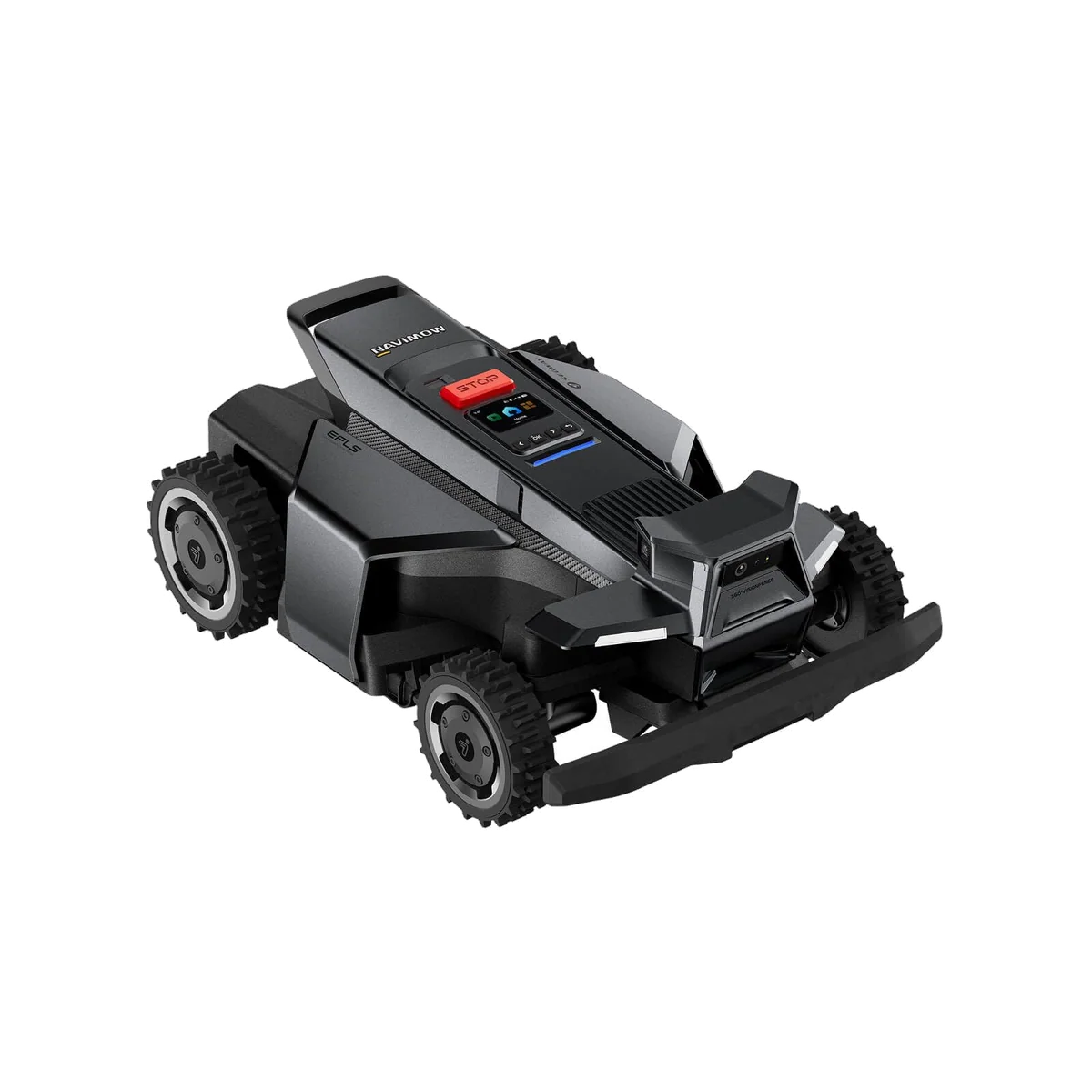
Buy the Navimow X430 for a large, steep or rough lawn that overwhelms smaller robots, but walk away if you need flawless edging, effortless setup or certainty that satellite positioning will suit your property.
A formidable mower with a property audition
Smart Lawn Bots lands on a qualified recommendation. The Navimow X430 has the hardware to make robot mowing credible on ground that used to point straight toward a riding or zero-turn mower. Its wide deck, four-inch maximum cut, traction and unusually gentle steering distinguish it from the small robots that are excellent until a lawn becomes genuinely difficult.
The property still gets a vote. Confirm Network RTK coverage, find a viable powered dock location, protect drops and water, inspect narrow routes, pre-cut tall grass and supervise the first cycles. If those conditions are acceptable, the X430 can return hours of routine mowing without turning the lawn into a perpetual robotics project. If they are not, its impressive chassis will not rescue a bad installation.
Best for: Large yards
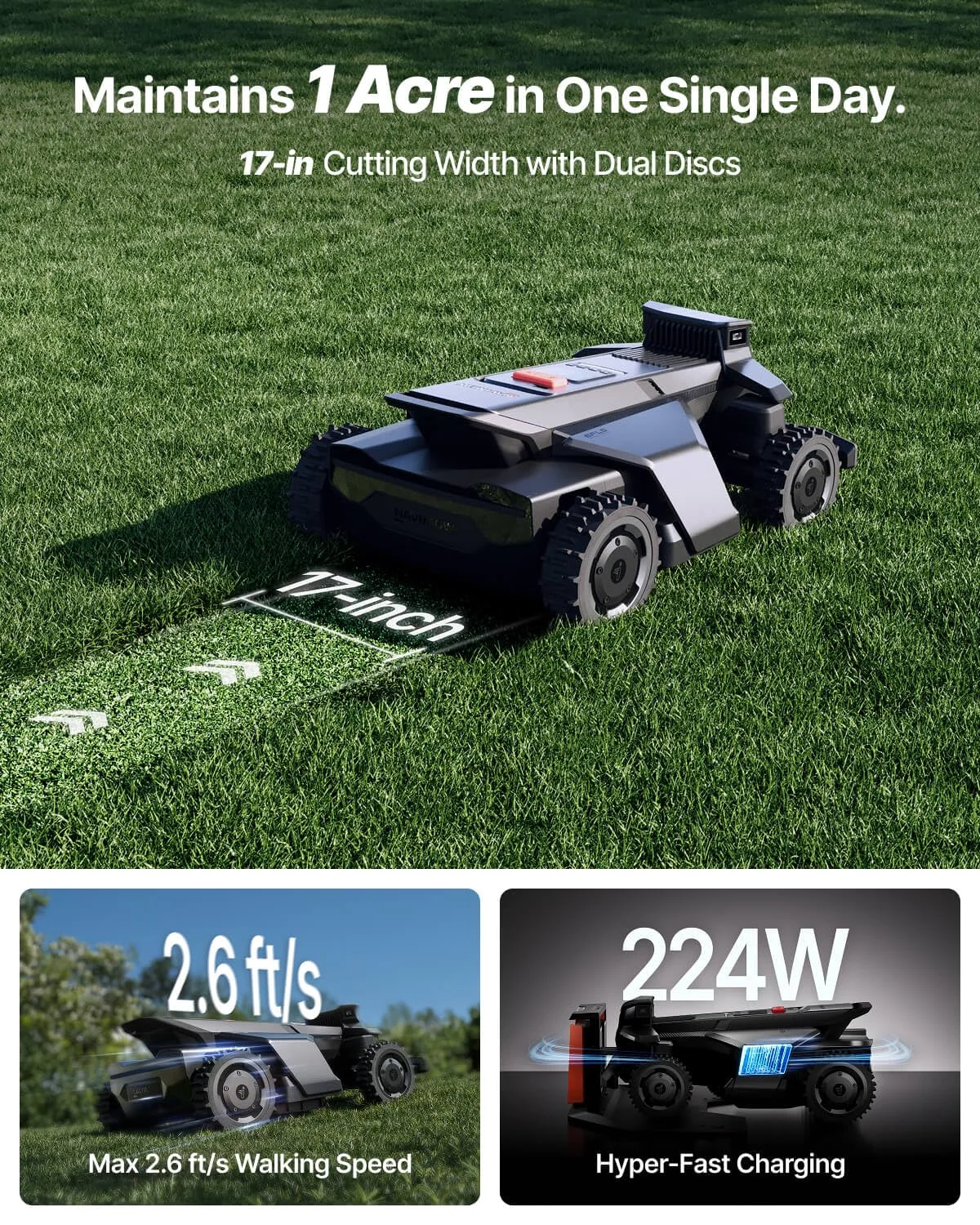
An acre changes the robot-mower problem. A small machine can eventually nibble through a lot of grass, but narrow decks, modest traction and repeated charging leave it living on the lawn. The X430 answers with a 17-inch dual-disc deck, four-wheel drive, suspension, steerable front wheels and a cutting-height range that reaches four inches. This is not a suburban robot stretched until the specification sheet says “large yard.” It is purpose-built hardware for lawns with distance, bumps and serious elevation.
The verdict is a qualified yes. X430 owners describe clean systematic cutting, quiet operation and unusually assured movement over steep, rooted or uneven ground. One remote-property owner scheduled roughly 20 cuts across a sloped quarter-acre yard with trees, sticks and a pond edge without a single rescue. Another chose the X430 specifically because smaller robots could not negotiate the transitions or maintain tall fescue at the preferred height.
The qualification matters just as much. One owner reported that the electronic height adjustment unexpectedly dropped to its minimum, scraped concrete and scalped the lawn. The same machine suffered severe positioning and battery problems. That account looks like a defective unit, a failed installation or both, rather than the normal X430 experience, but a mower capable of cutting bald patches without warning has earned more than a footnote.
Setup also decides whether this machine feels autonomous or absurd. Owners have moved the dock repeatedly to improve positioning, created special vision-disabled areas to make docking work and rebooted after firmware updates to cure chaotic navigation. Once configured correctly, that troubled machine changed overnight from wandering and overheating to cutting straight, orderly lanes. The turnaround is encouraging, although it also proves that “wire-free” and “effort-free” are not synonyms.
Key Specifications
Wire-free does not mean siting-free
The X430 replaces a buried perimeter cable with Network RTK positioning, cameras and virtual maps. Automatic mapping can identify obvious lawn boundaries, while GeoSketch editing, manually driven mapping, no-go areas, channels and separate zones provide control where the automatic result is too cautious. The app can assign schedules, heights and directions by zone, monitor progress and send the mower home.
The dock still needs outdoor power, stable ground and a location the positioning system accepts. A charger tucked close to a building failed for one owner until it was moved only a few feet into clearer sky. Other X430s have worked beneath heavy canopy, so trees alone do not settle compatibility; the shape of surrounding buildings, reflected satellite signals and local Network RTK coverage can matter more than a crude count of branches.
The listing advertises Network RTK service for the life of the X4 Series. That is the core positioning service, not a promise that every cellular, tracking or remote-connectivity feature will remain free. Buyers should separate NRTK, household Wi-Fi, Bluetooth setup and optional mobile data instead of treating “GPS” as one service with one fee.
After the initial firmware update, a complete power cycle is sensible before diagnosing crooked tracking, phantom collisions or docking failure. One owner spent three miserable days changing antenna and map settings before a restart transformed the mower’s behavior. A vision-disabled patch around the dock can also help when obstacle avoidance mistakes the charging approach for something it should refuse.
The cameras reduce rescues, not responsibility
The avoidance system has successfully routed around people, pets, trees, furniture, toys, a tripod and a fallen limb. It is much less convincing with thin, flat hazards. A ratchet strap disappeared beneath the deck rather than registering as an obstacle, and one X430 struggled to interpret a lamp post squeezed beside an electrical box.
Hoses, cords, straps, low wire and small debris should therefore be cleared before a run. The same caution applies to children, pets and wildlife. A library of more than 200 recognized object types is useful automation, not a safety guarantee.
Strengths & Limitations
Strengths
- The 17-inch dual-disc system covers large lawns more credibly than a narrow entry-level cutting deck.
- Four-wheel traction, suspension and steerable wheels make difficult transitions and slopes its natural territory.
- The 0.75-to-4-inch range accommodates both closely cut grass and tall fescue.
- Virtual mapping, zones and systematic routes remove the labor of installing perimeter wire.
- Frequent quiet cutting can keep a remote property maintained between visits.
Limitations
- Dock placement and positioning can demand trial, error and post-update troubleshooting.
- One owner reported an uncontrolled height drop that scalped grass and scraped concrete.
- Repeated dock and channel routes can wear visible tracks despite the turf-friendly steering.
- Raised borders, corners and obstacle clusters still require manual trimming.
- Thin hazards, storm debris and heavy leaves must still be cleared from the lawn.

The hill number is impressive, but the chassis is the real story
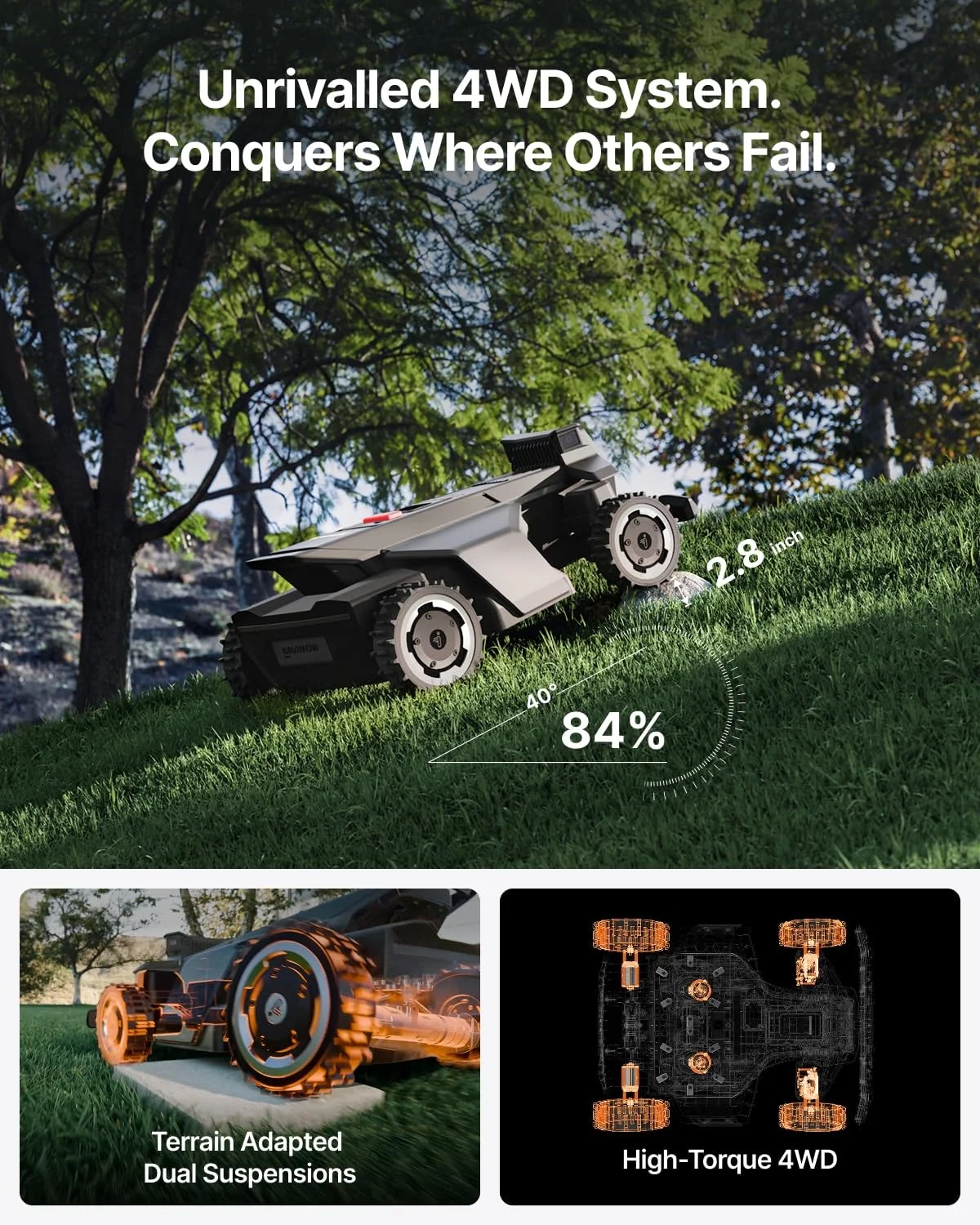
Navimow rates the X430 for an 84% grade, which is approximately 40 degrees. That is a manufacturer maximum, not permission to assume every wet bank, loose side slope or pond edge is mowable. The available evidence supports excellent real-world climbing on difficult residential ground, but it does not include a controlled full-duration cut on an independently measured 40-degree lawn.
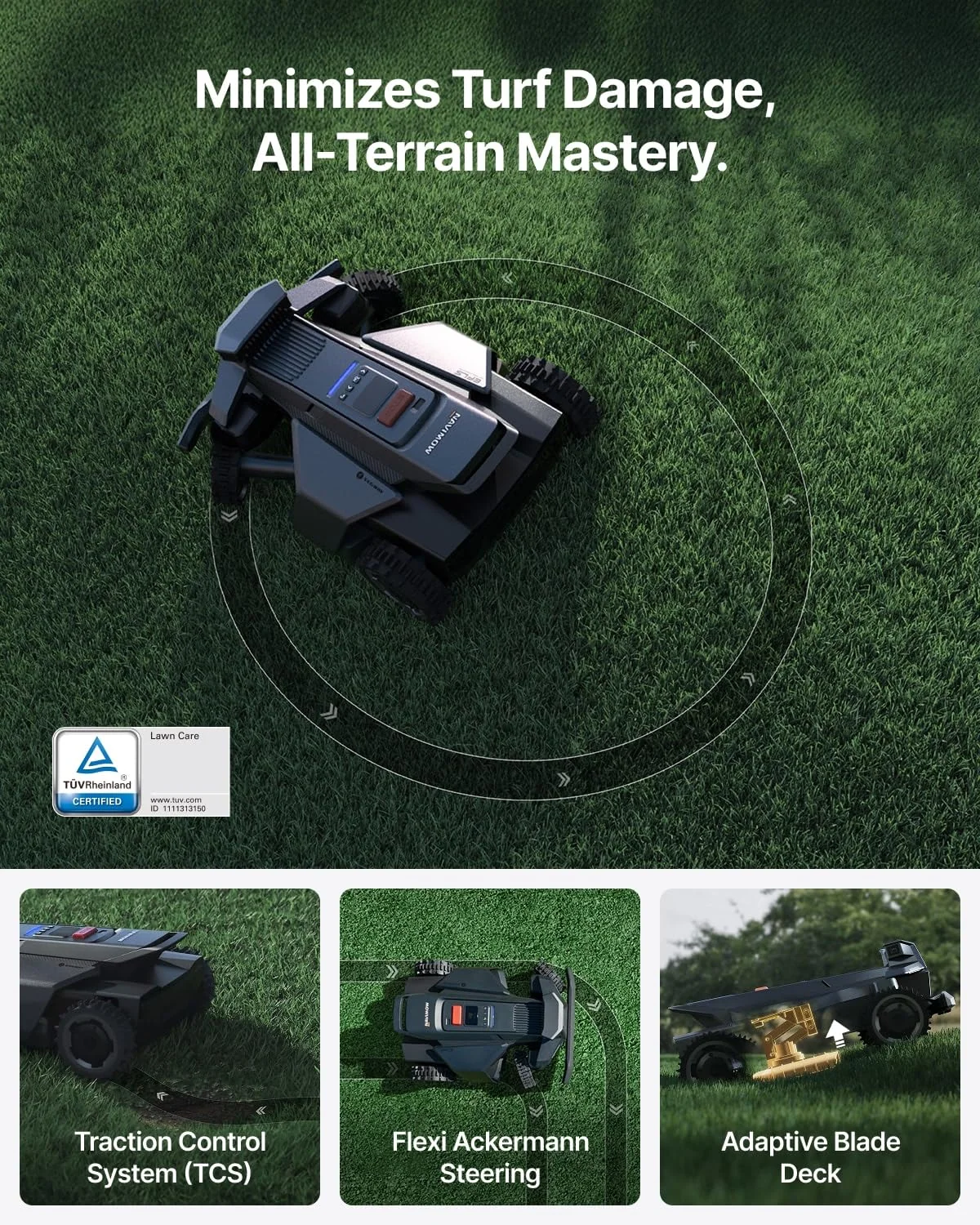
The more persuasive terrain case lies underneath that number. Four-wheel traction helps the mower keep moving, suspension lets its body follow uneven ground and steerable front wheels turn into a maneuver rather than dragging sideways through it. That combination is useful on driveway-to-grass transitions, roots, shallow ruts and slopes where a lighter two-wheel-drive robot spins or bottoms out.
Navimow’s “damage-free” wording goes too far. The steering design reduces the scrub caused by skid turns, but owners have still seen worn approaches to the charger, tracks across completed stripes and tired grass where every trip between zones follows the same narrow channel. Good steering cannot repeal traffic. Dock position and channel routing deserve the same attention as the mowing boundaries.
It cuts like a powerful maintenance mower
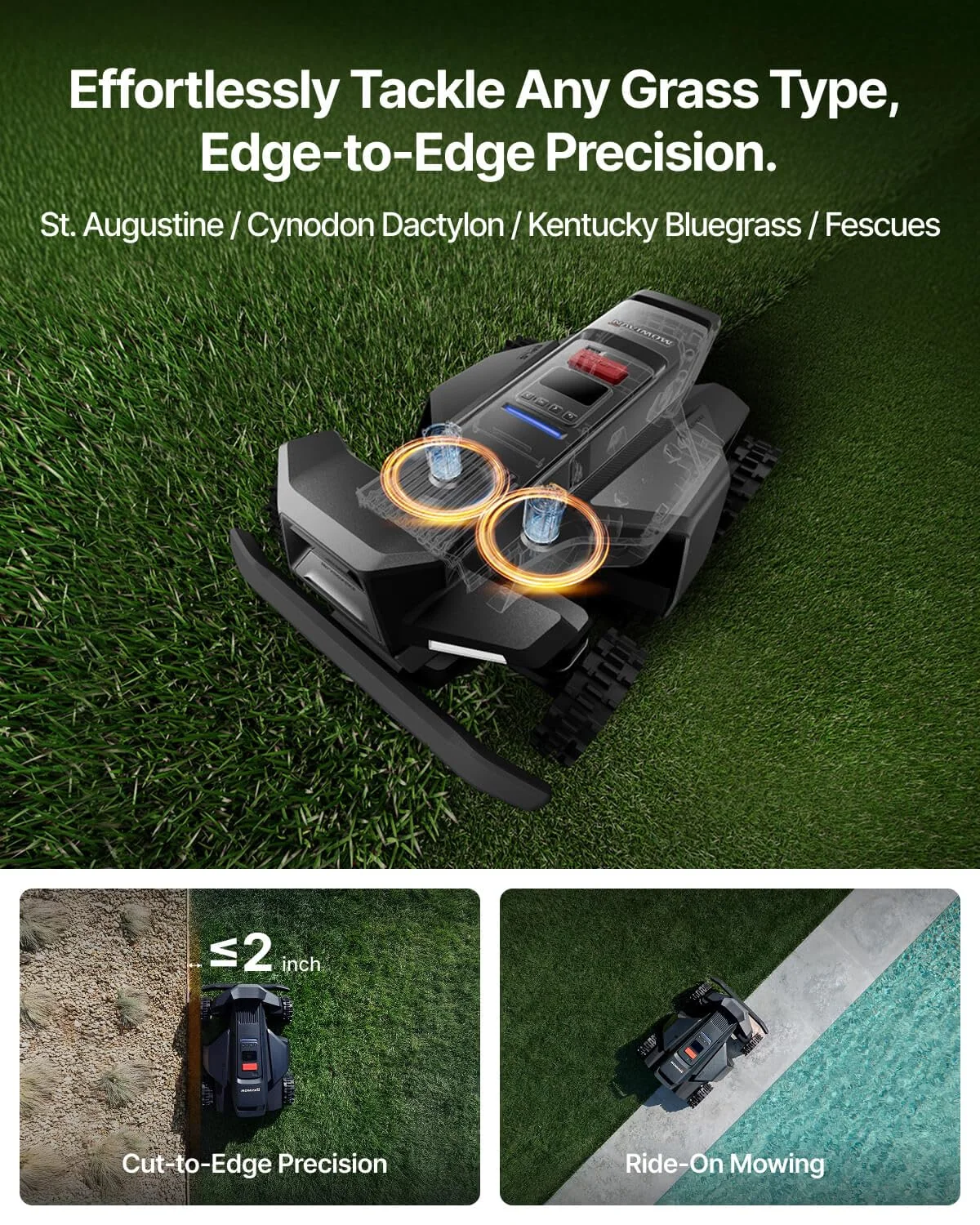
The twin discs carry 12 small folding blades across a 17-inch path, driven by two 180W motors. The resulting finish is consistently described as clean and even, including on mixed and uneven surfaces. The broad deck also makes more sense on a large lawn than the dinner-plate cutting width of an entry-level robot.
Power does not turn the X430 into a brush cutter. Robot blades create almost no suction, so flattened grass can survive one pass until a later change of direction catches it. Tall initial growth should be cut conventionally before mapping, then the robot should remove small amounts frequently. Heavy leaves, pine cones and fallen branches remain cleanup work rather than free mulch.
EdgeSense is claimed to leave less than two inches beside a boundary, which is good robot-mower geometry but not zero-edge cutting. Flush paving may let the wheels straddle the lawn edge; fences, raised beds, inside corners and clustered obstacles still leave work for a string trimmer. Anyone expecting the X430 to replace mowing, edging and blowing as a complete service is buying the wrong machine.
Pay for the difficult lawn, not the flagship badge
The X430 earns its premium when it replaces recurring labor on meaningful acreage, especially where a riding mower feels awkward, heavy or unsafe. Its value is strongest for tall-cut fescue, multiple connected zones, rough transitions and sustained slopes. It also makes sense at a remote property where frequent light cutting prevents the ugly first job after several weeks away.
A small, level lawn wastes most of what makes this machine special. The Navimow i215 LiDAR is the better fit for a smaller property hemmed in by trees or buildings, while the i215 and X430 comparison explains why navigation conditions and terrain matter more than simply choosing the larger number. The X430 wins on deck width, high cutting range, mapped area and extreme-terrain hardware; the i215 wins when a compact LiDAR mower can do the whole job without asking the yard for a reliable satellite view.
At the other end, a property with more than one acre of actual grass should not rely on extra charging cycles to defeat the X430’s managed-area ceiling. The Mammotion LUBA 3 AWD 5000H carries a larger advertised acreage allowance and is the more logical candidate when coverage is the limiting requirement. Buyers considering both can go directly to the X430 and LUBA 3 AWD 5000H comparison.
Measure mowable grass rather than the parcel recorded on a deed, then measure every gate and corridor. The X430’s body is 24 inches wide before comfortable clearance is added. An ordinary closed gate still stops an autonomous mower, and Navimow’s electronic MowGate solves that problem only as a separate piece of property infrastructure.
The sixth-week jobs do not disappear
Ownership settles into a lighter lawn-care routine, not the absence of one. The cameras and underside need cleaning, small razor blades need replacing, storm debris needs collecting and vulnerable travel lanes need watching for wear. Wet grass may be mowable, but it sticks under decks and asks more of traction, so weather resistance should not become a habit of cutting saturated ground.
The X430 is also a large, heavy robot. If it loses power away from the charger or becomes immobilized, carrying it home may be a two-person or wheelbarrow job. That matters at a holiday rental or an elderly relative’s house, where remote monitoring is useful only until the machine needs hands.
Replacement blades, cutting discs, a compatible 12.8Ah battery, antenna hardware, a protective Garage X and the automated MowGate are available within the Navimow ecosystem. None should be mistaken for a trivial ownership cost, and the garage is an accessory rather than an essential part of the mowing system. Reports of support range from prompt, helpful responses to delayed parts and difficult refunds, so a retailer’s opened-product return terms matter more here than they do for an ordinary mower.
Frequently Asked Questions
Can the Navimow X430 mow a full acre on one charge?
The one-acre figure describes the supported mapped lawn area, not a promise of single-charge coverage, and the mower can recharge before resuming an unfinished schedule.
Can the Navimow X430 really handle an 84% slope?
Navimow rates it for an 84% grade, equivalent to about 40 degrees, but wet grass, loose soil, sidehill travel, turns and exposed boundaries can reduce what is sensible on a real property.
Does the Navimow X430 require a boundary wire or RTK antenna?
It uses virtual boundaries and Network RTK without a buried perimeter wire, although the dock still needs power and some properties may require the included physical antenna or signal accessories.
Will the Navimow X430 eliminate string trimming?
No, its edge system can cut close to straightforward boundaries, but walls, raised beds, tight corners and awkward obstacle clusters still leave grass for a trimmer.
Can the Navimow X430 cut tall grass and leaves?
Its powerful dual-disc system is best used for frequent maintenance cuts after an initial conventional mow, while heavy leaves, branches, pine cones and cords should be removed.
Is the Navimow X430 suitable for a remote property?
It can be excellent for scheduled maintenance while the owner is away, provided the yard is mapped safely and somebody can reach the property if debris, connectivity or an immobilization requires physical help.
Sources (24)
- Amazon listings and customer reviews — Navimow X430
- Owner and reviewer video, 36 channels
- Toptenreviews — Article — www.toptenreviews.com
- Expertreviews — Article — www.expertreviews.co.uk
- Segway — Article — navimow.segway.com
- Trustedreviews — Article — www.trustedreviews.com
- Navimow — Article — navimow.com
- Trustpilot — Article — www.trustpilot.com
- Pcworld — Article — www.pcworld.com
- Lowes — Article — www.lowes.com
- Notebookcheck — Article — www.notebookcheck.net
- Mowingmagic — Article — mowingmagic.com
- Smart Dots — Article — www.smart-dots.com
- Cnygreenteam — Article — cnygreenteam.com
- Nytimes — Article — www.nytimes.com
- Trustpilot — Article — ie.trustpilot.com
- Homeandgardenselect — Article — homeandgardenselect.com
- Cnet — Article — www.cnet.com
- Yarbo — Article — www.yarbo.com
- Facebook — Article — www.facebook.com
- Mammotion — Article — us.mammotion.com
- Consumerreports — Article — www.consumerreports.org
- Easylawnmowing — Article — easylawnmowing.co.uk
- Eu — Article — www.letemsvetemapplem.eu