The RoboUP Raccoon 2 SE is the budget robot mower to buy, if your lawn already has a fence.
Cheap robot mowers divide into two uncomfortable groups. Traditional models make the owner install perimeter wire, while inexpensive camera models avoid the cable by asking the lawn itself to provide unmistakable borders. Neither approach is automatically bad. The mistake is buying the mower with the more exciting feature list instead of the one whose limitations match the yard.
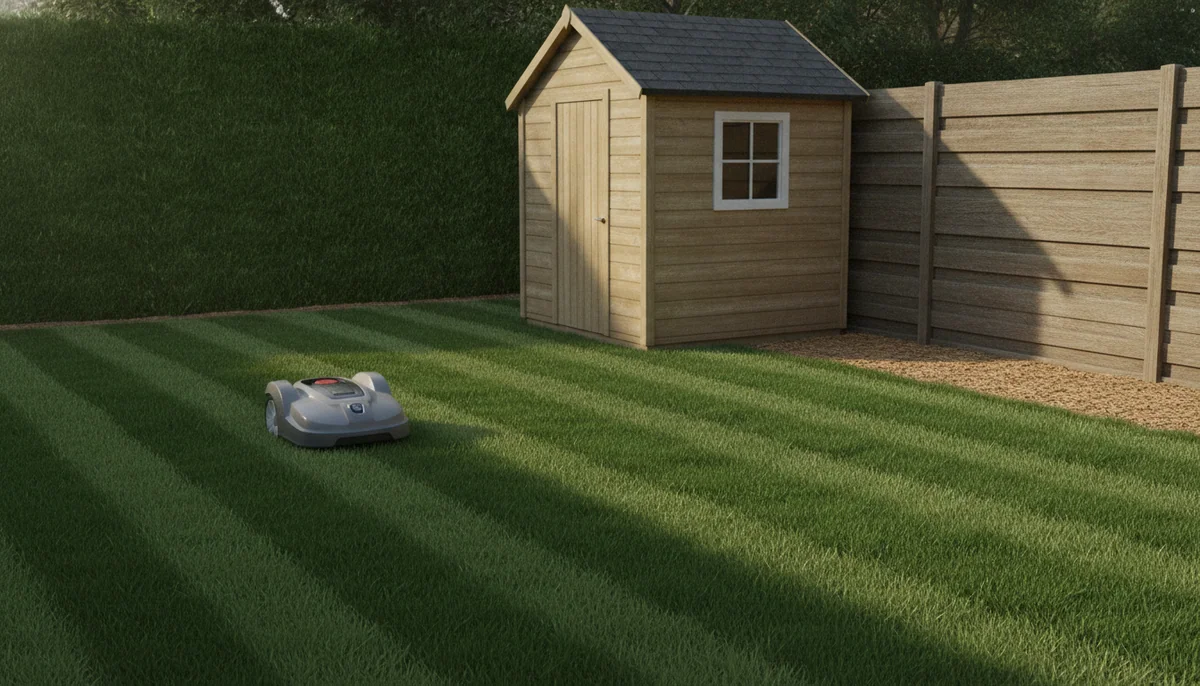
The RoboUP Raccoon 2 SE makes the most convincing compromise here. It needs no powered boundary loop or satellite antenna, returns to its own dock, can run scheduled maintenance and cuts already-short grass competently. Its onboard controls also make basic operation possible without a phone. That is a useful amount of autonomy for a compact fenced garden.
Its weakness is not a footnote. Normal mowing is random, open grass boundaries are unreliable, small hazards can reach the blade disc and raised edges leave roughly four inches for a string trimmer. On a lawn that fades into mulch, soil or the property next door, the Raccoon’s apparent simplicity becomes a supervision job.
The remaining field is difficult to recommend. Both YARDCARE E400 listings carry poor customer scores and repeated complaints about short runs, faults and patchy coverage. The M800Plus has the most ambitious specification sheet and the worst direct customer signal. The newer YARDCARE vision model has an encouraging rating but too little dependable product detail, while the V100 is a quiet small-lawn helper that still needs manual battery handling and border trimming.
This is why “budget” cannot mean the lowest checkout total. A mower that circles for ten minutes, misses the same patch and returns to its dock has not made lawn care cheaper. It has converted money into troubleshooting.
At a Glance: All budget robotic lawn mowers Compared
| Feature | Editor's Pick RoboUP Raccoon 2 SE | 2026 New Robot Lawn Mower | 2026 New Robot Lawn Mower | YARDCARE 2026 New M800Plus Robot | YARDCARE AI Vision Robotic Lawn | YARDCARE V100 |
|---|---|---|---|---|---|---|
| Price Range | Under $200 | Under $200 | Under $200 | Under $200 | $200–$500 | $200–$500 |
| Check Price on Amazon | Check Price on Amazon | Check Price on Amazon | Check Price on Amazon | Check Price on Amazon | Check Price on Amazon |
Six inexpensive mowers, one defensible winner
The ranking favors a mower that can maintain its stated kind of lawn without turning every run into an intervention. An attractive listing score helps, but only when the mower’s navigation, charging routine, boundaries and ownership chores are clear enough to understand what that score represents.
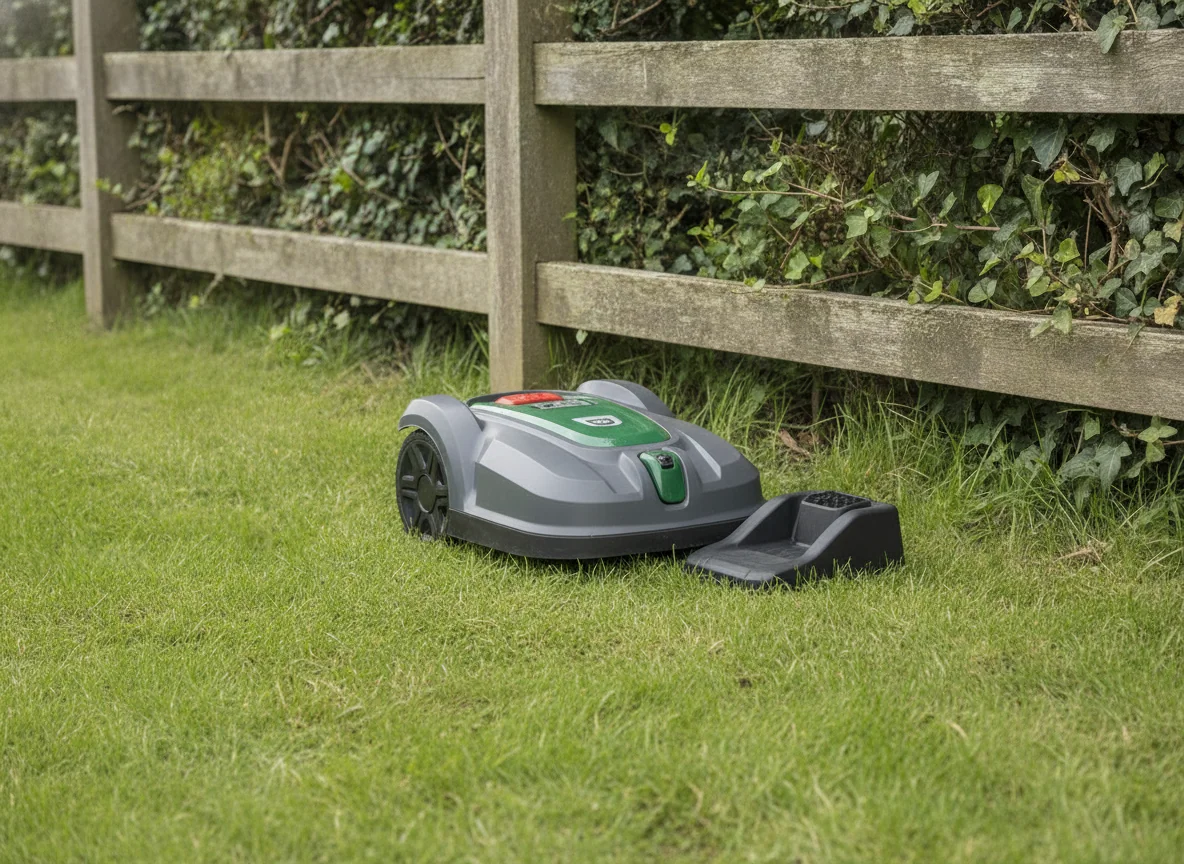
1. RoboUP Raccoon 2 SE — The RoboUP Raccoon 2 SE is the best choice for one small, enclosed lawn.
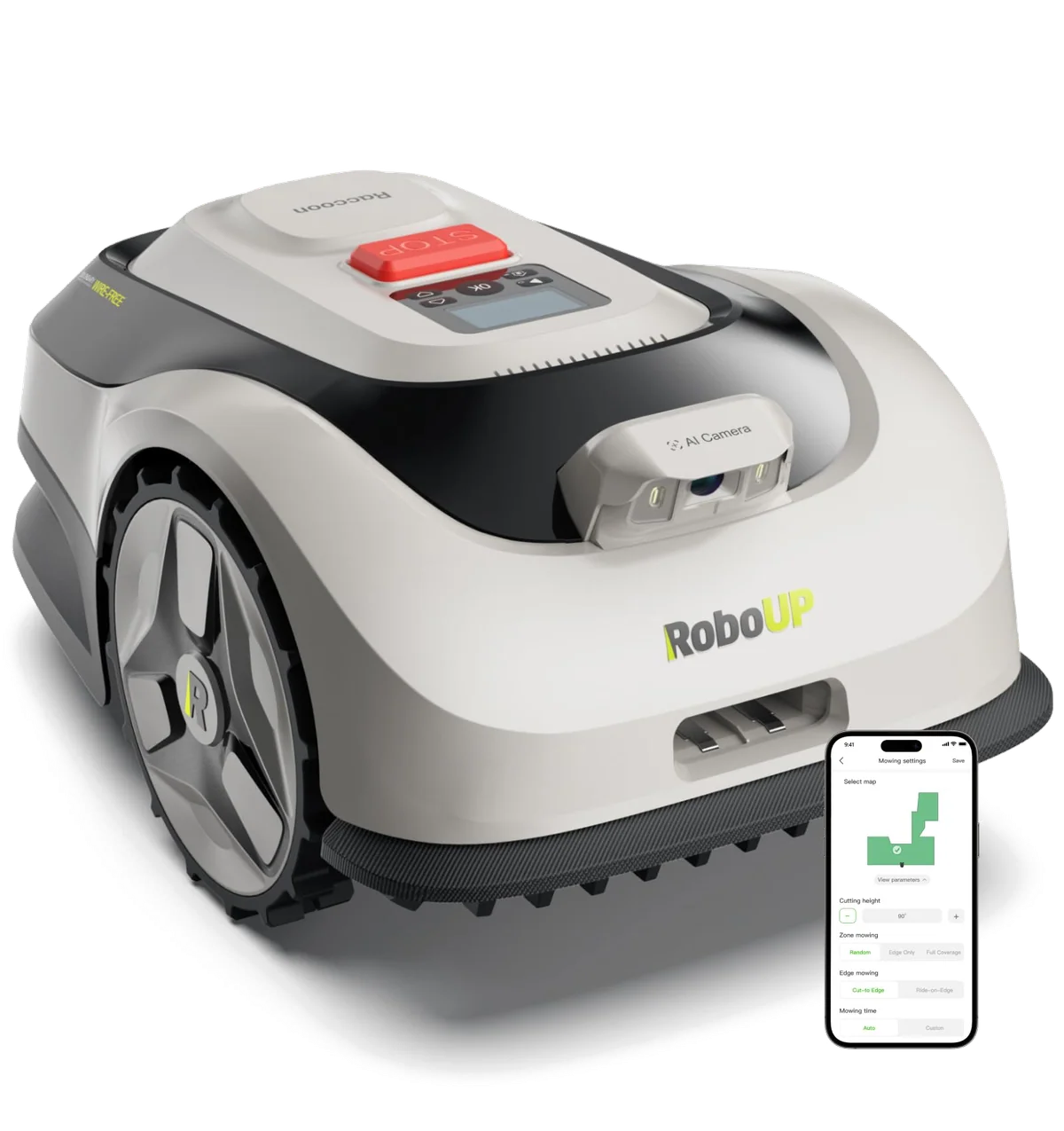
Its wire-free visual navigation, self-charging dock, quiet operation and optional app provide the strongest workable package in this field.
Random coverage is slow, and the saved map cannot reliably contain the mower where reachable grass continues beyond an open boundary.
The Raccoon earns first place because its useful claims survive contact with an ordinary garden. The three-blade disc cuts maintained grass across a 1.18-to-3.15-inch height range, battery endurance is ample for its intended small-lawn role and the machine returns to its charging station rather than handing the charging chore back to its owner. Five physical controls cover basic operation, while the app adds schedules, zones, remote steering, edge behavior and electric height adjustment.
Put it on a fenced urban lawn with paving along the remaining edges and the arrangement makes sense. There is no wire to peg down, no RTK antenna demanding a clear sky and no need to engineer a sophisticated map before the first cut. It is also quiet enough to recede into the background rather than sounding like a small appliance fighting for its life outside the kitchen window.
The route is the price of that simplicity. Whole-lawn mowing consists of random crossings, so comprehensive coverage can take hours and no single outing guarantees that every patch was reached. The camera also needs a visible change between grass and non-grass. A fence, wall or path is legible; an imaginary property line is not.
Small objects remain another reason to clear the lawn before starting. Larger trees, frames and balls are easier for the camera to avoid, but a tennis ball was overrun and a garden hose was detected inconsistently. Raised borders leave about four inches of grass because the cutting disc sits well inside the body. The Raccoon reduces mowing, but it does not dismiss the string trimmer.
The simpler LawnMaster OcuMow approach loses to the Raccoon when automatic charging, scheduling and adjustable settings matter. A mapped model such as the Segway Navimow i110N beats it when the yard needs deliberate lanes and virtual boundaries that behave like boundaries.
Strengths
- No perimeter wire or RTK antenna is required.
- Simple onboard controls make the app optional on a straightforward lawn.
- The quiet cutting system reliably maintains grass it actually reaches.
- Battery endurance is stronger than the normal route efficiency.
Limitations
- Normal whole-lawn coverage is random and cannot guarantee a complete pass.
- Open grass boundaries can let the mower leave its saved area.
- Tennis balls, hoses, and wildlife-sized objects are not detected consistently.
- Raised edges can leave roughly four inches for the string trimmer.
- Long-term parts, battery, warranty, and service support remain unclear.
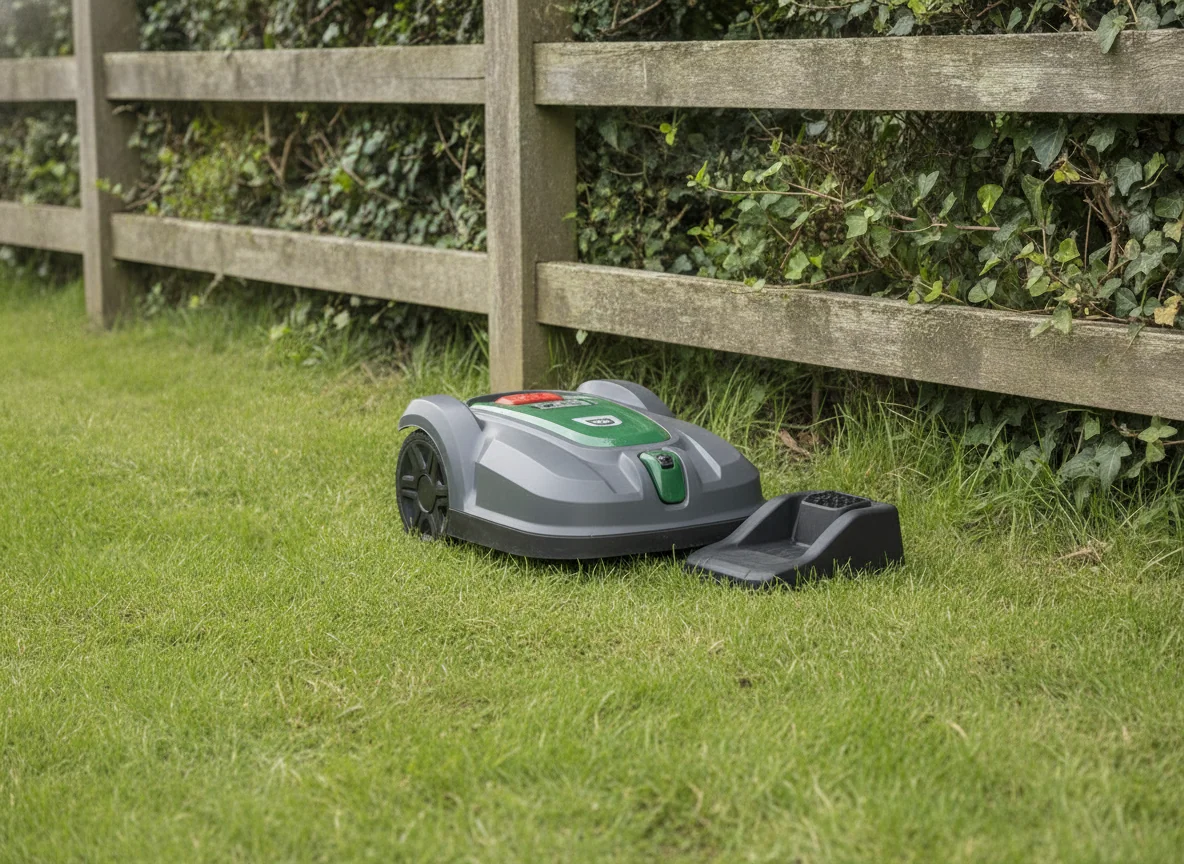
2. 2026 New Robot Lawn Mower — The gray YARDCARE E400 is the least-bad wired fallback.
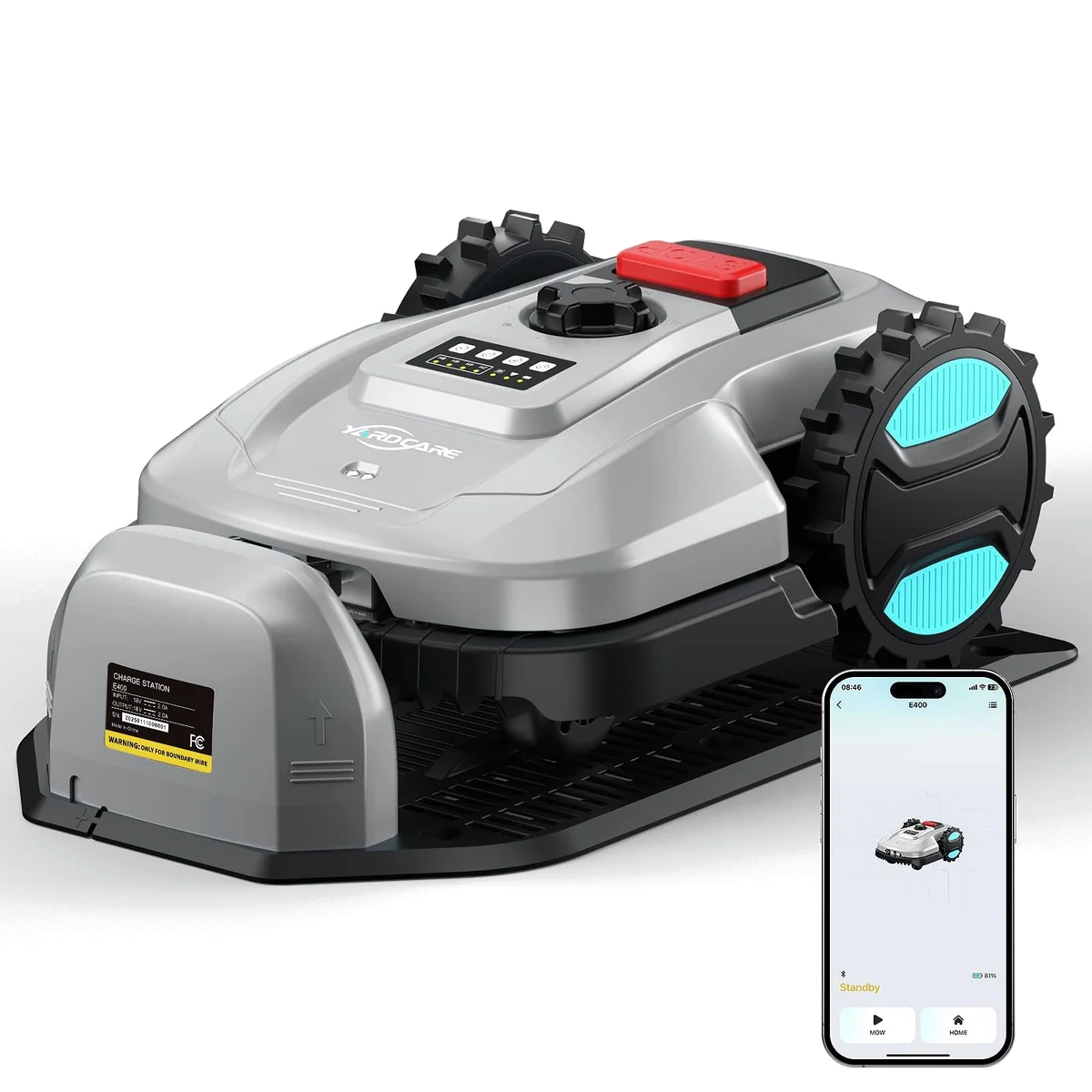
It combines a conventional perimeter loop with automatic charging, rain sensing, app controls and a simple three-blade cutting system for a small lawn.
Its 2.5-star customer score reflects repeated reports of ten-to-twenty-minute runs, charging failures, frequent errors and incomplete coverage.
The E400 makes one sensible engineering choice: a powered boundary wire is unglamorous, but it gives a small mower a physical signal to follow. Clear camera-visible borders are not required, and an owner willing to peg cable around a simple lawn can define the working area more explicitly than with the Raccoon’s visual containment.
The rest of the ownership record breaks the value case. Some owners describe clean cutting and welcome simplicity, particularly when the mower runs every day or every other day. Others report that it leaves the dock only after manual intervention, operates for about ten or twenty minutes, misses recurring areas or never charges at all. The 2.5-star average from 23 ratings is too poor to treat those complaints as harmless setup noise.
Installation also deserves more respect than the listing gives it. Closing the boundary circuit took one owner more than a day, documentation was described as thin and replacement wire reportedly failed to register for another buyer. The E400 can be considered only when the lawn is tiny, the return route is strong and the buyer is comfortable diagnosing a wired installation. Even then, it is a gamble rather than the safe economy option.
3. 2026 New Robot Lawn Mower — The dark-gray YARDCARE E400 is the same idea with an even shakier record.
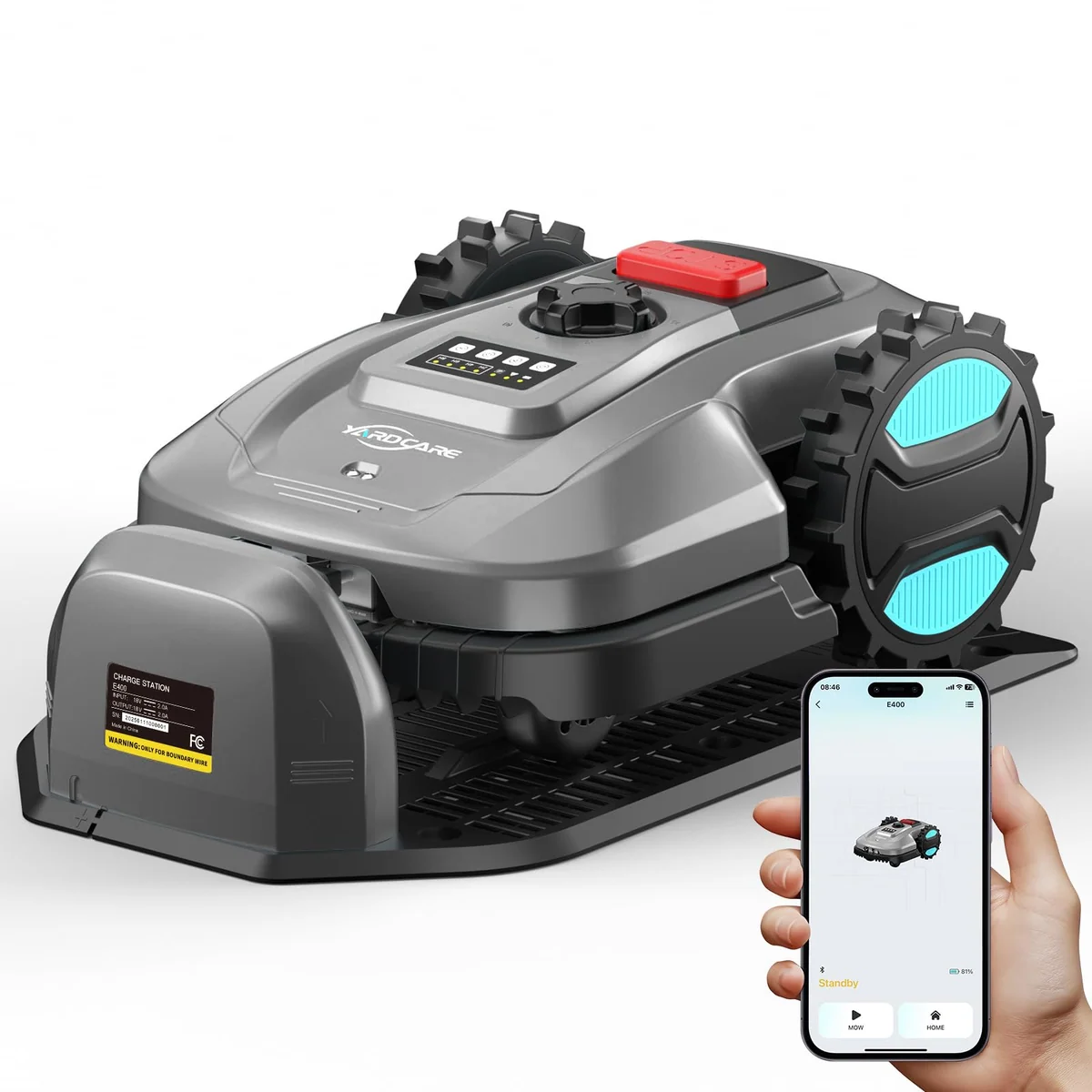
Its perimeter wire and automatic dock can suit a plain rectangular lawn when the mower completes enough random passes to reach every section.
Owners describe circles, recurring faults, patchy grass, limited app controls and Wi-Fi setup that can reject longer passwords.
The dark-gray E400 repeats the gray model’s specification: up to one-eighth acre, a 0.8-to-2.4-inch cutting range, bump detection, app control, a rain sensor and automatic charging. It also repeats the 2.5-star average, this time from 16 ratings.
A few favorable reports show what the mower can do in its easiest room. On a simple lawn with the wire correctly laid, random passes can eventually cover the grass and the basic cut can be satisfactory. The edge still needs separate attention, and “eventually” is doing important work because the mower does not map or follow systematic lanes.
The failures are too fundamental for a recommendation. Reports include a fault after every turn, a mower that merely circles, ten-to-fifteen-minute sessions followed by slow charging and an app that offered less scheduling control than the listing promised. A dark shell does not create a meaningful reason to choose this version over the already-risky gray model.
4. YARDCARE 2026 New M800Plus Robot — The YARDCARE M800Plus is a modern concept attached to an unacceptable confidence gap.
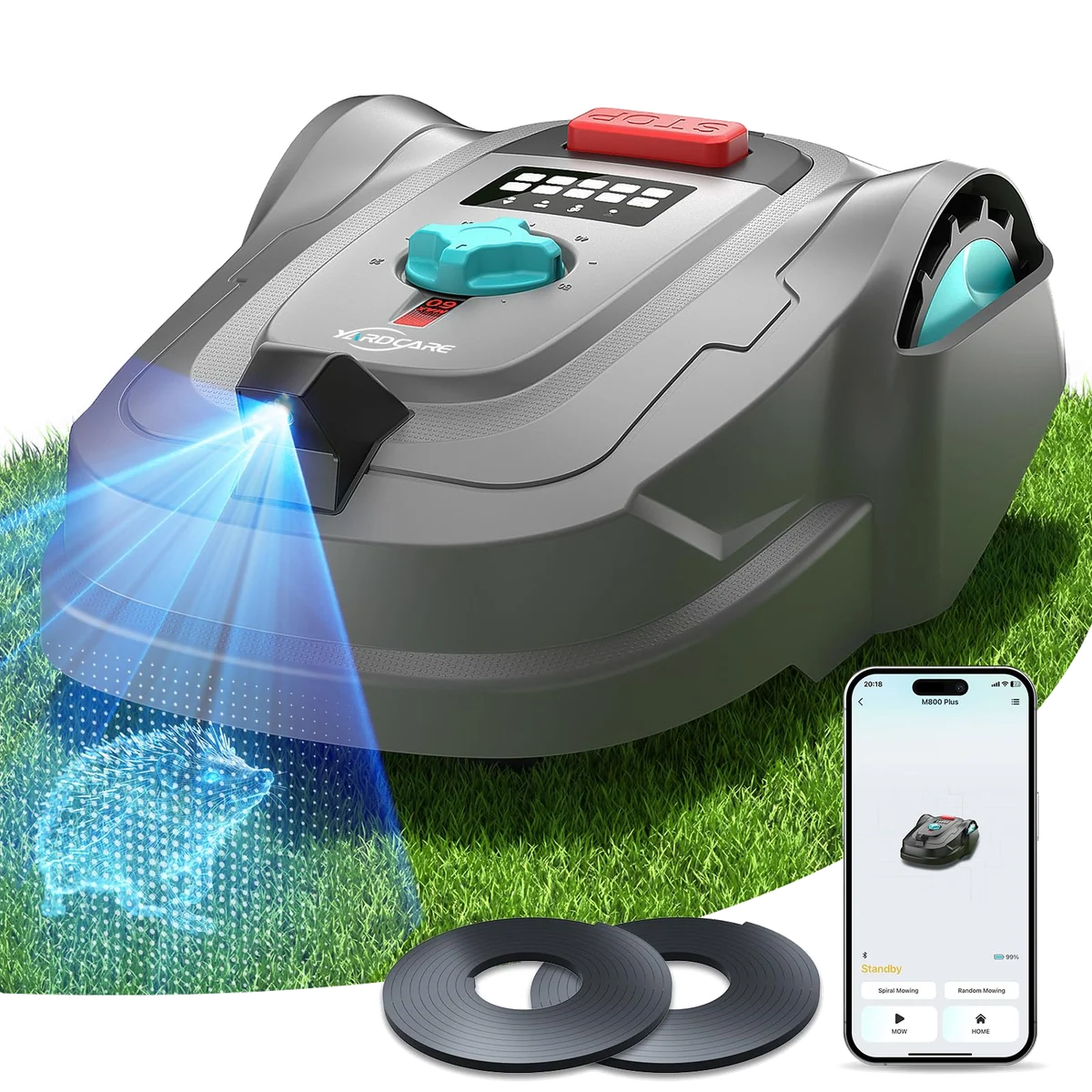
GPS, 3D vision, app scheduling and magnetic no-go strips could suit an already-short lawn with crisp visible borders.
Its 2.1-star score from 18 ratings sits beside missing runtime, charging, weatherproofing, warranty, repair and connectivity details.
The M800Plus promises the field’s most attractive escape from installation. Its camera is supposed to distinguish grass from non-grass, GPS assists navigation and roughly 32 feet of magnetic strip can close a gap or protect one restricted area. App scheduling, automatic charging, spiral spot mowing and a stated 8,611-square-foot ceiling make it look far more capable than the basic E400 models.
The phrase “wire-free” needs qualification. The mower still relies on visual boundaries, and magnetic strip must be laid anywhere the lawn does not supply one. Several beds, a play space, a pond and an open driveway can consume the included strip quickly. GPS is named, but RTK correction, positioning accuracy and app-drawn virtual boundaries are not.
Its seven-inch cutting disc and 0.8-to-2.4-inch height range also reveal a maintenance mower rather than an overgrowth solution. Grass above 2.6 inches should receive a conventional first cut. The claimed area is therefore a ceiling for frequent maintenance, not proof that the mower can cover a complicated 8,611-square-foot yard promptly.
The direct customer evidence supplies a rating but no written explanation of the failures. That prevents a responsible diagnosis, not a responsible verdict. At 2.1 stars, with no accessible manual or dependable ownership record to settle the basic questions, the M800Plus should remain out of the cart.
5. YARDCARE AI Vision Robotic Lawn — The newer YARDCARE vision mower is promising but too vaguely documented to trust yet.
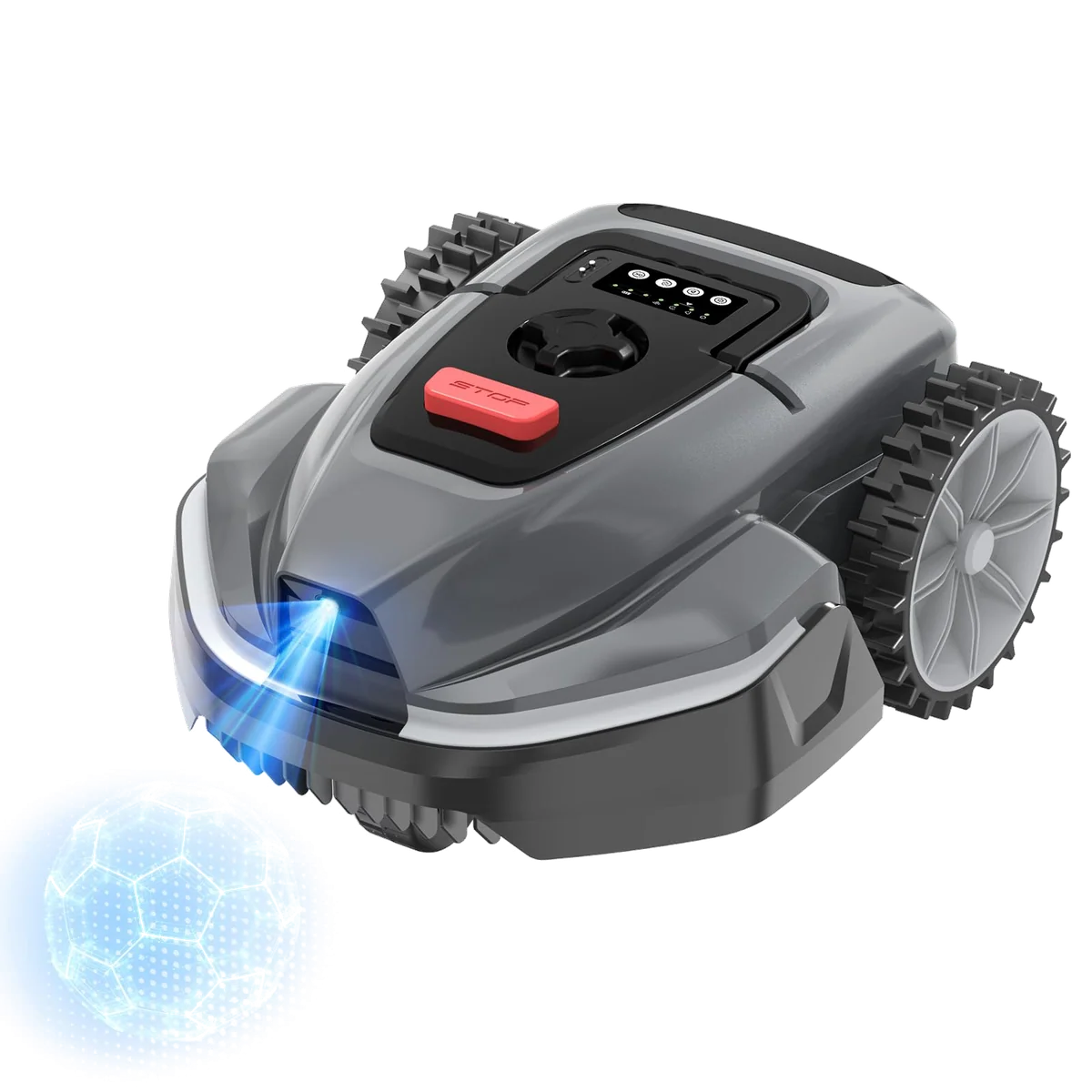
Its 4.8-star average, app control, magnetic no-go strip and wire-free camera navigation make it the most interesting YARDCARE model here.
The listing does not establish runtime, cutting dimensions, automatic docking or boundary performance, and one bullet identifies the machine as a LEBOSBO V3.
A 4.8-star score from 40 ratings is the strongest customer signal in the roundup. The package description also includes an 18V charger, magnetic strip, ground stakes, spare blades and a manual, while the app is said to schedule and monitor mowing. For a 1,600-square-foot lawn, that sounds like an appealing alternative to installing perimeter cable.
The listing is not precise enough to turn that appeal into a recommendation. It calls the product a YARDCARE mower in the title, then names the LEBOSBO V3 in its obstacle-sensing claim. It promises adjustable cutting height without stating the range and calls the setup plug-and-play without explaining what contains the mower at an open lawn edge. The package names a charger rather than an automatic charging station, leaving the most basic autonomy question unresolved.
The high rating makes this a model worth watching, not one worth choosing blindly. Confirm the exact model identity, charging method, cutting range, runtime, boundary requirements and return route before treating it as a finished answer to small-lawn maintenance.
6. YARDCARE V100 — The YARDCARE V100 is a quiet helper, not an autonomous lawn service.
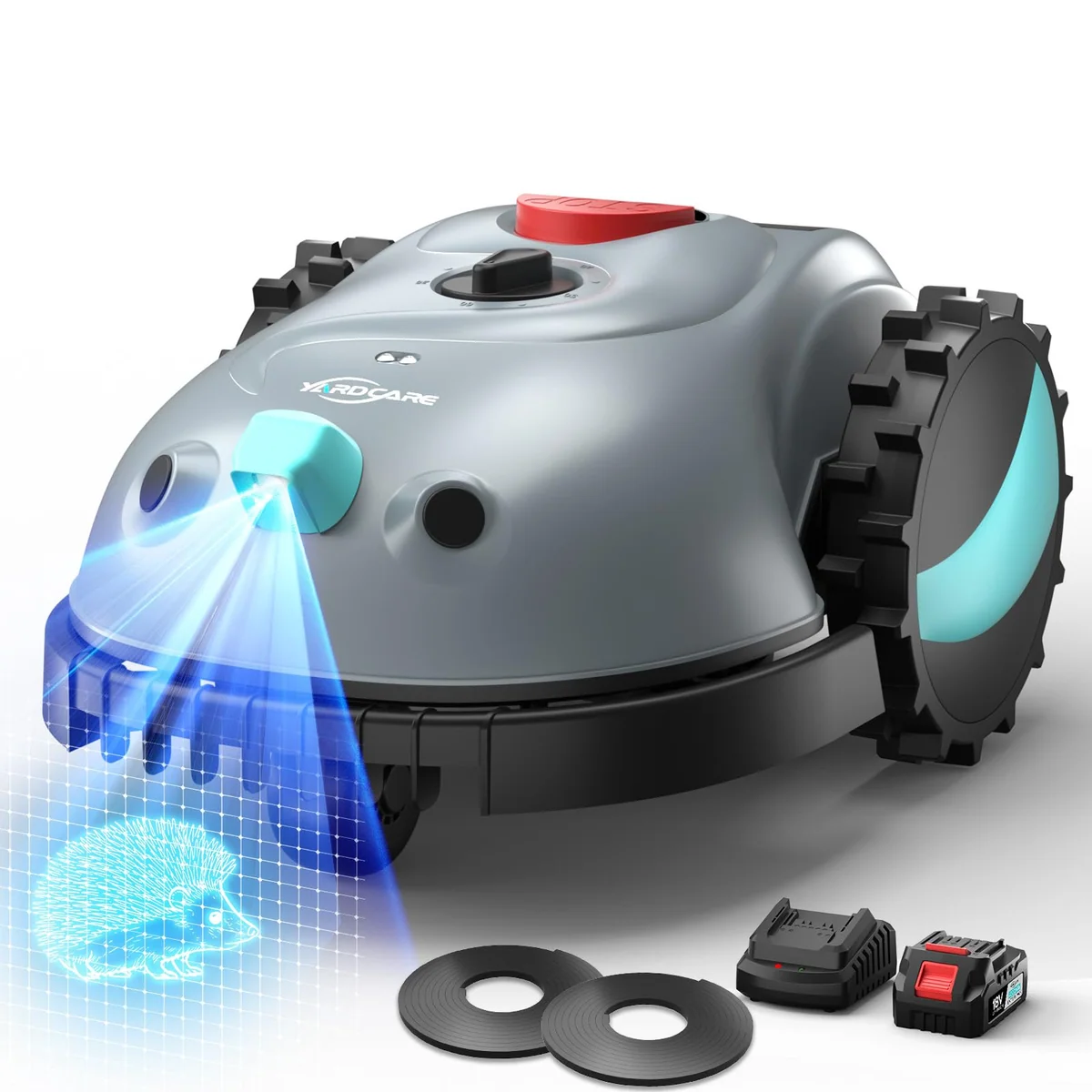
It can spare an owner the physical work of pushing a mower across a tiny, clearly bordered patch of short grass.
There is no app, map, schedule or self-charging dock, and the mower can leave four to eight inches of grass at the perimeter.
The V100 is easy to understand once the word “robot” loses some of its shine. Set it on short, dry grass in daylight and it wanders until its camera or bumper tells it to turn. The 6.3-inch deck cuts from 0.8 to 2.4 inches, the removable 4Ah battery can run for up to 70 minutes and the quiet motor makes it less intrusive than a conventional mower.
When the battery empties, someone must retrieve it, remove the pack, charge it for roughly 110 minutes and reinstall it. The mower cannot depart on a schedule, resume after charging or show missed areas on a map. For an older or disabled owner who mainly wants to avoid pushing a machine, that can still be a worthwhile reduction in physical effort. For anyone expecting the lawn to maintain itself, it is the wrong level of automation.
The suitable area is also smaller than the headline suggests. Although the listing claims 1,600 square feet, its own guidance recommends about 1,076 square feet with clear boundaries. Random navigation, a narrow disc and obstacles all make the larger number less convincing. Grass taller than roughly 2.6 inches can be read as an obstacle, so the V100 needs a conventional first cut and frequent follow-up runs.
Boundary information is contradictory. The exact listing says that 32 feet of magnetic strip is included, while YARDCARE’s separate product information says the V100 does not support magnetic strips. Buyers whose flower bed, pool or open property edge depends on that strip should confirm the precise revision in the box. The V100 and E400 comparison explains the central trade: the V100 removes the perimeter cable, while the E400 provides a dock and app at the cost of a much worse ownership record.
Our #1 Pick: RoboUP Raccoon 2 SE
Check Price on Amazon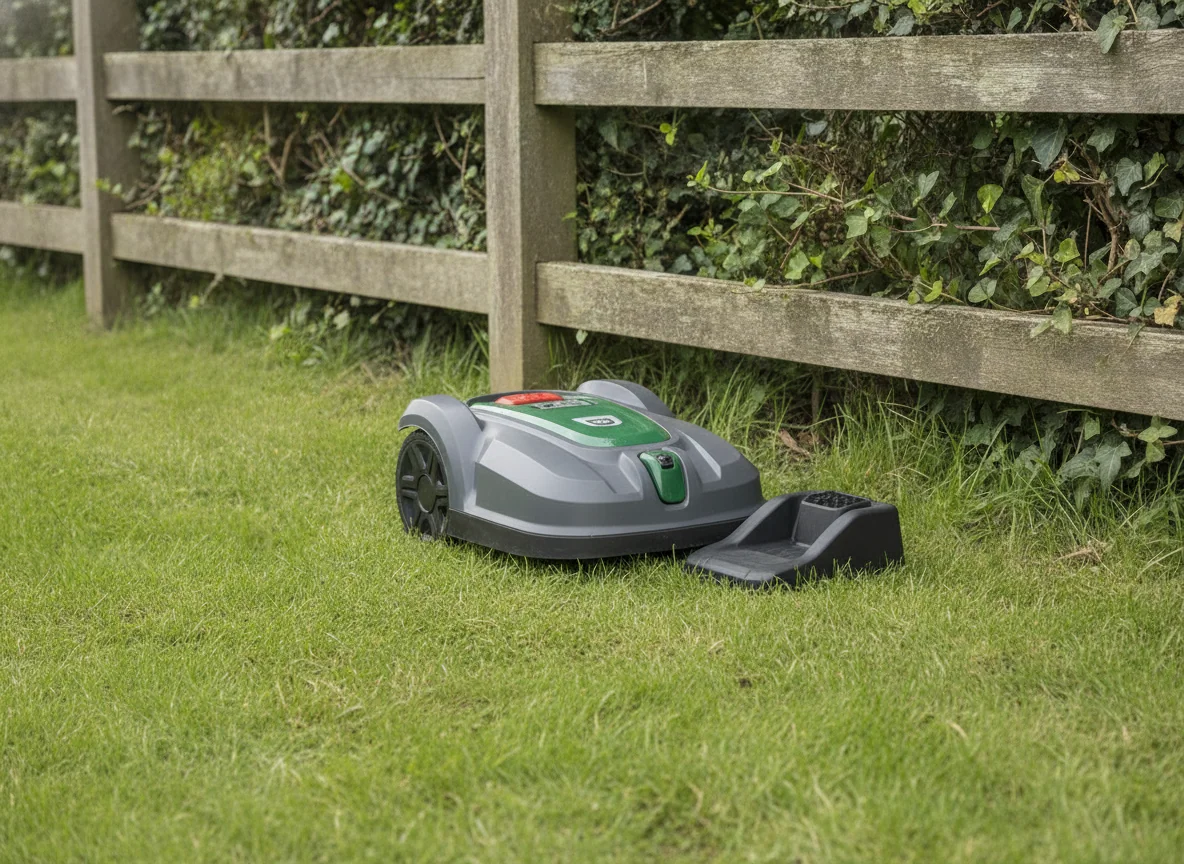
Budget begins with a lawn the mower can actually contain
Smart Lawn Bots weighted boundary reliability first, because every other feature becomes irrelevant after a mower leaves its intended area or refuses to enter part of it. Charging autonomy came next, followed by route efficiency, cutting range, obstacle behavior, edge clearance and the depth of the ownership record.
Maximum area claims received less weight than they usually receive on a product box. A random mower can technically revisit a large lawn across repeated sessions while still leaving visible tufts after any particular run. The useful question is not merely whether the battery and dock permit eventual maintenance. It is whether the mower can cover the actual shape, obstacles and passages outside the buyer’s door without constant rescue.
| Model | Boundary method | Normal route | Charging | Deciding drawback |
|---|---|---|---|---|
| RoboUP Raccoon 2 SE | Camera-visible physical edges | Random whole-lawn coverage | Automatic dock | Open grass boundaries are unreliable |
| YARDCARE E400, gray | Powered perimeter wire | Random | Automatic dock | Frequent faults and short-run complaints |
| YARDCARE E400, dark gray | Powered perimeter wire | Random | Automatic dock | Circling, errors and weak app reports |
| YARDCARE M800Plus | Vision plus magnetic exclusions | Claimed bow-shaped mowing | Automatic dock | Very poor rating and major evidence gaps |
| YARDCARE vision mower | Vision plus magnetic exclusions | Not established | Not established | Ambiguous identity and missing core specifications |
| YARDCARE V100 | Vision and physical edges | Random | Removable battery | Manual charging and a wide unfinished border |
Customer ratings were treated as signals, not laboratory results. A 2.1-star or 2.5-star average is serious evidence of risk even when it does not identify one universal defect. A 4.8-star average is encouraging, but it cannot fill in missing runtime, dock behavior or model identity. The Raccoon wins because its compromises are both unusually well documented and manageable in the right yard.
The cheapest machine is rarely the cheapest finished lawn
Choose the boundary system before the mower.
A perimeter-wire mower asks for the worst chore at the beginning. The cable must form a closed loop, respect obstacles and survive later gardening. In return, the machine receives an electrical boundary signal that does not care whether grass and soil look similar. A camera mower is easier to place in service, but fences, paving and raised borders become part of its navigation hardware.
If the lawn joins another lawn, fades into a bed or opens onto a driveway, do not assume a saved visual map creates an invisible wall. Read the site’s guide to how wire-free mowers stay inside a lawn before choosing convenience over containment.
Size random navigation more conservatively.
A maximum-area label describes favorable maintenance capacity, not a promise that one run will touch every blade of grass. Random mowers repeat old paths while untouched corners wait. Reduce the claimed area when the yard contains trees, beds, narrow recesses, slopes or awkward passages, and consult the guide to what robotic mower area ratings actually mean before buying to the printed ceiling.
Budget for the edge and the ownership tail.
None of these machines eliminates every follow-up chore. A central cutting disc cannot reach a wall, blade screws and cutters wear, wheels collect damp clippings and batteries eventually lose capacity. The real cost includes boundary materials, replacement blades, possible battery replacement and the time spent recovering a stranded mower. The site’s full guide to robotic mower costs covers those expenses without pretending the checkout figure tells the whole story.
For an enclosed compact lawn, the Raccoon remains the sensible buy because its limitations can be designed around: clear the grass, schedule repeated runs and trim the raised edges. For an open or irregular property, spend more on reliable mapping rather than spending less twice. The broader wire-free mower roundup is the right next step when app-drawn zones and systematic coverage are requirements rather than luxuries.
Frequently Asked Questions
What is the least expensive mower here that Smart Lawn Bots recommends?
The RoboUP Raccoon 2 SE is the only overall recommendation, and even it requires one small lawn enclosed by clear physical or visual boundaries.
Can an inexpensive wire-free mower stay inside an open lawn?
Not reliably when camera navigation sees continuous reachable grass and no fence, paving, raised edge or compatible magnetic strip marks the limit.
Do these mowers cut an overgrown lawn?
No, they are maintenance machines that work best after a conventional first cut has brought the grass within their supported height range.
Will a budget robot mower eliminate string trimming?
No, centrally mounted cutting discs leave grass beside walls, fences and raised borders even when the interior is maintained successfully.
Is perimeter wire always worse than camera navigation?
No, wire takes more effort to install but can provide clearer containment where the lawn itself does not present visible boundaries.
Should the maximum lawn area determine which model to buy?
No, boundary clarity, route efficiency, obstacles, slopes and narrow passages can matter more than the area printed on the listing.
Our Top Pick
The RoboUP Raccoon 2 SE earns the top spot. The RoboUP Raccoon 2 SE is the best choice for one small, enclosed lawn.
Compare Top Picks
Sources (14)
- Amazon listings and customer reviews
- Owner reports across r/roboticLawnmowers, r/brisbane, r/sunshinecoast and 5 more threads
- Nytimes — Article — www.nytimes.com
- Cnet — Article — www.cnet.com
- Yarbo — Article — www.yarbo.com
- Consumerreports — Article — www.consumerreports.org
- Easylawnmowing — Article — easylawnmowing.co.uk
- Pcmag — Article — www.pcmag.com
- Facebook — Article — www.facebook.com
- Wired — Article — www.wired.com
- Gardenersworld — Article — www.gardenersworld.com
- Notebookcheck — Article — www.notebookcheck.net
- Wellbots — Article — www.wellbots.com
- Yardcareinc — Article — yardcareinc.com