The RoboUP Raccoon 2 SE makes the wire disappear, not the boundaries
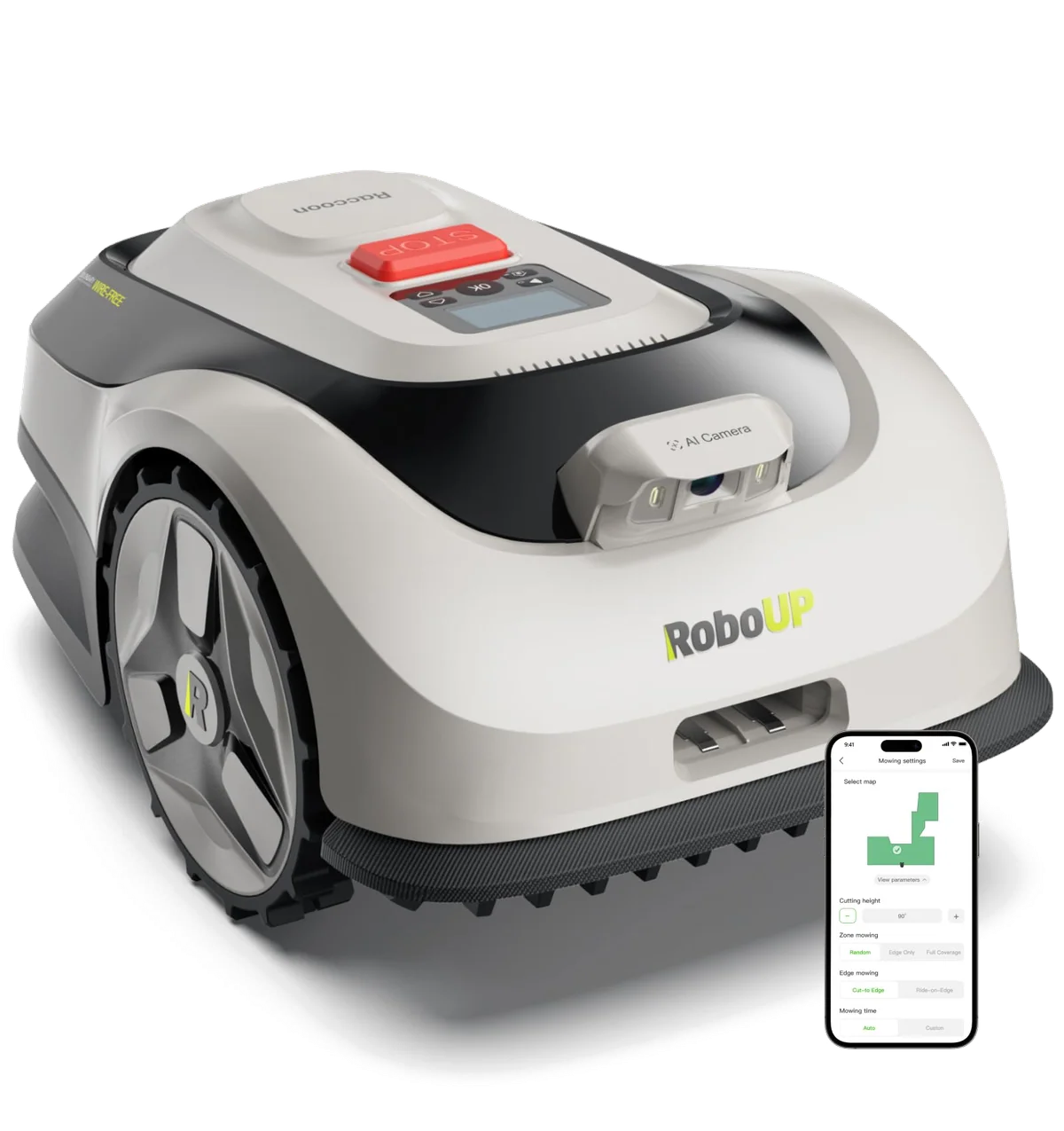
Buy the RoboUP Raccoon 2 SE only for a small, physically enclosed lawn with obvious edges; open boundaries, scattered toys, or an expectation of systematic mowing turn its appealing simplicity into supervision.
Buy the lawn fit, not the feature list
The Raccoon 2 SE is appealing precisely because it refuses the infrastructure of a conventional robotic mower. There is no buried cable, antenna mast, or mandatory app, and the basic cut is sound. Put it on one small, tidy lawn surrounded by clear non-grass boundaries, let it wander frequently, and accept that a trimmer finishes the perimeter. In that narrow setting, it is an unusually approachable route into automated lawn maintenance.
Everyone else should walk away. An open property line defeats its visual containment, random navigation wastes hours, small objects remain vulnerable, and the marketed acreage says nothing about timely complete coverage. Buyers who need virtual boundaries to behave like real boundaries should start with the site’s best wire-free robotic mowers rather than ask this camera to invent a fence.
Strengths
Weaknesses
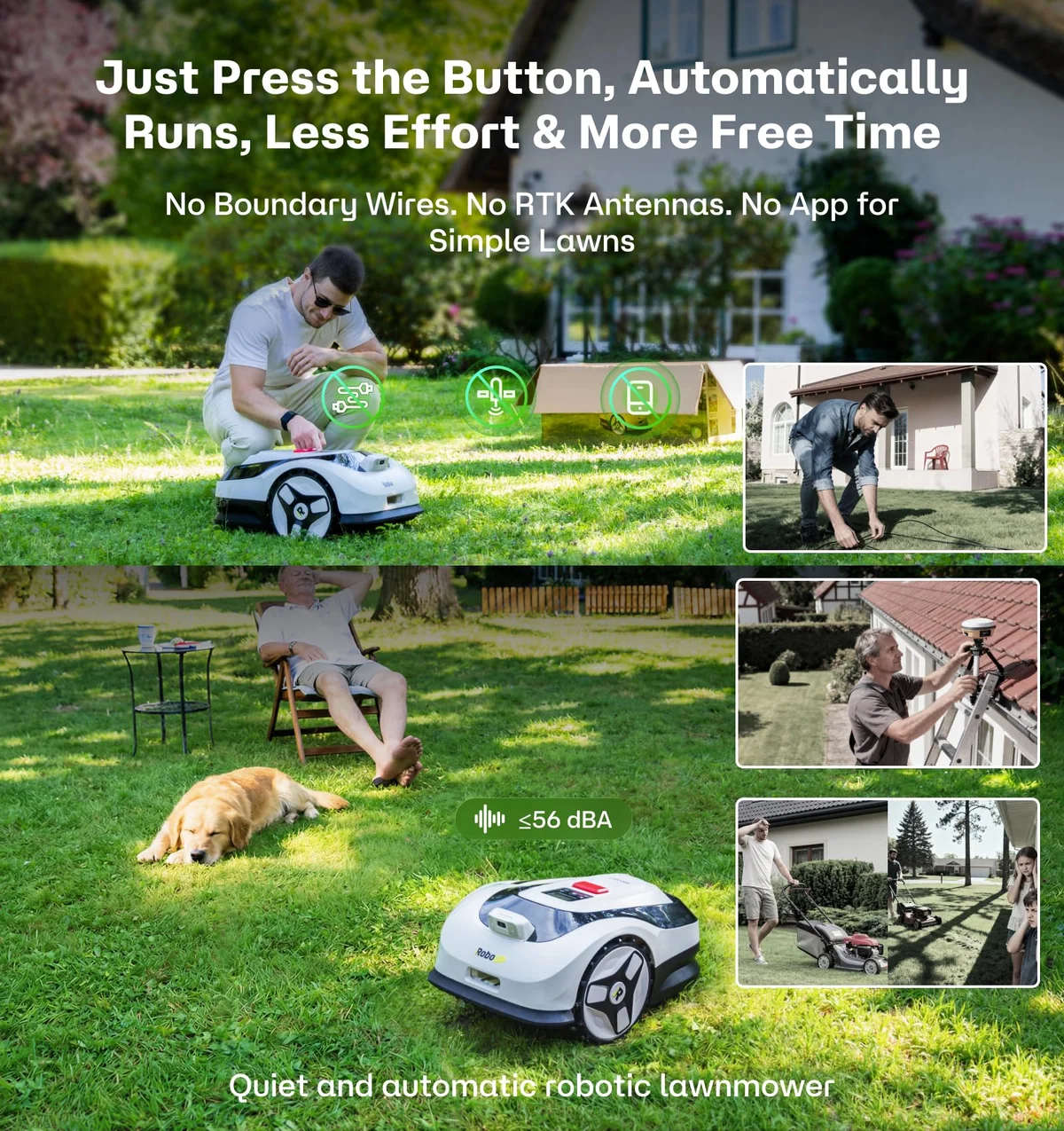
The Raccoon 2 SE removes the two installation chores that make many modern robot mowers feel like surveying equipment. There is no perimeter cable to peg into the soil and no RTK antenna to mount beneath an open sky. A front camera identifies grass, vSLAM and inertial sensors help it navigate, and a bumper provides the final line of defense. For a fenced city garden, that is a genuinely attractive arrangement.
The catch is that the camera does not create a dependable invisible fence. It looks for a visible change between lawn and everything else. A wall, raised border, fence, or strip of paving gives it something clear to follow; grass continuing into the neighbor’s property does not. Manual mapping records an area, but it does not physically stop the mower from following reachable grass beyond that line.
That distinction decides the review. This is not an RTK mower without the mast, and it is not a LiDAR mower at a lower price. It is a vision-guided maintenance mower whose best lawn already has boundaries the camera can understand.
Key Specifications
Setup is easy when the garden is easy
“Out of the box” needs translating. The charging station still requires power, placement, and fastening, while the front bumper must be attached and the battery charged. The mower then needs to map the lawn or be carried to a small target area. That is considerably less work than installing boundary wire, but it is not instant mowing from a sealed carton.
Automatic mapping followed distinct lawn edges reasonably well. Sparse grass, visible soil, and heavy leaf cover were harder to interpret, so some marginal areas were skipped during mapping even when the mower later entered them while cutting. Shade itself is not the problem it can be for satellite-dependent machines; an ambiguous grass edge beneath the shade is.
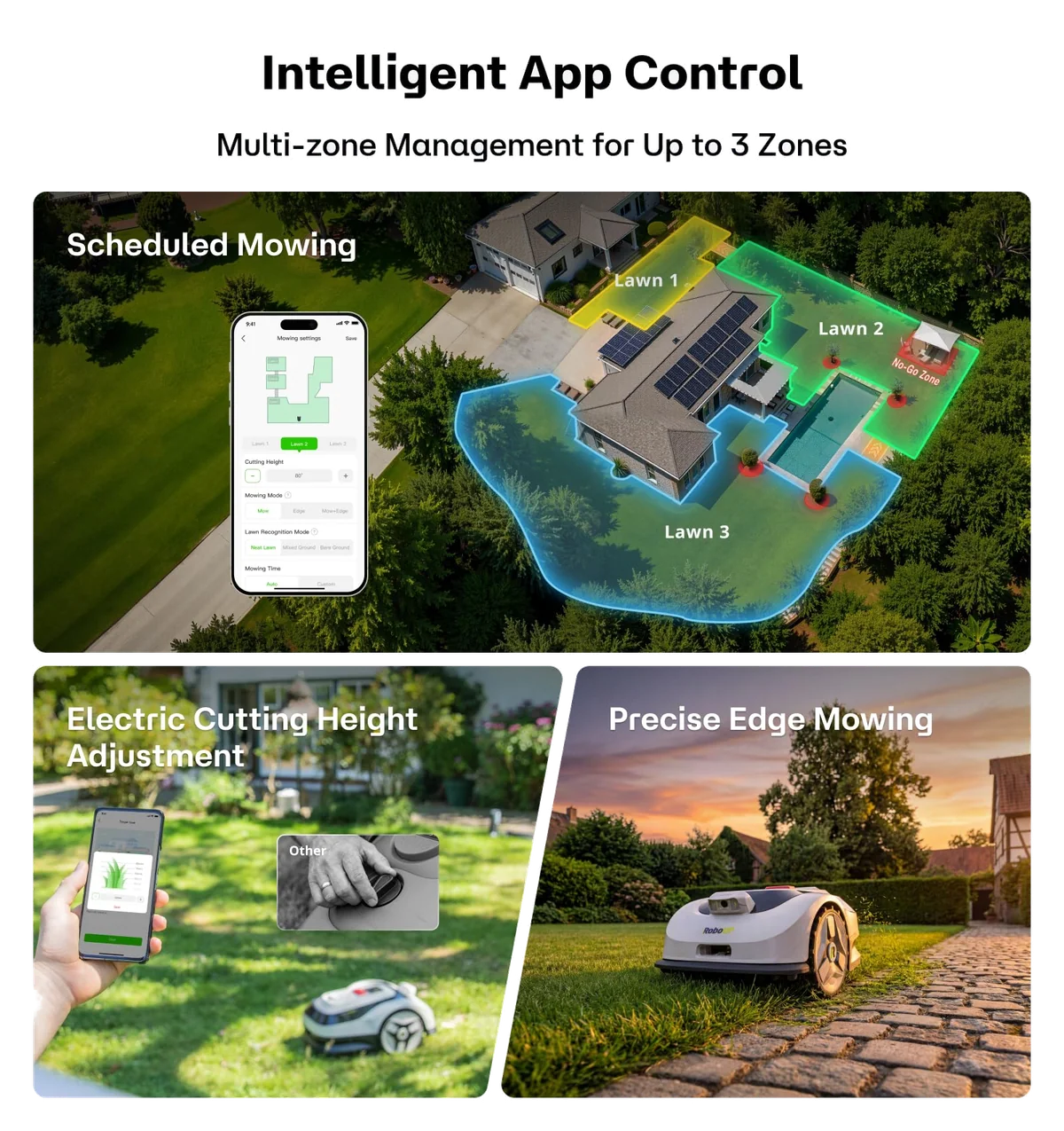
The onboard display and five buttons are more useful than the usual token controls. A simple enclosed lawn can be mapped and mown without a phone, which makes the Raccoon unusually friendly to an app-averse owner. The app remains necessary for the fuller experience, including schedules, manual mapping, remote driving, zone setup, edge behavior, operating modes, and electric height adjustment.
Up to three lawn areas can be configured, but transitions rely on conspicuous passage plates. The idea works better on a specification sheet than across a carefully landscaped garden. A single continuous lawn is the natural home for this machine; anyone managing disconnected sections should read our guide to how robot mowers handle multiple lawn areas before treating the three-zone claim as solved.
Strengths & Limitations
Strengths
- No perimeter wire or RTK antenna is required.
- Simple onboard controls make the app optional on a straightforward lawn.
- The quiet cutting system reliably maintains grass it actually reaches.
- Battery endurance is stronger than the normal route efficiency.
Limitations
- Normal whole-lawn coverage is random and cannot guarantee a complete pass.
- Open grass boundaries can let the mower leave its saved area.
- Tennis balls, hoses, and wildlife-sized objects are not detected consistently.
- Raised edges can leave roughly four inches for the string trimmer.
- Long-term parts, battery, warranty, and service support remain unclear.
The blades are competent; the route is the compromise
Once the mower reaches a blade of grass, the cutting system does its job. Three swinging razor blades on a floating 7.9-inch disc cut maintained grass reliably across the selected height range. The deck is narrow, but appropriately so for a compact mower intended to circulate frequently rather than clear an overgrown yard in one decisive pass.
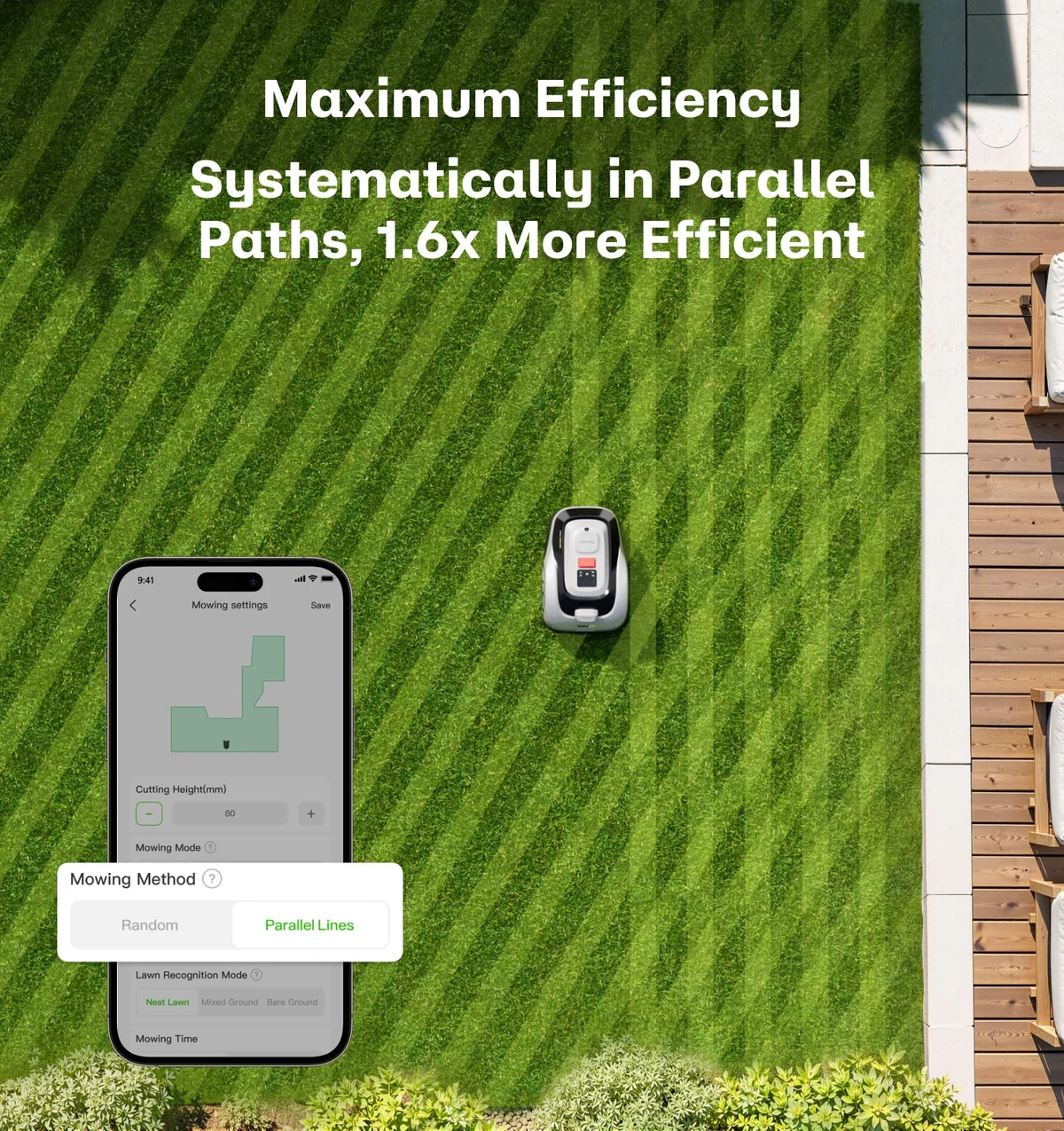
Normal whole-lawn mowing is random. The Raccoon drives toward an edge, turns through an arbitrary angle, and crosses the lawn again. On a 250 m² test area, reasonably comprehensive coverage required about 8.5 hours of actual mowing. A 25 m² terrace took a little over an hour. Repeated schedules can eventually keep the grass controlled, but no individual session guarantees complete coverage, straight rows, or a uniform finish.
The small target mode is the exception. On an area up to roughly 80 m², or 860 square feet, it can cut in parallel paths without first creating a map. The owner must carry or place the mower in that area, so this is a useful way to tidy a small patch, not a systematic dock-to-lawn routine for the whole property.
| Yard condition | What to expect |
|---|---|
| Fence, wall, or raised border | A clear boundary, although raised edges leave trimming behind. |
| Flush paving beside grass | The body can ride over the level edge for a closer cut. |
| Grass continuing into another property | The saved map cannot be trusted as a virtual fence. |
| Sparse, leafy, or bare margin | Automatic mapping can omit or misread the edge. |
| Narrow dead-end recess | The mower may enter and fail to find its way back out. |
Obstacle avoidance still requires a cleared lawn
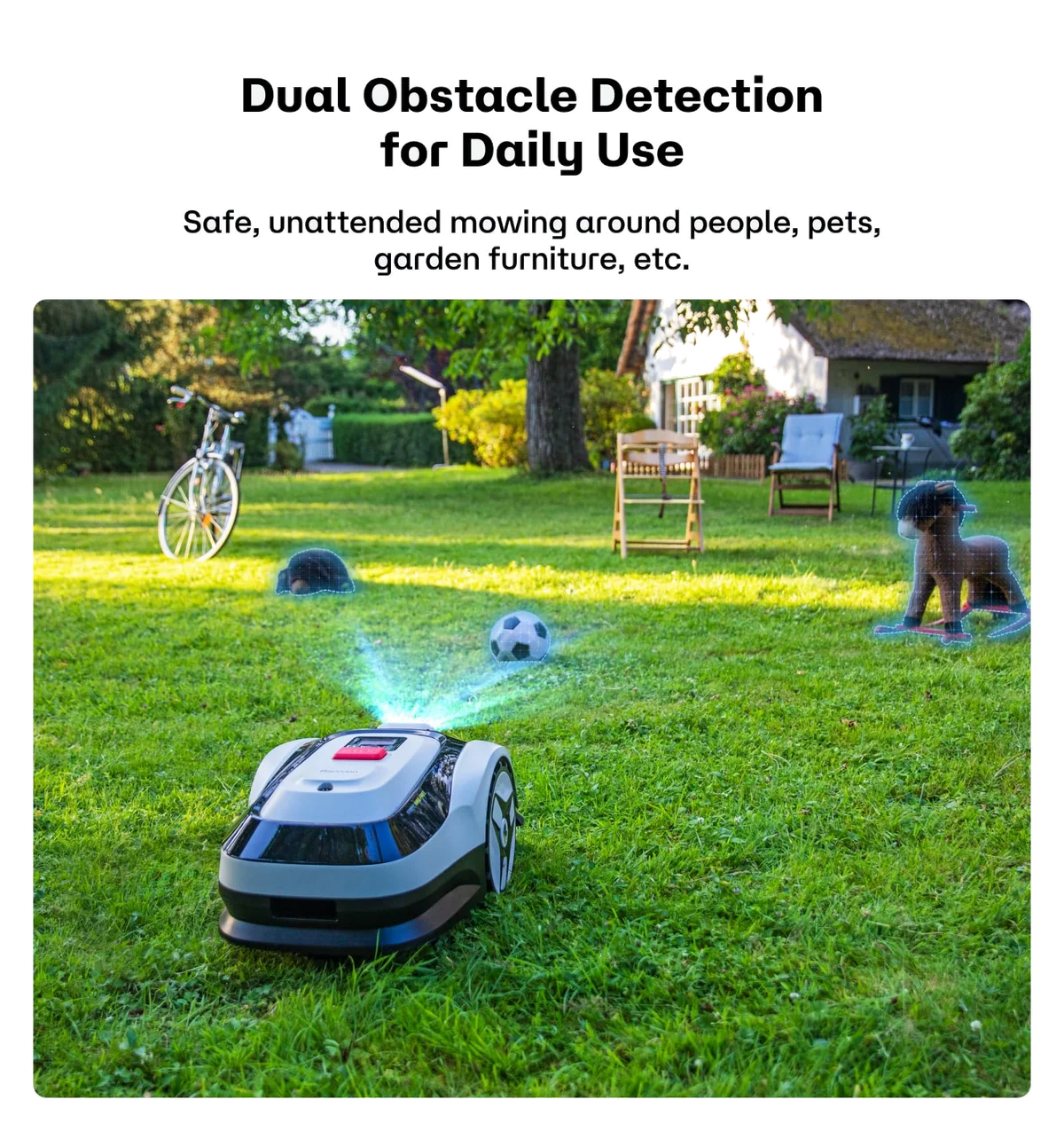
Large stationary objects were handled well. Trees and swing frames were avoided reliably, and a handball-sized ball prompted a turn with room to spare. Smaller hazards exposed the limits of the “AI” label: a tennis ball was run over every time, a garden hose was detected inconsistently, and a hedgehog dummy was sometimes recognized only after the bumper made contact.
The practical rule is simple. Pick up balls, hoses, sticks, small toys, pet waste, and anything else that should not meet the blade disc. Run it during the day on a cleared lawn, and do not regard camera avoidance as permission to mow around unattended children, pets, or wildlife. Our broader guide to robot-mower safety around families and animals explains why avoidance hardware remains a backup rather than a lawn-cleaning service.
Expect a four-inch border at raised edges
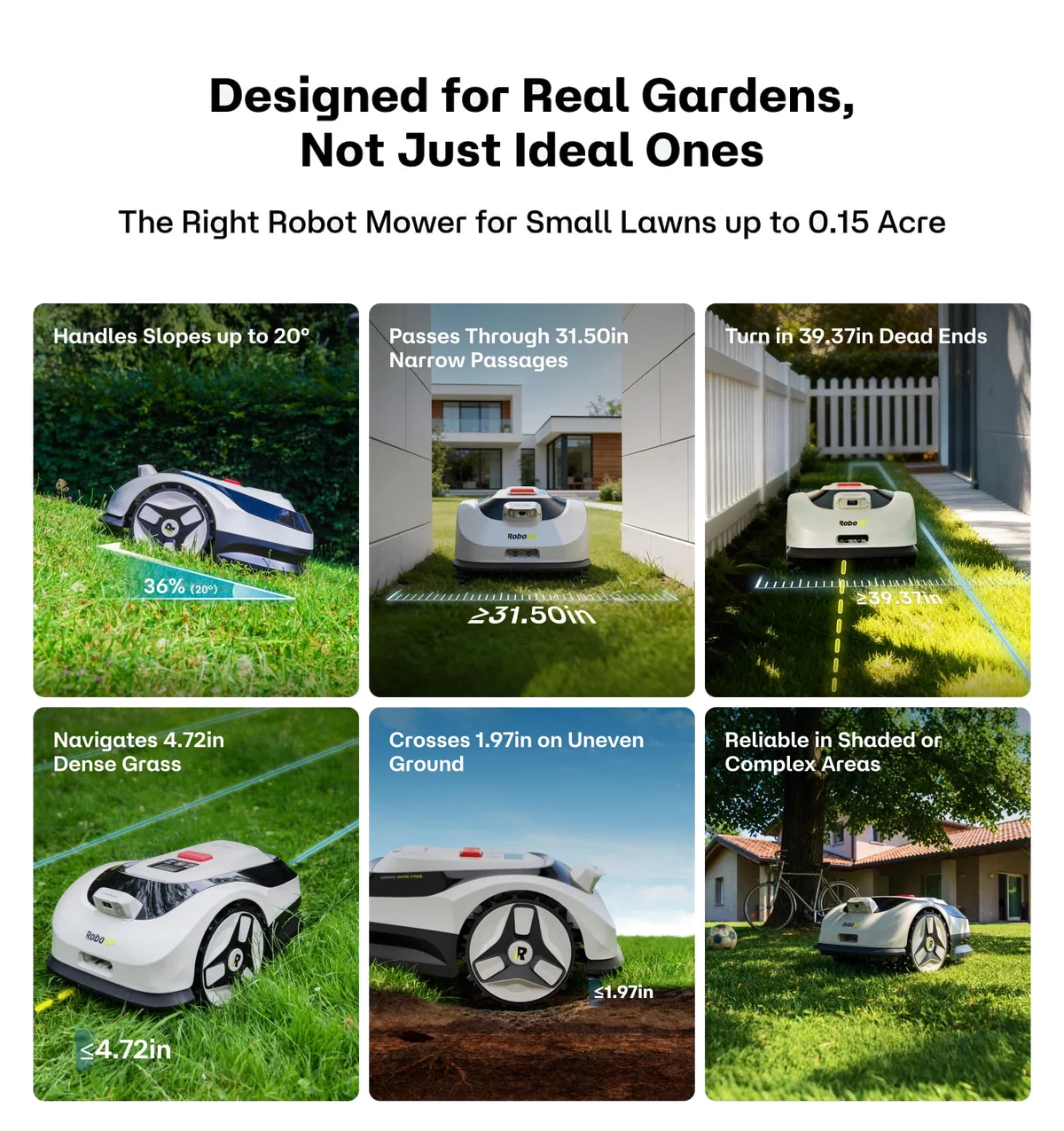
The central cutting disc sits well inside a body about 16 inches wide. Against a wall, fence, raised bed, or other non-traversable boundary, it can leave approximately four inches of uncut grass. Edge mode adds a perimeter pass, and flush paving lets the mower straddle the transition, but neither changes the deck’s physical position. A string trimmer remains part of ownership, as it does with many machines covered in our guide to robotic mower edge trimming.
The acreage number is the wrong way to size it
The Raccoon is sold as a 0.15-acre mower, equivalent to roughly 607 m², while the independent specification described it as intended for lawns below 500 m². More importantly, random navigation was already slow on 250 m². A maximum-area label means the machine may maintain that much grass through repeated outings; it does not mean it will cover every part of it quickly or within one battery cycle.
Battery performance is not the limiting factor. On already maintained grass, the mower ran for nearly three hours before returning to its dock at 20 percent, beating the 150-minute claim under that light load. Recharging to 90 percent took just over an hour, broadly matching the stated 70-minute charge time. The inefficiency comes from revisiting familiar grass while untouched patches wait their turn.
Value therefore depends less on the live checkout figure than on the geometry outside the kitchen window. At a meaningful discount to systematic wire-free machines, the Raccoon makes sense for a compact rectangle enclosed by paving and fences. On an open, irregular, or nearly 0.15-acre lawn, even a low price buys the wrong navigation system.
The simpler LawnMaster OcuMow approach is the rival the Raccoon beats when self-charging, scheduling, electric height adjustment, and optional app control matter. The Segway Navimow i215 LiDAR beats the Raccoon when systematic coverage, stronger mapping, and better small-object recognition justify moving upmarket. The direct MOVA LiDAX Ultra 1000 comparison is the more useful next stop for a buyer whose trees or buildings make satellite reception unattractive but whose lawn is too complicated for vision-only random mowing.
Easy cleaning cannot answer the ownership question
Routine care is uncomplicated. The IPX6 body can be cleaned with a garden hose, the floating disc should be checked for packed grass, and blade replacement requires a screwdriver. The supplied package included replacement blades in the independent test, although reported passage-plate quantities differ between the early test bundle and later retail information, so current box contents deserve checking before purchase.
The larger uncertainty is support. The available record does not establish the manufacturer’s standard warranty, battery replacement procedure, battery price, regional service coverage, repair turnaround, or firmware-support period. Amazon’s 3.9 average from 80 ratings signals mixed reception, but no review text was available to explain the complaints or establish multi-season reliability.
That uncertainty matters more here because occasional rescue is already part of the demonstrated behavior. The mower left its mapped area more than once, became stuck in bark mulch on one occasion, and could not escape a narrow dead end on another. It is quiet enough to work unobtrusively at around 55 dB, but it is not dependable enough to maintain a vacation property for weeks with nobody nearby.
Frequently Asked Questions
Will the Raccoon 2 SE stay out of a neighboring lawn?
No, not reliably when reachable grass continues across the property line without a clear physical or visual boundary.
Does it mow the whole lawn in straight lines?
Normal mapped mowing is random, while parallel cutting is limited to manually placed target areas of about 860 square feet or less.
Can it maintain the advertised 0.15 acre?
It is sold for that area, but slow random coverage means frequent repeated sessions rather than a quick or guaranteed complete cycle.
Does it require Wi-Fi or a smartphone app?
No for basic operation on a simple lawn, although the app unlocks schedules, manual mapping, zones, remote control, edge options, and electric height adjustment.
Will it avoid balls, hoses, and pet toys?
It reliably avoided larger objects but overran a tennis ball and detected a hose inconsistently, so the lawn still needs clearing before every run.
Can it mow beneath trees?
It does not depend on satellite reception, but fallen leaves, bare soil, and sparse grass can make the lawn boundary harder for its camera to recognize.
Sources (13)
- Amazon listings and customer reviews — Roboup Raccoon 2 Se
- Owner reports across r/homeautomation threads
- Nytimes — Article — www.nytimes.com
- Cnet — Article — www.cnet.com
- Yarbo — Article — www.yarbo.com
- Consumerreports — Article — www.consumerreports.org
- Easylawnmowing — Article — easylawnmowing.co.uk
- Pcmag — Article — www.pcmag.com
- Facebook — Article — www.facebook.com
- Wired — Article — www.wired.com
- Gardenersworld — Article — www.gardenersworld.com
- Notebookcheck — Article — www.notebookcheck.net
- Wellbots — Article — www.wellbots.com