The AIWEIYA AWY-550 can conquer a bank, but owning one is the steeper climb.
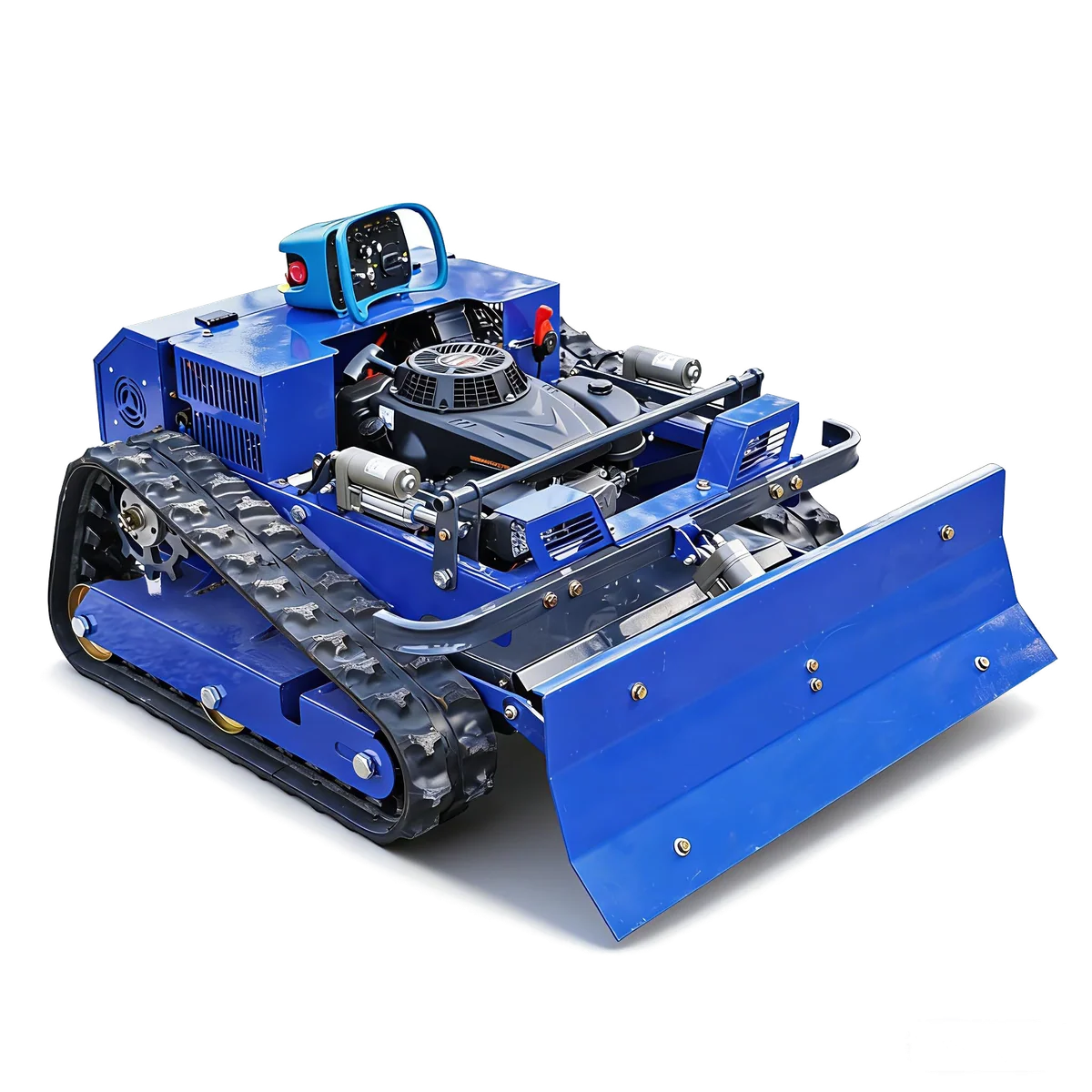
Do not buy the AIWEIYA AWY-550 as an autonomous lawn robot, and consider it as a remote-controlled slope mower only if severe terrain justifies the reliability risk and you can recover and repair a disabled 300-pound machine.
Who should take the risk
The right buyer has an ugly bank, rough acreage or brushy ground that makes conventional mowing unsafe, plus enough mechanical competence and equipment to diagnose, recover and transport a disabled tracked machine. That buyer should inspect both crawlers and the fuel system before the first serious outing, keep the mower out of wet conditions unless AIWEIYA supplies a credible weather rating, and secure exact parts and warranty answers before the return window becomes the only useful protection.
Everyone else should walk away. A small or manicured lawn will expose the tracks’ worst habit, a nonmechanical owner will inherit the support system’s worst gaps, and anyone wanting an AI-powered robot will receive none of the mapping, scheduling, obstacle recognition or automatic charging implied by that category. The AWY-550 is a capable slope mower trapped inside a risky ownership package, and its exceptional terrain talent does not make that risk ordinary.
Amazon places the AWY-550 among robotic lawn mowers, but there is no lawn robot hiding inside this blue tracked machine. It does not map boundaries, recognize obstacles, follow a schedule, return to a charging dock or mow while its owner gets on with the day. A person drives it by radio remote for the entire job.
That distinction is not pedantic. It changes both the work the machine can tackle and the work it leaves behind. The AWY-550 is closer to a compact radio-controlled brush mower: a gasoline engine turns swinging blades, an electrical system propels the crawler tracks, and the operator remains at a safer distance from the bank. Its purpose is not to manicure an ordinary suburban lawn. Its purpose is to cut the places where walking with a trimmer is exhausting and riding a mower feels reckless.
The concept works. Owners describe even cutting across grass, pasture, star thistle and moderate brush, including hills that had previously demanded cleats, weed eaters and days of physical labor. The ownership package is the problem. Reported faults include a fuel leak, an immobile crawler, water-damaged electronics, a failed controller, failed batteries and a starter that could not readily be sourced. When this mower works, it can transform a miserable job; when it does not, it becomes an exceptionally heavy repair problem.
Key Specifications
Remote control removes the climb, not the operator
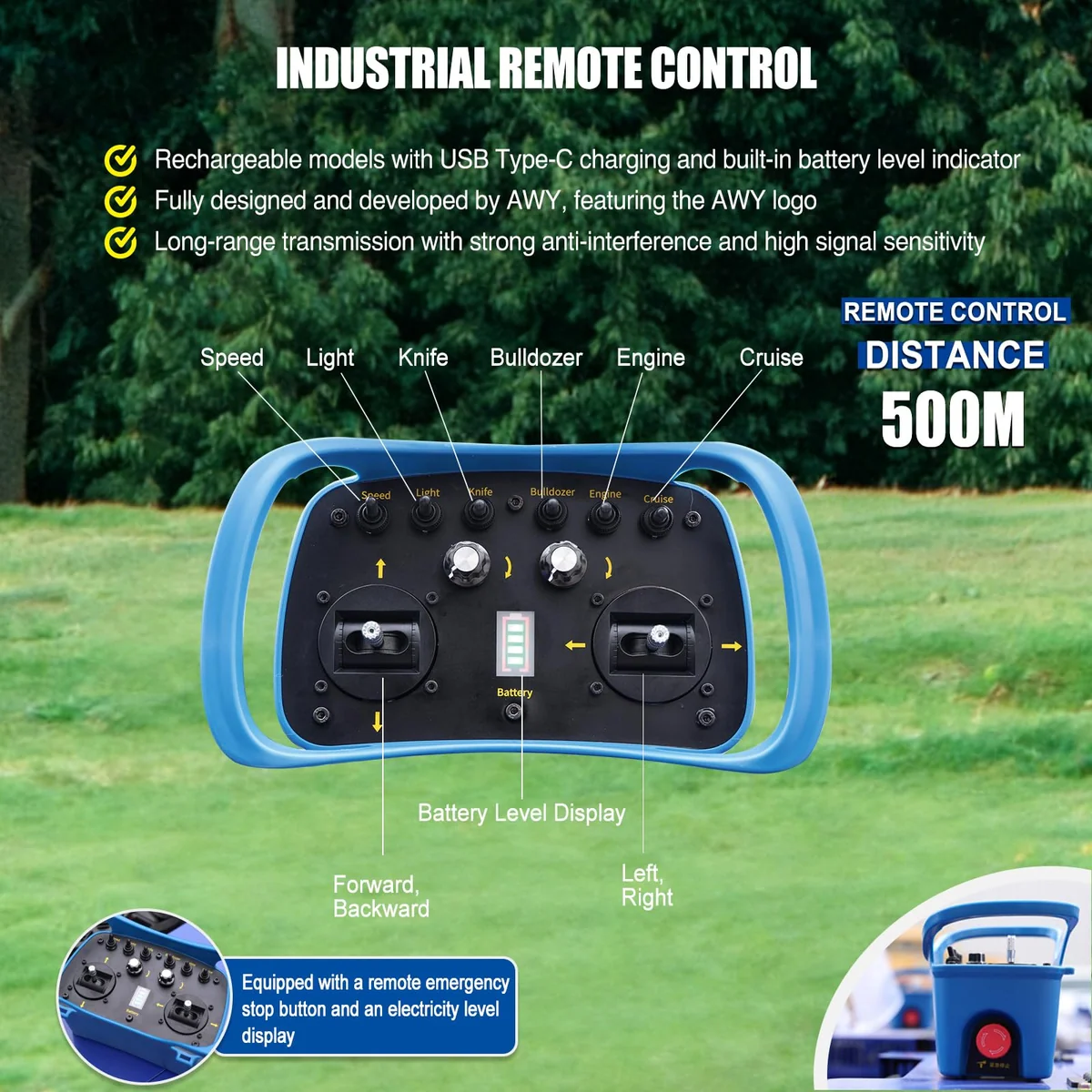
Remote start and stop, tracked steering and remote deck-height adjustment form a useful control set. Raising the deck for rough growth and lowering it for cleaner grass without approaching the machine is the feature owners praise most consistently. The controls reportedly become straightforward with familiarity, but there is still a learning curve and no evidence of autonomous assistance or artificial intelligence.
Direct control also avoids the satellite reception, boundary mapping and charging-station decisions that accompany many wire-free robots. The price of that simplicity is attention. The operator must watch the AWY-550 continuously, steer around people and objects, judge the slope and bring it back for every fuel stop. Anyone looking for scheduled maintenance should read how remote-control and autonomous mowers divide the work before treating these machines as substitutes.
Setup is much rougher than it should be. One machine arrived with a basic manual, another owner considered the instructions nonexistent, and a third had to find a video before the remote would respond. The nonobvious step was an “air switch” beneath a panel that had to be turned on. Whether the paper manual is missing or merely too thin to solve the problem, the practical result is the same: buyers have been relying on other owners to explain an expensive piece of powered equipment.
The hill is where the AWY-550 earns its keep
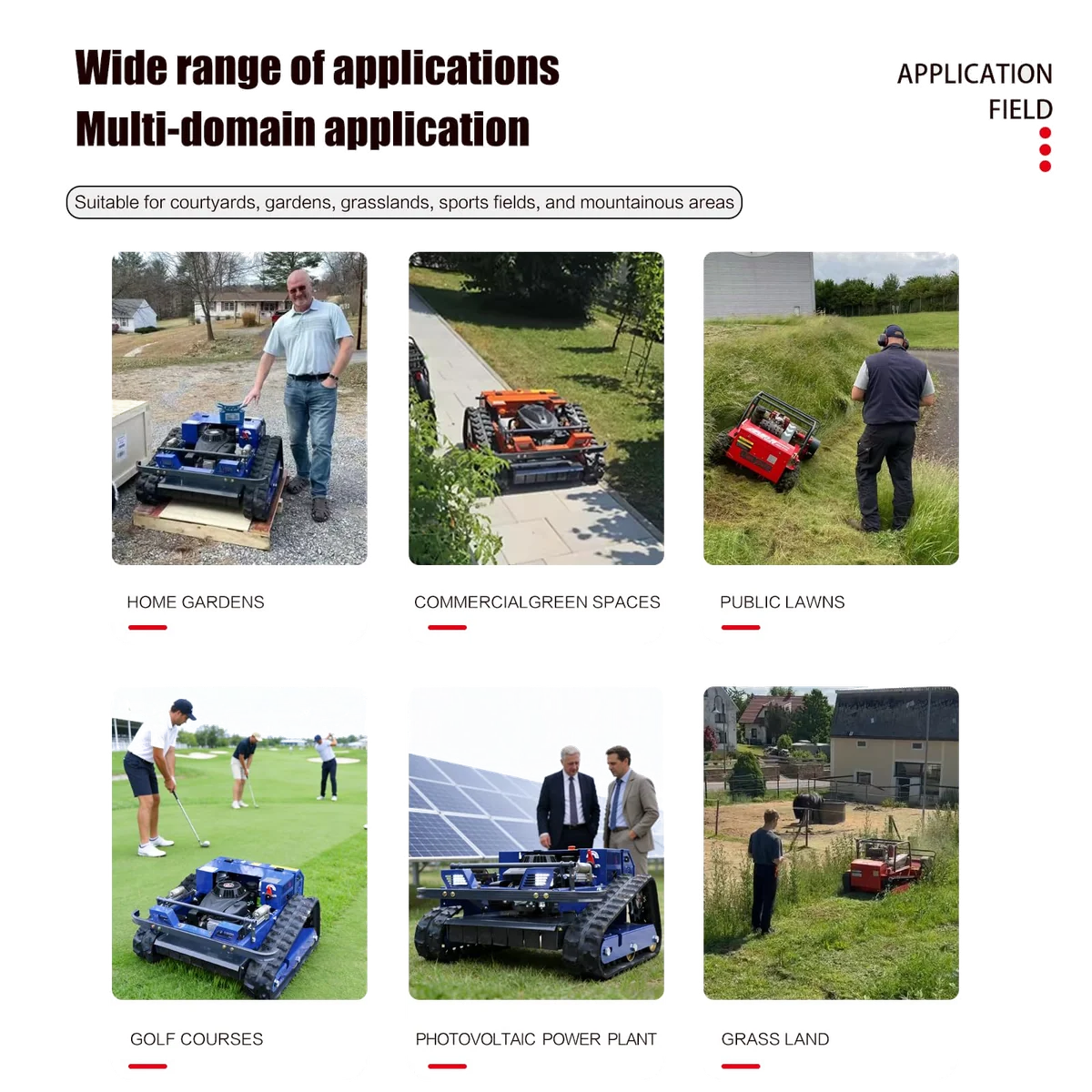
The convincing scene is not a flat rectangle behind a townhouse. It is a steep front bank, a pasture edge swallowed by thistle, or a mountain property where the hottest part of summer used to be spent climbing in mowing cleats. On that ground, owners found the AWY-550 capable enough to replace prolonged manual trimming with a day at the remote. Another owner who could no longer maintain an acre described the machine as giving back some independence. That is a more substantial benefit than saving a few minutes of weekly lawn care.
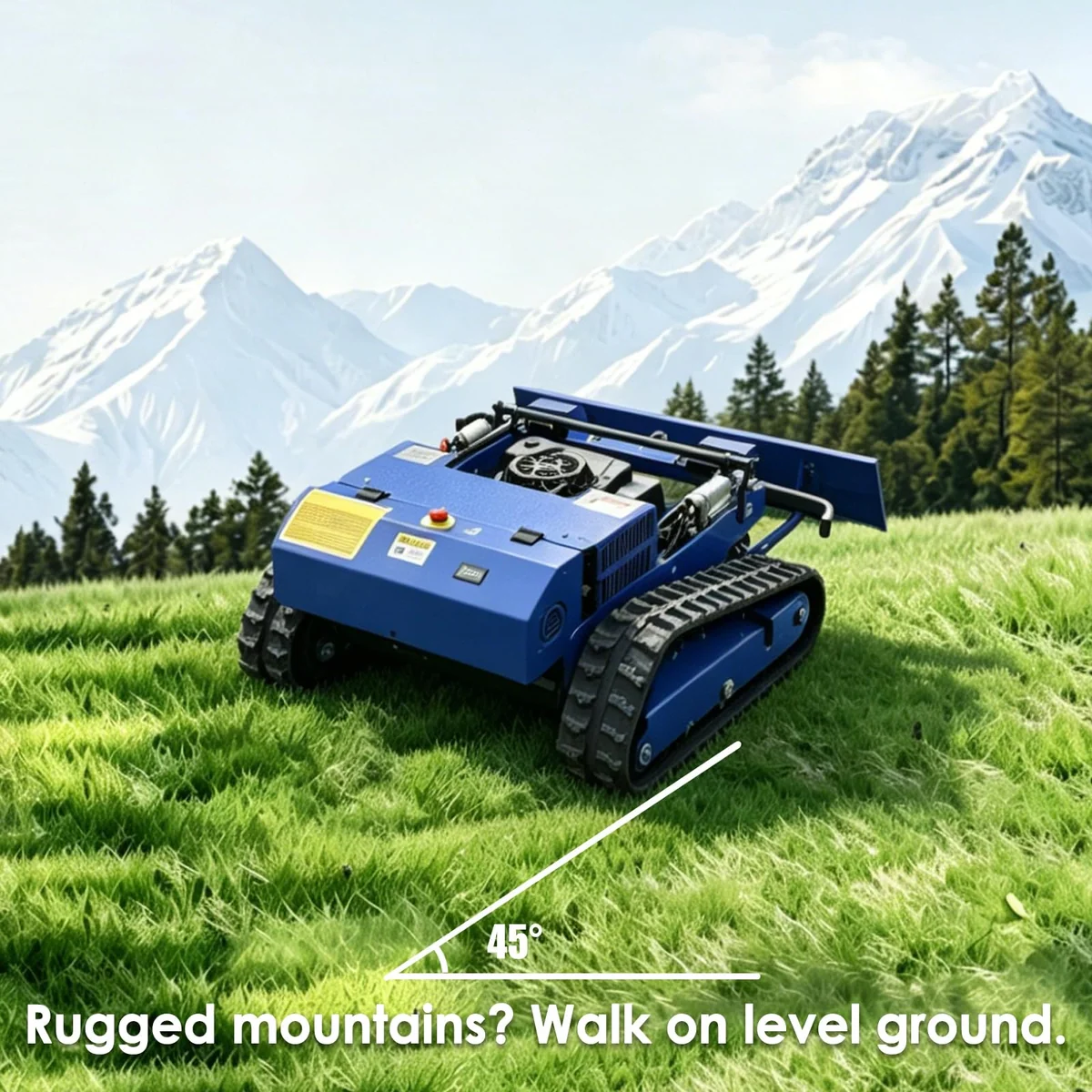
The listing claims operation on a 45-degree slope, equivalent to a 100 percent grade. The retained owner reports support strong climbing ability, but none supplies a measured angle. Treat 45 degrees as a ceiling claimed by the seller, not a proven operating prescription. Soil firmness, moisture, vegetation, travel direction and the shape of a bank all affect whether a heavy tracked mower remains controllable.
Its tracked chassis provides the bite that makes difficult ground plausible, but those tracks are hostile to delicate turf. Two positive owners warn that tight or abrupt turns can rip grass, and one advises against small lawns altogether. The deck can leave an even cut comparable to a push mower, yet turning scars may dominate the result on a lawn kept for stripes and presentation. This is vegetation control first and lawn finish second.
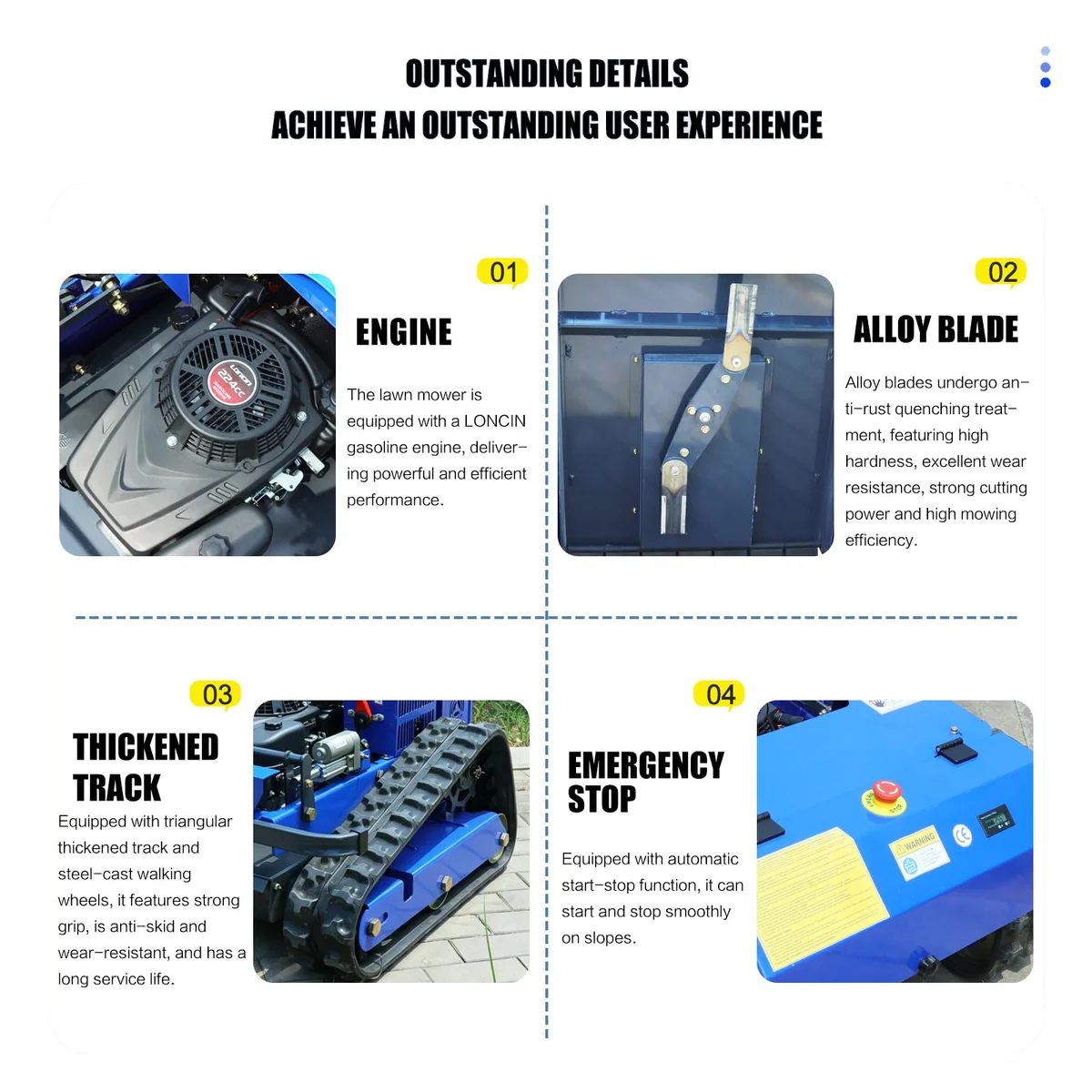
The clearest everyday defect is the fuel tank. Two otherwise satisfied hillside owners independently report only about 15 to 20 minutes between refills. Workload will change that figure, so it is not a universal runtime, but the agreement is hard to dismiss. On acreage, every stop means walking back for fuel, handling gasoline around hot machinery and interrupting the rhythm of the job. A machine marketed for large turf should not feel thirsty before the operator has settled into the controls.
Value depends on which burden it replaces
The AWY-550 makes the strongest financial case when it replaces paid hillside labor or physically dangerous work. One owner had been paying for acre maintenance every two to three weeks; another exchanged at least two days of strenuous slope trimming for one day at the controls. In those circumstances, the benefit is measured in avoided exertion, retained independence and reduced exposure to heat and unstable footing.
The calculation collapses if the mower arrives leaking fuel, stops after two outings or waits weeks for an unidentified component. Fuel, batteries, technician labor, recovery equipment, transport and downtime all belong in the ownership cost. A low acquisition cost relative to commercial slope machinery is little comfort if the only repair guidance is to hunt online for a vaguely similar part.
For severe banks and an initial rough cut, the AWY-550 can beat a conventional autonomous mower that expects prepared, repeatedly maintained grass. For routine care of established large turf, a true robot such as the Mammotion LUBA 3 AWD 5000H beats it by mapping the property, working without continuous steering and returning to charge. Buyers committed to remote operation should compare the AWY-550 directly with the Mowrator S1 4WD, while those shopping by terrain can see the broader field in our guide to remote-control mowers for steep hills and rough ground.
A 300-pound breakdown changes the review
A normal mower failure wastes a Saturday. An AWY-550 failure can strand roughly 300 pounds of track, blade and engine at the bottom of a hill. One owner with a failed left crawler dragged the machine back toward a shed about a foot at a time. Another controller failure required a trailer and several friends. A recovery plan is not an optional accessory here; ramps, a winch, a trailer or suitable machinery need to exist before the mower ventures somewhere it cannot be pushed home.
The most alarming arrival involved gasoline draining from the carburetor area while one crawler would not drive properly. The seller suggested tightening a screw, offered a repair allowance and later advised finding a carburetor for a small motorcycle engine without identifying a compatible part. That is not an acceptable service path for a new machine with a fuel leak. A mower spilling gasoline onto its deck and the ground should not be started.
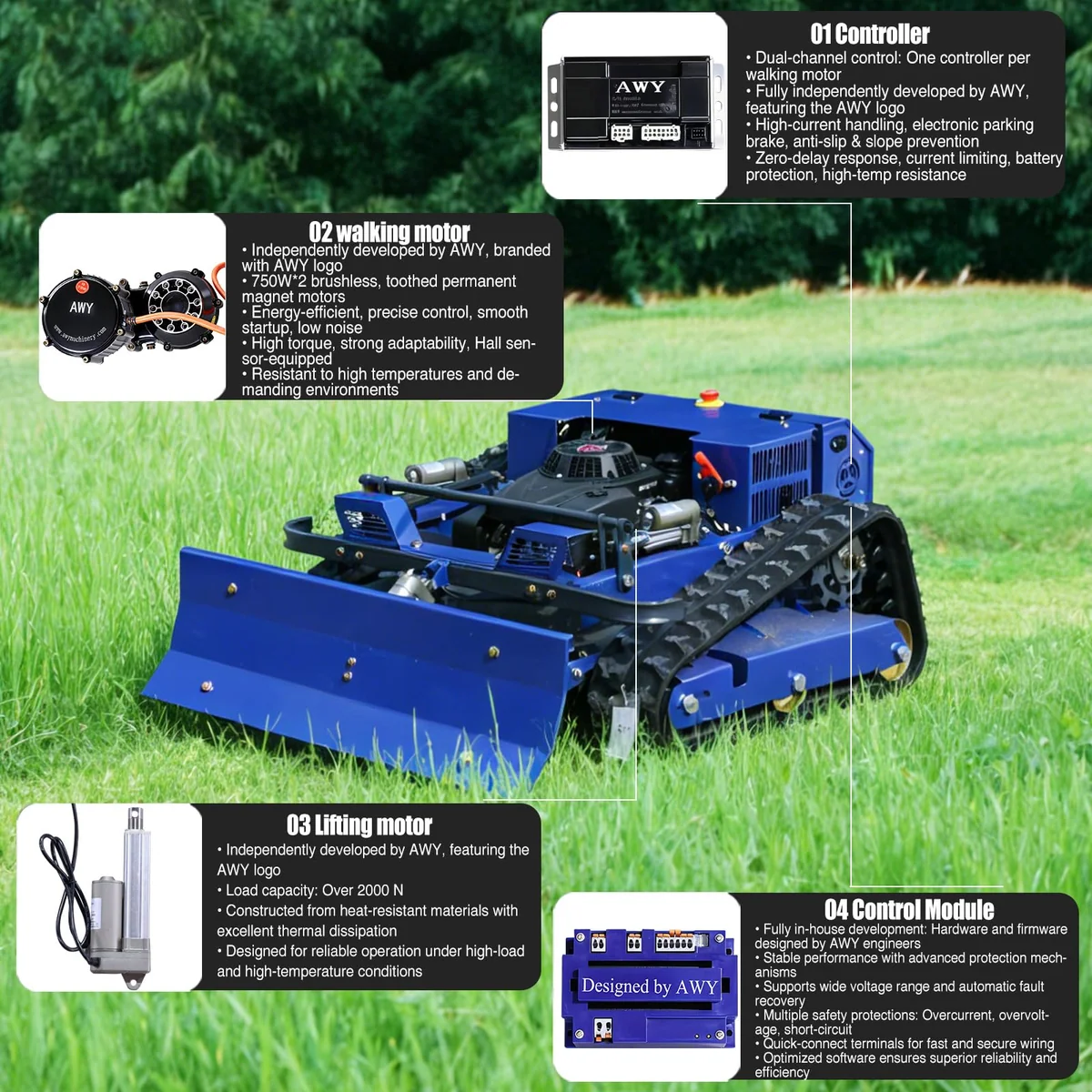
Other reports do not point to one tidy weak component. Water entered through a shutoff switch in one case, reached the control panel and led to melted wiring; another controller stopped after two uses; another owner replaced both batteries before the starter failed within three months. The listing’s brushless-drive-motor claim may be true in isolation, but it cannot support a whole-machine durability verdict when the surrounding electrical, starting, fuel and track systems have produced these failures.
Support is inconsistent rather than uniformly absent. Some buyers received prompt email replies, a custom installation video and replacement accessory hardware shipped from Hong Kong. Others waited weeks for diagnosis or tracking information and still lacked a working mower. Responsiveness matters less than resolution when the machine cannot move, and there is no evidence here of a local dealer network ready to identify parts or collect a disabled unit.
Frequently Asked Questions
Is the AIWEIYA AWY-550 an autonomous robotic lawn mower?
No, it is a radio-controlled tracked mower that requires an operator to steer it throughout the job.
Does the AWY-550 really mow a 45-degree slope?
The listing claims a 45-degree maximum and owners report impressive hillside performance, but no retained owner verified that angle with a measurement.
How long does the AWY-550 run before refueling?
Two positive owners working on hills report roughly 15 to 20 minutes per tank, although load and terrain can change fuel duration.
Will the AWY-550 give a normal lawn a clean finish?
It can cut grass evenly, but its weight and crawler tracks can tear turf during abrupt turns and make it a poor choice for small or striped lawns.
Can the AWY-550 be used in rain or standing water?
Wet operation is not advisable without a documented protection rating because one owner reports water entering the shutoff switch and damaging the control electronics.
Is a snow plow included with the AWY-550?
Plow inclusion appears package-dependent, and owners report separately paid, missing, delayed or incorrectly supplied plow components.
Is the AWY-550 reliable?
Its cutting performance earns real praise when functional, but reported early failures across the fuel, crawler, controller, battery, starter and wiring systems make reliability the central buying risk.
Sources (3)
- Amazon listings and customer reviews — Aiweiya Awy 550
- Owner reports across r/tech_news_and_gadgets, r/dapsCA, r/Sino and 6 more threads
- Owner and reviewer video, 3 channels