The acreage badge on a robot mower is a ceiling, not a lawn size.
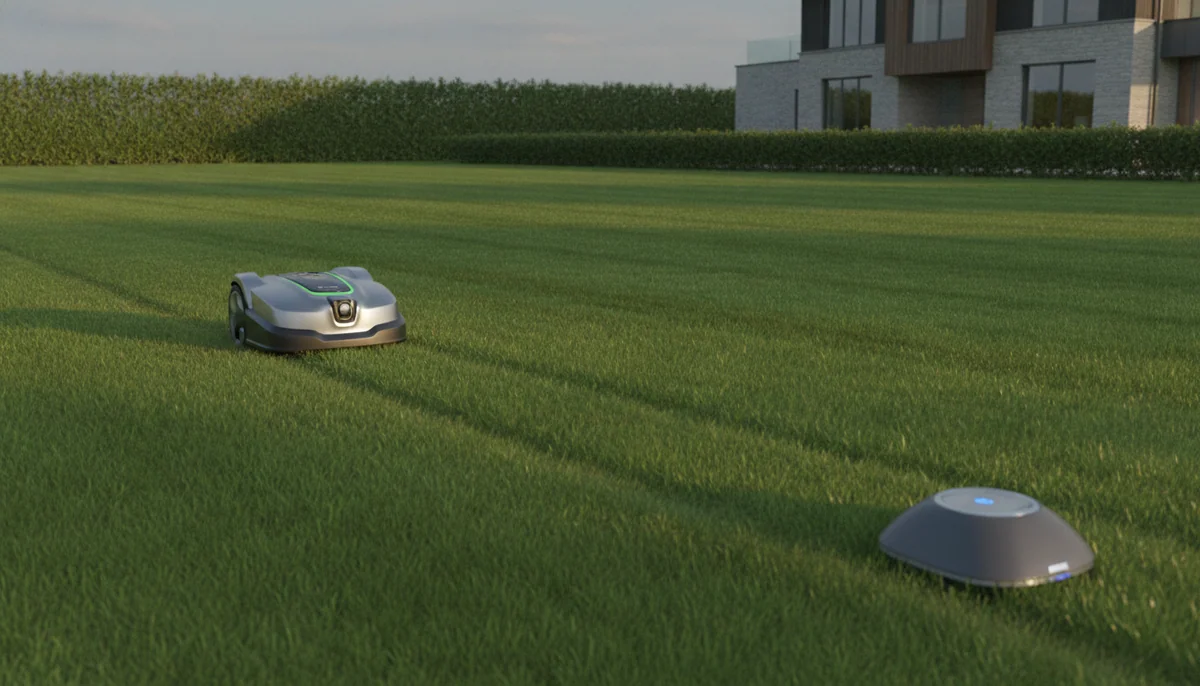
A robot mower rated for one acre does not cut an acre in one charge. It may not finish in one day. The number usually means the largest mapped area the manufacturer expects it to maintain by mowing, returning to the dock, charging, resuming, and repeating that cycle throughout the week.
That is not necessarily a trick. A person cares whether a push mower takes 45 minutes or three hours because the person is walking behind it. A robot can spend the afternoon outside without wasting the owner’s afternoon. Slow coverage becomes a problem only when the machine cannot catch up with growth before rain, closed gates, charging pauses, darkness, navigation faults, or another scheduled zone consume the available time.
The useful sizing question is therefore not “How many acres does the box claim?” It is “Can this mower keep every reachable section of my grass at maintenance height during the worst ordinary week?” That answer depends on much more than area.
One acre contains 43,560 square feet, but the mower only cares about grass
Start with mowable turf, not the parcel size shown on a property record. Subtract the house, driveway, patio, beds, woodland, pond, pool, paths, sheds, and every section that will remain outside the virtual boundary. A quarter-acre residential lot can contain barely 4,000 square feet of grass, while a larger rural parcel may devote almost all of its open ground to lawn.
Mapping the lawn with satellite imagery provides a useful first estimate, but walking the perimeter reveals the parts that matter to the robot. A narrow side strip, island beyond a driveway, fenced front yard, drainage ditch, or bank beside water may be included in the square footage while remaining impossible or unwise for the mower to reach autonomously.
| Advertised area | Square feet | Square metres |
|---|---|---|
| 1/8 acre | 5,445 sq ft | 506 m² |
| 0.15 acre | 6,534 sq ft | 607 m² |
| 0.2 acre | 8,712 sq ft | 809 m² |
| 1/4 acre | 10,890 sq ft | 1,012 m² |
| 0.3 acre | 13,068 sq ft | 1,214 m² |
| 0.37 acre | About 16,100 sq ft | About 1,500 m² |
| 1/2 acre | 21,780 sq ft | 2,023 m² |
| 3/4 acre | 32,670 sq ft | 3,035 m² |
| 1 acre | 43,560 sq ft | 4,047 m² |
| 1.5 acres | 65,340 sq ft | 6,070 m² |
These conversions prevent one common mistake, but they do not select the mower. Two lawns with the same area can impose completely different workloads.
The badge measures a week of work, not one heroic outing
Small pivoting blades, modest batteries, and narrow decks make robot mowers patient rather than fast. They remove a little growth, leave the fine clippings in the turf, and return often enough that the lawn never needs a major cut. Our guide to systematic cutting, mulching, docking, and charging explains that routine in detail.
The Sunseeker S4 illustrates the difference. It is rated for a quarter acre, yet a documented 0.2-acre lawn required two returns to the dock. The ECOVACS GOAT A2000 LiDAR PRO carries a half-acre rating while mowing for about 50 minutes before a roughly equal charging pause. The Mammotion LUBA Mini 2 1500H is rated for 1,500 square metres, but its stated coverage of up to 350 square metres per charge implies more than four ideal battery loads at the ceiling.
Large ratings stretch the same idea further. BESTMOW says its T100 can maintain 1.5 acres while covering more than 4,000 square feet per full charge, so a property at the maximum contains more than sixteen charge-sized sections before turns, slopes, and detours enter the calculation. Yarbo’s 6.2-acre claim describes repeated work across much of the week, not a 120-minute sweep of six acres.
Automatic charging makes those pauses tolerable. It does not make capacity infinite. A machine working near its limit has little recovery room after several rainy days, a blocked blade, an app failure, or grass growth that outruns the normal schedule. Once the lawn becomes tall, small razor blades flatten stems, leave clumps, and miss growth that a conventional rotary mower would lift into its deck.
Five things shrink usable capacity
Zones and access
Twenty saved zones do not help if a locked gate, flight of steps, loose gravel bed, or dangerous road separates them. Count an area as autonomous only when the mower can drive there and return to its dock without being carried. A safe paved crossing can work; a closed gate still turns its owner into part of the schedule.
Turns, obstacles, and narrow passages
A rectangular lawn lets the mower spend most of its battery cutting long rows. Trees, play equipment, beds, tight corners, and narrow side yards replace those productive minutes with braking, turning, rerouting, and short fragmented passes. The map can contain the same square footage while demanding far more work.
Slopes and ground condition
Climbing, wheelspin, and repeated recovery maneuvers consume time and energy. A two-wheel-drive mower may ascend a smooth dry bank yet slide while traversing it or dig into soft turf during a turn. Ruts, roots, curb lips, sprinkler hollows, and damp grass can reduce practical capacity more severely than a broad, even slope.
Navigation conditions
RTK mowers need dependable satellite correction, camera-led machines need visible grass and usable light, and LiDAR works best when stable features give it something to recognize. Choosing the wrong navigation system creates pauses, remapping, and missed routes that no acreage figure includes. The RTK, LiDAR, and camera-navigation guide is the better place to settle that part of the purchase.
Grass and weather
Dense turf, rapid spring growth, leaves, dew, and frequent rain all slow the schedule. A mower that comfortably maintains dry short grass may fall behind when several lost days create a heavier recovery cut. Grass compatibility and maximum cutting height can disqualify a mower even when its area rating looks generous.
Buy headroom where the yard creates friction
A simple, dry rectangle with obvious borders can sensibly use most of a mower’s stated capacity. A divided lawn with hills, trees, narrow corridors, rough transitions, and a gate should not. Smart Lawn Bots would move up at least one capacity class when several of those penalties occur together rather than buying the smallest machine whose maximum number technically contains the measured grass.
Headroom buys more than a larger map. Depending on the model, stepping up can bring a wider cutting deck, larger battery, stronger drive system, higher cutting range, or more time to recover after bad weather. It can also bring unnecessary weight, awkward access, more turf wear, and a larger body that no longer fits a side passage. Capacity must still fit through the gate.
| Rated class | Credible fit | Reason to choose more mower |
|---|---|---|
| Up to 1,600 sq ft | The YARDCARE V100 suits a tiny, dry, clearly bounded patch where manual charging and random coverage are acceptable. | Choose a mapped, self-charging model if schedules, deliberate lanes, or several zones matter. |
| About 1/8 acre | The ANTHBOT M5 is a credible small-lawn choice when its RTK antenna has open sky. | Move up if the lawn approaches the limit, lacks a clean satellite view, or regularly defeats two-wheel traction. |
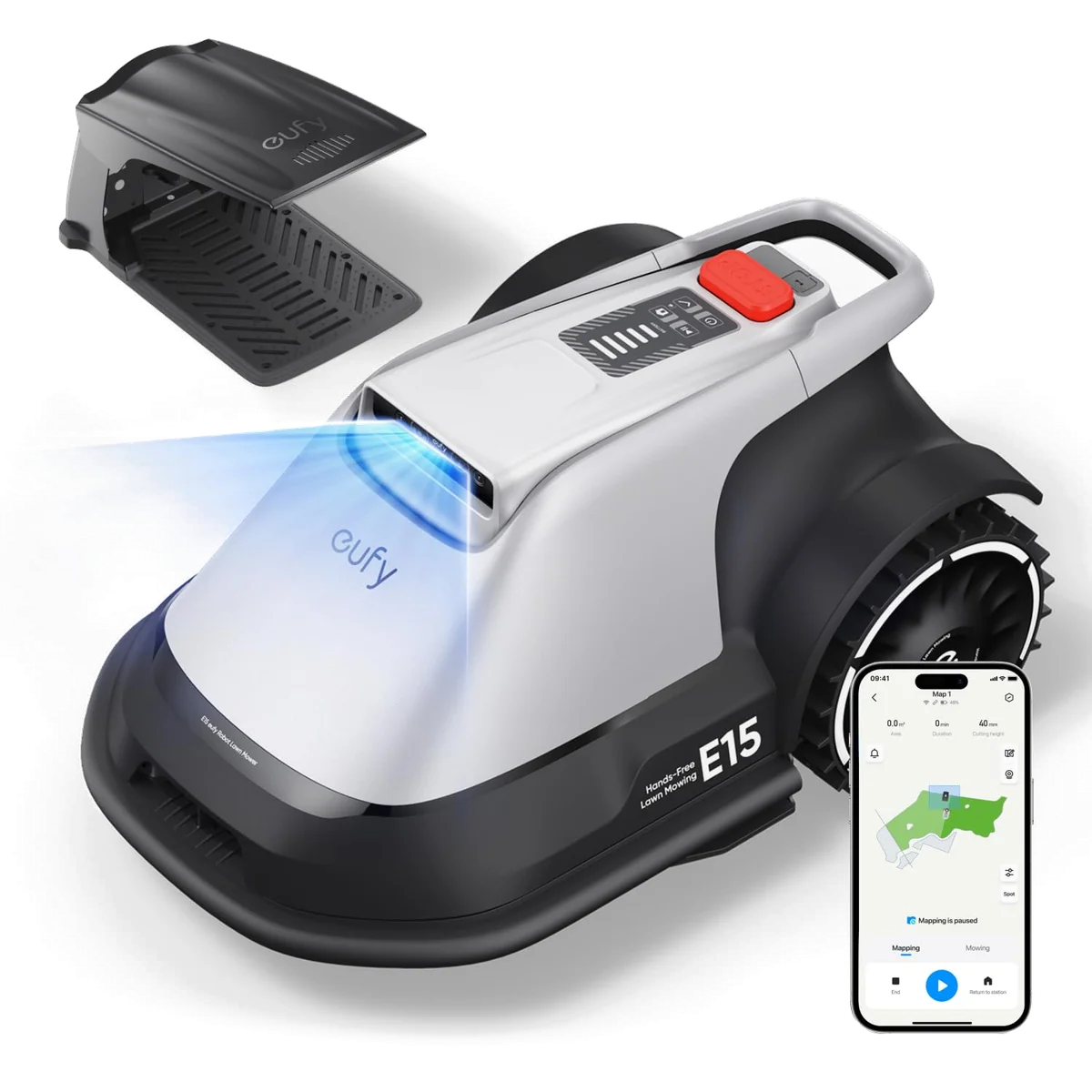
| 0.2 to 0.3 acre | The eufy E15 and E18 suit smooth, connected, camera-legible turf where avoiding an antenna matters. | The E18 raises mapped capacity but does not add a wider deck, longer established runtime, or tougher chassis. |
| 1/4 acre | The Sunseeker S4 and ECOVACS GOAT O1000 LiDAR PRO suit shaded or enclosed lawns that favor onboard LiDAR. | Both use narrow decks, while the O1000’s edge trimmer and the S4’s automatic resume do not eliminate charging time or manual finishing. |
| 0.37 acre | The Mammotion LUBA Mini 2 1500H fits rough or steep ground, while the Navimow i215 favors structured lawns with poor satellite reception. | Choose the LUBA for traction and the i215 for compact LiDAR navigation, but do not expect either to finish maximum area in one charge. |
| 1/2 acre | The ECOVACS GOAT A2000 LiDAR PRO is persuasive on smooth, clearly bounded grass where its wide deck and edge trimmer can work cleanly. | Its short mowing shifts and restrictive map correction make difficult boundaries or rough slopes reasons to look elsewhere. |
| 3/4 acre | The HOOKII Neomow X2 SE has the battery and LiDAR premise for a maintained lawn beneath trees. | Software, docking, traction, and recovery failures make it too uncertain for a property that cannot tolerate interruptions. |
| 1 acre | The Navimow X430 is the strongest fit here for serious terrain because it combines a 17-inch deck, four-wheel drive, suspension, and a four-inch maximum cut. | Its large body, positioning requirements, unfinished edges, and demanding dock placement still require a property audition. |
| More than 1 acre | A purpose-built large-lawn platform becomes necessary rather than simply adding more charging cycles to a smaller mower. | The BESTMOW T100 lacks enough supporting evidence, and Yarbo should not be the only mower on a multi-acre property. |
The sensible choices at each end of the scale
For roughly 1/8 acre of open, maintained grass, the ANTHBOT M5 is the straightforward capacity match. Its systematic cutting and recharge-and-resume behavior are more autonomous than a drop-and-mow machine, but the RTK station needs open sky and the inset disc leaves trimming beside walls and fences.
At a quarter acre beneath trees or beside buildings, the Sunseeker S4 makes a stronger case than its narrow deck first suggests. Onboard LiDAR removes the antenna problem, while slow multi-charge coverage, weak vertical-edge cutting, and rear-wheel-drive vulnerability remain the price of that convenience.
For up to 0.37 acre where hills, roots, and rough transitions define the yard, the Mammotion LUBA Mini 2 1500H is the more convincing compact machine. Its AWD hardware earns the recommendation, although more than four ideal battery loads at maximum area, occasional app trouble, and unfinished raised edges argue for comfortable capacity headroom.
For a smooth lawn approaching half an acre, the ECOVACS GOAT A2000 LiDAR PRO pairs a useful 12.96-inch deck with antenna-free navigation and a real side trimmer. It is less persuasive on adjoining fenced zones, curb drops, rough grades, or any property where stubborn map editing could prevent the mower from reaching half the grass.
At the one-acre class, the Segway Navimow X430 is the first machine in this set whose hardware looks proportionate to the badge. Its 17-inch deck and four-wheel-drive chassis address throughput and terrain directly, but a 24-inch body needs generous access and the positioning system still has to accept the dock location.
Beyond one acre, caution becomes more valuable than optimism. The large-yard mower guide considers platforms built for that scale, including alternatives with more credible capacity than asking a residential robot to live permanently between the lawn and charger. A mower that reaches the entire property slowly and unreliably is not larger in any useful sense.
A five-minute sizing audit before checkout
- Measure only the grass. Record each lawn section separately instead of relying on the lot size.
- Trace the route home. Confirm that the mower can drive from every zone to the dock without steps, traffic, loose ground, or a gate that will usually be closed.
- Identify the yard’s hardest condition. Choose around blocked sky, steep traverses, wet turf, rough transitions, or narrow access before comparing acreage.
- Check the working calendar. Allow for charging, rain delays, daylight limits, sprinklers, pets, and the hours when gates can remain open.
- Leave recovery margin. Do not buy directly on the advertised ceiling unless the lawn is unusually simple and every other requirement is favorable.
The final choice should feel slightly overqualified for the measured grass and correctly qualified for the difficult part of the property. That is not wasted capacity. It is what lets the robot lose a day, recharge several times, take a cautious route around a tree, and still keep the lawn from turning into a recovery job.
Frequently Asked Questions
Does a one-acre rating mean the mower cuts one acre on a single charge?
No, it normally describes the total mapped grass the machine can maintain through repeated mowing, charging, and automatic resumption.
Should I use my property’s lot size when choosing a robot mower?
No, measure only the mowable grass and then check whether every included section has a safe driveable route to the charging station.
Should I buy a mower rated for exactly the amount of grass I have?
Only a simple favorable lawn should approach the advertised ceiling, while complicated properties deserve at least one capacity class of headroom.
Do multiple zones increase the acreage a mower can handle?
No, zones organize the existing mapped capacity and do not expand the mower’s supported total area.
Can a robot mower maintain separate front and back lawns?
Yes, but only when it can travel safely between them and return to its dock without being carried or waiting for someone to open a gate.
Does a larger battery always mean a larger acreage rating?
No, cutting width, navigation efficiency, charging speed, terrain, software limits, and the manufacturer’s mapped-area allowance also determine useful capacity.
What happens if the robot mower is too small for the lawn?
It spends too much of the week mowing and charging, then falls behind when weather, faults, or rapid growth interrupt the schedule.
Sources (122)
- Amazon listings and customer reviews
- Owner reports across r/RobotVacuums, r/eufyS1Pro, r/eufy and 36 more threads
- Owner and reviewer video, 249 channels
- Walmart listing
- Costco listing
- Target listing
- Facebook — Article — www.facebook.com
- Hedgecombers — Article — hedgecombers.com
- Bestrobovacuums — Article — www.bestrobovacuums.com
- Chewy — Article — www.chewy.com
- eufy — Article — www.eufy.com
- Substack — Article — robovacinsights.substack.com
- eufy — Article — service.eufy.com
- Countryliving — Article — www.countryliving.com
- Rtings — Article — www.rtings.com
- Vacuumwars — Article — vacuumwars.com
- Younghouselove — Article — www.younghouselove.com
- Womanandhome — Article — www.womanandhome.com
- Interlightus — Article — www.interlightus.com
- Coredy — Article — www.coredy.com
- Moderncastle — Article — moderncastle.com
- Thecarpentersdaughter — Article — thecarpentersdaughter.co.uk
- Techradar — Article — www.techradar.com
- Trustedreviews — Article — www.trustedreviews.com
- Lbtechreviews — Article — www.lbtechreviews.com
- Tomsguide — Article — www.tomsguide.com
- Pcmag — Article — www.pcmag.com
- Zdnet — Article — www.zdnet.com
- Trustpilot — Article — uk.trustpilot.com
- Amgardaseeblick — Article — amgardaseeblick.com
- Pistonheads — Article — www.pistonheads.com
- Bestbuy — Article — www.bestbuy.com
- Ycombinator — Article — news.ycombinator.com
- Mammotion — Article — us.mammotion.com
- Trustpilot — Article — www.trustpilot.com
- Pcworld — Article — www.pcworld.com
- Toptenreviews — Article — www.toptenreviews.com
- Trustpilot — Article — au.trustpilot.com
- Mammotion — Article — eu.mammotion.com
- Mammotion — Article — uk.mammotion.com
- Easylawnmowing — Article — www.easylawnmowing.com
- Easylawnmowing — Article — easylawnmowing.co.uk
- Therobotmower — Article — therobotmower.co.uk
- Androidauthority — Article — www.androidauthority.com
- Freshlycharged — Article — freshlycharged.com
- Au — Article — robotlawnmowers.com.au
- Nytimes — Article — www.nytimes.com
- Cnet — Article — www.cnet.com
- Consumerreports — Article — www.consumerreports.org
- Expertreviews — Article — www.expertreviews.co.uk
- Gardenersworld — Article — www.gardenersworld.com
- Smarthomescene — Article — smarthomescene.com
- HOOKII — Article — hookii.com
- Mammotion — Article — ca.mammotion.com
- Tractorsupply — Article — www.tractorsupply.com
- Substack — Article — jjtechish.substack.com
- Basic Tutorials — Article — basic-tutorials.com
- Smarthomeassistent — Article — www.smarthomeassistent.de
- Mein Gartenexperte — Article — www.mein-gartenexperte.de
- Techreviewer — Article — www.techreviewer.de
- Mowingmagic — Article — mowingmagic.com
- Fr — Article — maniaques.fr
- Basic Tutorials — Article — basic-tutorials.de
- Frandroid — Article — www.frandroid.com
- Appgefahren — Article — www.appgefahren.de
- Yarbo — Article — www.yarbo.com
- Lowes — Article — www.lowes.com
- Fredshed — Article — www.fredshed.co.uk
- Tv — Article — www.stuff.tv
- Yarbo — Article — forum.yarbo.com
- Yarboreview — Article — yarboreview.com
- Shopsunseekertech — Article — shopsunseekertech.com
- T3 — Article — www.t3.com
- Warehouserunner — Article — app.warehouserunner.com
- Electricrevolutionreviews — Article — electricrevolutionreviews.com
- Sunseekertech — Article — sunseekertech.com
- Sunseekerelite — Article — sunseekerelite.com
- Bobvila — Article — www.bobvila.com
- Segway — Article — navimow.segway.com
- Navimow — Article — navimow.com
- Au — Article — segway.com.au
- Lifehacker — Article — lifehacker.com
- Theverge — Article — www.theverge.com
- Maison Et Domotique — Article — www.maison-et-domotique.com
- Au — Article — roboticmower.com.au
- Techadvisor — Article — www.techadvisor.com
- Homedepot — Article — www.homedepot.com
- Cnygreenteam — Article — cnygreenteam.com
- Outdoor Usa — Article — outdoor-usa.com
- Protoolreviews — Article — www.protoolreviews.com
- Homebuilding — Article — www.homebuilding.co.uk
- Gizmodo — Article — gizmodo.com
- Suncolawns — Article — shop.suncolawns.com
- Smartyardnw — Article — smartyardnw.com
- the Ambient — Article — www.the-ambient.com
- Outdoorica — Article — outdoorica.com
- Notebookcheck — Article — www.notebookcheck.net
- Smart Dots — Article — www.smart-dots.com
- Trustpilot — Article — ie.trustpilot.com
- Homeandgardenselect — Article — homeandgardenselect.com
- Eu — Article — www.letemsvetemapplem.eu
- Robomowlab — Article — robomowlab.com
- Eftm — Article — eftm.com
- ECOVACS — Article — www.ecovacs.com
- Au — Article — www.harveynorman.com.au
- Thespruce — Article — www.thespruce.com
- Pcmag — Article — uk.pcmag.com
- 9to5google — Article — 9to5google.com
- Mensjournal — Article — www.mensjournal.com
- Lawncraftsupply — Article — lawncraftsupply.com
- Smarthomecompared — Article — smarthomecompared.com
- Smarthomeexplorer — Article — www.smarthomeexplorer.com
- Mowscout — Article — www.mowscout.com
- Hunker — Article — www.hunker.com
- WORX — Article — www.worx.com
- Upzy — Article — www.upzy.com
- Newatlas — Article — newatlas.com
- Reviewed — Article — www.reviewed.com
- Pwcparts — Article — pwcparts.com
- Familyhandyman — Article — www.familyhandyman.com
- Sitejabber — Article — www.sitejabber.com
- Yardcareinc — Article — yardcareinc.com