Wire-free robot mowers cut the boundary cable, not every connection.
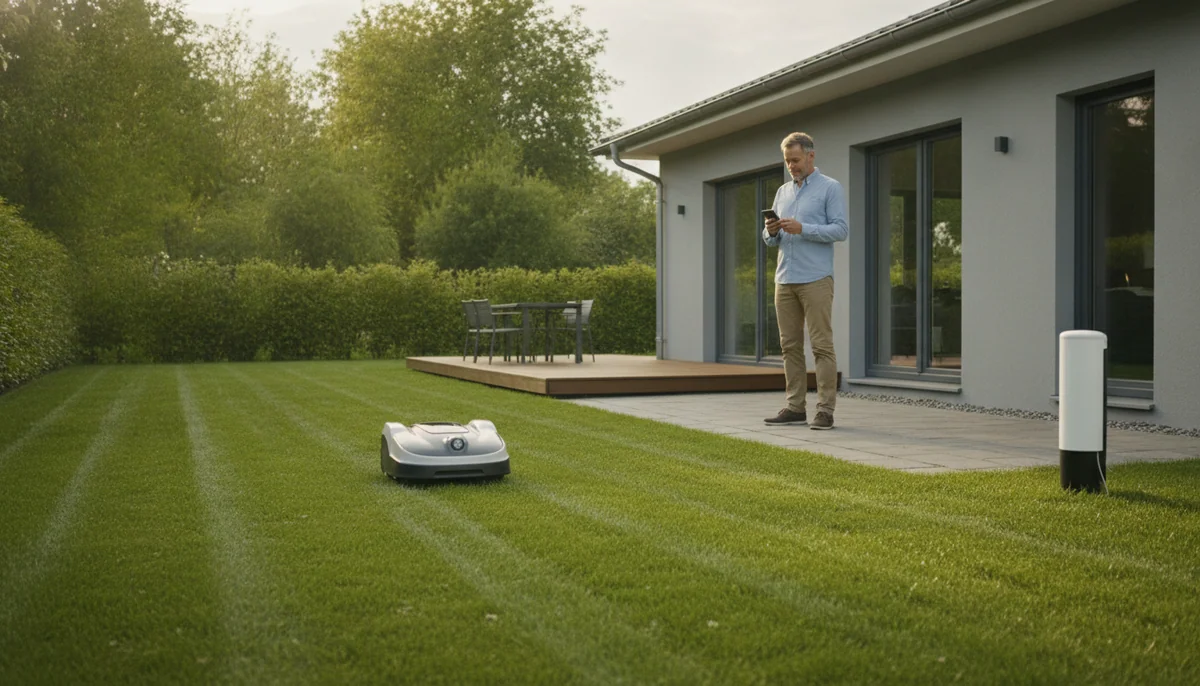
“Wire-free” makes one specific promise: there is no perimeter cable buried or pegged around the grass. It does not promise that the mower is offline, satellite-free, antenna-free, account-free, or able to work after every supporting service disappears. Those are separate questions, despite product listings routinely compressing them into one fog of GPS, AI, RTK, 4G, LiDAR, and app-control language.
The distinction becomes obvious in the yard. A LiDAR mower beneath mature trees can navigate perfectly well while the phone has weak Wi-Fi, because it is reading nearby geometry rather than asking a router where the flower bed begins. An RTK mower on an open lawn may also travel beyond household Wi-Fi, but its own satellite receiver and fixed reference antenna must maintain accurate positioning. A Network RTK mower can remove that pole, although it then relies on correction data arriving from infrastructure the owner does not control.
Choose the positioning system first. Treat Wi-Fi, cellular service, and subscriptions as ownership questions after that. A useful app cannot rescue a mower that loses its boundary beside the shed, while a mower with reliable local navigation can often keep cutting even when its remote status screen becomes unavailable.
Four connections that do four different jobs
| Technology | Usual job | What it does not automatically mean | The buying question |
|---|---|---|---|
| Wi-Fi | Account setup, firmware downloads, schedules, map editing, notifications, and remote control | It does not necessarily position the mower or need to cover every blade of grass. | Which functions disappear when the mower leaves router range? |
| GPS or other satellite navigation | Positioning, security tracking, or both, depending on the model | A GPS theft marker does not prove that satellites guide the cutting route. | Is satellite reception part of mowing, theft recovery, or merely a map display? |
| Physical RTK antenna | Provides a fixed local reference that corrects satellite-positioning errors | It is not a household Wi-Fi aerial and does not create internet coverage. | Can it be mounted firmly with a broad, lasting view of the sky? |
| Network RTK or cellular data | Delivers correction data, remote access, tracking, or alerts through an external network | Included service for one function does not make every connected feature free forever. | Which service is essential to navigation, what is merely optional, and what happens if either ends? |
| Bluetooth | Close-range pairing, manual mapping, and local setup | It does not provide remote monitoring from inside the house or across town. | Which map changes require standing beside the mower? |
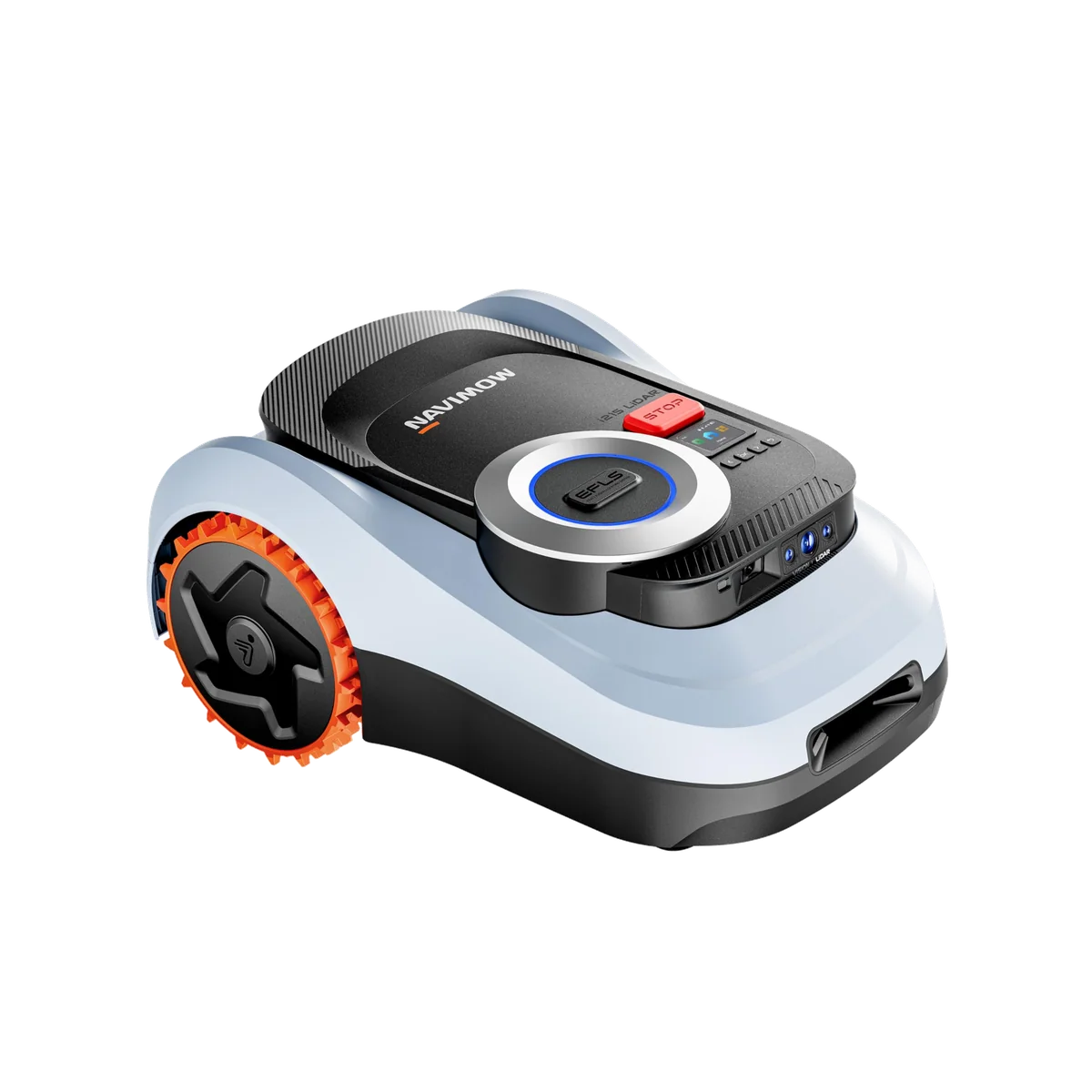
“GPS mower” is therefore too vague to guide a purchase. The Navimow i215 carries GPS security functions, yet LiDAR and vision handle the mowing map. The ANTHBOT M5 uses satellites for its central navigation and needs the supplied RTK reference station. The Navimow X430 normally obtains correction through Network RTK, so it can avoid a permanent antenna in a suitable location. All three can be described with satellite language, but they impose very different conditions on the property.
The same care is needed with Wi-Fi. These are app-based machines, so an internet connection near the dock is valuable for pairing, updates, maps, and remote control. Complete lawn coverage is a different matter. A weak signal at the far fence may remove a live camera view or delay a status update without making an onboard LiDAR map vanish. The exact fallback behavior belongs in the manual for the exact model, not in a general promise about “smart mowing.”
For a fuller account of how virtual boundaries are created, start with how wire-free robot mowers replace perimeter cable; the practical differences among the sensors themselves are covered in the RTK, LiDAR, and camera-navigation guide.
The six mowers answer the connection question differently
| Mower | What guides it | Physical antenna | Subscription position | Honest drawback |
|---|---|---|---|---|
| Navimow i215 LiDAR | Onboard solid-state LiDAR and vision | None for mowing | Ordinary local mowing does not depend on renewing cellular monitoring after its included period. | Rear-wheel drive, uncertain docking on some properties, and no dedicated cliff sensor demand a prepared lawn. |
| Navimow X430 | Network RTK, vision, and visual-inertial positioning | Normally none, although some installations may use the supplied receiver hardware | Its core Network RTK service is advertised as included for the life of the X4 Series, but that does not settle every cellular or tracking feature. | Dock siting and signal behavior can require experimentation, and one serious report described uncontrolled cutting-height changes. |
| ECOVACS GOAT A2000 LiDAR PRO | Rotating LiDAR, depth-sensing LiDAR, and a camera | None | No required mowing subscription is established in the available record. | Short mowing shifts are manageable, but stubborn map correction can defeat complicated fenced zones. |
| ECOVACS GOAT O1000 LiDAR PRO | Dual onboard LiDAR and vision | None | No required mowing subscription is established, and there is no cellular connection to fill Wi-Fi gaps. | Manual mapping is fussy, while small casters and rear drive are poorly suited to soft or rough ground. |
| ANTHBOT M5 | Full-band RTK and dual cameras | Yes, the supplied RTK reference station is central to positioning | Local RTK navigation does not require active 4G, although setup and control remain tied to ANTHBOT’s app ecosystem. | The antenna needs open sky, and the inset cutting disc leaves a fringe beside hard boundaries. |
| ANTHBOT M9 | RTK, NRTK, and dual vision are claimed without a clear explanation of how they hand off | A reference station is included | NRTK connectivity and fee terms are not established clearly enough to budget with confidence. | A 3.2-star customer rating and missing ownership details make the entire package too uncertain for a dependable recommendation. |
The table exposes the real divide. LiDAR models exchange satellite-placement work for dependence on stable, visible surroundings. RTK models exchange boundary wire for an antenna-placement job. Network RTK removes the pole but introduces a network service into the positioning chain. None is automatically superior; the correct system is the one least likely to lose its place in the hardest part of the yard.
Under trees, buy the mower that can see the yard
A shaded lawn between a house, fence, mature trees, and raised beds is the strongest case for onboard LiDAR. Those fixed surroundings give the mower geometry to read while the roofline and canopy make satellite reception troublesome. The trade is not perfection. A featureless open field can offer LiDAR fewer useful landmarks, and moving objects do not become permanent boundaries merely because a sensor can see them.
For roughly a quarter acre, the GOAT O1000 LiDAR PRO is the compact choice. Its dedicated side trimmer can substantially reduce cleanup along long, flush paving, but fences, inside corners, raised edges, and conservative no-go areas still defeat the “edge-to-edge” promise. Its narrow deck also turns a near-capacity lawn into several patient mowing and charging sessions.
The Navimow i215 stretches the same antenna-free idea to a rated 0.37 acre and provides deeper control over zones, directions, and schedules. It suits an enclosed, structured lawn where fences, buildings, and trees create recognizable landmarks. Its off-road tires do not make it an AWD machine, however, and wet traverses, ruts, thick turf, abrupt drops, or unreliable dock approaches can turn autonomy into retrieval work.
The GOAT A2000 LiDAR PRO is the better medium-lawn answer when deck width and edge reduction matter more than compact access. Its overlapping dual discs cover nearly 13 inches per pass, and its separate trimmer attacks the strip most robots simply leave behind. The mower is convincing on smooth, clearly divided grass; the software is much less convincing when adjoining zones, fences, and narrow passages make local map correction essential.
Buy none of these solely because trees exist. LiDAR still needs clean sensors, legible surroundings, a safe virtual boundary, and a dock with power and a workable approach. The guide to robot mowers for trees, buildings, and poor satellite reception narrows the choice by yard shape rather than sensor label.
Under open sky, a physical antenna can be the simpler bargain
An RTK station is not inherently a burden. On a small open property, it can be a stable local reference that does its work without a recurring data plan. The trouble begins when the only mounting point sits beneath branches, against a tall wall, or somewhere likely to move. Shifting the reference after mapping can shift the virtual lawn with it.
The ANTHBOT M5 makes the strongest value case among these products. It maintains roughly 1/8 acre in orderly passes, manages multiple zones, returns to charge, and can continue beyond complete yard-wide Wi-Fi coverage because the local RTK system handles positioning. Its limits are equally clear: it wants open sky, maintained grass, moderate terrain, cleared obstacles, and a string trimmer for walls and fences.
The larger ANTHBOT M9 should not be treated as the obvious upgrade. Its quarter-acre brief, automatic mapping, thirty-zone claim, dual cameras, RTK, and NRTK read like answers to every objection. The ownership record does not establish dependable mapping, navigation handoffs, battery behavior, weather protection, parts supply, or NRTK fees, while its customer rating signals substantial dissatisfaction without explaining one correctable cause. Smart Lawn Bots would pass until those uncertainties are resolved.
A large difficult lawn changes the calculation
The Navimow X430 is the outlier because its positioning question sits inside a much larger terrain decision. A 17-inch dual-disc deck, four driven wheels, suspension, steerable front wheels, and a four-inch maximum cutting height make it credible on an acre where a compact LiDAR mower would spend most of its life charging or struggling through transitions.
Its Network RTK system usually avoids a permanent lawn antenna, and the core correction service is advertised as included for the X4 Series. That is not permission to ignore connectivity. The dock still needs a powered location the positioning system accepts, surrounding structures can complicate reception, and remote-property ownership still needs someone capable of reaching a stranded machine. One report of the cutting height dropping unexpectedly and scalping grass also makes a supervised property audition essential.
A flat suburban rectangle wastes much of the X430’s capability, while grass beyond its one-acre managed-area ceiling calls for more capacity rather than endless extra charging. The large-yard guide covers that capacity decision, and the Navimow i215 and X430 comparison separates a navigation problem from a terrain problem.
What happens when the internet goes out
Do not assume either complete failure or complete independence. A mower with a stored map and onboard positioning may continue an existing schedule while app commands, notifications, camera viewing, weather data, and remote changes become unavailable. A local RTK mower may still know where it is when household Wi-Fi fails. A Network RTK mower has a different dependency because correction data must reach it from outside the property.
The only safe pre-purchase answer is model-specific. Ask whether a saved schedule starts offline, whether an interrupted job resumes, whether the stop control remains local, whether maps survive an account or router change, and whether a lost correction service makes the mower stop safely or continue with degraded accuracy. “App controlled” answers none of those questions.
Subscriptions deserve the same precision. A fee may fund mobile tracking or remote connectivity without affecting ordinary mowing, while a separate positioning service may be included under different terms. Record the included period and renewal conditions before buying, then decide whether losing each feature would be an inconvenience, a security compromise, or the end of autonomous cutting. The broader robot-mower cost guide includes connectivity alongside blades, accessories, repairs, and other ownership expenses.
Buy for the failure your yard is most likely to produce
- Walk the weakest-signal area first. Stand beside the house, under the densest canopy, and inside every narrow side passage rather than judging reception from the patio.
- Separate mowing navigation from theft tracking. A GPS location dot can help find a stolen mower without guiding a single cutting lane, as explained in the guide to robot-mower theft protection and GPS tracking.
- Choose the antenna location before the RTK mower. It needs stable mounting, power where required, and a lasting view of the sky, not merely an empty spot that works before the trees leaf out.
- Test the offline state deliberately. After mapping, disconnect household Wi-Fi and confirm scheduling, docking, resumption, local stopping, and app behavior while the return window still protects the decision.
- Read service promises one function at a time. Position correction, remote control, camera access, theft alerts, and cellular tracking can have different terms even when one product page calls all of them “connectivity.”
The useful verdict is not that connected mowers are bad or that LiDAR always wins. A compatible wire-free mower can remove most central-lawn work without a boundary cable or monthly mowing fee. The wrong navigation system merely replaces that cable with a recurring signal problem. Buy the machine whose dependencies your property can satisfy on an ordinary cloudy Tuesday, not the one with the longest row of acronyms.
Frequently Asked Questions
Does a wire-free robot lawn mower need Wi-Fi across the entire yard?
Usually not for positioning, but weak Wi-Fi can remove remote controls, live status, camera access, updates, or other app functions depending on the exact mower.
Can a robot mower work without GPS?
Yes, an onboard LiDAR-and-vision mower can navigate without satellite positioning, although the same machine may still include GPS for location or theft features.
Does every RTK robot mower need an antenna in the yard?
No, local RTK models use a physical reference station while Network RTK models can receive correction data through an external service instead.
Does RTK require a monthly subscription?
Not inherently, because a supplied local reference station can provide correction without a recurring data plan, while Network RTK and optional cellular features follow model-specific service terms.
Will a LiDAR mower keep cutting when the internet fails?
Its onboard navigation and saved map may continue working, but remote commands, notifications, updates, weather information, and live viewing can disappear until connectivity returns.
Is cellular tracking the same as GPS navigation?
No, GPS can establish a location while cellular service transmits that location remotely, and neither fact alone proves that the mower uses satellites to follow its cutting boundary.
Which mower should I choose for a yard beneath mature trees?
Start with an onboard LiDAR model when dense canopy and nearby buildings make a stable RTK antenna position doubtful, then verify that the lawn offers firm ground and useful fixed landmarks.
Sources (62)
- Amazon listings and customer reviews
- Owner reports across r/roboticLawnmowers, r/Navimow_Segway, r/SegwayNavimow and 10 more threads
- Owner and reviewer video, 103 channels
- Toptenreviews — Article — www.toptenreviews.com
- Expertreviews — Article — www.expertreviews.co.uk
- Segway — Article — navimow.segway.com
- Trustedreviews — Article — www.trustedreviews.com
- Therobotmower — Article — therobotmower.co.uk
- Navimow — Article — navimow.com
- Trustpilot — Article — www.trustpilot.com
- Pcmag — Article — www.pcmag.com
- Pcworld — Article — www.pcworld.com
- Facebook — Article — www.facebook.com
- Au — Article — segway.com.au
- Lifehacker — Article — lifehacker.com
- Theverge — Article — www.theverge.com
- Maison Et Domotique — Article — www.maison-et-domotique.com
- Au — Article — roboticmower.com.au
- Lowes — Article — www.lowes.com
- Techadvisor — Article — www.techadvisor.com
- Homedepot — Article — www.homedepot.com
- Tv — Article — www.stuff.tv
- Cnygreenteam — Article — cnygreenteam.com
- Outdoor Usa — Article — outdoor-usa.com
- Easylawnmowing — Article — www.easylawnmowing.com
- Protoolreviews — Article — www.protoolreviews.com
- Homebuilding — Article — www.homebuilding.co.uk
- Techradar — Article — www.techradar.com
- Gizmodo — Article — gizmodo.com
- Suncolawns — Article — shop.suncolawns.com
- Smartyardnw — Article — smartyardnw.com
- the Ambient — Article — www.the-ambient.com
- Outdoorica — Article — outdoorica.com
- T3 — Article — www.t3.com
- Notebookcheck — Article — www.notebookcheck.net
- Mowingmagic — Article — mowingmagic.com
- Smart Dots — Article — www.smart-dots.com
- Nytimes — Article — www.nytimes.com
- Trustpilot — Article — ie.trustpilot.com
- Homeandgardenselect — Article — homeandgardenselect.com
- Cnet — Article — www.cnet.com
- Yarbo — Article — www.yarbo.com
- Mammotion — Article — us.mammotion.com
- Consumerreports — Article — www.consumerreports.org
- Easylawnmowing — Article — easylawnmowing.co.uk
- Eu — Article — www.letemsvetemapplem.eu
- Robomowlab — Article — robomowlab.com
- Bobvila — Article — www.bobvila.com
- Eftm — Article — eftm.com
- ECOVACS — Article — www.ecovacs.com
- Au — Article — www.harveynorman.com.au
- Bestbuy — Article — www.bestbuy.com
- Thespruce — Article — www.thespruce.com
- Pcmag — Article — uk.pcmag.com
- 9to5google — Article — 9to5google.com
- Mensjournal — Article — www.mensjournal.com
- Tomsguide — Article — www.tomsguide.com
- Lawncraftsupply — Article — lawncraftsupply.com
- Smarthomecompared — Article — smarthomecompared.com
- Smarthomeexplorer — Article — www.smarthomeexplorer.com
- Mowscout — Article — www.mowscout.com
- Hunker — Article — www.hunker.com