The ANTHBOT M5 makes budget RTK mowing credible, but only under open sky.
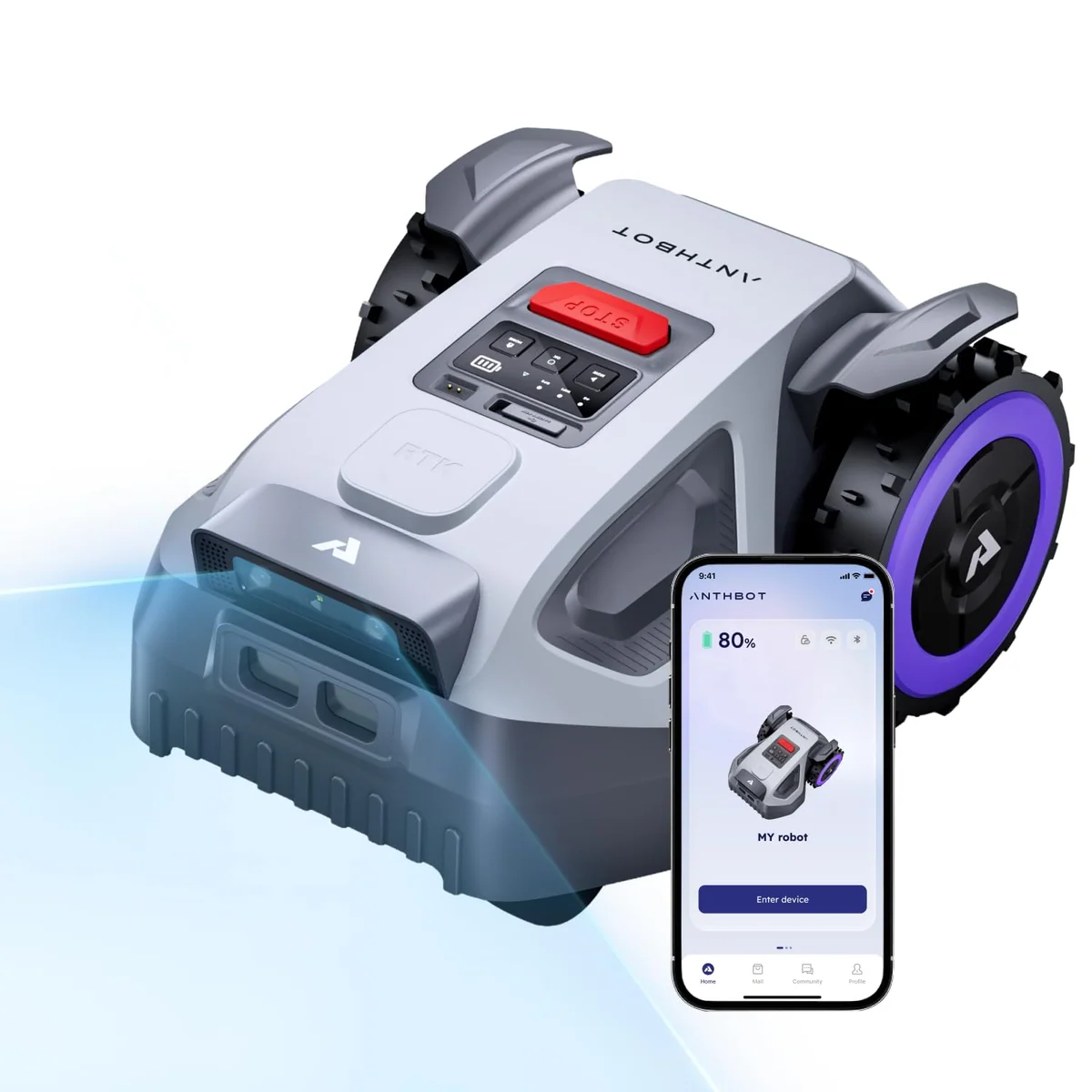
Buy the ANTHBOT M5 for a mostly open lawn of roughly 1/8 acre, but walk away if trees, close buildings, difficult hills, or a demand for perfect edging define the yard.
The right lawn turns the M5 into a bargain
The ANTHBOT M5 deserves a recommendation because it performs the job that matters on a suitable lawn: it keeps maintained grass short, orderly, and presentable with little weekly involvement. Manual mapping is manageable, the app has genuine depth, separate zones work, recharge-and-resume works, and the mower is quiet enough to become background activity.
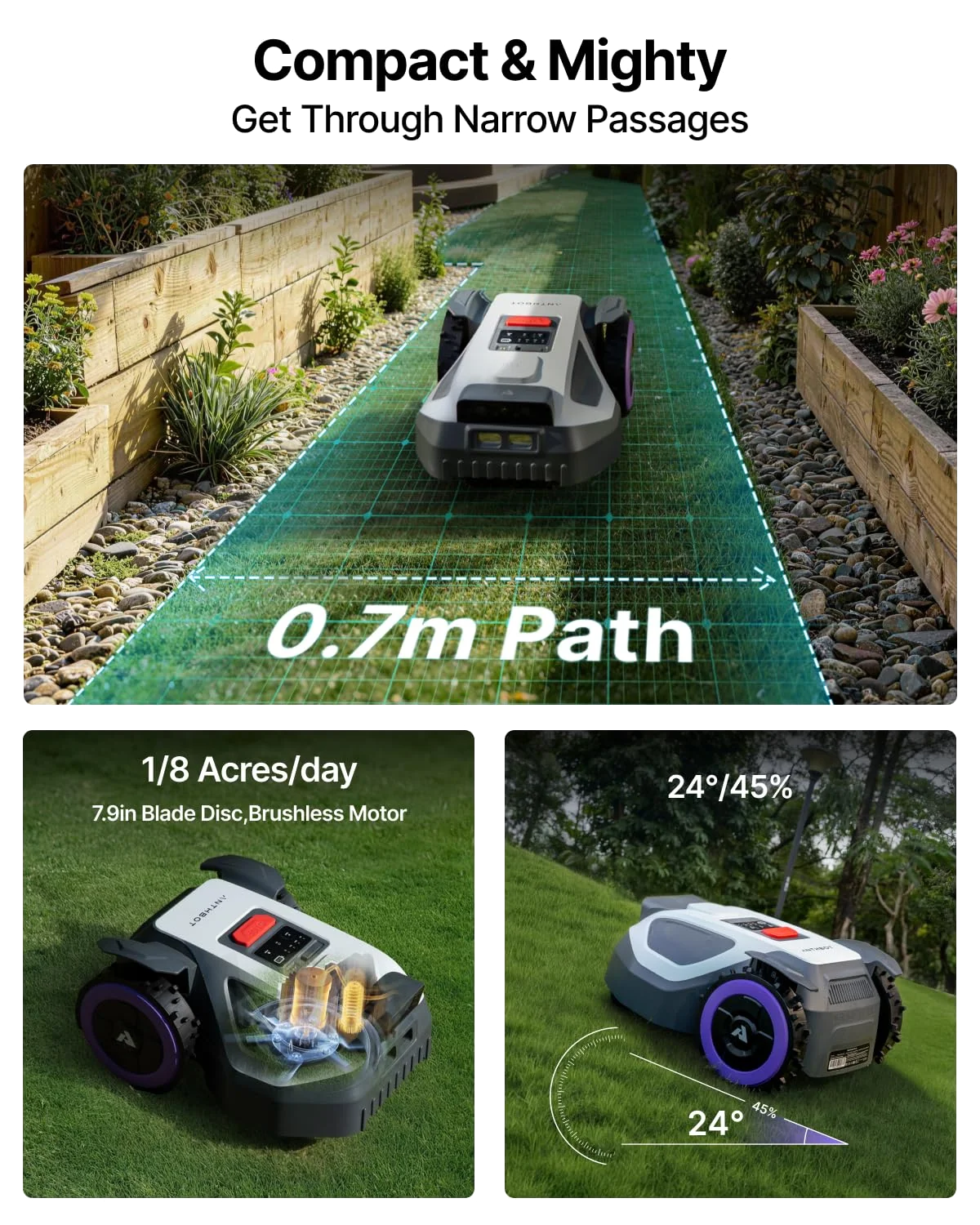
It is not the default choice for every small yard. Reject it when the RTK station cannot see open sky, the lawn is rough or persistently wet, hills are a defining feature, or walls and raised borders make the remaining edge fringe unacceptable. The claimed 45% maximum grade is about 24 degrees, not 45 degrees, and conflicting owner outcomes make that a marketing ceiling rather than a safe planning figure.
Buy it for roughly 1/8 acre of mostly smooth, clearly bounded grass where regular maintenance matters more than leaf mulching or perfect edging. Keep a string trimmer, clear the toys, and do not confuse the standard RTK M5 with its LiDAR namesake. Under those conditions, it removes most routine mowing without pretending to remove every yard chore.
The M5 is the rare inexpensive robot mower whose ambition does not immediately outrun its hardware. It maps without a buried perimeter wire, follows orderly lanes rather than wandering randomly, changes cutting height from the app, manages separate zones, returns to charge, and resumes the unfinished job. On maintained grass, the five-blade disc leaves convincing straight stripes.
That sounds like a premium mower condensed into a compact shell. It is not. The M5 earns its value by being narrowly good at a small, favorable lawn rather than universally capable. Its RTK reference station needs open sky, its cameras do not make every obstacle safe, and the inset blade disc cannot cut flush against walls or fences.
The first buying decision is therefore not whether robot mowing sounds useful. It is whether this particular navigation system fits the property. The standard M5 reviewed here is an RTK-and-camera mower, not the separate M5 LiDAR variant. A search result or product description that blurs those machines is hiding the most important distinction.
Key Specifications
The cameras help, but the sensitivity setting decides how much
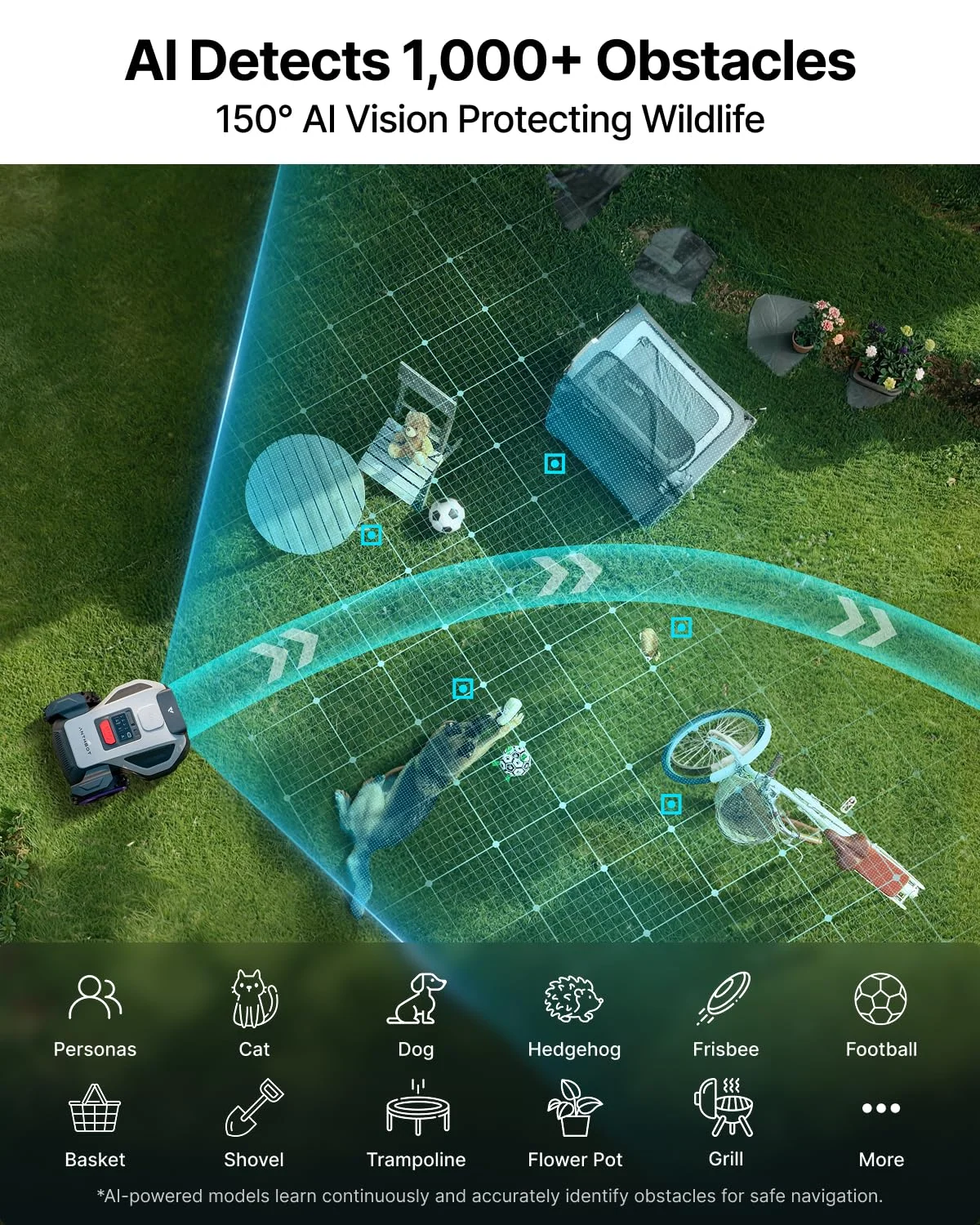
Obstacle avoidance is useful rather than magical. At medium sensitivity, the M5 can identify and steer around conspicuous objects such as a ball or a piece of pipe. Raise the setting and it becomes more cautious around smaller targets. Leave it on low and even obvious objects can reach the mower; transparent, low-profile items such as clear glasses remain particularly difficult.
The practical rule is dull but important: tune sensitivity for the yard, then clear the grass before every scheduled run. Shoes, hoses, sticks, pet waste, glasses, small toys, and wildlife do not become safe because the product page promises recognition of more than a thousand object types. The cameras reduce interruptions and collisions; they do not transfer responsibility for the lawn to an algorithm.
Mapping is easy when the yard is easy
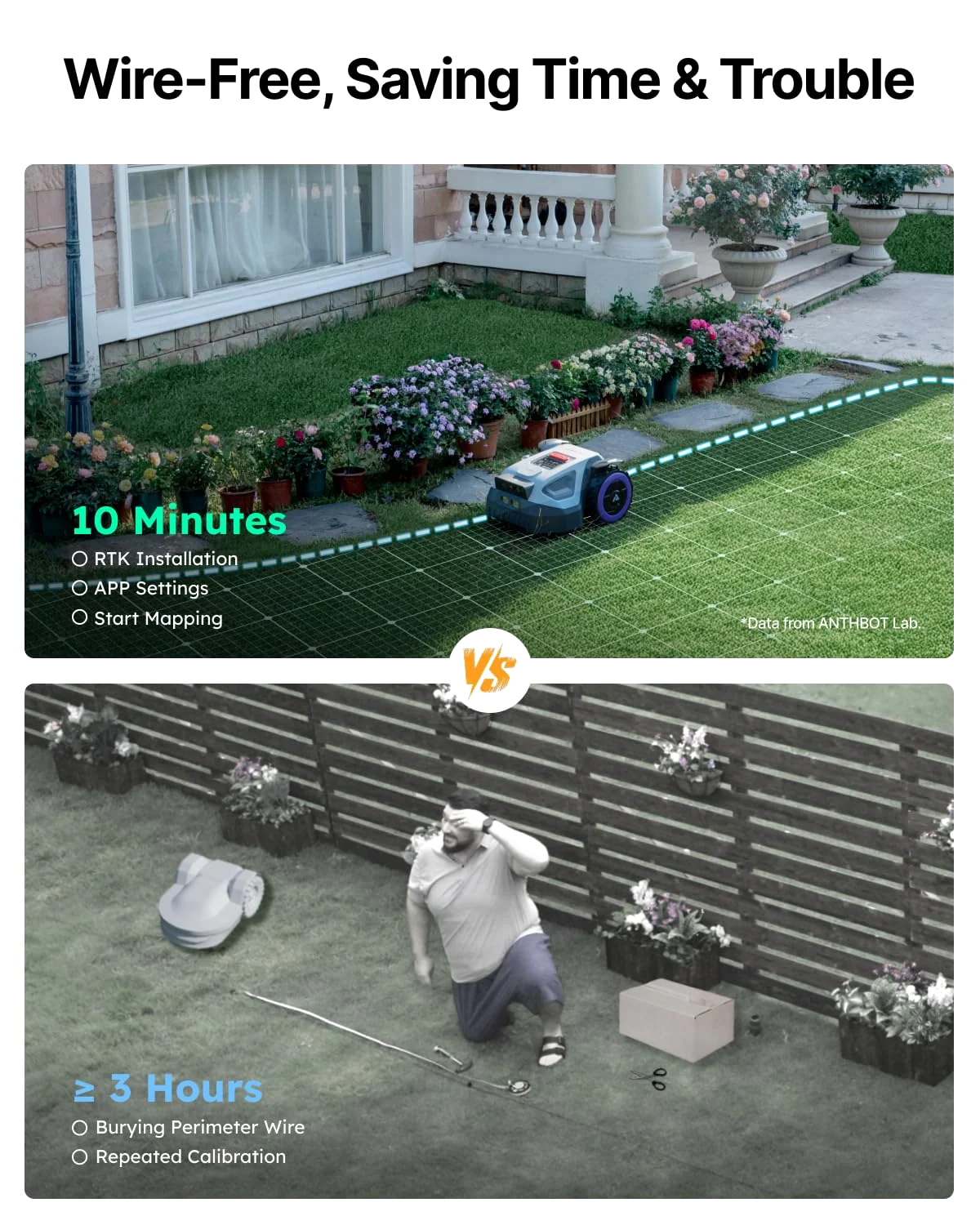
Physical installation is short because there is no perimeter cable to trench, splice, or repair. The dock is anchored, the RTK station is powered, the mower is paired in the ANTHBOT app, and the boundary can be created by driving the machine around the lawn with the phone. No-go areas, additional zones, and connecting paths use the same understandable process.
Automatic mapping also exists, but it needs boundaries the cameras can interpret. A charger beside a bush, an ambiguous transition, or a poorly defined lawn edge can defeat the promised hands-off map. Manual boundary driving is the reliable fallback, and it is straightforward enough that this limitation need not sink an otherwise suitable installation.
Once mapped, the app offers more control than the M5’s price positioning suggests: individual zones, selected edge passes, mowing direction, one or two passes, spot mowing, schedules, rain detection, electronic height adjustment, map backup, anti-theft alerts, and firmware updates. It feels like a real lawn-management tool rather than a remote with a start button.
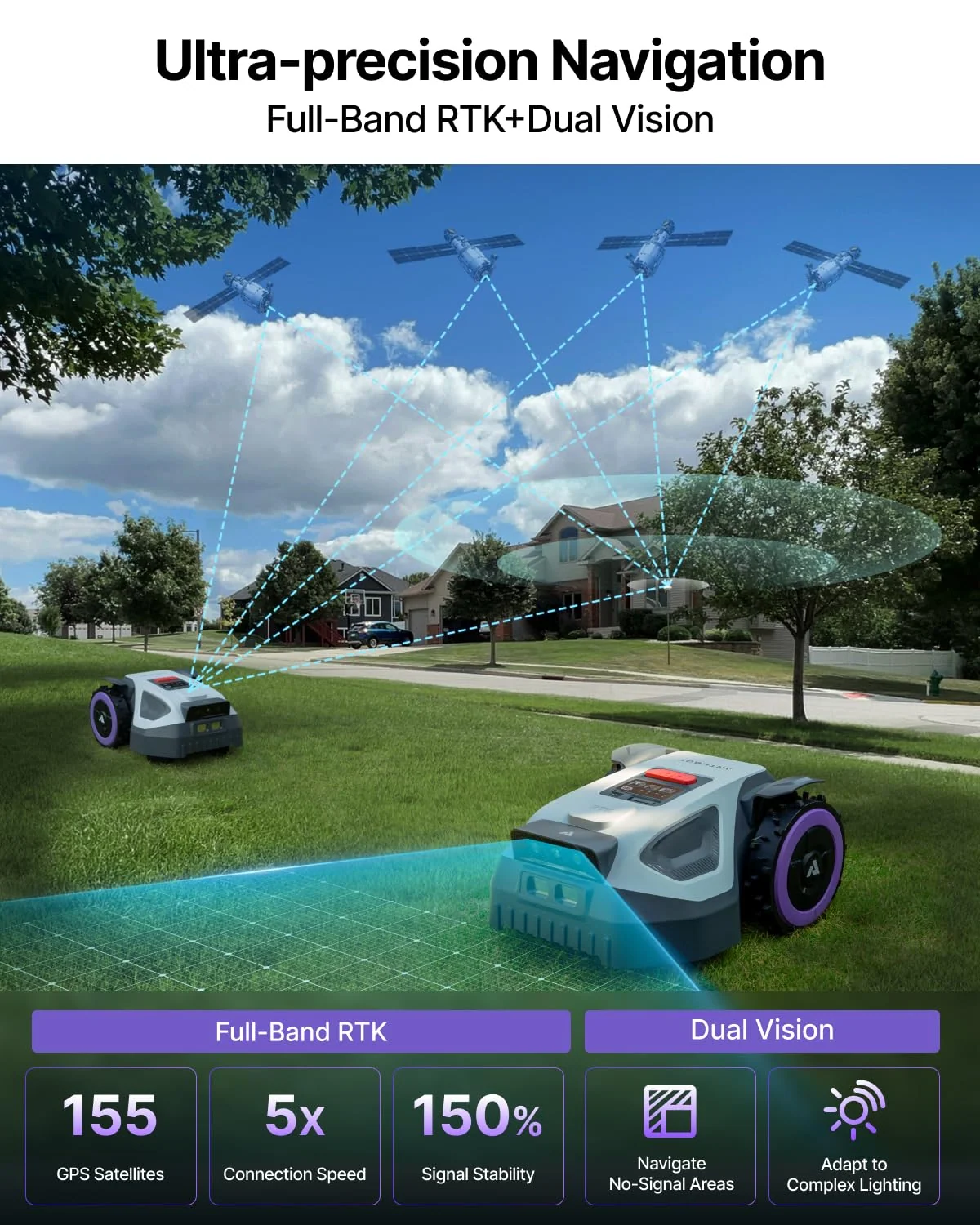
The RTK antenna chooses whether this works
The reference station needs a broad view of the sky and a mounting point that will not shift or tilt. Trees, close two-story buildings, narrow side passages, and reflective walls can block or distort satellite signals. Moving the antenna after mapping can displace the virtual boundary and force the job to be mapped again.
Dual cameras provide useful support, but they do not turn the standard M5 into a satellite-independent LiDAR mower. A small lawn beneath dense canopy can be a worse fit than a larger lawn with open sky. Buyers facing deep shade or close buildings should compare the ECOVACS GOAT O1000 LiDAR PRO, while our explanation of RTK, LiDAR, and camera navigation shows why the same yard can suit one system and frustrate another.
Strengths & Limitations
Strengths
- Wire-free mapping avoids the labor and future repairs of a buried perimeter cable.
- Systematic lanes, adjustable angles, and a five-blade disc produce an attractive maintenance cut.
- Zones, paths, no-go areas, electronic height control, and scheduling give the app useful depth.
- Automatic charging and resumption let a longer job continue without manual intervention.
- Quiet operation makes frequent daytime mowing easy to live with.
Limitations
- RTK accuracy depends on an open, stable antenna position with good satellite visibility.
- The inset cutting disc leaves a fringe beside walls, fences, beds, and drops.
- Obstacle avoidance can miss small or transparent objects and changes sharply with sensitivity.
- Overgrown grass exposes clumping, missed strips, and the limits of a razor-disc mower.
- Hill performance is not proven at the advertised maximum and owners report conflicting results.
- The proprietary app ecosystem offers no demonstrated local API or Home Assistant integration.
A maintenance mower, not a weekly rescue crew
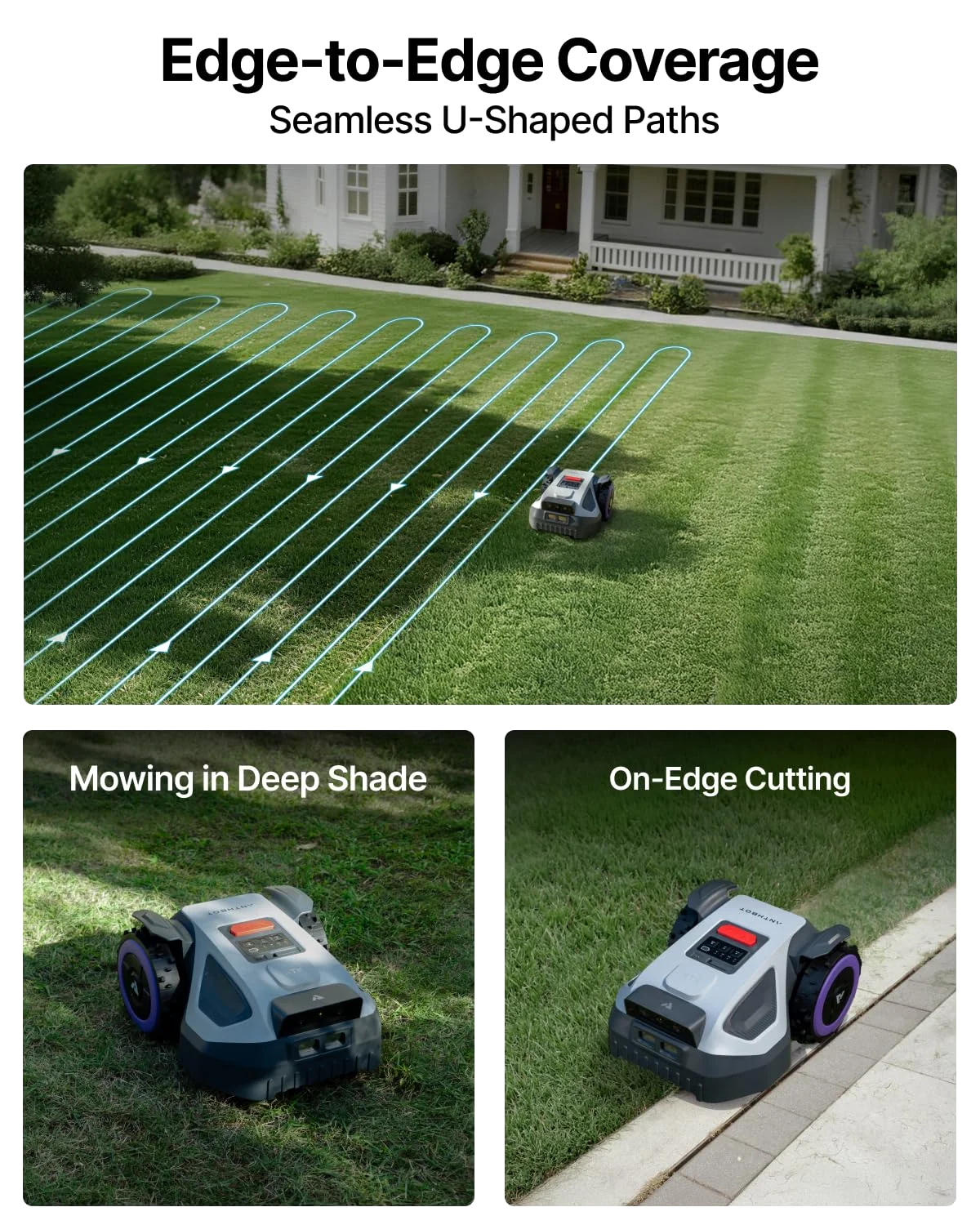
Put the M5 on short grass several times a week and its purpose becomes obvious. It cuts narrow, deliberate lanes, can alter the mowing angle, and offers a second pass for a checkerboard finish. Tiny clippings disappear into the turf, so there is no bag to empty and no pile to dispose of. The mower may spend longer outside than a person with a push mower, but that is machine time rather than owner time.
Let the lawn become seriously overgrown and the illusion breaks. The M5 has enough cutting power to work through grass far taller than a robot should normally face, but one pass can leave clumps, standing strips, and the narrow ridges commonly called mohawks. Its pivoting razor blades trim the top of the grass without the suction or mulching force of a conventional rotary deck. Leaves, sticks, and flattened blades can remain below the cutting plane.
That is not a small technicality. A robotic mower succeeds through frequency, clipping a little and returning before the lawn looks long. Anyone hoping to wheel it out whenever the grass becomes embarrassing still needs a conventional mower.
The edge pass still leaves a fringe
Edge mode brings the M5 closer to a mapped boundary than its normal lane pattern, but the blade disc sits inside the body. Beside a wall, fence, raised bed, or drop, an uncut strip remains. Flush paving can reduce the problem because the wheels may travel over it; hard vertical boundaries still demand a string trimmer.
This is the drawback most likely to survive long after setup frustrations have faded. The M5 can replace the repetitive work across the center of the lawn, not the finishing pass around its perimeter. For buyers who treat zero manual trimming as the entire point, the better starting place is our guide to robot mowers that get closest to an edge.
Quiet enough to vanish into the afternoon
The cutting disc is so subdued that wheel noise can be more noticeable than the blades, which fits the stated limit of 58 dB. Conversation, a patio lunch, or an open window need not be surrendered while it works. That does not make unattended night mowing a good idea, since pets, wildlife, toys, and debris are harder to spot after dark.
The value is real because the compromises are visible
The M5’s case is not that it matches a premium all-wheel-drive LiDAR machine for a fraction of the cost. It does not. Its case is that a small-lawn owner can get systematic mowing, virtual boundaries, multiple zones, automatic charging, app-controlled height, and competent camera avoidance without paying for acreage or terrain hardware that the property does not need.
Against the simpler LawnMaster OcuMow, the M5 wins on mapping, repeatable stripes, charging autonomy, scheduling, and multi-zone control. The OcuMow remains the cleaner alternative for someone who dislikes accounts and proprietary apps, accepts random navigation, and would rather charge a removable battery manually; the differences are laid out in our LawnMaster OcuMow review.
The M5 also has a hard capacity boundary. Its title specifies 1/8 acre, while another listing claim stretches the maximum to 0.15 acre. The conservative figure is the useful one: about 5,000 to 5,500 square feet, with recharge cycles expected as complexity and area increase. Acreage ratings describe what a mower may maintain across a schedule, not what one battery necessarily completes.
For a materially larger lawn, buying more capacity is wiser than asking a small machine to spend most of the day cycling between grass and dock. The ANTHBOT M5 versus M9 comparison explains when the larger sibling’s extra margin becomes worthwhile, and the broader small-lawn mower guide shows alternatives with different navigation and ownership trade-offs.
What remains after the novelty wears off
The M5 returns to its dock and resumes after charging, but autonomy is not the same as zero attention. One documented return route crossed freshly completed stripes on the way home, and the promised software correction was not confirmed. Repeated turns near any robot-mower dock can also wear the same patch of turf, so a firm, clear approach is preferable to a soft corner of the lawn.
The five razor blades are accessible consumables rather than lifetime parts. Dull edges tear grass tips and make the lawn look tired, while accumulated debris beneath the deck deserves periodic removal. Firmware should stay current because navigation, routing, and avoidance behavior can change through software.
There is also an ownership boundary around connectivity. Local RTK navigation does not require an active 4G connection, and the mower can work where yard-wide Wi-Fi is incomplete, but setup and control use the proprietary ANTHBOT app and registration. The available evidence does not establish a local API, native Home Assistant support, or fully independent LAN operation. Buyers who refuse manufacturer accounts should treat that as a rejection criterion, not a feature request for later.
Anti-theft alerts, a safety key, an alarm, and a virtual boundary discourage casual interference. They do not prove that a powered-off mower can be located and recovered after it leaves Wi-Fi coverage. A portable machine working in public view still needs sensible scheduling and physical security.
Frequently Asked Questions
Is the standard ANTHBOT M5 a LiDAR mower?
No, this M5 uses full-band RTK and dual cameras, while the M5 LiDAR is a separate variant intended for more satellite-obstructed properties.
Can the M5 mow without a perimeter wire?
Yes, it stores virtual boundaries created automatically on simple lawns or manually by driving the mower around the perimeter with the app.
How much lawn should the M5 maintain?
Plan around the title’s conservative 1/8-acre rating, roughly 5,445 square feet, rather than assuming the separate 0.15-acre maximum will suit every layout.
Will the M5 cut right against a wall or fence?
No, edge mode reduces the uncut strip but the inset blade disc still leaves work for a string trimmer beside hard vertical boundaries.
Does it need Wi-Fi or 4G to navigate?
Local RTK navigation can continue without 4G and beyond complete yard-wide Wi-Fi coverage, but setup and app control still belong to ANTHBOT’s connected ecosystem.
Can it handle a 45-degree hill?
No such capability is claimed, because the advertised 45% grade equals about 24 degrees and even that maximum lacks controlled independent confirmation.
What does a robot lawn mower actually replace?
It replaces frequent central-lawn maintenance rather than edging, leaf collection, debris mulching, or recovery cuts through badly overgrown grass.
Sources (3)
- Amazon listings and customer reviews — Anthbot M5
- Owner reports across r/SegwayNavimow, r/homeautomation, r/roboticLawnmowers and 5 more threads
- Owner and reviewer video, 15 channels