A wire-free robot mower is only as good as the system that replaces its cable.
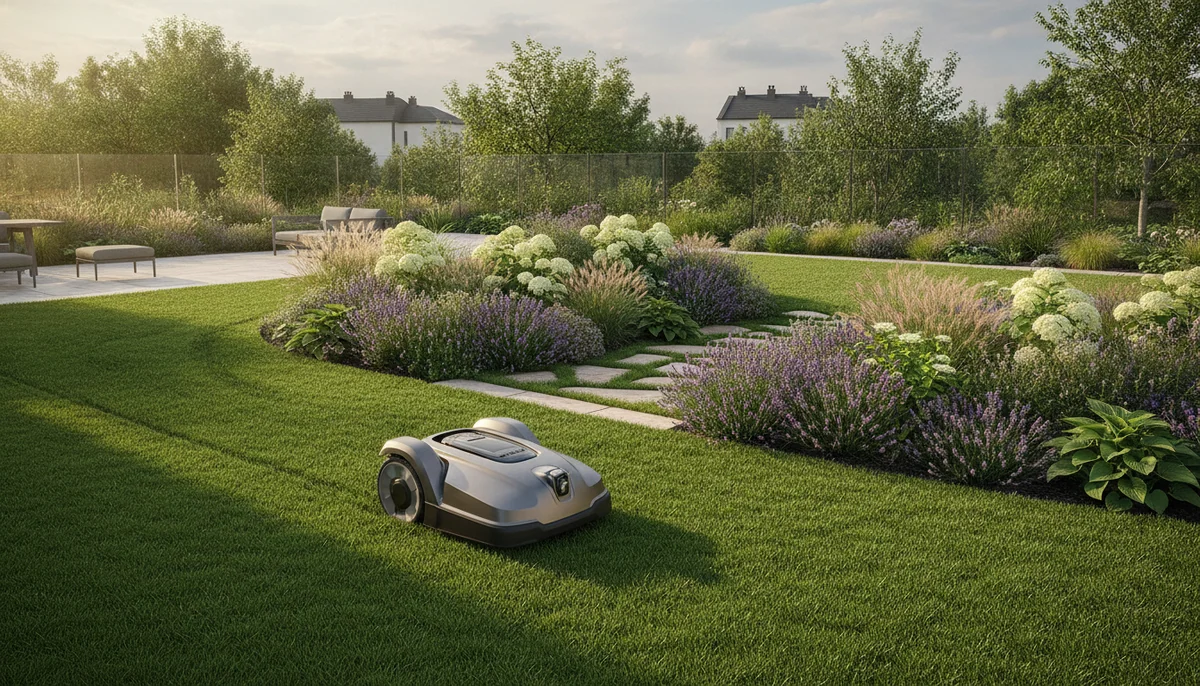
“Wire-free” sounds as though the mower has escaped installation altogether. It has not. A traditional robot follows the electromagnetic field from an energized cable laid around the lawn; a wire-free model replaces that field with sensors, a saved map and software that continually decides where the machine is allowed to travel.
That is a genuine improvement. There is no continuous loop to trench or staple, no buried break to find, and no cable to reroute when a flower bed changes shape. A virtual boundary can be edited from an app, divided into zones and threaded through a safe corridor to another lawn. The machine can plan orderly lanes, return to its dock, charge and resume the unfinished area.
The catch is that “wire-free” describes what disappeared, not what replaced it. A Segway Navimow i110N uses corrected satellite positioning and vision. A Sunseeker S4 or Navimow i215 builds its position from LiDAR and surrounding landmarks. A eufy E15 or E18 reads the yard through stereo cameras. A LawnMaster OcuMow simply reacts to the grass edge it can see and wanders in a new direction. Those are not four versions of the same invisible fence.
Smart Lawn Bots treats the replacement system as the first buying decision. Open sky favors RTK. Trees and close buildings favor onboard LiDAR. A smooth, dry lawn with crisp borders can suit camera mapping. A tiny enclosed patch may tolerate simple optical containment. If the lawn ends at a road, pond, drop or invisible property line, marketing phrases such as “AI vision” and “automatic mapping” are not enough.
The invisible boundary is not one technology
| System | What replaces the loop wire | Best fit | Main weakness |
|---|---|---|---|
| Local RTK with vision | Corrected satellite coordinates from a reference antenna, reinforced by cameras and motion sensors | Open lawns with a useful view of the sky | Canopy, close buildings, reflected signals and antenna placement |
| Network RTK | Satellite corrections delivered through a remote reference network | Open lawns where installing a local mast is awkward | Coverage, connectivity, activation and long-term service dependence |
| LiDAR with vision | A local three-dimensional map of trees, walls, fences and buildings | Shaded or enclosed yards with stable physical landmarks | Featureless spaces, sensor obstruction and software interpretation |
| Mapped stereo vision | Recognized grass edges, visual landmarks and estimated movement through the scene | Smooth, dry lawns with clear borders and enough daylight | Leaves, bare soil, shadows, indistinct edges and weak terrain performance |
| Simple optical containment | Live grass-to-non-grass contrast, sometimes backed by a magnetic strip | One tiny, physically enclosed lawn | No dependable arbitrary boundary and often no systematic map |
Local RTK begins with ordinary satellite signals, then improves them using observations from a fixed reference point. The resulting coordinate map can describe an outer polygon, internal no-go islands and connecting corridors. This is why an RTK mower can hold an imaginary line across identical grass when a simple camera mower cannot. It has been told where the line exists in coordinates rather than asked to see a change in the ground.
Network RTK moves the reference service off the property. That can remove the pole and antenna cable, but it does not remove satellite reception at the mower or the need for a working correction service. WORX Vision Cloud models and some Mammotion machines show the bargain clearly: less hardware in the yard, more dependence on connectivity, regional service and successful account activation.
LiDAR takes the opposite approach. A rotating or solid-state scanner measures nearby geometry, and SLAM software builds a map while estimating the mower’s position inside it. The trees and walls that weaken satellite reception can become useful landmarks. That makes LiDAR a persuasive starting point for lawns beneath canopy, beside tall buildings or under deep eaves, though a wide and nearly featureless field may give it less to recognize.
Cameras can serve two different jobs. They may identify chairs, people and toys while another system handles location, or they may also infer the lawn boundary and build a visual map. Good object recognition does not prove good containment. A mower can avoid a chair and still misread sparse turf as the end of the lawn.
A magnetic strip is easier to move than a powered perimeter loop, but it is still physical boundary material laid in the yard.
How a digital outline becomes a finished lawn
- The dock is installed. Most autonomous models need outdoor power, level ground, a firm approach and enough clearance to align with their charging contacts.
- The first map is created. The mower may follow obvious borders automatically, or the owner may steer it around the perimeter with a phone.
- Permission is added. Zones define where to cut, no-go areas protect permanent exclusions, and corridors tell the mower how to travel between lawns.
- The mower localizes itself. RTK, LiDAR, cameras, wheel movement and inertial sensors are compared with the stored map.
- Software plans the work. A mapped machine divides the zone into parallel or U-shaped lanes and records what has already been covered.
- Real-time sensors watch the route. Cameras, LiDAR, bumpers and lift sensors react to objects that were not part of the original map.
- The mower charges and resumes. When the battery falls, it follows a saved route to the dock and later continues the remaining lanes.
Automatic mapping works best when short grass meets paving, gravel, a fence or a neat bed. An open property line, pond, road shoulder or complicated curve needs human judgment. Driving the perimeter manually is not a betrayal of wire-free mowing; it is how the owner expresses an intention that no sensor can infer.
The first attractive map should be treated as a draft. Watch a complete run from each mowing direction, the trip through every connector and several approaches to the dock. Small mapping errors become important when a rear wheel swings beyond a boundary or repeated passes wear the same travel route. A major firmware update deserves another supervised cycle because the lawn may be unchanged while the software interpreting it is not.
Positioning answers “Where am I?”
Mapping answers “Where may I go?”
Routing answers “Where should I go next?”
The chassis answers “Can I physically get there?”
This separation explains many apparently absurd failures. A mower may hold a straight LiDAR lane and then drop a front caster into a rut. RTK may locate the dock correctly while a lip prevents the contacts from meeting. AWD may climb a dry incline yet scar soft turf while turning. The virtual boundary can be exact while an inset cutting disc leaves several inches beside a wall.
Buy for the hardest part of the yard
Open sky makes RTK the straightforward choice
The Segway Navimow i110N is the clearest quarter-acre example. Its local antenna anchors a virtual coordinate map, while vision helps with edges and obstacles. On smooth open ground, patient setup can produce orderly, quiet maintenance and editable zones without a perimeter loop.
Its honest drawback is that vision enhances RTK rather than replacing it. Dense canopy, a narrow passage between buildings or poor antenna placement can produce weak positioning, map drift and failed routes, while the low two-wheel-drive chassis remains vulnerable to holes and rough transitions. The full Navimow i110N review is the better next stop if this describes the property, and the i110N versus i206 AWD comparison shows when traction justifies moving up.
Trees and buildings make onboard LiDAR more convincing
The Navimow i215, Sunseeker S4, MOVA LiDAX Ultra 1000 and ECOVACS GOAT O1000 LiDAR PRO locate themselves from the yard around them rather than from a local RTK mast. Trees that obstruct satellites can become recognizable geometry, and close buildings no longer create the same navigation problem. This is the strongest category for a structured small lawn under canopy.
None of these machines turns LiDAR into traction. The i215, S4, MOVA and O1000 remain rear-drive residential mowers with small front wheels or casters, so humps, wet turf, roots and soft transitions can demand rescues even when the map is correct. Automatic outlines also need correction around invisible lines and consequential hazards. Start with the site’s guide to mowers for yards with trees and poor satellite reception, then compare the Sunseeker S4 with the Navimow i215 if those two fit the lawn.
A smooth little lawn can make cameras look brilliant
The eufy E15 and E18 are the best examples of sophisticated pure-vision mapping in this group. Stereo cameras trace a visually legible lawn, create editable zones and guide planned parallel passes without an RTK antenna. The E18 offers a larger map allowance than the E15, but it does not bring a tougher chassis, wider deck or stronger slope capability.
Both depend on readable borders, daylight and forgiving ground. Damp grass, holes, modest undulations, dense turf and disconnected areas expose the limits quickly, while a continuous grass-to-grass property line still needs an explicit virtual wall and careful verification. The E15 versus E18 comparison separates the capacity difference from the shared mechanical limits.
LawnMaster OcuMow and YARDCARE V100 sit much lower on the autonomy ladder. They can react to visible grass boundaries without a cable, but they do not provide the same stored coordinate map, systematic coverage or dock-and-resume routine. Someone carries them out, retrieves them and charges a removable battery. That simplicity can suit a tiny enclosed courtyard, but an open edge, path or street makes visual containment a poor gamble.
Rough ground demands chassis before sensor count
The current Mammotion LUBA Mini 2 1500H bundle combines onboard LiDAR and cameras with AWD, while the Segway Navimow X430 pairs Network RTK, vision and VIO with a much wider dual-disc deck, four driven wheels and suspension. These are materially better physical answers for slopes and broken ground than a light rear-drive mower that happens to advertise the same boundary precision.
Strong hardware brings different costs. The LUBA’s app, map editing and firmware behavior can be finicky, and tight turns can scrub weak or wet turf. The X430 still depends on correct commissioning, stable software and property-specific positioning; its large body also needs generous gates and turning space. Neither deserves to be bought only because a grade percentage looks impressive. The steep-hill guide separates navigation claims from the traction and clearance that actually move a mower uphill.
Map like a lawyer and test like a skeptic
A camera recognizes patterns, not property deeds. LiDAR recognizes geometry, not danger. RTK follows coordinates, not common sense. Where identical grass continues into a neighbor’s lawn, the owner must define the line. Where the boundary meets a road, pool, pond or retaining drop, that line needs a generous setback and, when failure would be serious, a physical barrier.
A no-go zone and obstacle avoidance solve different problems. The no-go zone is a permanent instruction stored in the map. Obstacle avoidance reacts to something unexpected during the current run. Claims that a mower recognizes hundreds of object types do not reveal how reliably it sees a hose, pinecone, cable, small toy, pet waste or wildlife in difficult light. Clear the lawn before every scheduled run and keep children and animals away.
A property audition before the return window closes
- Measure the actual mowable grass rather than the lot size.
- Classify every edge as flush paving, raised border, open grass, water, road or drop.
- Check sky exposure before choosing local or network RTK.
- Choose LiDAR when blocked sky is the central navigation problem.
- Measure gates and passages against the mower’s body width plus turning clearance.
- Prove a safe, driveable route from every zone back to the dock.
- Map dangerous edges conservatively and add physical protection where needed.
- Supervise the steepest traverse, weakest boundary and every recharge-and-resume cycle.
- Repeat the critical checks after a major software update.
- Confirm replacement blades, batteries, wheel parts, service access and connected-service terms.
Keep the packaging until the mower has completed several full cycles. A yard that looks simple from the patio can contain one wet ramp, one satellite canyon or one docking lip that turns an otherwise competent machine into a daily rescue.
The cable disappears, but the lawn does not become effortless
Robot mowers are maintenance machines. Their small pivoting blades shave frequent, shallow clippings and leave them in the turf rather than filling a bag. They are poor tools for recovering overgrown grass, cutting mature weeds or processing heavy leaves and branches. Give the lawn a conventional first cut, then schedule the robot often enough that every pass removes only a little growth; the separate guide to robot-mower clippings and mulching explains why that rhythm matters.
Maximum acreage is also a managed-area rating, not a one-charge promise. Narrow residential decks may need several mowing and charging shifts to finish even a modest lawn. Rain delays, obstacle detours, corners, separate zones and limited daylight for camera-first models consume more of that capacity. Leave headroom rather than buying at the exact published ceiling, and use the acreage-rating guide to size by throughput rather than the map limit.
Multi-zone software cannot open a gate, climb steps or cross an unsafe road. Every autonomous zone needs a traversable connector to the dock. Carrying a mower to a disconnected patch may be acceptable when the model supports a drop-and-mow routine, but it is human handling rather than whole-property autonomy; the site’s multi-zone guide covers that distinction in detail.
Edging remains the stubborn final job. A virtual boundary controls the chassis, while the deck determines where the blade can reach. Flush paving may let the housing overlap safely and produce a close cut. Walls, fences, trees, raised beds and conservative hazard setbacks leave a strip for a string trimmer, even on models advertised with edge systems. No satellite, laser or camera can move an inset blade through solid plastic.
Wire-free mowing is real and often worth choosing, but the winning question is not whether a mower avoids cable. Ask what replaces the cable, whether that system can be corrected when it misunderstands the property, and whether the chassis can complete the map without becoming stranded on the way home.
Frequently Asked Questions
Does a wire-free mower automatically know where my property ends?
It may recognize a visible grass-to-paving or grass-to-bed transition, but an invisible line across continuous grass normally needs manual mapping and careful verification.
Does every wire-free mower use GPS?
No, some use corrected satellite positioning, some use onboard LiDAR, some rely mainly on cameras, and many combine several systems.
Does an RTK robot mower always need an antenna in the yard?
A local-RTK mower needs a fixed reference antenna, while a network-RTK model can receive remote corrections but then depends on coverage, connectivity and service terms.
Can LiDAR robot mowers work beneath trees?
Yes, LiDAR is well suited to blocked-sky yards because it measures local surroundings, although dirty sensors, weak landmarks, difficult terrain and software errors can still interrupt mowing.
Can a wire-free mower handle separate front and back lawns?
It can do so autonomously only when a safe, open and mapped route connects every lawn to the charging dock.
Are virtual boundaries as safe as a fence or physical barrier?
No, virtual boundaries are editable and usually precise enough for ordinary lawn divisions, but water, traffic and dangerous drops still deserve conservative setbacks and physical protection.
Does obstacle avoidance replace mapped no-go zones?
No, obstacle avoidance reacts to unexpected objects while a no-go zone records a permanent exclusion, and neither is infallible at a serious hazard.
Will a wire-free mower eliminate string trimming?
No, walls, fences, raised beds, trees and inside corners remain beyond an inset cutting disc even when the mower follows its virtual boundary accurately.
Sources (165)
- Amazon listings and customer reviews
- Owner reports across r/RobotVacuums, r/eufyS1Pro, r/eufy and 39 more threads
- Owner and reviewer video, 345 channels
- Walmart listing
- Costco listing
- Target listing
- Toptenreviews — Article — www.toptenreviews.com
- Pcworld — Article — www.pcworld.com
- Homedepot — Article — www.homedepot.com
- Lowes — Article — www.lowes.com
- Robotmowerlab — Article — robotmowerlab.com
- Forbes — Article — www.forbes.com
- Lifehacker — Article — lifehacker.com
- Makeuseof — Article — www.makeuseof.com
- Navimow — Article — navimow.com
- Segway — Article — navimow.segway.com
- Tomsguide — Article — www.tomsguide.com
- Site — Article — segway-navimow.my.site.com
- Consumerreports — Article — www.consumerreports.org
- Propartsdirect — Article — www.propartsdirect.net
- Facebook — Article — www.facebook.com
- Easylawnmowing — Article — easylawnmowing.co.uk
- Trustedreviews — Article — www.trustedreviews.com
- Cleva — Article — us.cleva.com
- Bestutahrealestate — Article — bestutahrealestate.com
- Cleva Uk — Article — www.cleva-uk.com
- Expertreviews — Article — www.expertreviews.co.uk
- Cleva — Article — eu.cleva.com
- Currys — Article — www.currys.co.uk
- Mowerbotlab — Article — mowerbotlab.com
- Gardentool360 — Article — gardentool360.co.uk
- Ukgardenreviews — Article — ukgardenreviews.com
- Gardenersworld — Article — tollbit.gardenersworld.com
- Hedgecombers — Article — hedgecombers.com
- Bestrobovacuums — Article — www.bestrobovacuums.com
- Chewy — Article — www.chewy.com
- eufy — Article — www.eufy.com
- Substack — Article — robovacinsights.substack.com
- eufy — Article — service.eufy.com
- Countryliving — Article — www.countryliving.com
- Rtings — Article — www.rtings.com
- Vacuumwars — Article — vacuumwars.com
- Younghouselove — Article — www.younghouselove.com
- Womanandhome — Article — www.womanandhome.com
- Interlightus — Article — www.interlightus.com
- Coredy — Article — www.coredy.com
- Moderncastle — Article — moderncastle.com
- Thecarpentersdaughter — Article — thecarpentersdaughter.co.uk
- Techradar — Article — www.techradar.com
- Lbtechreviews — Article — www.lbtechreviews.com
- Pcmag — Article — www.pcmag.com
- Zdnet — Article — www.zdnet.com
- Trustpilot — Article — uk.trustpilot.com
- Amgardaseeblick — Article — amgardaseeblick.com
- Pistonheads — Article — www.pistonheads.com
- Bestbuy — Article — www.bestbuy.com
- Ycombinator — Article — news.ycombinator.com
- Mammotion — Article — us.mammotion.com
- Trustpilot — Article — www.trustpilot.com
- Trustpilot — Article — au.trustpilot.com
- Mammotion — Article — eu.mammotion.com
- Mammotion — Article — uk.mammotion.com
- Easylawnmowing — Article — www.easylawnmowing.com
- Therobotmower — Article — therobotmower.co.uk
- Androidauthority — Article — www.androidauthority.com
- Freshlycharged — Article — freshlycharged.com
- Au — Article — robotlawnmowers.com.au
- Nytimes — Article — www.nytimes.com
- Cnet — Article — www.cnet.com
- Gardenersworld — Article — www.gardenersworld.com
- Smarthomescene — Article — smarthomescene.com
- HOOKII — Article — hookii.com
- Mammotion — Article — ca.mammotion.com
- Tractorsupply — Article — www.tractorsupply.com
- Substack — Article — jjtechish.substack.com
- Basic Tutorials — Article — basic-tutorials.com
- Smarthomeassistent — Article — www.smarthomeassistent.de
- Mein Gartenexperte — Article — www.mein-gartenexperte.de
- Techreviewer — Article — www.techreviewer.de
- Mowingmagic — Article — mowingmagic.com
- Fr — Article — maniaques.fr
- Basic Tutorials — Article — basic-tutorials.de
- Frandroid — Article — www.frandroid.com
- Appgefahren — Article — www.appgefahren.de
- Yarbo — Article — www.yarbo.com
- Fredshed — Article — www.fredshed.co.uk
- Tv — Article — www.stuff.tv
- Yarbo — Article — forum.yarbo.com
- Yarboreview — Article — yarboreview.com
- Tech — Article — us.mova.tech
- Slashgear — Article — www.slashgear.com
- Newatlas — Article — newatlas.com
- Tech — Article — au.mova.tech
- at — Article — www.galaxus.at
- Appleinsider — Article — appleinsider.com
- Notebookcheck — Article — www.notebookcheck.net
- Maison Et Domotique — Article — www.maison-et-domotique.com
- Au — Article — www.gadgetguy.com.au
- MOVA Tech — Article — us.forum.mova-tech.com
- Au — Article — www.techguide.com.au
- Wellbots — Article — www.wellbots.com
- Novabot — Article — novabot.com
- Techiwant — Article — techiwant.com
- Samsclub — Article — www.samsclub.com
- Heyupnow — Article — community.heyupnow.com
- T3 — Article — www.t3.com
- Tech — Article — uk.mova.tech
- Robocleaners — Article — www.robocleaners.com
- Mowscout — Article — mowscout.com
- Wired — Article — www.wired.com
- Shopsunseekertech — Article — shopsunseekertech.com
- Warehouserunner — Article — app.warehouserunner.com
- Electricrevolutionreviews — Article — electricrevolutionreviews.com
- Sunseekertech — Article — sunseekertech.com
- Sunseekerelite — Article — sunseekerelite.com
- Bobvila — Article — www.bobvila.com
- Au — Article — segway.com.au
- Theverge — Article — www.theverge.com
- Au — Article — roboticmower.com.au
- Techadvisor — Article — www.techadvisor.com
- Cnygreenteam — Article — cnygreenteam.com
- Outdoor Usa — Article — outdoor-usa.com
- Protoolreviews — Article — www.protoolreviews.com
- Homebuilding — Article — www.homebuilding.co.uk
- Gizmodo — Article — gizmodo.com
- Suncolawns — Article — shop.suncolawns.com
- Smartyardnw — Article — smartyardnw.com
- the Ambient — Article — www.the-ambient.com
- Outdoorica — Article — outdoorica.com
- Smart Dots — Article — www.smart-dots.com
- Trustpilot — Article — ie.trustpilot.com
- Homeandgardenselect — Article — homeandgardenselect.com
- Eu — Article — www.letemsvetemapplem.eu
- Robomowlab — Article — robomowlab.com
- Eftm — Article — eftm.com
- ECOVACS — Article — www.ecovacs.com
- Au — Article — www.harveynorman.com.au
- Thespruce — Article — www.thespruce.com
- Pcmag — Article — uk.pcmag.com
- 9to5google — Article — 9to5google.com
- Mensjournal — Article — www.mensjournal.com
- Lawncraftsupply — Article — lawncraftsupply.com
- Smarthomecompared — Article — smarthomecompared.com
- Smarthomeexplorer — Article — www.smarthomeexplorer.com
- Hunker — Article — www.hunker.com
- Thetechnologyman — Article — thetechnologyman.com
- Mammotion — Article — mammotion.com
- Carplaylife — Article — www.carplaylife.com
- Smarthomejunkie — Article — www.smarthomejunkie.net
- Iheart — Article — rocketerie.iheart.com
- WORX — Article — www.worx.com
- Upzy — Article — www.upzy.com
- Reviewed — Article — www.reviewed.com
- Ai — Article — www.robotmower.ai
- Dreamhomeplace — Article — dreamhomeplace.com
- Ibisik — Article — www.ibisik.com
- Requiemforadream — Article — www.requiemforadream.com
- Renovationrated — Article — renovationrated.com
- Dreametech — Article — yardcare.dreametech.com
- Ign — Article — www.ign.com
- Glroboticsusa — Article — www.glroboticsusa.com
- Pwcparts — Article — pwcparts.com
- Familyhandyman — Article — www.familyhandyman.com
- Sitejabber — Article — www.sitejabber.com
- Yardcareinc — Article — yardcareinc.com