The eufy E18 buys more map, not a better mower
Choose the E15 for a smooth, connected lawn comfortably below 0.2 acre, move to the E18 only when the same sort of lawn exceeds that limit, and reject both when terrain rather than area is the hard part.
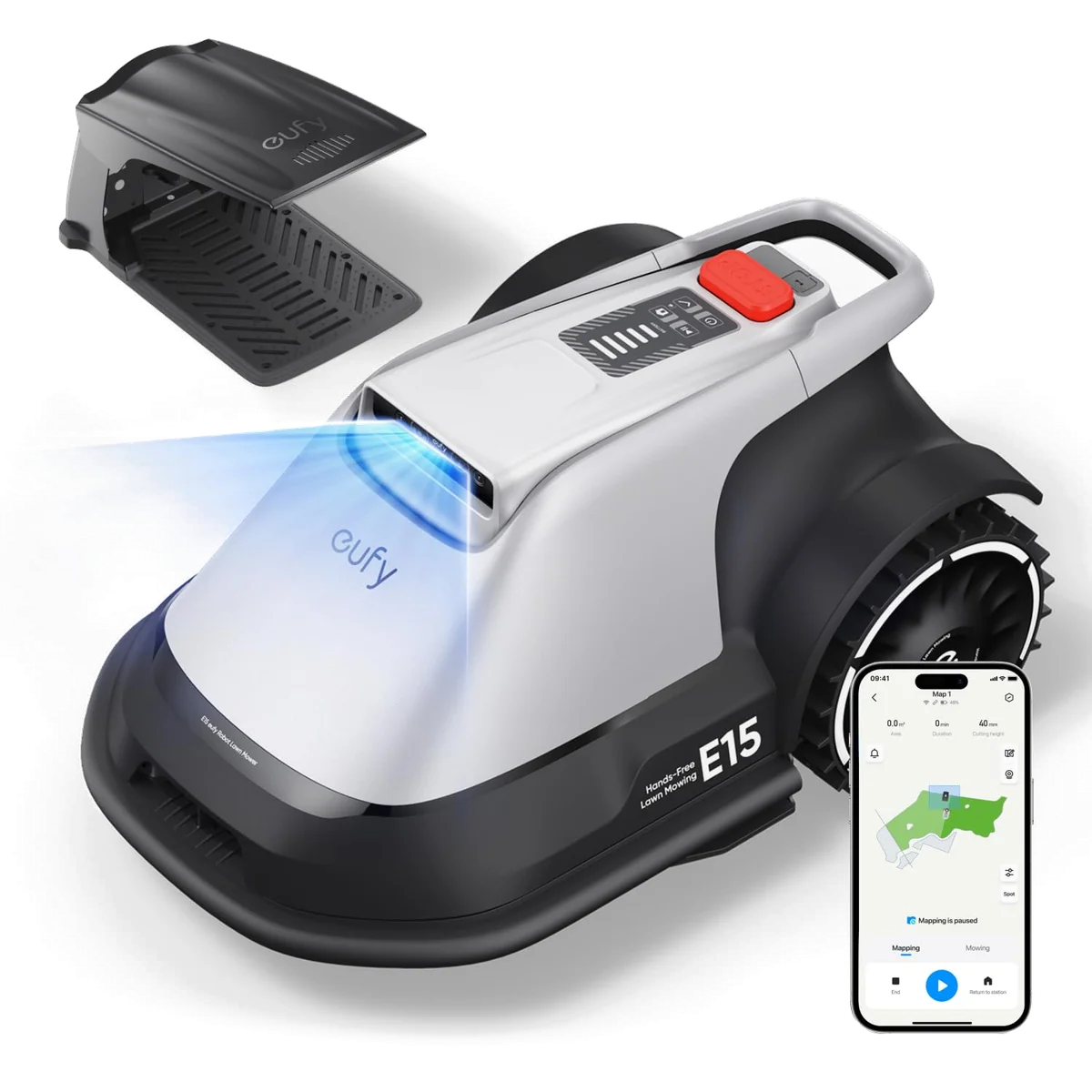
Eufy E15 robot lawn mower
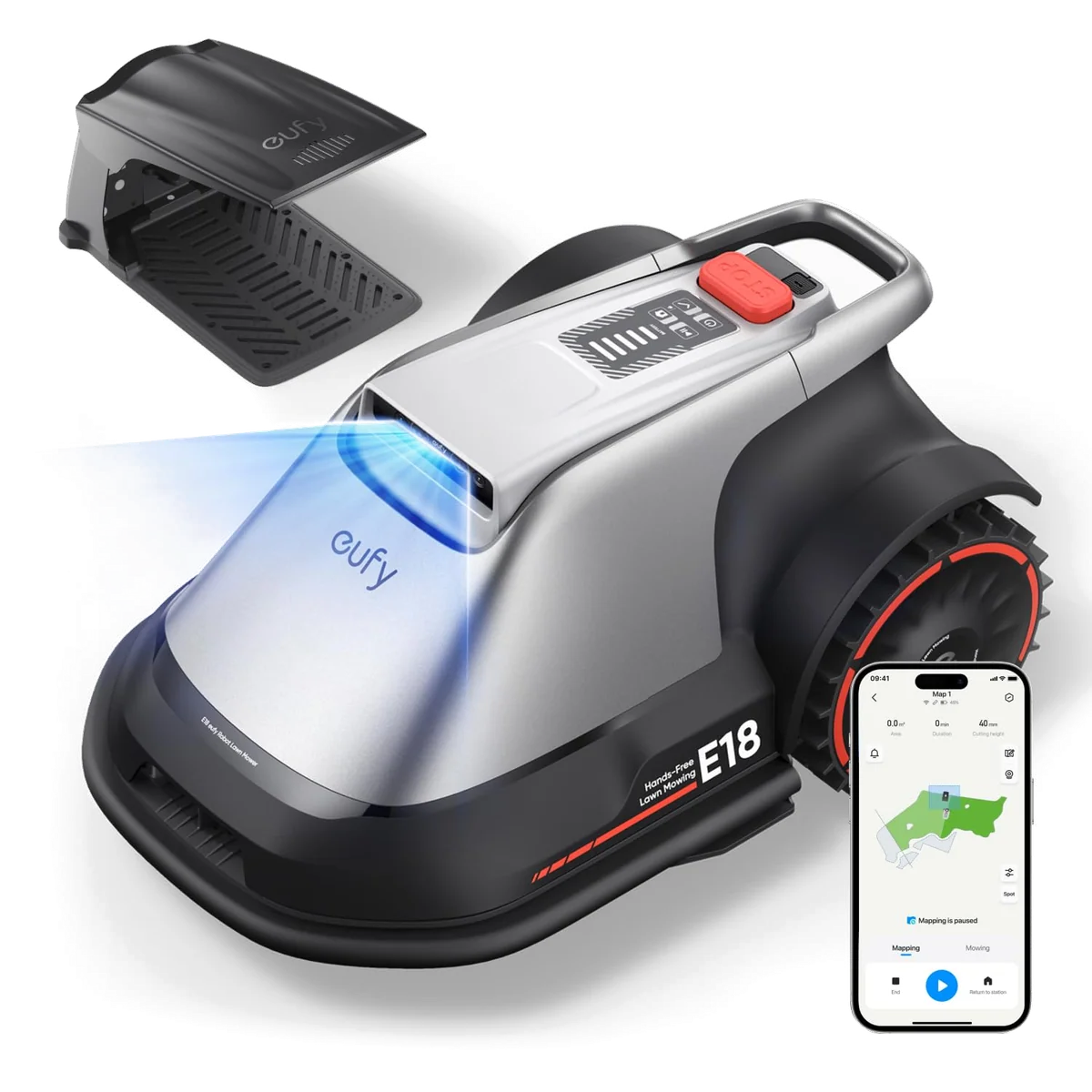
Eufy E18 robot lawn mower
eufy presents the E15 and E18 as two steps in a range, but the step between them is unusually small. The E15 can map up to 0.2 acre, about 8,700 square feet, while the E18 raises the ceiling to 0.3 acre, or 13,000 square feet. The larger model does not bring a wider cutting disc, a higher cut, a tougher slope rating, or a navigation system that sees the lawn differently.
That makes the E15 the sensible first choice, provided the lawn leaves comfortable room below its limit. The E18 earns its place when a connected mowing area genuinely crosses that boundary. Buying it for a small yard in the hope of better traction or more polished edges is paying for capacity the grass cannot use.
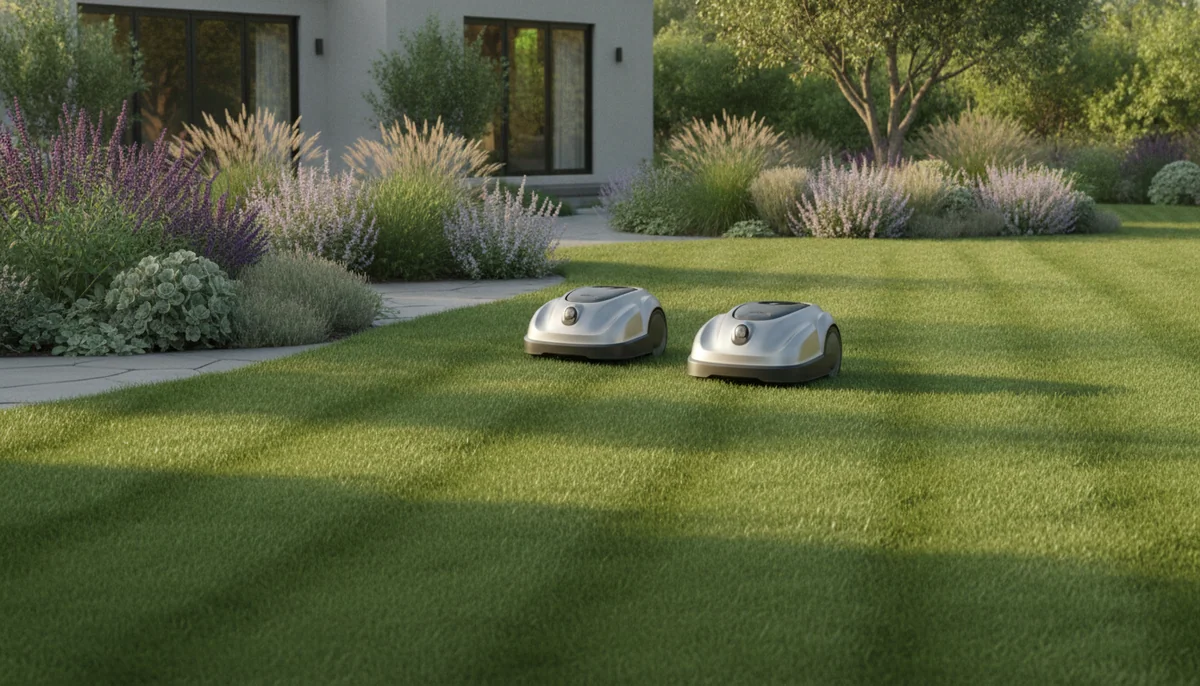
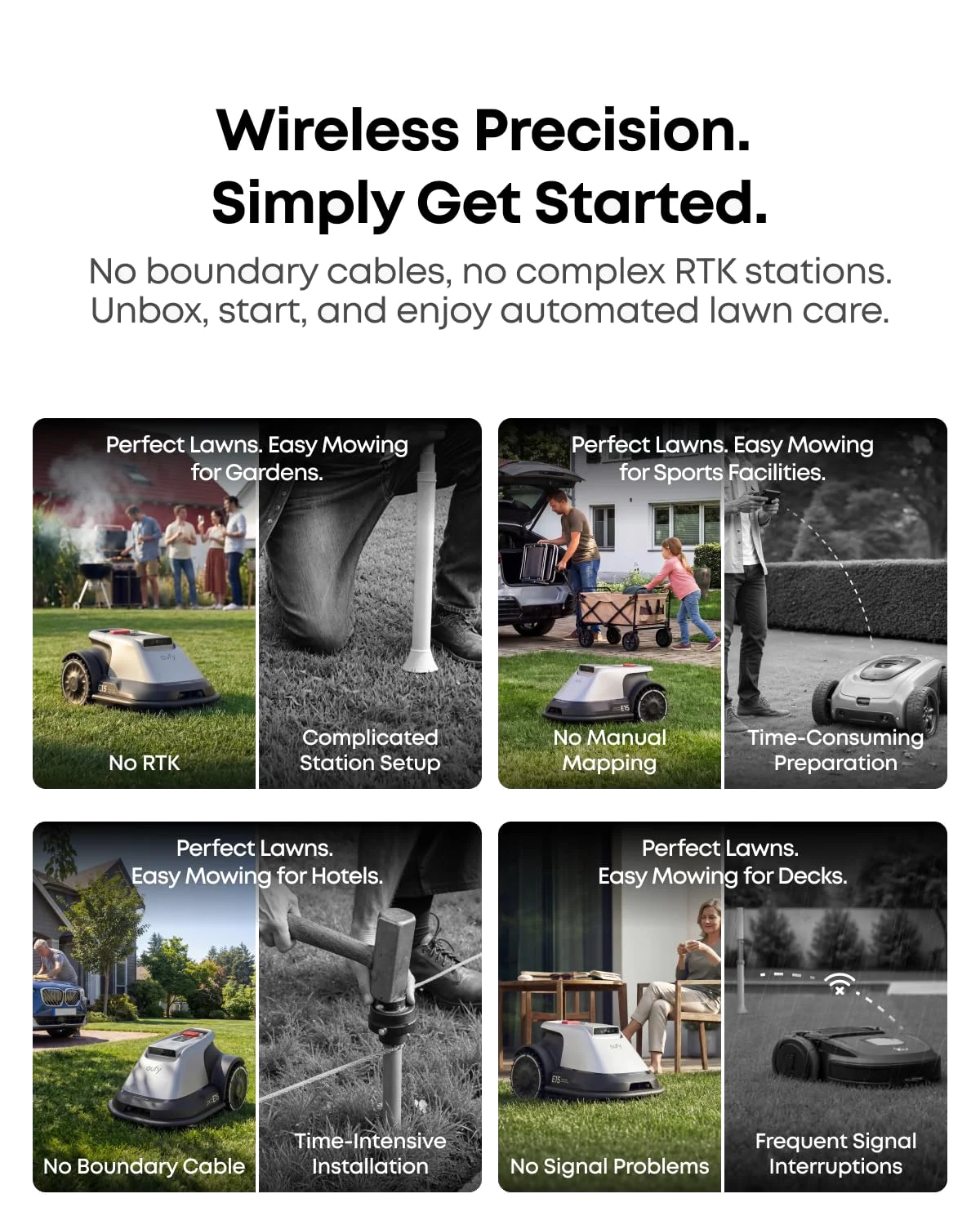
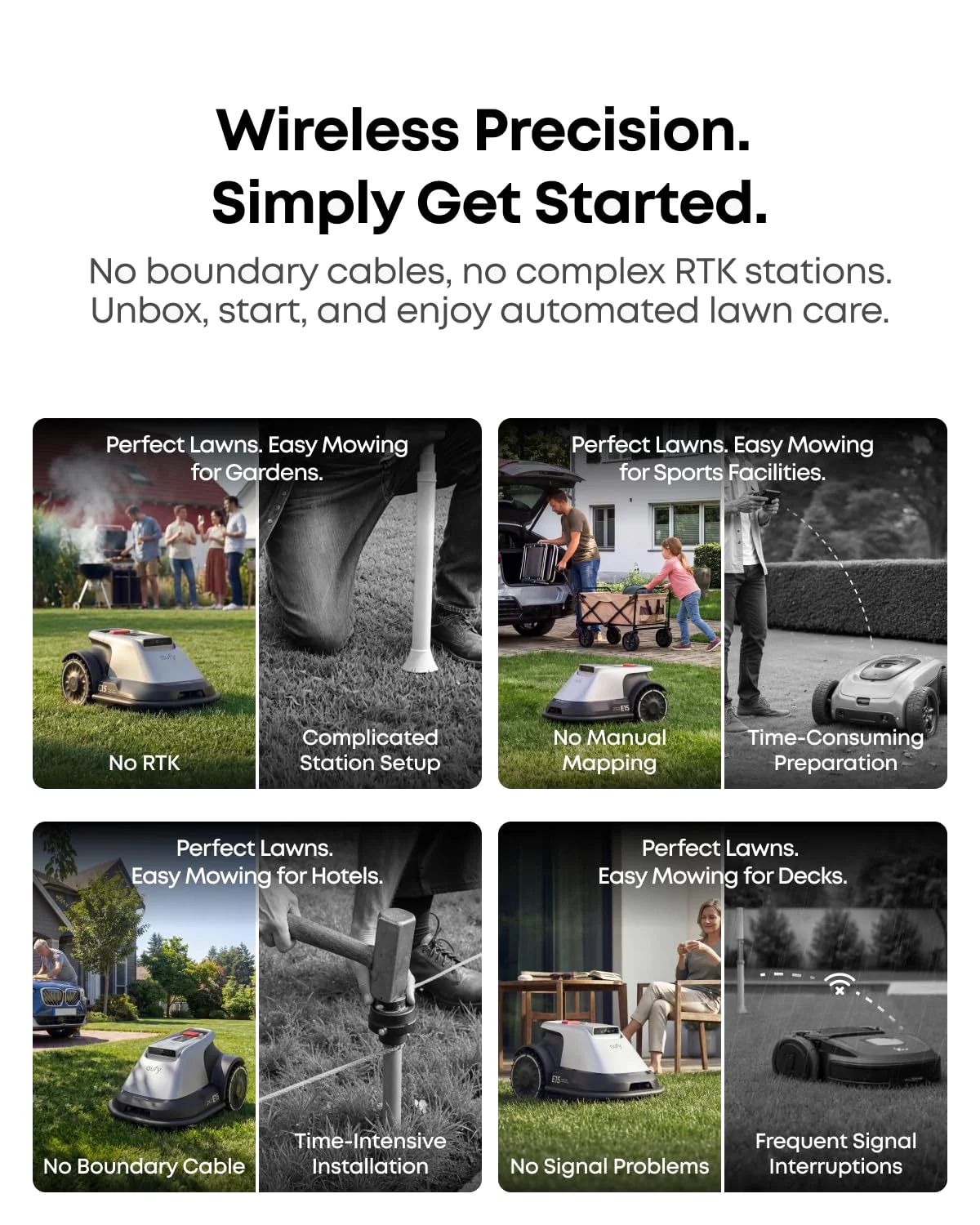
Both machines share the same bargain. Cameras remove the buried perimeter wire and the awkward RTK antenna, then automatic mapping turns a clear, maintained lawn into orderly parallel mowing. In return, the grass, borders, ground conditions, and daylight become part of the navigation system. A wet hollow, closed gate, indistinct property line, or wall-side strip can create more work than the simple installation saved.
Eufy E15 robot lawn mower
Eufy E18 robot lawn mower
At a Glance
| Feature | Editor's Pick Eufy E15 robot lawn mower | Eufy E18 robot lawn mower |
|---|---|---|
| Price Range | $1,000–$1,500 | Under $200 |
| Cutting height | 1–3 inches, electronically adjusted | 1–3 in |
| Recommended lawn size | — | 0.3 acre, or 13,000 sq ft |
| Cutting width | 8 inches | 8 in |
| Check Price on Amazon | Check Price on Amazon |
The only decisive difference is how much lawn they may map
| Decision point | eufy E15 | eufy E18 |
|---|---|---|
| Maximum mapped lawn | 0.2 acre, about 8,700 sq ft | 0.3 acre, about 13,000 sq ft |
| Navigation | Stereo-camera vision, without wire or RTK | Camera vision, without wire or RTK |
| Cutting system | 8-inch disc, 1–3-inch height range | 8-inch disc, 1–3-inch height range |
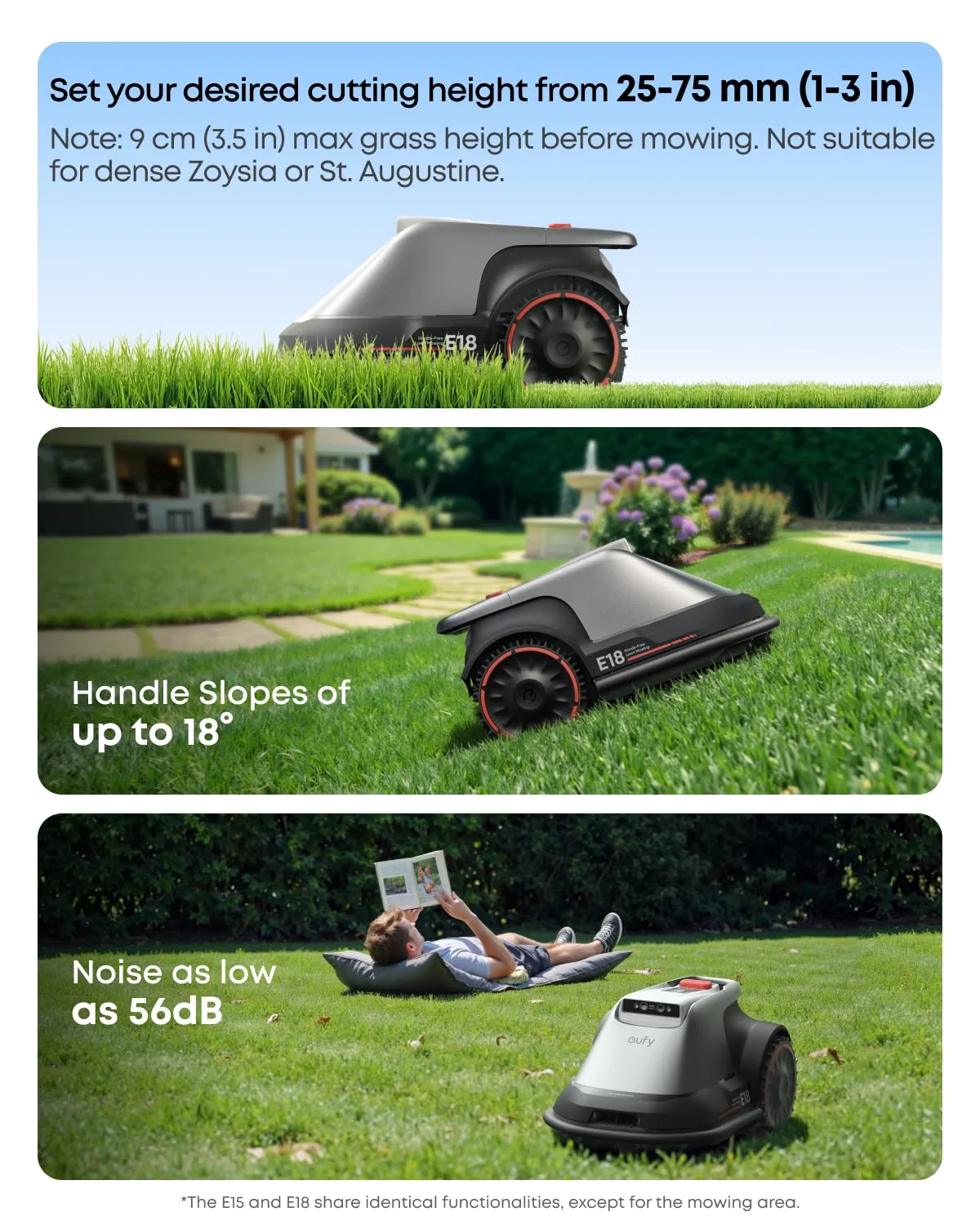
| Supported slope | Up to 18° | Up to 18° |
| Best lawn | Small, smooth, dry, connected, clearly bounded | Larger, smooth, dry, connected, clearly bounded |
The E18’s extra acreage is capacity, not speed
The 0.3-acre badge does not mean the E18 will finish a large lawn in one charge or even in one short session. It still cuts through an 8-inch path, returns to its dock, recharges, and resumes. A quarter-acre result has taken around 12 hours, while a complex 3,731-square-foot area required almost four hours including a recharge. The waiting is autonomous, but it still consumes daylight.
The E15 also needs several mowing and charging cycles near its own ceiling. Its documented per-charge coverage is roughly 100–150 square metres, so the maximum figure describes the total lawn it can manage rather than the grass it clears in one outing. Acreage headroom matters because weather, shade, charging pauses, and awkward geometry all shrink the useful working window.

Camera navigation solves one installation problem by making the lawn readable
Neither model needs a boundary cable or an RTK reference station. Place the powered dock, connect the app, and allow the mower to trace the turf for itself. That is a genuine advantage beside buildings and under trees, where finding a satisfactory antenna position can become the hardest part of owning an RTK mower. Buyers facing that problem can see why these machines belong among the stronger options for obstructed yards.
The camera cannot see a property deed. Identical grass continuing into a neighbor’s yard needs a virtual boundary, while sparse turf, bare soil, fallen leaves, flowers, or hardstanding can confuse the first map. The app supplies virtual walls, no-go areas, must-mow regions, pathways, and zones, but the owner must notice the mistake and draw the correction. Automatic mapping avoids a perimeter walk; it does not make every first map authoritative.
Multi-zone management has the same fine print on both models. A front lawn, side strip, and back lawn can share a schedule when the mower has a level, drivable route between them. Steps, rock beds, and closed gates turn one advertised multi-zone property into disconnected jobs. Carrying the mower across the obstruction does not guarantee that it will localize or stop searching for its unreachable dock.
The chassis matters more than the intelligence above it
A smooth bank can be less troublesome than a shallow hole. Recessed sprinklers, paver gaps, ruts, soft soil, and modest undulations can strand a wheel even when the cameras have identified the lawn correctly. Damp grass adds wheel slip and packs clippings beneath the deck. The shared 18-degree rating should therefore be treated as a favorable-condition ceiling, not a promise for wet cambers or rough ground.
Both are maintenance mowers for grass already below 3.5 inches, and neither is suitable for St. Augustine or dense Zoysia. They mulch frequent, small clippings rather than collecting an overgrown lawn in a bag. The cut itself can be clean and convincingly striped, but the yard has to be brought into the mower’s operating range first.
Walls, darkness, and tiny hazards survive the upgrade
The centered cutting disc can overlap a flush grass-to-paving transition when a wheel has room to ride across it. Against a fence, wall, raised curb, bed, or drop, the body must remain safely back and a strip survives for the string trimmer. Increasing the edge overlap trades less trimming for a greater chance of putting a wheel somewhere it should not go.
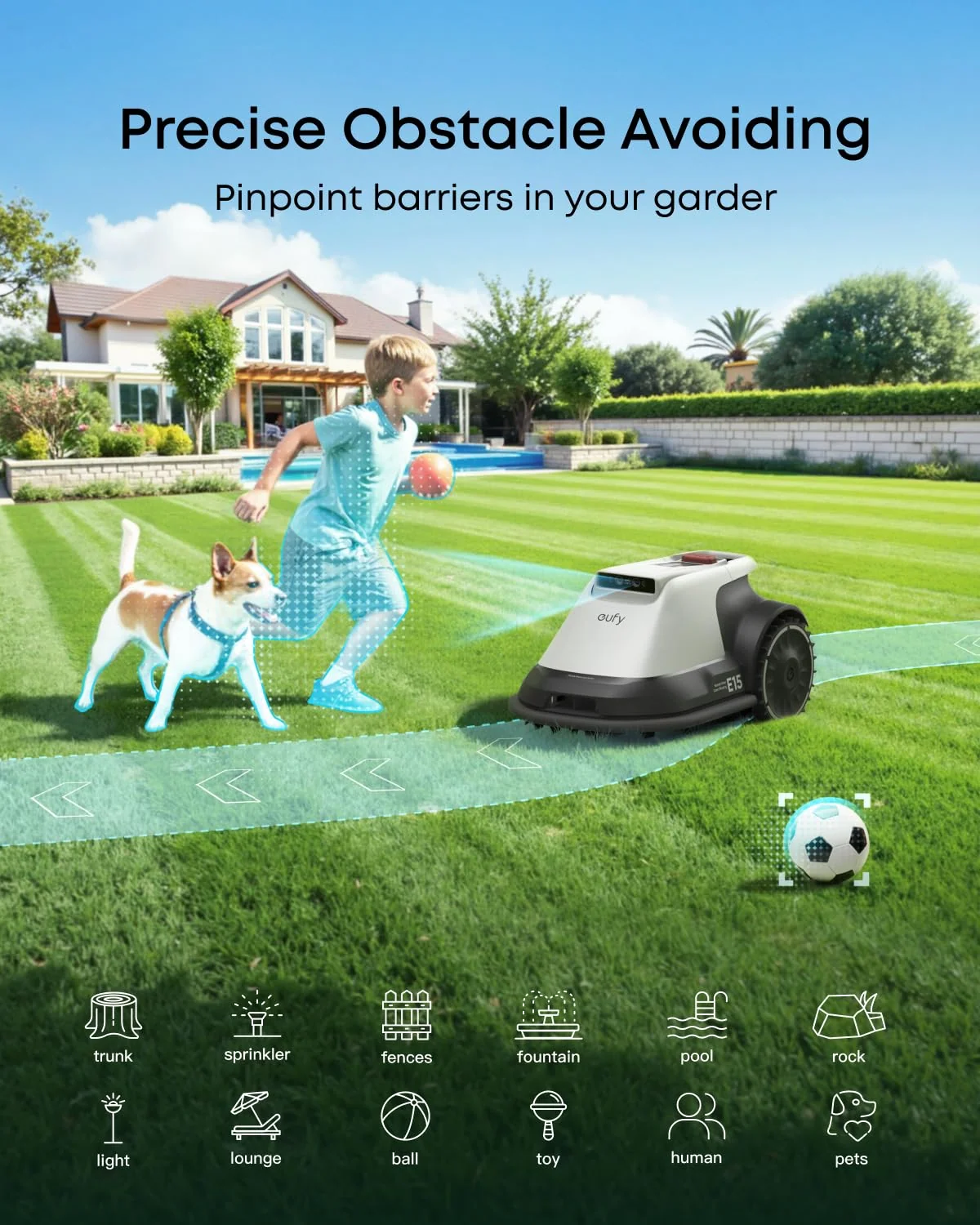
Camera navigation also ends the mowing day when useful light disappears. Both models recall themselves as conditions darken, so the headlight is not a license for overnight cutting. Their obstacle recognition is convincing around conspicuous toys, trees, and furniture, but small, low, or ambiguous objects still belong in the pre-mow sweep. Vision reduces collisions; it does not replace ordinary blade safety.
The ranking
The eufy E15 is the better buy for lawns comfortably below 0.2 acre.
It delivers the same essential camera mapping, 8-inch cutting system, 1–3-inch height range, app tools, and 18-degree slope ceiling without charging for unused mapping capacity.
Damp turf, rough transitions, ambiguous borders, closed gates, daylight limits, and unfinished edges can turn its effortless setup into regular intervention.

The eufy E18 is the right choice only when a suitable lawn outgrows the E15.
Its 0.3-acre mapping allowance makes one connected 8,700-to-13,000-square-foot lawn possible without changing the wire-free camera-navigation proposition.
The larger allowance brings no established improvement in cutting width, endurance, terrain ability, night operation, edge finish, or support for disconnected lawns.
Eufy E15 robot lawn mower
Eufy E18 robot lawn mower
Choose the lawn fit, then worry about the model number
Choose the E15 when the job has generous headroom
A good E15 lawn is smaller than the published maximum, mostly level, dry by the time mowing begins, and joined by routes the robot can drive without help. Its edges are visually obvious, its grass is supported and already maintained, and its owner accepts occasional trimming and a quick sweep for hazards. In that setting, the E15 removes the most irritating setup work without asking the buyer to fund unused acreage.
Choose the E18 when the area limit is the actual obstacle
The E18 becomes rational once the connected lawn exceeds roughly 8,700 square feet but remains within the same terrain and grass restrictions. Measure only mowable turf rather than the whole lot, then allow margin for awkward zones and short daylight. The site’s guide to what mower acreage ratings really mean explains why a machine should not be matched to a yard by the largest number on its box alone.
Choose neither when the yard needs mechanical ability
Ruts, persistent dew, soft banks, closed gates, significant slopes, tall-cut grass, St. Augustine, and dense Zoysia are not reasons to move from E15 to E18. They are reasons to leave this pair. The MOVA LiDAX Ultra 1000 is the more credible alternative when the priorities are a 45% slope rating and a higher 1.2–3.9-inch cutting range, while the broader wire-free mower comparison covers other ways to avoid a perimeter cable.
Replacement parts remain the ownership warning
Routine blade replacement is straightforward, and blade sets plus an E15 cutting disc have been documented. The expensive repair path is much less clear. The available record does not establish a dependable retail supply of replacement batteries, wheel assemblies, cameras, charging bases, or power supplies for either mower, nor does it confirm that owners are meant to replace the traction battery themselves.
App control should not be confused with a separate handheld mower remote. The E18 can be driven from the app, but the evidence does not confirm blade-powered manual touch-up mowing through those controls. Before choosing either model, ask eufy how battery service works in the buyer’s region, which mower-specific assemblies can be ordered, and what happens when a major component fails outside warranty.
The verdict does not need a feature-count tiebreaker. The E15 wins below its comfortable capacity because it already contains the reasons to buy this design; the E18 wins only where its extra map allowance prevents the smaller model from accepting the lawn at all.
Ready to Choose?
Sources (31)
- Amazon listings and customer reviews — Eufy E15 Robot Lawn and Eufy E18 Robot Lawn
- Owner reports across r/RobotVacuums, r/eufyS1Pro, r/eufy and 9 more threads
- Owner and reviewer video, 26 channels
- Walmart listing
- Facebook — Article — www.facebook.com
- Hedgecombers — Article — hedgecombers.com
- Bestrobovacuums — Article — www.bestrobovacuums.com
- Chewy — Article — www.chewy.com
- eufy — Article — www.eufy.com
- Substack — Article — robovacinsights.substack.com
- eufy — Article — service.eufy.com
- Countryliving — Article — www.countryliving.com
- Rtings — Article — www.rtings.com
- Vacuumwars — Article — vacuumwars.com
- Younghouselove — Article — www.younghouselove.com
- Womanandhome — Article — www.womanandhome.com
- Interlightus — Article — www.interlightus.com
- Coredy — Article — www.coredy.com
- Moderncastle — Article — moderncastle.com
- Thecarpentersdaughter — Article — thecarpentersdaughter.co.uk
- Techradar — Article — www.techradar.com
- Trustedreviews — Article — www.trustedreviews.com
- Lbtechreviews — Article — www.lbtechreviews.com
- Tomsguide — Article — www.tomsguide.com
- Pcmag — Article — www.pcmag.com
- Zdnet — Article — www.zdnet.com
- Trustpilot — Article — uk.trustpilot.com
- Amgardaseeblick — Article — amgardaseeblick.com
- Pistonheads — Article — www.pistonheads.com
- Bestbuy — Article — www.bestbuy.com
- Ycombinator — Article — news.ycombinator.com