The MOVA LiDAX Ultra 1000 is brilliant only after the yard stops fighting back.
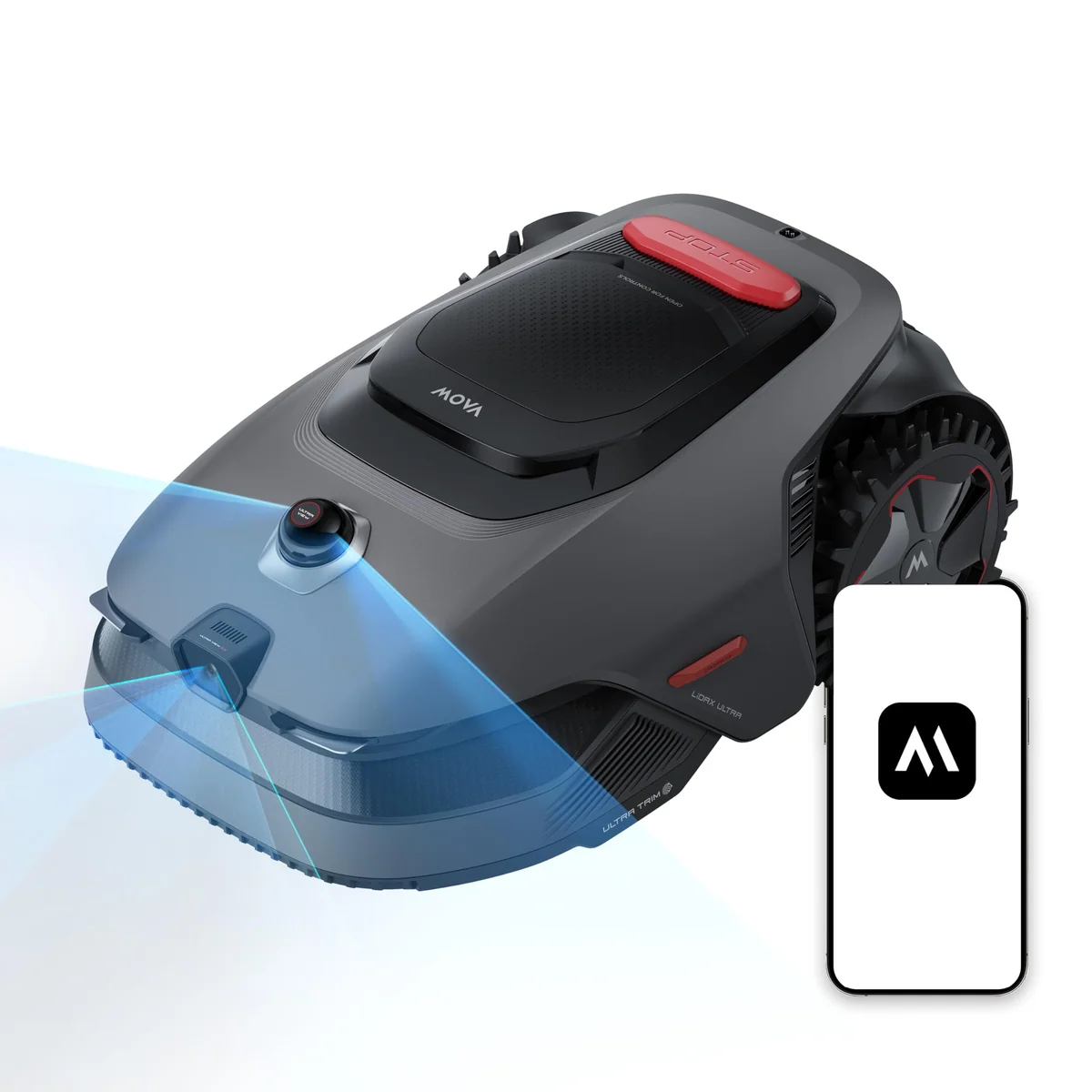
Buy the MOVA LiDAX Ultra 1000 for a firm, mostly smooth lawn where trees make RTK awkward, but skip it for sand, ledges, soft slopes or any yard that cannot tolerate hours of initial supervision.
The case, without the lawn-brochure language
Smart Lawn Bots recommends the LiDAX Ultra 1000 for a small, firm and mostly forgiving lawn where shade makes RTK inconvenient and slow background mowing is acceptable. Its excellent finish, quiet operation and sophisticated app are real strengths. So are its limits: the front casters dislike troublesome ground, the narrow deck takes its time, UltraTrim can scalp tall turf and dependable autonomy may require hours of conservative mapping.
The decisive fact is not that this mower can produce a good cut. It can. Once the map is conservative and every troublesome curb, shrub, rut and transition has been excluded, its orderly passes leave an even, deliberate finish while making remarkably little noise. The problem is everything that may happen before the lawn reaches that point.
The two passive front casters are the weak link. Firm grass and gentle, continuous grades are manageable, but loose soil, sandy turf, abrupt seams and small ledges can catch the nose while the driven rear wheels keep pushing. One detailed account went from more than two dozen rescues on an inadequately prepared map to an uninterrupted 12-hour job after several hours of remapping. That transformation captures the entire review: the LiDAX Ultra 1000 can become dependable, but it may demand more yard engineering than its “automatic” pitch suggests.
Physical installation is still much easier than burying a boundary wire or placing an RTK antenna. The dock needs power, firm level ground and reliable 2.4 GHz Wi-Fi for setup, then the app guides pairing and mapping. A simple lawn can be running quickly. An irregular lawn requires walking behind the mower, steering an accurate perimeter, creating paths and marking no-go zones before trusting a schedule.
Key Specifications
LiDAR solves the sky problem, not the ground problem
The strongest reason to choose the MOVA is a yard where trees, buildings or a covered docking area make satellite reception unreliable. Its 360-degree LiDAR maps physical surroundings rather than depending on an RTK reference station, and the mower can hold position under tree cover and in low light. For a shaded garden where an antenna has nowhere clean to see the sky, it is easier to place than the RTK-dependent Segway Navimow i110N.
LiDAR does not make the mower clairvoyant. The camera and point cloud usually avoid people, furniture, larger toys and obvious tools, but low objects remain inconsistent. Hoses, tennis balls, small toys, sticks and pet waste should be removed before every unattended run. Tall grass can trigger false positives, while reduced sensitivity improves coverage by accepting more collision risk.
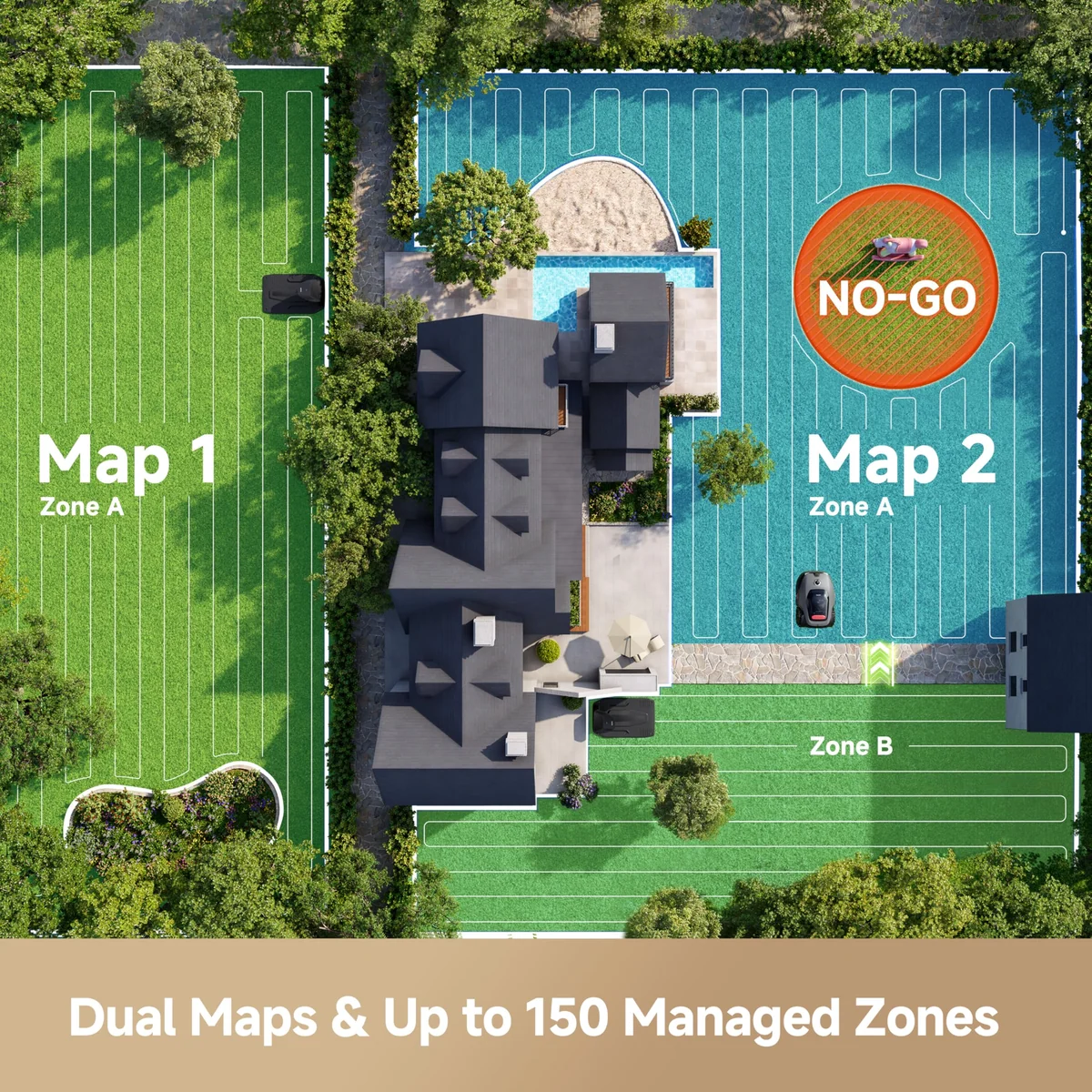
The app is unusually deep once its layout makes sense. It supports two maps, zones, connecting paths, multiple no-go-zone shapes, electronic cutting height, seasonal schedules, rain and frost protection, mowing direction, obstacle thresholds, quiet hours, task logs and maintenance reminders. What it still lacks is equally important: fine reshaping of an irregular boundary can mean remapping, moving the dock may disturb existing map work, and owners have encountered awkward dual-map scheduling and occasional failed starts.
“Zero edge” is the claim to ignore
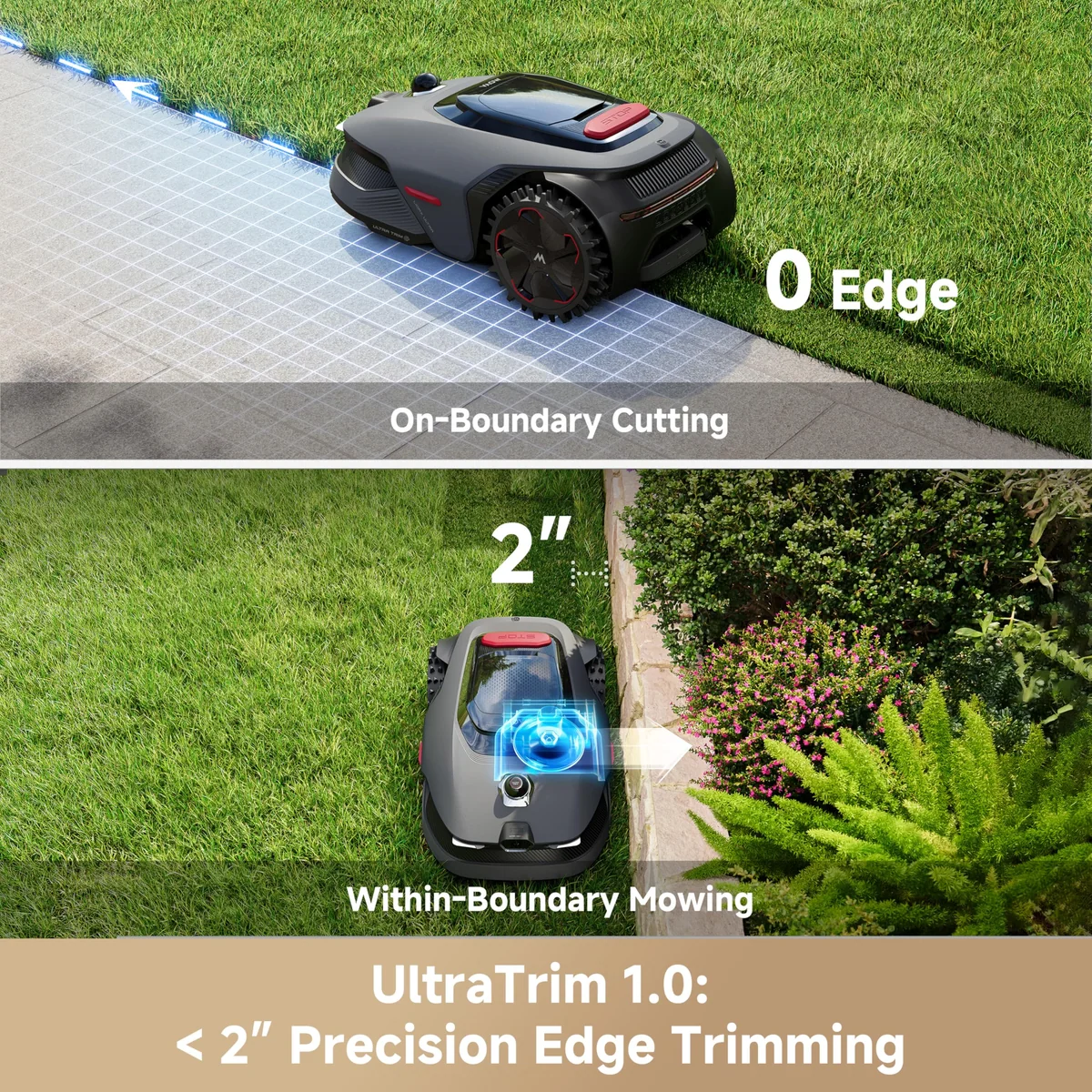
The movable UltraTrim disc can reduce the strip left beside a boundary, particularly where grass meets flush paving and the mower can safely straddle the transition. Beside walls it commonly leaves around one or two inches, tight corners leave more, and dangerous drop-offs require a wider safety margin. A street curb may need roughly a foot of setback to give the mower room to turn without falling beyond its virtual boundary.
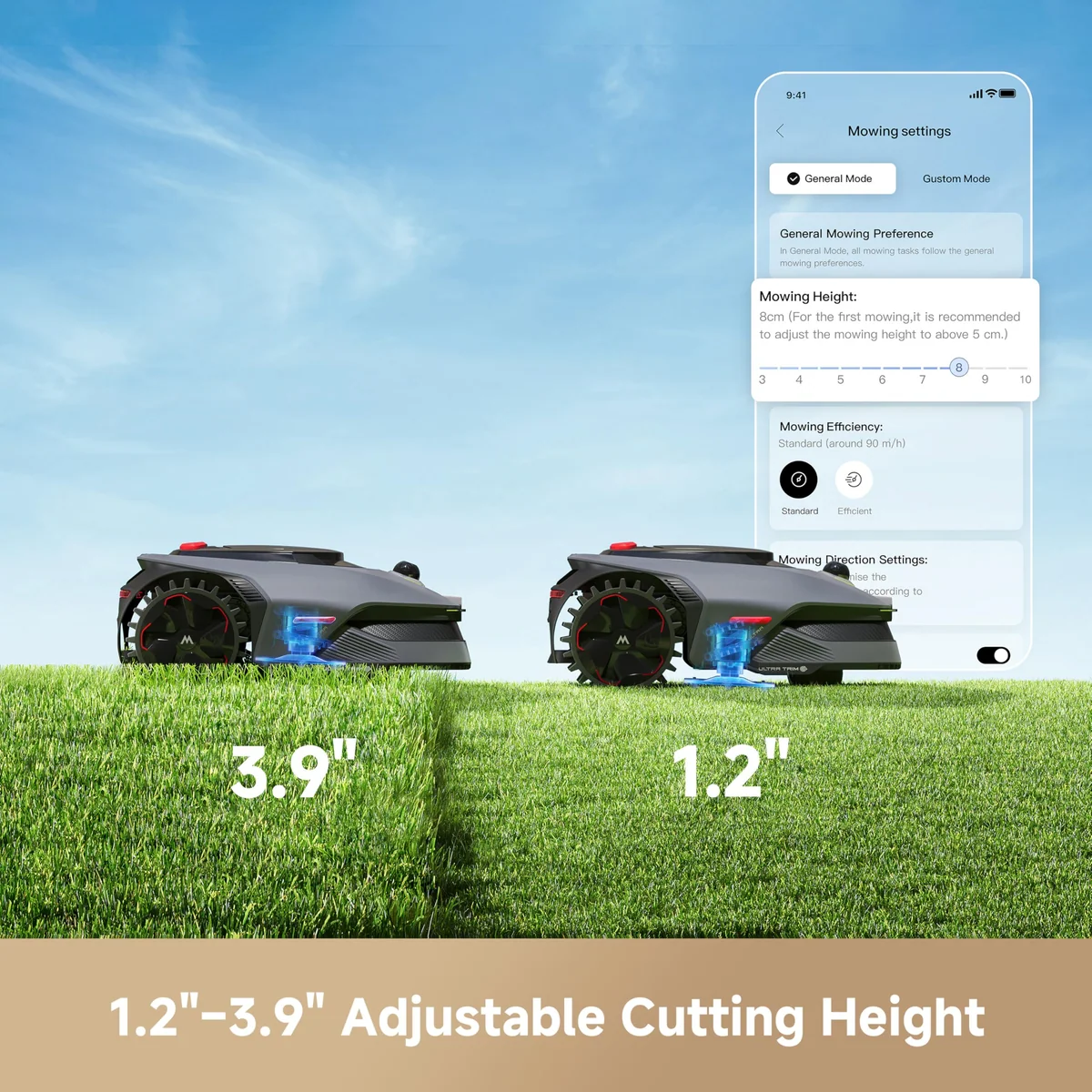
UltraTrim also cuts its outward pass at a fixed low height of about 1.2 inches rather than following the main deck setting. On a lawn maintained at three or four inches, that can create a scalped border or an obvious pale line across an internal zone boundary. Keep the regular edge pass at the chosen mowing height and disable UltraTrim if the first low perimeter lap looks harsher than the rest of the lawn.
Strengths & Limitations
Strengths
- LiDAR navigation removes the boundary wire and RTK antenna without surrendering organized mowing under trees.
- The main deck produces a clean systematic cut across an unusually broad 1.2–3.9-inch height range.
- Quiet operation, automatic recharge and deep zone controls suit frequent background maintenance.
Limitations
- Passive front casters can strand the mower on sand, soft soil, small ledges and awkward transitions.
- The quarter-acre map rating can mean several charges and most of a day rather than one quick session.
- UltraTrim cuts at a fixed low height, so it may scalp the very tall-cut lawn the main deck otherwise handles well.
- Edges, low objects, occasional rescues and immature map editing prevent genuine set-and-forget ownership.

A quarter-acre rating with a very small asterisk
The asterisk is time. The 0.25-acre figure describes the maximum managed map, not the amount this mower finishes on one charge. Its narrow single disc and 60–80-minute mowing window make automatic return, recharge and resume part of normal operation rather than an emergency fallback.
Real jobs vary dramatically. About 5,400 square feet has taken three charging stops and four to five hours, while a complicated 7,683-square-foot lawn needed more than 12 elapsed hours after its map was corrected. Smaller, simpler areas have managed roughly 1,500–1,800 square feet per run. Obstacles, edge passes, grass density, overlap and route geometry matter too much for a universal square-feet-per-hour promise.
That pace is acceptable if the mower maintains short grass several times a week while nobody waits for it to finish. It is frustrating if the yard must be free for children, dogs or entertaining by lunchtime. Anyone near the mapping limit should compare the larger-battery model in our LiDAX Ultra 1000 versus 2000 guide rather than buying the smaller machine at the edge of its capacity.
The cut is better than the journey
The 7.9-inch floating disc uses three small swing blades and follows structured U-shaped lanes instead of wandering randomly. It produces a smooth maintenance cut with narrow stripes, particularly when alternating directions or using a crisscross pattern. The trade-off is speed, and the blades are designed to shave frequent light growth rather than attack a neglected lawn.
Pre-mow tall grass, clear tough runners and deal with mature weeds before the first scheduled cycle. St. Augustine runners have trapped the casters during mapping, while tall clumps can be classified as obstacles and left standing. This mower reduces conventional mowing; it does not replace the first cut, weed control or every future pass with a string trimmer.
The slope percentage is not the terrain verdict
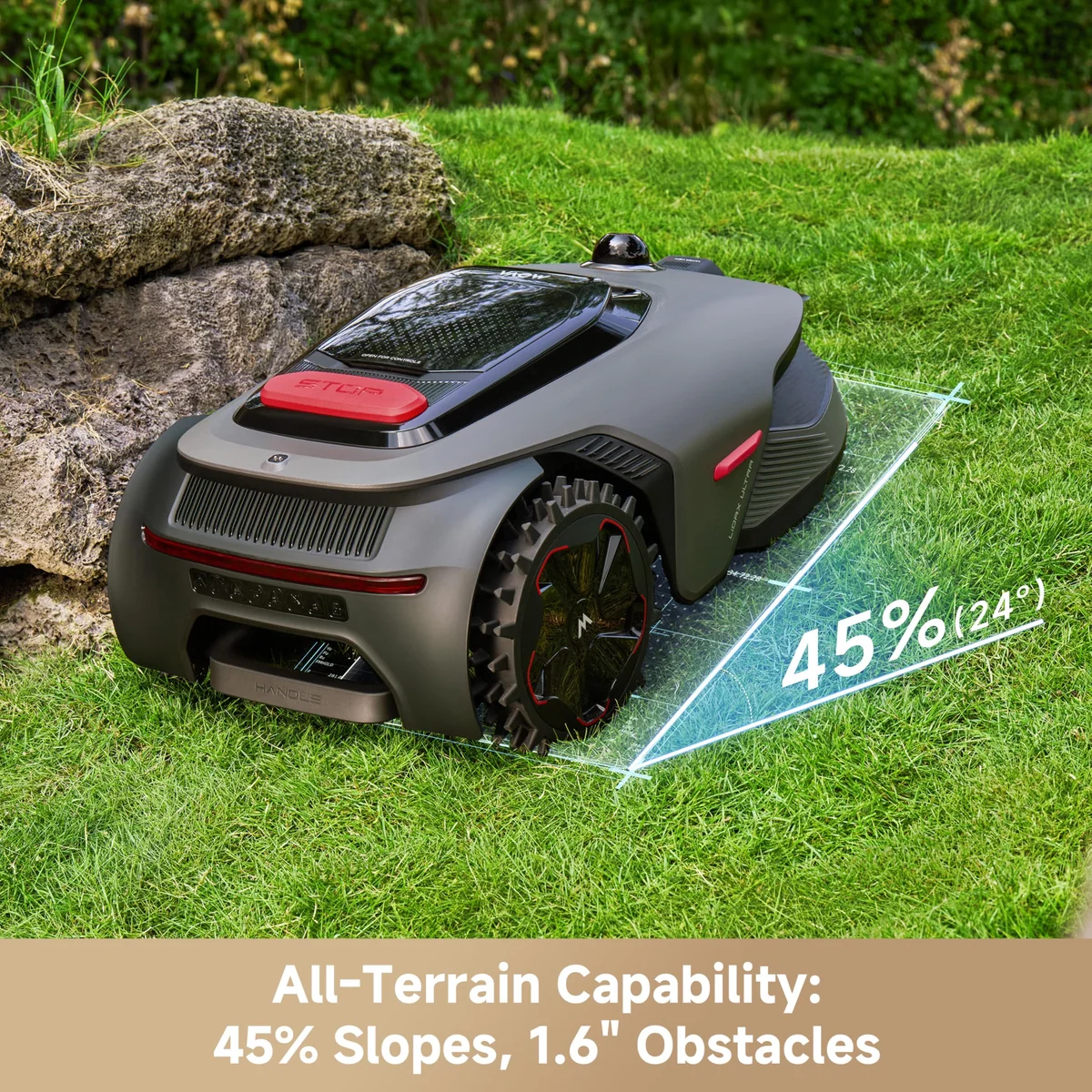
The advertised 45% grade is about 24 degrees, not 45 degrees. More importantly, a smooth incline is not equivalent to a ditch, a soft downhill turn or a caster dropping into an eroded seam. The rear wheels can climb while firm soil holds them, yet the same wheels may dig ruts when the nose becomes trapped.
Run mowing lanes along the slope where possible, avoid repeated turns across soft inclines and leave generous setbacks beside roads, pools and retaining walls. If the yard is defined by roots, holes, loose ground or steep turns, use our guide to robotic mowers for steep and uneven ground; no app setting can turn this rear-drive chassis into an AWD mower.
Who gets the unusually good value
The value case is excellent for firm, established turf comfortably below the maximum map size. The buyer receives antenna-free navigation, a broad electronic height range, structured cutting, two maps and unusually rich scheduling without moving into a large AWD machine. That combination is especially useful for fescue lawns kept tall, provided the low UltraTrim pass stays off.
The value collapses when the yard forces repeated rescues. Sand, damp loose soil, St. Augustine runners, curb seams and abrupt elevation changes turn saved mowing time into notification chasing. A remote property is therefore a poor assignment even if its square footage looks suitable, because no cellular module can lift a stranded caster.
The Segway Navimow i215 LiDAR is the stronger alternative where automatic mapping, roots and faster completion matter more than close edge work or a tall maximum cut. It has proved more tolerant of rooty terrain and finishes comparable areas sooner, though it can leave a substantially wider strip beside raised boundaries. The MOVA wins on antenna-free value for a carefully prepared small lawn; the Segway wins when the mower must cope with more of the yard as it already exists.
| Good match | Walk away or size up |
|---|---|
| Firm, established turf with smooth transitions | Sand, mud, loose loam or eroded seams |
| Tree cover or buildings that complicate RTK | Frequent ledges, roots, holes and curb drop-offs |
| Plenty of capacity margin below 0.25 acre | A complex lawn close to the full map limit |
| An owner willing to refine the first map | A remote site with nobody available for rescues |
The sixth week still includes lawn work
Frequent light mowing is easy on the cutting system, but the machine still needs attention. Inspect the three razor blades every few weeks, replace nicked or dull blades according to conditions, clear sticks from the rear tread and remove packed clippings beneath the deck. Wipe the camera and exposed LiDAR turret, particularly after pollen, dust or low branches.
The rain sensor can send the mower home and resume later, but damp ground is a traction problem even when the electronics tolerate water. A stuck mower can remain outside until its battery drains, so wet-weather automation deserves more caution than the IPX6 rating implies. A garage is optional rather than necessary, although shade and protection from debris, hail and sustained weather are sensible for an outdoor machine with a spinning sensor turret.
Security also needs sober expectations. PIN protection, a lift alarm and camera features are standard defenses, but real-time cellular location and off-map alerts depend on the optional Link Module and its service terms. An AirTag compartment is removable, and none of these measures makes a 30-pound mower theft-proof.
The unresolved issue is longevity. The warranty is listed as three years, but the useful ownership evidence covers weeks or months rather than multiple seasons, and the maturity of parts and repair support is not yet proven. Preserve the packaging, confirm the exact warranty in writing and use the return period to test docking, scheduled starts, heat, slopes, every narrow turn and a complete recharge-resume cycle.
Frequently Asked Questions
Does the MOVA LiDAX Ultra 1000 mow a quarter acre on one charge?
No, the quarter-acre figure is its maximum mapped area and a full job can require several 60–80-minute mowing cycles separated by charging stops.
Does it need a perimeter wire or RTK antenna?
No, it maps with LiDAR and AI vision, but it still needs a powered dock, app pairing and a carefully prepared virtual map.
Will it cut right to every edge?
No, flush paving gives the closest result while walls, corners and risky drop-offs still leave grass for a string trimmer.
Can it handle a 45-degree slope?
No, its rating is a 45% grade, or about 24 degrees, and soft soil or on-slope turns can defeat it below that limit.
Can one mower maintain disconnected front and back lawns?
It can store two maps, but disconnected areas still require carrying the mower, opening a physical route or adding another compatible charging arrangement.
Does the LiDAX Ultra 1000 need a garage?
No, its IPX6 weather resistance allows outdoor operation, although shelter can reduce exposure to sun, debris and severe weather.
Is cellular tracking included?
No, the Ultra 1000 requires the optional Link Module and applicable service terms for cellular data, GPS location and off-map alerts.
Sources (27)
- Amazon listings and customer reviews — Mova Lidax Ultra 1000
- Owner and reviewer video, 46 channels
- Walmart listing
- Tech — Article — us.mova.tech
- Freshlycharged — Article — freshlycharged.com
- Facebook — Article — www.facebook.com
- Slashgear — Article — www.slashgear.com
- Newatlas — Article — newatlas.com
- Tech — Article — au.mova.tech
- at — Article — www.galaxus.at
- Basic Tutorials — Article — basic-tutorials.com
- Appleinsider — Article — appleinsider.com
- Notebookcheck — Article — www.notebookcheck.net
- Maison Et Domotique — Article — www.maison-et-domotique.com
- Au — Article — www.gadgetguy.com.au
- MOVA Tech — Article — us.forum.mova-tech.com
- Au — Article — www.techguide.com.au
- Wellbots — Article — www.wellbots.com
- Nytimes — Article — www.nytimes.com
- Novabot — Article — novabot.com
- Techiwant — Article — techiwant.com
- Samsclub — Article — www.samsclub.com
- Heyupnow — Article — community.heyupnow.com
- T3 — Article — www.t3.com
- Tech — Article — uk.mova.tech
- Robocleaners — Article — www.robocleaners.com
- Mowscout — Article — mowscout.com