The Navimow i215 beats bad GPS, but it cannot beat a bad yard.
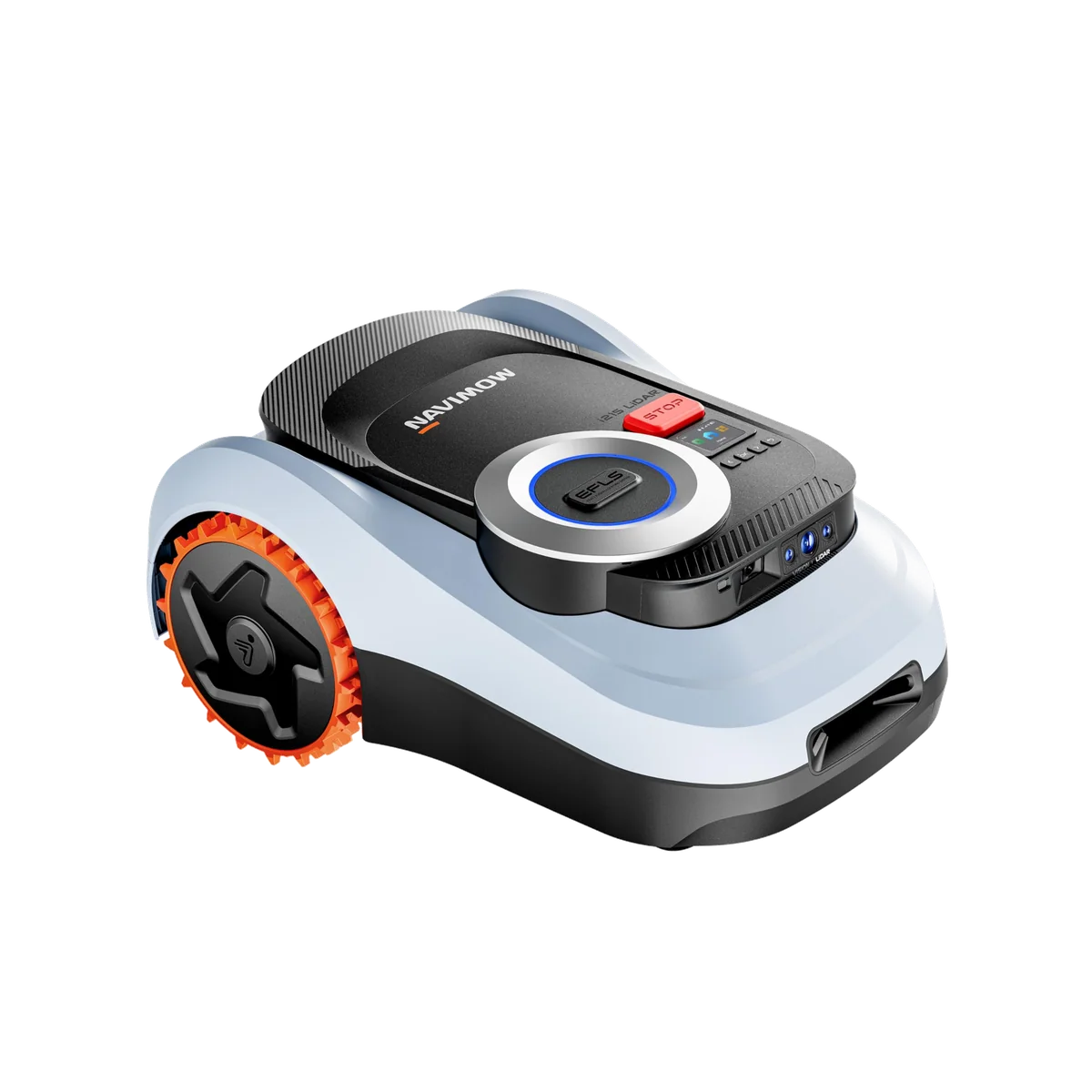
Buy the Navimow i215 for an enclosed, well-prepared lawn with useful LiDAR landmarks and poor satellite reception; skip it if the mower must cross severe slopes, negotiate hazardous edges, or work without an occasional rescue.
A clever mower with a narrow path to excellence
The i215 is worth buying when its antenna-free navigation solves a problem the lawn actually has. Give it stable landmarks, firm ground, conservative hazardous-edge boundaries, manageable slopes, and time to recharge, and it can turn the main mowing job into quiet background maintenance. Ask its two driven wheels and virtual map to overcome soft ruts, exposed drops, severe traverses, unreliable gate routes, or a featureless open field, and the robot becomes the chore.
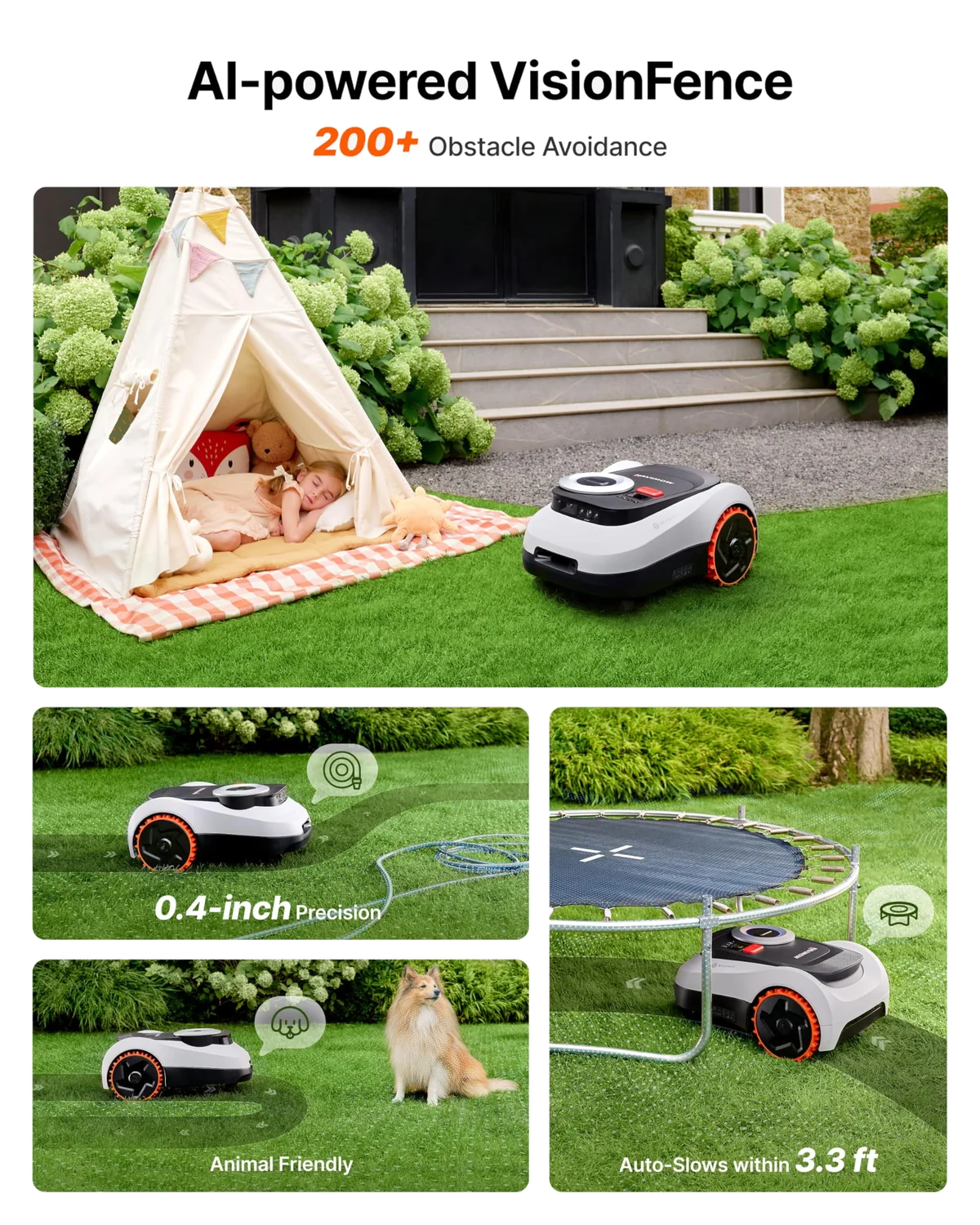
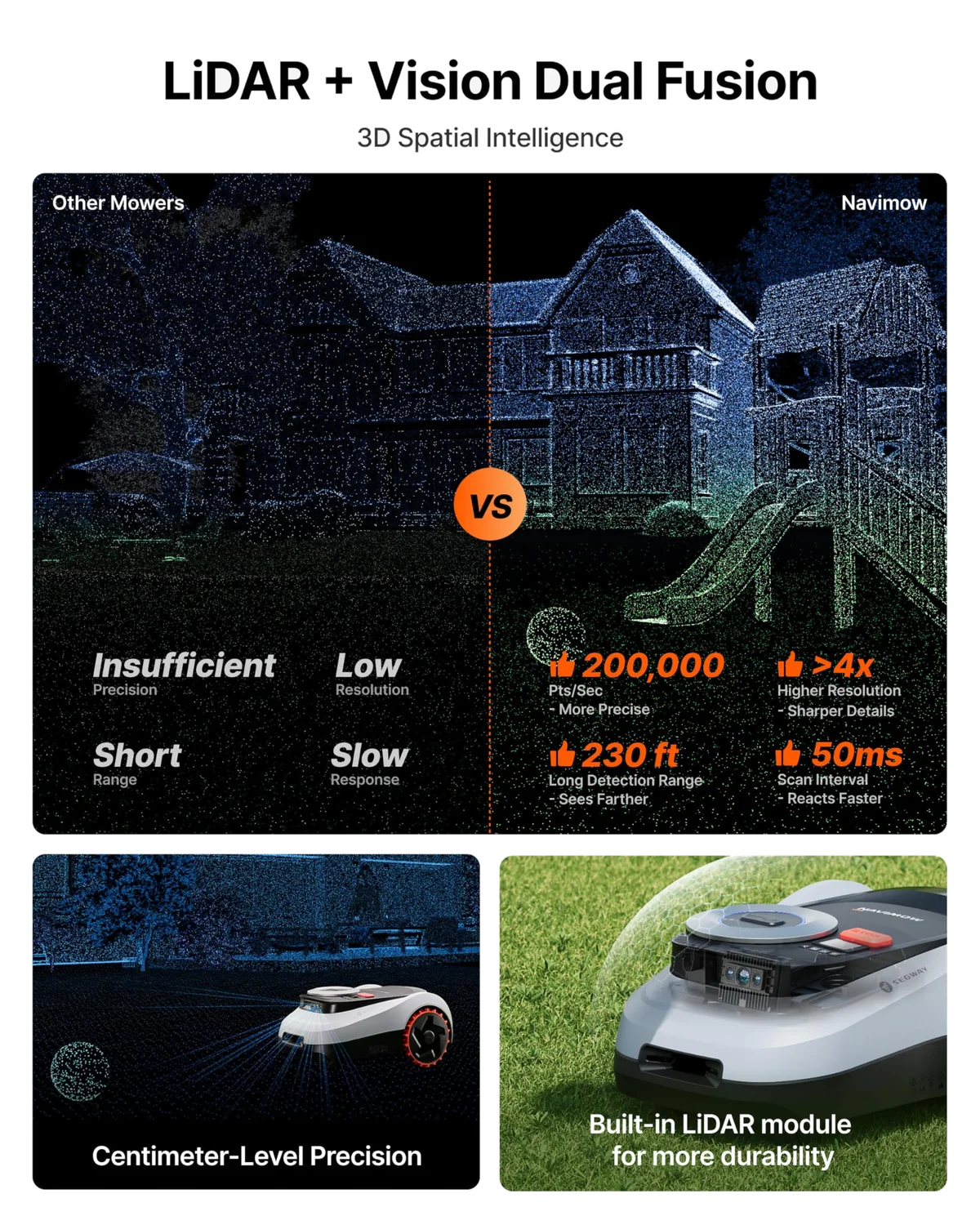
The i215 exists to remove the most irritating part of a modern wire-free mower: finding somewhere to plant an RTK antenna with a dependable view of the sky. There is no boundary wire to bury and no positioning pole to negotiate with trees, walls, or the roofline. The mower scans the yard with LiDAR, adds vision for object recognition, and builds an editable virtual map.
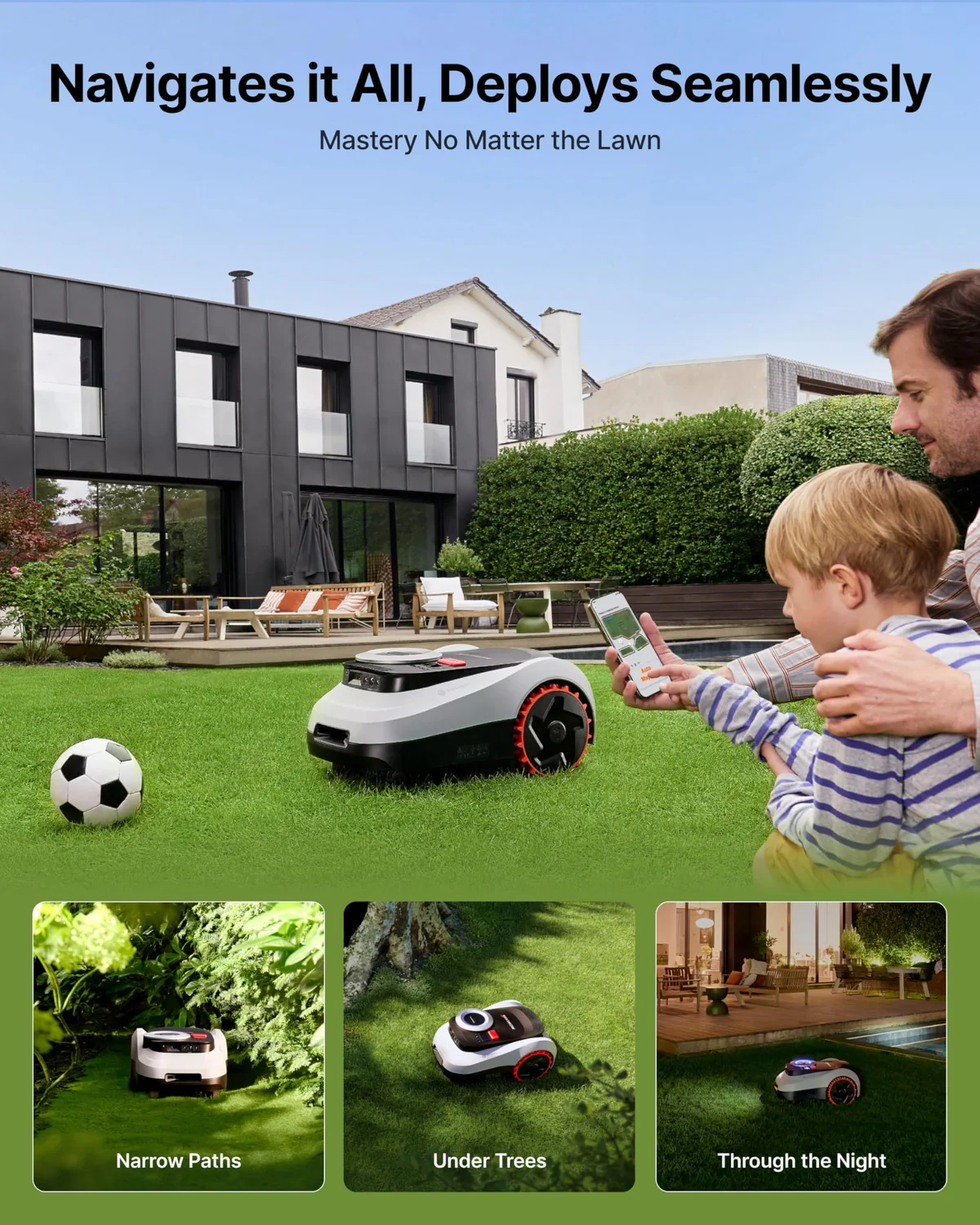
That distinction matters. In a horseshoe-shaped 0.3-acre backyard hemmed in by trees more than 100 feet tall, weak satellite reception stopped being the problem and the mower settled into quiet, systematic maintenance. A separate 7,645-square-foot lawn with trees, shade, fencing, mulch borders, slopes, bare areas, and a play structure also ended with an even cut once its map was refined. This is the yard the i215 was built for.
The mistake is assuming LiDAR makes location infallible. It trades dependence on satellites for dependence on stable surroundings. Trees, fences, buildings, and beds can provide useful geometry; a broad, featureless lawn may give the mower less to orient itself against. That helps explain the split between owners who barely think about mowing and owners watching the machine spin, miss strips, lose a connector route, or approach its dock as though the charger has moved overnight.
Smart Lawn Bots’ standard is stricter than “the blades turned and some grass became shorter.” A robot must cover the mapped lawn, remain inside it, return home, charge, and resume without turning the owner into a retrieval service. The i215 can complete that chain beautifully, but its success depends more heavily on the yard than the polished setup experience suggests.
Key Specifications
LiDAR removes the pole, not the setup
Installation is genuinely lighter than either burying wire or positioning an RTK station. The dock still needs power, level ground, a clean approach, and enough room for alignment. Pairing, charging, firmware updates, and the first trip from dock to grass also happen before automatic mapping begins. On a clearly bounded lawn, the mower can trace the perimeter itself; when the edge is ambiguous, manual steering remains available.
The best complicated-yard setup is deliberately unglamorous: map one zone, let it complete a cut, correct the boundary, and only then add the next zone. An i215 maintaining 750 m² across five zones worked well with that approach, splitting the lawn across alternating days and restricting narrow strips to a sensible mowing direction. The app’s control over zones, schedules, cutting direction, height, no-go areas, and working mode is not decoration. It is how a merely functional map becomes a reliable one.
Automatic mapping also needs a human veto. The i215 has no dedicated downward-facing cliff sensor. On one raised grass edge beside a fence, it followed the saved boundary yet slipped into the narrow lower strip twice and needed lifting back onto the lawn. Leave a generous virtual buffer beside retaining walls, steps, pools, creek banks, drainage channels, and road edges, then watch several complete runs before trusting the boundary.
That is the difference between wire-free mowing and risk-free mowing: the former is real, while the latter is not.
Strengths & Limitations
Strengths
- LiDAR and vision remove the perimeter wire and external RTK antenna from a genuinely complicated setup.
- Editable zones, schedules, directions, and cutting heights make it adaptable to divided residential lawns.
- Frequent systematic mowing is quiet, leaves tiny mulched clippings, and can keep the main lawn consistently presentable.
- Tree cover, fences, and buildings can become useful navigation landmarks instead of satellite obstacles.
Limitations
- Docking, missed strips, and connector routes are inconsistent enough that the first successful map cannot be trusted by itself.
- Rear-wheel drive struggles with some ruts, thick turf, leaves, wet transitions, and lateral slopes.
- There is no dedicated cliff sensor, so immediate drop-offs need a deliberately conservative virtual boundary.
- Raised edges and cautious obstacle avoidance leave real string-trimmer work behind.

The acreage and slope numbers need translating
0.37 acre is a workload ceiling
The rated area is roughly 16,100 square feet of actual grass, not the size of the entire property and not a promise that one battery charge clears everything. A 6,500-square-foot front-and-back installation used about one charge for either section, but not both. Elsewhere, a divided 0.19-acre lawn demanded four or five charging cycles and occupied most of a weekend. Another yard just over 0.25 acre took into a third day to complete its first zone.
Charging itself is not a failure. Robot mowers are maintenance machines, and elapsed time matters less when nobody is pushing them. The distinction is whether the i215 returns, charges, resumes at the right place, and finishes within the available schedule. Reports of docking on roughly one attempt in eight, missing the contacts by inches, or requiring the mower to be carried onto the lawn turn slow autonomy into manual work.
Buy with comfortable capacity rather than treating 0.37 acre as a target to hit exactly. Simple geometry, short maintained grass, firm transitions, sensible stripe direction, and dependable docking all improve daily throughput. Divided lawns, repeated turns, ruts, heavy growth, conservative obstacle avoidance, and failed routes consume it.
The mower climbs better than it traverses
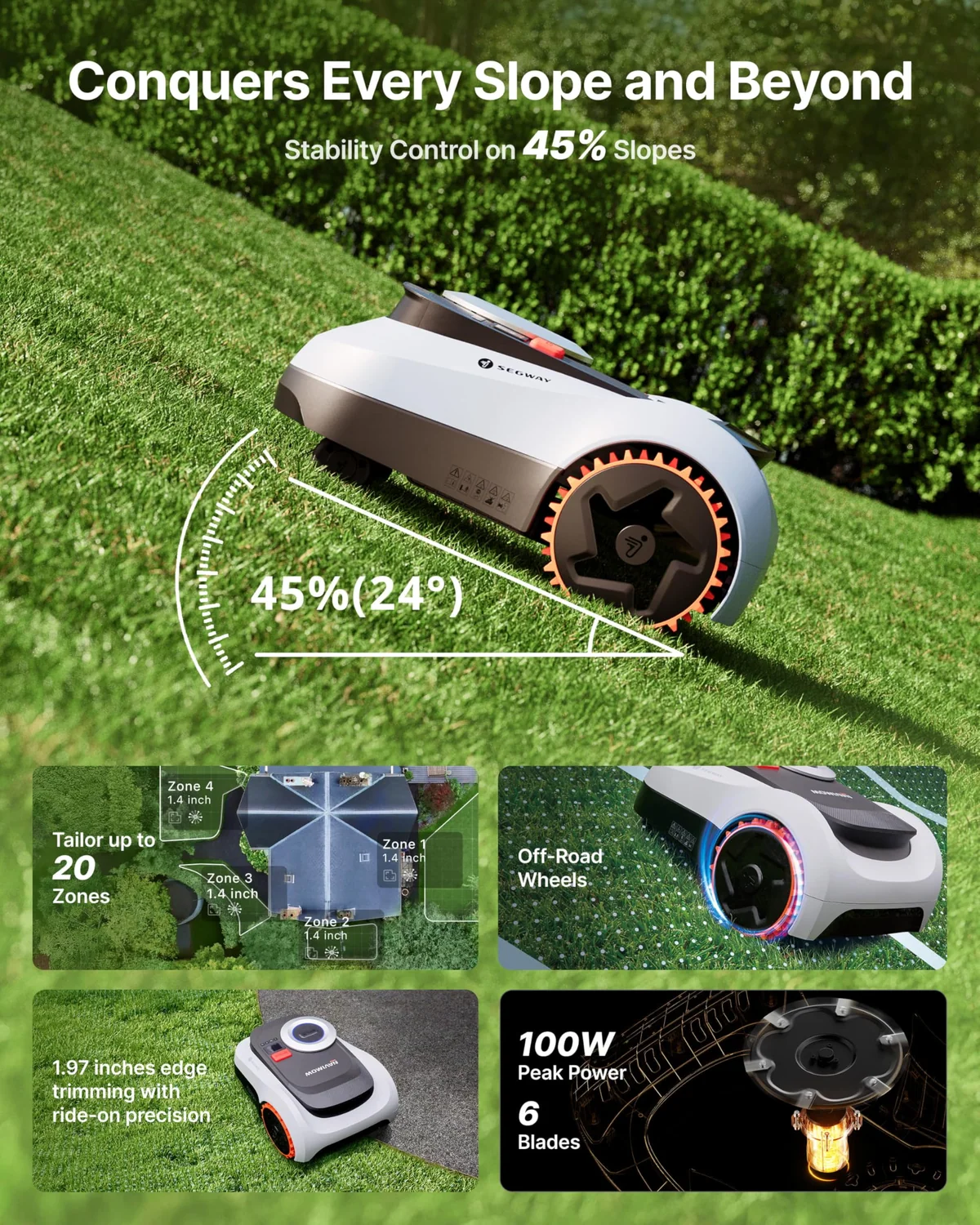
The advertised 45% maximum is a grade, not an angle; it equals about 24°. That is still steep, but the number describes a limit rather than an ideal working surface. The closest two-wheel-drive LiDAR slope account found that a straight climb around 25° was possible while a horizontal line around 20° caused downhill sliding. Locking passes uphill and downhill reduced sideways travel, but could leave narrow uncut “mohawks.”
Off-road tread does not make the i215 an AWD mower. Thick St. Augustine, leaves, damp ramps, soft soil, sidewalk ruts, and abrupt grass-to-paving transitions have all exposed the rear-drive chassis. Fill holes before scheduling it, keep the steepest work dry, and do not interpret a successful climb as proof that it can turn neatly across the same slope. The broader guide to robot mowing on hills explains why grade, direction, moisture, and turning room belong in the same calculation.
Quiet cutting, unfinished edges
Noise is the least controversial claim. The rated 59 dB(A) has not been independently established in the supplied exact-model measurements, but the lived result is consistently described as a low, unobtrusive sound. Long sessions are far easier to tolerate than a conventional mower droning outside the window.
Main-lawn results range from clean stripes to wavy lines and recurring missed patches. Frequent cutting helps because each pass removes little grass and a later direction can catch a stray blade. It also produces tiny clippings that disappear into the turf rather than filling a collection bag. This is not a recovery mower, so bring overgrown grass down conventionally before asking it to maintain the height.
Expect a string trimmer at fences, raised beds, trunks, and tight corners. Flush paving gives EdgeSense room to let a wheel overlap the border, but the cutting disc remains inside the body. Obstacle avoidance can compound the problem by swinging one or two feet around certain objects. Recognition succeeded, yet the lawn was not finished. Buyers who care about that distinction should read how robot mower edge cutting changes with border geometry.
Choose the mower for the yard’s hardest problem
The i215 is the better Navimow than the i110N when tree cover makes an RTK installation doubtful, the lawn needs a higher capacity, or antenna placement would dictate an absurd dock location. Paying for LiDAR on a small, open rectangle is much harder to justify because cheaper positioning can already work there.
The i210 AWD beats the i215 when traction is the real obstacle and the mowable area fits its smaller rating. Its AWD chassis is the more credible choice for ruts, persistent slopes, thick turf, and damp ground, provided satellite positioning has enough sky. The i215 wins the opposite argument: blocked sky, useful surrounding landmarks, and no appetite for an antenna.
For a genuinely larger or much rougher property, the Navimow X430 is the machine to consider. It brings the size, throughput, and four-wheel-drive hardware that the compact i215 does not pretend to have. It is also a disproportionate answer for narrow residential zones where the i215’s smaller body is an advantage.
The decision is therefore not LiDAR versus AWD in the abstract. It is positioning versus traction. Buy the system that solves the failure your lawn is most likely to produce.
The sixth week is about support, not specifications
The strongest longer-run i215 account covers about 100 operating hours and 50 mows. It is a favorable ownership story, but success required splitting zones, moving boundaries inward, teaching a safer route to the charger, adding molding at low brick edging, and avoiding a slick wet ramp. That is reasonable one-time preparation if it leads to a season without a push mower; it is not the same thing as opening the box and forgetting the yard exists.
Reliability and support are less settled. Error codes have turned otherwise capable machines into stationary equipment, with one owner receiving a replacement after video diagnosis and another waiting without a useful remedy. Direct i215 support reports range from effective case ownership to slow email exchanges, repeated log requests, and weeks of unsuccessful remapping.
Preserve the packaging and use the retailer’s return window as an engineering trial. Test every zone, repeated docking from different directions, recharge and resume, the steepest cross-slope, gates, sidewalk transitions, damp ground, and the boundary nearest any road or drop. A beautiful first map proves almost nothing.
Routine care is straightforward but not optional. Keep the LiDAR and camera windows clean, clear packed clippings from beneath the deck, inspect the six blades, and use the correct screws and thread locking when replacing them. Cheap aftermarket hardware has loosened during use. Built-in cellular monitoring also becomes a renewal decision after its included service period, although ordinary local mowing does not depend on keeping that subscription active.
Frequently Asked Questions
Does the Navimow i215 need an RTK antenna or perimeter wire?
No, it navigates with onboard LiDAR and vision, while GPS serves separate security functions rather than requiring a local positioning antenna for mowing.
Can the Navimow i215 mow 0.37 acre on one charge?
The 0.37-acre figure is its rated maintainable area, not a one-charge promise, so larger or divided lawns should be expected to involve automatic charging and resumption.
Does a 45% slope rating mean the mower can handle a 45-degree hill?
No, a 45% grade is about 24°, and turning across wet or soft slopes can become difficult well before the straight-climbing limit.
Will the Navimow i215 cut all the way to a fence?
No, flush paving can permit close ride-on edging, but fences, walls, trees, raised beds, and cautiously avoided obstacles leave grass for a string trimmer.
Sources (34)
- Amazon listings and customer reviews — Navimow I215 Lidar
- Owner reports across r/roboticLawnmowers, r/Navimow_Segway, r/SegwayNavimow and 5 more threads
- Owner and reviewer video, 39 channels
- Toptenreviews — Article — www.toptenreviews.com
- Expertreviews — Article — www.expertreviews.co.uk
- Segway — Article — navimow.segway.com
- Trustedreviews — Article — www.trustedreviews.com
- Therobotmower — Article — therobotmower.co.uk
- Navimow — Article — navimow.com
- Trustpilot — Article — www.trustpilot.com
- Pcmag — Article — www.pcmag.com
- Pcworld — Article — www.pcworld.com
- Facebook — Article — www.facebook.com
- Au — Article — segway.com.au
- Lifehacker — Article — lifehacker.com
- Theverge — Article — www.theverge.com
- Maison Et Domotique — Article — www.maison-et-domotique.com
- Au — Article — roboticmower.com.au
- Lowes — Article — www.lowes.com
- Techadvisor — Article — www.techadvisor.com
- Homedepot — Article — www.homedepot.com
- Tv — Article — www.stuff.tv
- Cnygreenteam — Article — cnygreenteam.com
- Outdoor Usa — Article — outdoor-usa.com
- Easylawnmowing — Article — www.easylawnmowing.com
- Protoolreviews — Article — www.protoolreviews.com
- Homebuilding — Article — www.homebuilding.co.uk
- Techradar — Article — www.techradar.com
- Gizmodo — Article — gizmodo.com
- Suncolawns — Article — shop.suncolawns.com
- Smartyardnw — Article — smartyardnw.com
- the Ambient — Article — www.the-ambient.com
- Outdoorica — Article — outdoorica.com
- T3 — Article — www.t3.com