Robot mowers cut the lawn, but the last strip is still yours.
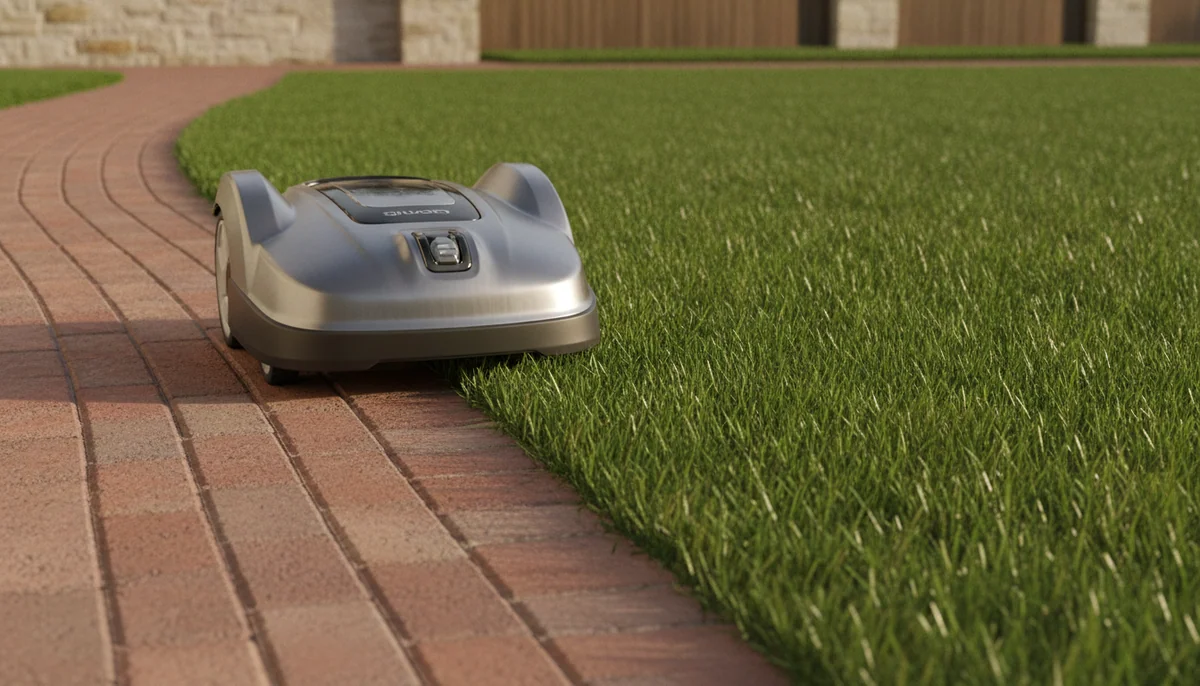
A robot mower can keep the broad center of a lawn looking freshly cut all week and still leave a bright green outline around the property. That outline is not necessarily a navigation error. The cutting disc usually sits several inches inside the body, while the wheels, bumper and safety margin must remain clear of anything the mower cannot drive over.
The border decides how much work remains. Where grass ends level with a sidewalk, patio or driveway, the mower can place one or more wheels on the hard surface and carry its blades close to the grass line. Put the same mower beside a fence, wall, raised bed or curb, and its chassis reaches the obstacle before the blades reach the last strip.
Smart Lawn Bots would plan for a handheld trimmer every one or two weeks around vertical and irregular boundaries. The best edge-focused machines can turn that into a short touch-up rather than a second mowing job, but “edge cutting” should never be read as a promise of a finished perimeter on every kind of yard.

The mower can only cut where its blades can physically reach
Most residential robot mowers use a horizontal disc fitted with three to six small pivoting blades. The disc is enclosed beneath the chassis so hands, feet and solid objects do not meet an exposed cutting edge. That protective space creates the uncut margin.
More accurate positioning does not remove it. RTK, LiDAR and camera vision can all place a mower close to a saved boundary, but centimeter-level navigation cannot move an inset blade through a fence. Navigation determines whether the mower follows the intended line; deck geometry determines where the grass is actually severed.
Obstacle avoidance may widen the gap further. A tree trunk, fence post, downspout or garden ornament can be recognized correctly while the mower swings around it with a generous safety radius. Nothing has collided, yet a halo of long grass remains. Turning down avoidance sensitivity may reclaim some turf, but it also reduces protection for toys, hoses, wildlife and other low hazards.
| Boundary | Likely result | Finishing work |
|---|---|---|
| Flush sidewalk, patio or driveway | The wheels can overlap the hard surface, allowing a ride-on edge pass to bring the disc close to the grass line. | Little or none when the paving is level, wide and safely mapped. |
| Fence, wall or raised bed | The chassis reaches the vertical face before a centered cutting disc reaches the grass beneath it. | Usually a narrow but visible strip along the full boundary. |
| Curb, step, pond or retaining drop | A conservative virtual boundary keeps the wheels away from the fall, moving the blades inward as well. | A wider strip is the sensible price of keeping the mower on the lawn. |
| Tree, post or downspout | Obstacle avoidance and turning space create an uneven ring that may be wider than the deck’s physical inset. | Quick circular touch-up with a trimmer. |
| Inside corner or narrow recess | The body cannot adopt the position needed to place its blades in the corner. | Manual trimming remains unavoidable. |
| Soft or crumbling shoulder | Overlapping the edge risks wheelspin, rutting or dropping a wheel off the supported surface. | Map safely inside the edge and accept the remaining grass. |
Two inches is excellent, and six inches is entirely possible
There is no honest universal clearance figure because the same machine produces different margins around the same yard. A mower may nearly erase the line beside flush concrete, leave three or four inches at a fence and stand six inches away from a rocky bed after obstacle avoidance adds its own buffer.
The eufy E15 and E18 illustrate the ordinary centered-disc result. Both can ride onto suitable paving, but their eight-inch cutting systems remain inside the chassis. Eufy allows for as much as four inches beside walls, and imperfect visual boundaries can leave more. Increasing edge overlap may narrow the fringe, but it can also put a wheel over a curb or into a bed. The E15 and E18 comparison explains why buying the larger model changes lawn capacity rather than this edge geometry.
The HOOKII Neomow X2 SE has produced an edge gap around 15 cm, close to six inches, despite accurate LiDAR navigation. The YARDCARE V100 is more explicit about its limitations: its listing says it may stop 10–20 cm, roughly four to eight inches, before the edge. The V100’s random coverage, manual charging and broad border make it a poor choice when the entire point of the purchase is a finished-looking small lawn.
Better deck placement reduces the problem. Navimow claims less than two inches for the X430’s EdgeSense system, and its broad dual-disc deck is much more credible on a large lawn than a tiny centered disc. It still cannot cut through walls, inside corners or obstacle clusters, and its 24-inch body needs room to approach. The Navimow X430 review is the better next stop for buyers whose difficult acre also needs four-wheel drive and a four-inch maximum cutting height.
The Mammotion LUBA Mini 2 1500H goes further by adding a dedicated side disc. It can leave roughly 5–10 cm beside raised obstacles, depending on access and mapping, but it reaches closer along level transitions than a central disc alone. Its AWD chassis is also the stronger choice for bumpy or sloped ground. The drawback is that tight corners remain unfinished and its software and support history are less settled than its hardware.
A real side trimmer is the most convincing answer
The ECOVACS GOAT O1000 and A2000 LiDAR PRO carry a separate string-trimmer head on the side of the mower. That is a meaningful mechanical advantage, not simply a more optimistic name for an ordinary edge pass. Along a straight driveway, sidewalk, square bed or accessible fence run, the powered line reaches grass that a centered blade disc would leave standing.
The A2000 is the stronger version for lawns approaching half an acre. Its two main discs cover almost 13 inches, while TruEdge handles the perimeter as a separate operation. On firm, clearly bounded grass, that combination can reduce routine trimming to occasional work around posts, irregular rocks and awkward corners.
Its drawback sits in the map. Closely separated zones, fences and difficult exclusions can expose stubborn automatic decisions that are hard to redraw cleanly. TruEdge also shuts down when safety detection sees a person nearby, and inaccessible geometry still wins. It removes most trimming only when the border gives the mower room to use it.
The smaller GOAT O1000 LiDAR PRO brings the same basic edge-trimmer idea to a compact lawn, but its narrow 8.66-inch mowing disc makes large areas slow. The O1000 and A2000 comparison separates the tight-access option from the wider, faster mower. Neither deserves to be bought solely on “edge-to-edge” language if the garden is dominated by inside corners, raised stonework and closely spaced obstacles.
The lawn can be redesigned to meet the mower halfway
The cleanest robotic edge often comes from changing the border rather than changing the robot. A level strip of pavers around a fence or bed gives the wheels somewhere safe to travel while placing the grass within reach of the deck. The hard strip needs to be broad enough for the mower’s wheel position, level with the turf and firmly supported so repeated passes do not tip or sink it.
A mowing strip is especially useful beneath fences, where string trimming risks damaging wood, vinyl or wire. It also prevents grass from growing in the small space that no enclosed blade system can safely occupy. This is permanent landscaping work, but it benefits every future mower instead of depending on one app or one proprietary accessory.
Do not solve a cosmetic fringe by mapping recklessly near a drop. Curbs beside roads, retaining walls, pools, drainage channels and pond banks need a deliberate safety margin. A wider manual strip is preferable to a robot sliding off the lawn. The same principle applies on wet slopes, where a machine may hold the edge in dry conditions and lose it as soon as traction changes.
Good mapping still matters on safe borders. Let the wheels overlap flush paving, keep leaves from disguising the grass line and watch the first complete edge pass. If a mower repeats the same cautious detour around a harmless fixed object, a carefully redrawn boundary or a no-go area with less wasted space may help. If the obstacle is genuinely dangerous, the grass is not worth reclaiming.
Choose by the perimeter, not the marketing name
Walk the lawn before comparing models. Separate the boundary into flush paving, vertical obstacles, drops, soft shoulders and irregular objects, then estimate how many minutes each section takes with a trimmer. A mower that leaves four inches along ten feet of fence creates a small job. The same margin around an intricate half-acre property may preserve most of the chore the buyer hoped to remove.
The best ordinary edge mode suits a lawn surrounded by level hardscape. A side disc such as the LUBA Mini 2’s helps when closer cutting and AWD terrain ability are both important. A powered string head such as TruEdge makes the strongest case when long accessible borders dominate. No current design turns narrow recesses, fence posts, tree rings, raised corners and protected drop-offs into zero-work edges.
That makes remaining trim time the honest comparison. Five quiet minutes every other week is a successful robot-mower outcome. Twenty minutes after every run means the border design and mower design are poorly matched, however straight the central stripes look. Buyers who want model-specific choices can continue to the site’s guide to the best robotic mowers for edge cutting.
The verdict remains simple: buy a robot mower to remove the repeated walking across the lawn, not to abolish every tool in the shed. Flush edges may finish beautifully, dedicated trimmers can remove most of the rest, and vertical or hazardous boundaries still belong to the person holding the string trimmer.
Frequently Asked Questions
Will a robot mower cut directly against a fence?
No, an enclosed cutting disc normally remains inside the chassis, so a fence leaves a strip that needs trimming unless a separate side cutter can safely reach it.
Which lawn border gives the closest robotic cut?
A wide, firm surface installed level with the grass gives the mower room to overlap the boundary and bring its blades closest to the edge.
Does more accurate GPS or LiDAR eliminate the edge gap?
No, better navigation can follow the boundary more consistently but cannot overcome an inset deck, required turning space or a safety buffer.
How often will the remaining grass need trimming?
Most maintained lawns need a quick finishing pass every one or two weeks, although growth rate, season, border length and acceptable appearance determine the real interval.
Can a mowing strip eliminate manual edge work?
A properly sized level strip can remove most trimming along a straight boundary, but posts, corners, obstacles and adjoining drops may still need attention.
Is an integrated string trimmer better than ride-on edge mode?
Yes for accessible vertical borders, but ride-on mode can be equally effective where grass meets level paving and neither method reaches every tight corner.
Sources (116)
- Amazon listings and customer reviews
- Owner reports across r/RobotVacuums, r/eufyS1Pro, r/eufy and 35 more threads
- Owner and reviewer video, 230 channels
- Walmart listing
- Target listing
- Facebook — Article — www.facebook.com
- Hedgecombers — Article — hedgecombers.com
- Bestrobovacuums — Article — www.bestrobovacuums.com
- Chewy — Article — www.chewy.com
- eufy — Article — www.eufy.com
- Substack — Article — robovacinsights.substack.com
- eufy — Article — service.eufy.com
- Countryliving — Article — www.countryliving.com
- Rtings — Article — www.rtings.com
- Vacuumwars — Article — vacuumwars.com
- Younghouselove — Article — www.younghouselove.com
- Womanandhome — Article — www.womanandhome.com
- Interlightus — Article — www.interlightus.com
- Coredy — Article — www.coredy.com
- Moderncastle — Article — moderncastle.com
- Thecarpentersdaughter — Article — thecarpentersdaughter.co.uk
- Techradar — Article — www.techradar.com
- Trustedreviews — Article — www.trustedreviews.com
- Lbtechreviews — Article — www.lbtechreviews.com
- Tomsguide — Article — www.tomsguide.com
- Pcmag — Article — www.pcmag.com
- Zdnet — Article — www.zdnet.com
- Trustpilot — Article — uk.trustpilot.com
- Amgardaseeblick — Article — amgardaseeblick.com
- Pistonheads — Article — www.pistonheads.com
- Bestbuy — Article — www.bestbuy.com
- Ycombinator — Article — news.ycombinator.com
- Mammotion — Article — us.mammotion.com
- Trustpilot — Article — www.trustpilot.com
- Pcworld — Article — www.pcworld.com
- Toptenreviews — Article — www.toptenreviews.com
- Trustpilot — Article — au.trustpilot.com
- Mammotion — Article — eu.mammotion.com
- Mammotion — Article — uk.mammotion.com
- Easylawnmowing — Article — www.easylawnmowing.com
- Easylawnmowing — Article — easylawnmowing.co.uk
- Therobotmower — Article — therobotmower.co.uk
- Androidauthority — Article — www.androidauthority.com
- Freshlycharged — Article — freshlycharged.com
- Au — Article — robotlawnmowers.com.au
- Nytimes — Article — www.nytimes.com
- Cnet — Article — www.cnet.com
- Consumerreports — Article — www.consumerreports.org
- Expertreviews — Article — www.expertreviews.co.uk
- Gardenersworld — Article — www.gardenersworld.com
- Smarthomescene — Article — smarthomescene.com
- HOOKII — Article — hookii.com
- Mammotion — Article — ca.mammotion.com
- Tractorsupply — Article — www.tractorsupply.com
- Substack — Article — jjtechish.substack.com
- Basic Tutorials — Article — basic-tutorials.com
- Smarthomeassistent — Article — www.smarthomeassistent.de
- Mein Gartenexperte — Article — www.mein-gartenexperte.de
- Techreviewer — Article — www.techreviewer.de
- Mowingmagic — Article — mowingmagic.com
- Fr — Article — maniaques.fr
- Basic Tutorials — Article — basic-tutorials.de
- Frandroid — Article — www.frandroid.com
- Appgefahren — Article — www.appgefahren.de
- Yarbo — Article — www.yarbo.com
- Lowes — Article — www.lowes.com
- Fredshed — Article — www.fredshed.co.uk
- Tv — Article — www.stuff.tv
- Yarbo — Article — forum.yarbo.com
- Yarboreview — Article — yarboreview.com
- Segway — Article — navimow.segway.com
- Navimow — Article — navimow.com
- Au — Article — segway.com.au
- Lifehacker — Article — lifehacker.com
- Theverge — Article — www.theverge.com
- Maison Et Domotique — Article — www.maison-et-domotique.com
- Au — Article — roboticmower.com.au
- Techadvisor — Article — www.techadvisor.com
- Homedepot — Article — www.homedepot.com
- Cnygreenteam — Article — cnygreenteam.com
- Outdoor Usa — Article — outdoor-usa.com
- Protoolreviews — Article — www.protoolreviews.com
- Homebuilding — Article — www.homebuilding.co.uk
- Gizmodo — Article — gizmodo.com
- Suncolawns — Article — shop.suncolawns.com
- Smartyardnw — Article — smartyardnw.com
- the Ambient — Article — www.the-ambient.com
- Outdoorica — Article — outdoorica.com
- T3 — Article — www.t3.com
- Notebookcheck — Article — www.notebookcheck.net
- Smart Dots — Article — www.smart-dots.com
- Trustpilot — Article — ie.trustpilot.com
- Homeandgardenselect — Article — homeandgardenselect.com
- Eu — Article — www.letemsvetemapplem.eu
- Robomowlab — Article — robomowlab.com
- Bobvila — Article — www.bobvila.com
- Eftm — Article — eftm.com
- ECOVACS — Article — www.ecovacs.com
- Au — Article — www.harveynorman.com.au
- Thespruce — Article — www.thespruce.com
- Pcmag — Article — uk.pcmag.com
- 9to5google — Article — 9to5google.com
- Mensjournal — Article — www.mensjournal.com
- Lawncraftsupply — Article — lawncraftsupply.com
- Smarthomecompared — Article — smarthomecompared.com
- Smarthomeexplorer — Article — www.smarthomeexplorer.com
- Mowscout — Article — www.mowscout.com
- Hunker — Article — www.hunker.com
- WORX — Article — www.worx.com
- Upzy — Article — www.upzy.com
- Newatlas — Article — newatlas.com
- Reviewed — Article — www.reviewed.com
- Pwcparts — Article — pwcparts.com
- Familyhandyman — Article — www.familyhandyman.com
- Sitejabber — Article — www.sitejabber.com
- Yardcareinc — Article — yardcareinc.com