A robot lawn mower keeps grass short by working often, not by cutting hard.
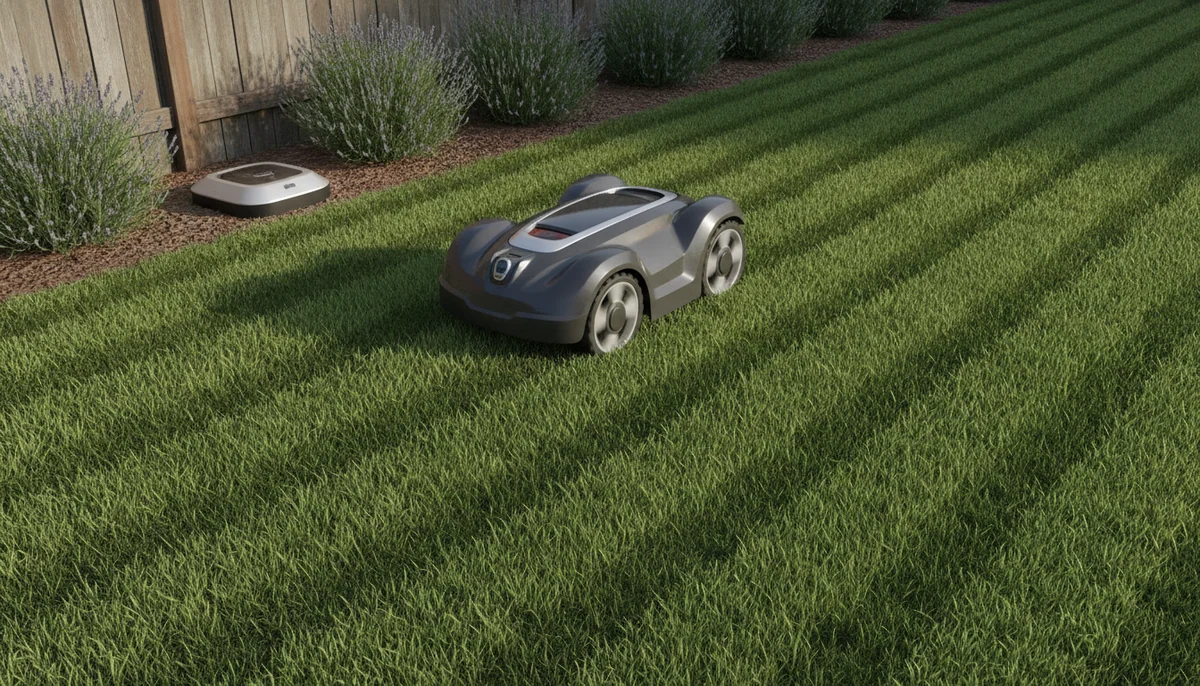
A charged mower leaves its station, crosses a mapped route to the grass and settles into a run of parallel lanes. The cutting disc removes the tips, not a week’s worth of growth. When the battery reaches its return threshold, the mower goes home with enough power left to dock, charges and later picks up the unfinished job.
That loop is the entire proposition. A robotic mower automates repetitive maintenance, while the owner still handles the first cut, hazardous boundaries, debris, awkward edges and the occasional rescue. The useful comparison is not whether the robot mows faster than a person. It is whether the machine can complete this loop repeatedly without needing a person beside it.
- The mower learns or senses where it may travel.
- It localizes itself within that permitted area.
- It follows planned lanes or repeats random paths across the grass.
- A spinning disc of small blades clips a little growth and leaves the clippings behind.
- The mower detects obstacles, detours around them or stops when it cannot proceed.
- It returns to the dock, charges and resumes the saved job or waits for its next schedule.
The boundary is only the first decision
Before a robot can cut, it needs an answer to two separate questions: where is the permitted lawn, and where am I inside it? A perimeter wire, corrected satellite position, LiDAR map or camera-readable edge can supply those answers. None of them guarantees that the mower will choose an efficient route, find grip on wet turf or make it through a narrow gate.
| Method | How it contains or locates the mower | Where it makes sense | The honest drawback |
|---|---|---|---|
| Perimeter wire | A pegged or buried loop marks the work area. | Lawns where a physical boundary is preferable to satellite or visual positioning. | Installation takes work, landscaping changes require cable changes and broken wire must be found and repaired. |
| RTK or network RTK | Corrected satellite positioning places the mower on a virtual map. | Open lawns with useful sky exposure and clearly planned zones. | A local antenna, network correction service, suitable dock position or some combination may still be required. |
| LiDAR | Laser measurements turn nearby trees, walls and buildings into local map features. | Structured yards where tree cover or buildings make satellite reception troublesome. | It cannot infer an invisible property line or prevent wheels and casters from beaching on poor ground. |
| Camera vision | Cameras recognize grass, borders, landmarks and objects. | Smooth daylight lawns with strong contrast between turf and paving, beds or fences. | Leaves, bare soil, long grass, shadows and identical neighboring turf can confuse the boundary. |
| Sensor fusion | Satellite correction, cameras, LiDAR and motion sensors support one another. | Complex properties that expose the weakness of any single positioning method. | More sensors do not cure immature mapping software, poor traction or an unreliable route home. |
A wired installation shows how quickly simple area figures lose meaning. The Husqvarna Large Installation Kit contains 1,312 feet of loop wire, yet its published allowance falls from about 1.24 acres on an open lawn to about 0.62 acre on a complex one. Beds, ponds, islands, narrow passages and guide routes consume cable; a long thin lawn can need more than a compact lawn with the same grass area. The kit is installation material, not a mower, and it cannot increase the capacity of the machine inside the loop.
Wire-free models exchange that cable work for another kind of setup. A Segway Navimow i110N still needs a powered dock, a carefully placed RTK antenna and a map containing boundaries, channels and exclusions. LiDAR machines such as the ECOVACS GOAT O1000 avoid the satellite antenna, but an ambiguous grass-to-grass property line still has to be drawn. Camera-only eufy E15 and E18 models can explore a clear lawn automatically, while sparse turf, flowers or fading daylight can make that first map less trustworthy.
Automatic mapping is best treated as a first draft. The owner remains responsible for the real property line and for conservative exclusions beside roads, water, retaining walls and drops. The first boundary lap, every connecting route and the first return to the charger deserve supervision. For a closer look at which sensor fits which yard, see the RTK, LiDAR and vision comparison.
A map does not tell you how the mower cuts
Modern mapped mowers usually divide a zone into parallel or U-shaped lanes. They track covered ground, turn with deliberate overlap and save their progress when charging interrupts the job. Many let the owner change the angle between outings so the same wheels do not press the same tracks and the blades approach flattened grass from another direction.
The result can look satisfyingly deliberate, but systematic does not mean perfect. A detour around a toy can leave an island. False obstacle detection can erase a strip from the plan. Bad lane spacing can leave a narrow ridge between twin cutting discs. The mower may also postpone an apparently abandoned patch until after its next charging stop.
Random mowers use a simpler bargain. They travel until a boundary or obstacle forces a turn, choose another direction and repeat. Coverage accumulates through time rather than a stored record of completed lanes. This can work on a tiny rectangle with ample battery time, but one session may cross the same corner repeatedly while leaving a tuft untouched elsewhere.
The LawnMaster OcuMow 200 makes the distinction unusually clear. Its camera reads the visible lawn edge, yet it does not store a full property map, schedule itself from a dock or resume an unfinished route. The owner carries it out, starts it and later retrieves its removable battery for charging. The mower automates pushing across a small, securely contained lawn; it does not automate the whole maintenance cycle.
RoboUP’s Raccoon 2 SE proves the opposite point: a machine may save a lawn map and still mow the whole area randomly. Boundary method and route method are separate specifications, so “maps your yard” is not enough to promise stripes or predictable completion.
The blades shave; frequency creates the mulch
Most residential robot mowers spin one or more horizontal discs beneath the chassis. Small razor blades pivot outward as the disc turns and fold back on some impacts. The design is quiet and well suited to clipping grass tips, but it produces little of the suction and lift associated with a full-size rotary deck.
There is normally no collection bag. The short clippings fall between the standing blades and become difficult to see. Calling this mulching is fair only if the word describes that lawn-care result: the robot removes tiny pieces often enough that they settle into the turf. It is not a promise that the machine will finely shred a long first cut, fallen leaves or thick weeds.
This is why a conventional reset cut matters. Bring the lawn to the intended height, clear sticks and leaves, then let the robot remove a small amount daily, every other day or several times each week. After rain or an absence, growth can outrun the little disc and produce clumps, bent stems and missed strips. Keep a conventional mower or another recovery plan for those occasions.
Blades are consumables rather than permanent hardware. Dull or damaged edges tear grass tips and make a weak finish look like a navigation problem. The routine owner jobs are straightforward: inspect the underside, follow the model’s blade and screw replacement instructions, and clean packed grass before it interferes with the disc or wheels.
Charging is part of the job, not a failure to finish
A mower near its acreage limit is not expected to cut the whole lawn on one battery. The rating usually describes the grass it can maintain through a schedule of mowing, returning, charging and resuming. It does not describe the entire parcel, and it says little about how quickly an awkward property will be completed.
The numbers make the distinction plain. The eufy E15 is rated for about 800 square metres, while its reported coverage per charge is roughly 100 to 150 square metres. The LUBA Mini 2 1500H is rated for 1,500 square metres, against a claimed 350 square metres per charge. Near either ceiling, several shifts are built into the design before turns, slopes, obstacles and travel between zones add more time.
Deck width matters too. The one-acre WORX WR344 uses an 8.7-inch cutting disc, while the one-acre Segway Navimow X430 lists a 17-inch twin-disc deck. Both may have enough scheduled capacity to maintain an acre, but those badges do not promise similar same-day throughput. The acreage-rating guide explains how to size for actual grass rather than the lot line.
The return sequence starts before the battery is empty. The mower preserves enough reserve to follow a saved route, align with the station and make charging contact. Once charged, it either stays home until the next schedule or returns to the saved point. A small battery is acceptable when that sequence is dependable; it becomes a serious mismatch when a closed gate, slippery connector or docking fault repeatedly strands the mower.
The dock deserves a trial period
A reliable station needs outdoor power, firm level ground, a clear approach and whatever positioning or connectivity that model requires. A half-inch lip, a slight tilt or a location pressed against a building can be enough to produce repeated approaches and missed contacts. Test several complete mow, return, charge and resume cycles before permanently fixing a questionable station in place.
Firm paving can be kinder than grass beneath a busy dock because repeated turning may wear a bare patch. A garage is usually optional shelter rather than a charging requirement, and any cover still has to preserve the mower’s approach and sensor clearances. The separate garage guide covers that choice without confusing shelter with the dock itself.
The lawn still gets a vote
Accurate positioning cannot pull a passive caster out of sand, give two driven wheels grip on wet grass or soften an abrupt curb. This is the category’s most important buying distinction. Choose LiDAR or satellite correction for the positioning problem, then choose the chassis for the ground problem. A tree-covered but smooth yard asks something different of a mower than an open yard full of ruts and side slopes.
Multiple zones work only when the mower can travel between them and return to its one dock. Flush paving may form a usable channel. Steps, loose gravel, traffic and a closed gate do not become passable because the app displays both lawns in green. A gate that is sometimes closed turns the owner into a gate attendant, while a narrow route may acquire visible wheel tracks through repetition. The multi-zone guide deals with connected and genuinely disconnected lawns.
Obstacle avoidance is another backup that marketing tends to promote as permission. Cameras, LiDAR, bumpers and lift sensors can react to conspicuous objects, but thin cords, sticks, low sprinkler hardware, pet waste and toys partly hidden by grass remain poor bets. Clear the lawn before a scheduled run, keep children and pets away from the operating area, and use physical separation or generous no-go margins where one mistake would put the mower in water, traffic or a drop. More detail belongs in the robot mower safety guide.
The trimmer survives too. A central cutting disc sits inside a wider body, so a perfectly accurate virtual boundary still leaves grass beside walls, fences and raised beds. Flush paving gives the best result because the wheels can overlap it. Offset discs and powered side trimmers reduce the fringe, but corners, posts, rocks and conservative hazard buffers still need attention.
What remains on the human schedule
- Make the initial cut and reset the height after overgrowth.
- Correct boundaries, exclusions, channels and lane direction.
- Keep gates and travel routes open during scheduled work.
- Remove debris and keep serious hazards outside the operating area.
- Clean sensors, wheels and the underside, then inspect the blades.
- Trim the margins the chassis cannot safely overlap.
- Watch the first run after a major map or firmware change.
That is not zero-effort lawn care. It is a transfer of effort away from pushing a mower across the same open grass every week and toward setup, light maintenance and exceptions. On a compatible yard, that is an excellent trade. On a disconnected, neglected or hazardous one, the promised autonomy breaks at the exact places the brochure leaves out.
Frequently Asked Questions
Do all robot lawn mowers use GPS?
No; robotic mowers may follow a perimeter wire, corrected satellite position, LiDAR map, camera-readable boundary or a combination of systems.
Do robotic lawn mowers collect the grass?
Most leave frequent, fine clippings in the turf instead of carrying them to the dock in a collection bag.
Can a robot mower maintain separate lawn areas?
It can manage multiple mapped zones when a safe, driveable route connects them to the dock, but a closed gate or disconnected lawn interrupts full autonomy.
How does a robotic mower find its charger?
It reserves battery for the return trip and follows its boundary guidance or saved map to a configured dock approach before aligning with the charger.
Will a robotic mower cover its full acreage rating on one charge?
Usually not near the rated maximum, because the mower is designed to accumulate coverage through repeated cutting, charging and resuming.
Sources (157)
- Amazon listings and customer reviews
- Owner reports across r/RobotVacuums, r/eufyS1Pro, r/eufy and 35 more threads
- Owner and reviewer video, 323 channels
- Walmart listing
- Costco listing
- Target listing
- Toptenreviews — Article — www.toptenreviews.com
- Pcworld — Article — www.pcworld.com
- Homedepot — Article — www.homedepot.com
- Lowes — Article — www.lowes.com
- Robotmowerlab — Article — robotmowerlab.com
- Forbes — Article — www.forbes.com
- Lifehacker — Article — lifehacker.com
- Makeuseof — Article — www.makeuseof.com
- Navimow — Article — navimow.com
- Segway — Article — navimow.segway.com
- Tomsguide — Article — www.tomsguide.com
- Site — Article — segway-navimow.my.site.com
- Consumerreports — Article — www.consumerreports.org
- Propartsdirect — Article — www.propartsdirect.net
- Facebook — Article — www.facebook.com
- Easylawnmowing — Article — easylawnmowing.co.uk
- Trustedreviews — Article — www.trustedreviews.com
- Cleva — Article — us.cleva.com
- Bestutahrealestate — Article — bestutahrealestate.com
- Cleva Uk — Article — www.cleva-uk.com
- Expertreviews — Article — www.expertreviews.co.uk
- Cleva — Article — eu.cleva.com
- Currys — Article — www.currys.co.uk
- Mowerbotlab — Article — mowerbotlab.com
- Gardentool360 — Article — gardentool360.co.uk
- Ukgardenreviews — Article — ukgardenreviews.com
- Gardenersworld — Article — tollbit.gardenersworld.com
- Hedgecombers — Article — hedgecombers.com
- Bestrobovacuums — Article — www.bestrobovacuums.com
- Chewy — Article — www.chewy.com
- eufy — Article — www.eufy.com
- Substack — Article — robovacinsights.substack.com
- eufy — Article — service.eufy.com
- Countryliving — Article — www.countryliving.com
- Rtings — Article — www.rtings.com
- Vacuumwars — Article — vacuumwars.com
- Younghouselove — Article — www.younghouselove.com
- Womanandhome — Article — www.womanandhome.com
- Interlightus — Article — www.interlightus.com
- Coredy — Article — www.coredy.com
- Moderncastle — Article — moderncastle.com
- Thecarpentersdaughter — Article — thecarpentersdaughter.co.uk
- Techradar — Article — www.techradar.com
- Lbtechreviews — Article — www.lbtechreviews.com
- Pcmag — Article — www.pcmag.com
- Zdnet — Article — www.zdnet.com
- Trustpilot — Article — uk.trustpilot.com
- Amgardaseeblick — Article — amgardaseeblick.com
- Pistonheads — Article — www.pistonheads.com
- Bestbuy — Article — www.bestbuy.com
- Ycombinator — Article — news.ycombinator.com
- Mammotion — Article — us.mammotion.com
- Trustpilot — Article — www.trustpilot.com
- Trustpilot — Article — au.trustpilot.com
- Mammotion — Article — eu.mammotion.com
- Mammotion — Article — uk.mammotion.com
- Easylawnmowing — Article — www.easylawnmowing.com
- Therobotmower — Article — therobotmower.co.uk
- Androidauthority — Article — www.androidauthority.com
- Freshlycharged — Article — freshlycharged.com
- Au — Article — robotlawnmowers.com.au
- Nytimes — Article — www.nytimes.com
- Cnet — Article — www.cnet.com
- Gardenersworld — Article — www.gardenersworld.com
- Smarthomescene — Article — smarthomescene.com
- HOOKII — Article — hookii.com
- Mammotion — Article — ca.mammotion.com
- Tractorsupply — Article — www.tractorsupply.com
- Substack — Article — jjtechish.substack.com
- Basic Tutorials — Article — basic-tutorials.com
- Smarthomeassistent — Article — www.smarthomeassistent.de
- Mein Gartenexperte — Article — www.mein-gartenexperte.de
- Techreviewer — Article — www.techreviewer.de
- Mowingmagic — Article — mowingmagic.com
- Fr — Article — maniaques.fr
- Basic Tutorials — Article — basic-tutorials.de
- Frandroid — Article — www.frandroid.com
- Appgefahren — Article — www.appgefahren.de
- Yarbo — Article — www.yarbo.com
- Fredshed — Article — www.fredshed.co.uk
- Tv — Article — www.stuff.tv
- Yarbo — Article — forum.yarbo.com
- Yarboreview — Article — yarboreview.com
- Tech — Article — us.mova.tech
- Slashgear — Article — www.slashgear.com
- Newatlas — Article — newatlas.com
- Tech — Article — au.mova.tech
- at — Article — www.galaxus.at
- Appleinsider — Article — appleinsider.com
- Notebookcheck — Article — www.notebookcheck.net
- Maison Et Domotique — Article — www.maison-et-domotique.com
- Au — Article — www.gadgetguy.com.au
- MOVA Tech — Article — us.forum.mova-tech.com
- Au — Article — www.techguide.com.au
- Wellbots — Article — www.wellbots.com
- Novabot — Article — novabot.com
- Techiwant — Article — techiwant.com
- Samsclub — Article — www.samsclub.com
- Heyupnow — Article — community.heyupnow.com
- T3 — Article — www.t3.com
- Tech — Article — uk.mova.tech
- Robocleaners — Article — www.robocleaners.com
- Mowscout — Article — mowscout.com
- Wired — Article — www.wired.com
- Shopsunseekertech — Article — shopsunseekertech.com
- Warehouserunner — Article — app.warehouserunner.com
- Electricrevolutionreviews — Article — electricrevolutionreviews.com
- Sunseekertech — Article — sunseekertech.com
- Sunseekerelite — Article — sunseekerelite.com
- Bobvila — Article — www.bobvila.com
- Au — Article — segway.com.au
- Theverge — Article — www.theverge.com
- Au — Article — roboticmower.com.au
- Techadvisor — Article — www.techadvisor.com
- Cnygreenteam — Article — cnygreenteam.com
- Outdoor Usa — Article — outdoor-usa.com
- Protoolreviews — Article — www.protoolreviews.com
- Homebuilding — Article — www.homebuilding.co.uk
- Gizmodo — Article — gizmodo.com
- Suncolawns — Article — shop.suncolawns.com
- Smartyardnw — Article — smartyardnw.com
- the Ambient — Article — www.the-ambient.com
- Outdoorica — Article — outdoorica.com
- Smart Dots — Article — www.smart-dots.com
- Trustpilot — Article — ie.trustpilot.com
- Homeandgardenselect — Article — homeandgardenselect.com
- Eu — Article — www.letemsvetemapplem.eu
- Robomowlab — Article — robomowlab.com
- Eftm — Article — eftm.com
- ECOVACS — Article — www.ecovacs.com
- Au — Article — www.harveynorman.com.au
- Thespruce — Article — www.thespruce.com
- Pcmag — Article — uk.pcmag.com
- 9to5google — Article — 9to5google.com
- Mensjournal — Article — www.mensjournal.com
- Lawncraftsupply — Article — lawncraftsupply.com
- Smarthomecompared — Article — smarthomecompared.com
- Smarthomeexplorer — Article — www.smarthomeexplorer.com
- Hunker — Article — www.hunker.com
- Thetechnologyman — Article — thetechnologyman.com
- Mammotion — Article — mammotion.com
- Carplaylife — Article — www.carplaylife.com
- Smarthomejunkie — Article — www.smarthomejunkie.net
- Iheart — Article — rocketerie.iheart.com
- WORX — Article — www.worx.com
- Upzy — Article — www.upzy.com
- Reviewed — Article — www.reviewed.com
- Ai — Article — www.robotmower.ai
- Dreamhomeplace — Article — dreamhomeplace.com
- Ibisik — Article — www.ibisik.com
- Requiemforadream — Article — www.requiemforadream.com