Boundary wire is bought by the route, not the acre
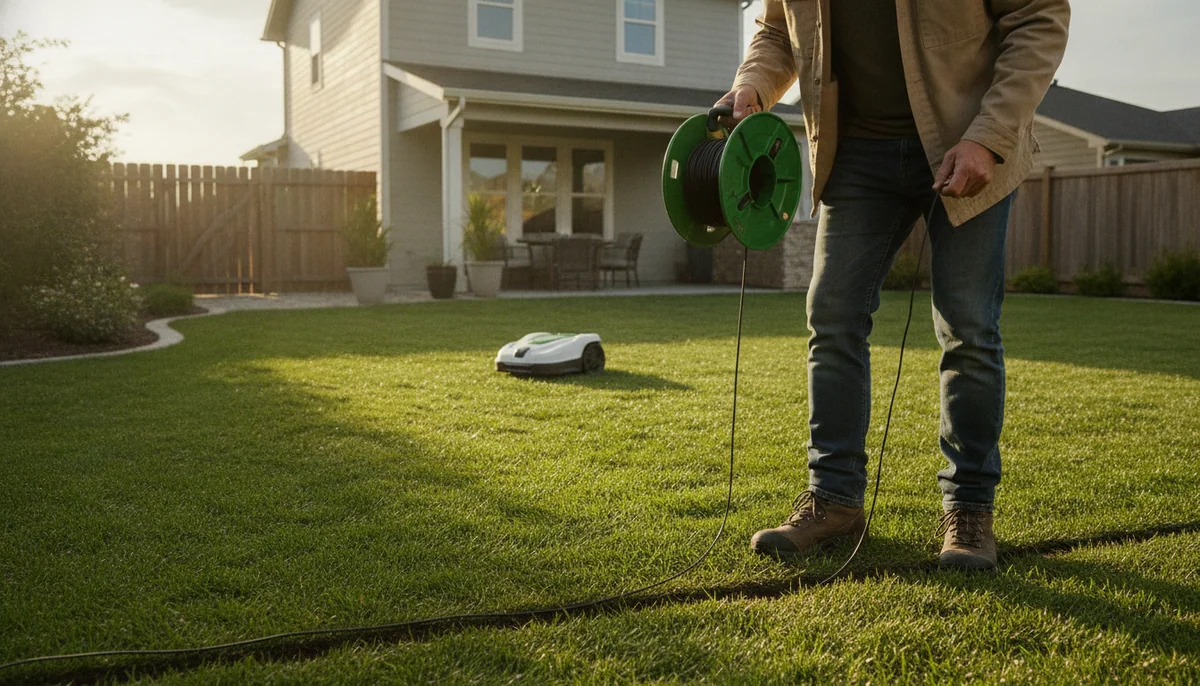
The useful answer is not a standard number of feet per acre. Boundary wire follows the shape of the mowing area, not the amount of grass inside it. A long side yard, an inset patio, a pond, three flower beds, and a guide route back to the charging station can empty a reel while the lawn still looks modest from the kitchen window.
Sketch those runs, measure them, and add them together. Then check the routing instructions for the exact mower before ordering. The manual decides the required offsets, guide arrangement, and connection method; the property deed and the mower’s acreage badge do not.
Why two equal lawns can need different reels
Perimeter changes with shape even when area does not. A square 10,000-square-foot lawn measures 100 by 100 feet and has a 400-foot perimeter. Stretch the same area into a 50-by-200-foot rectangle and its perimeter becomes 500 feet. Nothing has been added to the lawn, yet the second boundary consumes 25 percent more wire before a single bed, pond, passage, or guide route enters the drawing.
| Lawn shape | Dimensions | Area | Outer perimeter |
|---|---|---|---|
| Square | 100 × 100 ft | 10,000 sq ft | 400 ft |
| Long rectangle | 50 × 200 ft | 10,000 sq ft | 500 ft |
Real lawns are less polite than either example. The route bends around beds, hardscape, drops, water, and places the mower must not cross. A narrow strip beside the house creates two long parallel edges. An exclusion island adds its own loop and may require an approach specified by the mower manual. A distant section can add a substantial guide-wire run without adding anything to the outer perimeter.
This is why a compact but divided yard may require more cable than a larger open lawn. Acreage remains useful for choosing the mower itself, but the machine’s acreage rating answers a different question: whether the mower can maintain the grass, not whether a particular reel can describe its boundaries.
Walk the route before opening the product page
Start with a plain sketch. Mark the charging station, the mowable outer edge, every bed or hazard that may need exclusion, each narrow passage, and any guide route required to reach distant mowing areas. Leave the house, driveway, patio, and other non-mown ground out of the lawn-area calculation, but include every cable run their presence creates.
-
Trace the outer mowing boundary
Break an irregular edge into measurable straight or gently curved sections, record each one, and total them rather than estimating the whole perimeter by sight.
-
Add every internal exclusion
Measure the planned cable route around ponds, beds, gravel, tree islands, and other places the mower must avoid, including any connecting route required by the manual.
-
Count passages and guide routes
A side lawn or remote mowing zone may look small on a plan while demanding long parallel boundary sections and a guide wire back toward the charging station.
-
Allow for connections and repairs
Include the manual-required routing at the charging station and keep enough unused wire to correct a placement error or make a later repair without leaving the finished loop short.
A worksheet makes the decision harder to fudge. The figures below are an example of the arithmetic, not a specification for any particular mower or yard.
| Planned run | Measured length |
|---|---|
| Outer boundary | 500 ft |
| Exclusions and their required routing | 160 ft |
| Guide-wire routes | 210 ft |
| Charging-station connection routing | 20 ft |
| Measured subtotal | 890 ft |
The purchase threshold is not 890 feet in that example. It is 890 feet plus the allowance justified by the manual, the installation method, and the amount of correction or repair wire the owner wants to retain. A reel barely longer than the subtotal leaves no room for the moment a corner must move or a damaged section must be replaced.
What Husqvarna’s 1,312-foot kit actually covers
The Husqvarna Large Installation Kit contains 1,312 feet, approximately 400 meters, of black loop wire, plus 600 staples, five splicers, and five connectors. It is a substantial bundle for a compatible, measured Automower installation. It is not a mower, charging station, power supply, or tool set, and “Large” describes the installation package rather than the size or mowing ability of an Automower.
Husqvarna publishes two very different planning limits for the kit: up to 5,000 square meters, approximately 53,820 square feet or 1.24 acres, for an open lawn; and up to 2,500 square meters, approximately 26,910 square feet or 0.62 acre, for a complex lawn. The halved complex-lawn figure is the warning that matters. Beds, bottlenecks, islands, and guide routes consume cable without producing a matching increase in mowable area.
The honest drawback is that the box looks like a complete answer before the installation has been designed. It is only a fixed collection of consumables. Six hundred staples average one for every 2.19 feet if spread across the entire reel, but that arithmetic is not installation guidance. Corners, slopes, loose ground, contours, and the mower manual determine actual spacing. Five splicers and five connectors may suit one plan and fall short on another, and the available record does not establish the wire specification, connector type, burial depth, required tools, or whether the cable is one continuous length.
Freshly surface-pinned wire may also remain visible until grass grows around it. The finished boundary can become unobtrusive, but it does not disappear the moment the last staple enters the soil.
Compatibility must be checked by exact model. Husqvarna names the Automower 310, 315, 315X, 410iQ, 415X, 420iQ, 430X, 430XH, 435iQ AWD, 435X AWD, 440iQ, 450X, 450XH, and 535AWD. The 115H is not on that supplied list. Its absence does not prove that it cannot use the kit, but this listing alone is not enough evidence to order for one.
Once the route has been measured, the mower confirmed, and the missing installation details checked in its manual, the Husqvarna Large Installation Kit becomes an easy recommendation when 1,312 feet leaves a sensible margin. Before those checks, it is an expensive-looking guess wrapped around a large reel.
Large is not automatically the right kit
Husqvarna’s published area guidance separates its three installation-kit sizes sharply. These figures help narrow the choice, but the measured route still makes the final call.
| Kit | Open lawn | Complex lawn |
|---|---|---|
| Small | About 0.20 acre | About 0.10 acre |
| Medium | About 0.49 acre | About 0.25 acre |
| Large | About 1.24 acres | About 0.62 acre |
Large offers two and a half times Medium’s nominal area allowance, so it wins when the designed route clearly exceeds Medium territory or when complex geometry consumes the smaller reel’s headroom. Medium wins when its contents comfortably cover the finished plan. Extra cable does not improve cutting, navigation, docking, or the mower’s capacity, and there is no measured price evidence here to turn “bigger” into “better value.”
The mower’s capacity remains a separate ceiling. Putting a Large kit around 1.24 open acres cannot make an undersized Automower maintain that lawn, and the kit’s figures should not be stretched into support for a two-acre property, golf course, or commercial installation.
When the wire is the deal-breaker
A measured cable route is worthwhile when the compatible mower is already chosen and a physical boundary suits the property. If drawing, pinning, and later repairing that route is precisely the ownership burden you want to avoid, stop shopping for a larger reel. Read how wire-free robotic mowers replace a physical perimeter, then use the wire-free mower shortlist to compare machines built around that choice.
For a wired Automower, though, the decision stays simple: measure the route, check the manual, and buy the smallest compatible kit that clears the completed plan with room for correction and repair.
Frequently Asked Questions
Can lawn acreage alone tell me how much boundary wire to buy?
No, because shape, exclusion islands, narrow passages, guide routes, and charging-station routing can make equal-sized lawns require very different cable lengths.
Is 1,312 feet of wire enough for a one-acre lawn?
It can cover an open one-acre layout within Husqvarna’s published guidance, but only a measured route can confirm that the reel also accommodates obstacles, passages, guide wires, and a repair allowance.
Does the Husqvarna Large Installation Kit include an Automower?
No, it contains 1,312 feet of loop wire, 600 staples, five splicers, and five connectors rather than a mower or charging system.
Is the Husqvarna Large kit listed for the Automower 115H?
No, the supplied compatibility list does not name the 115H, so its exact wiring and connection requirements need independent confirmation before ordering.