Trees do not stop a robot mower, but the wrong navigation system will.
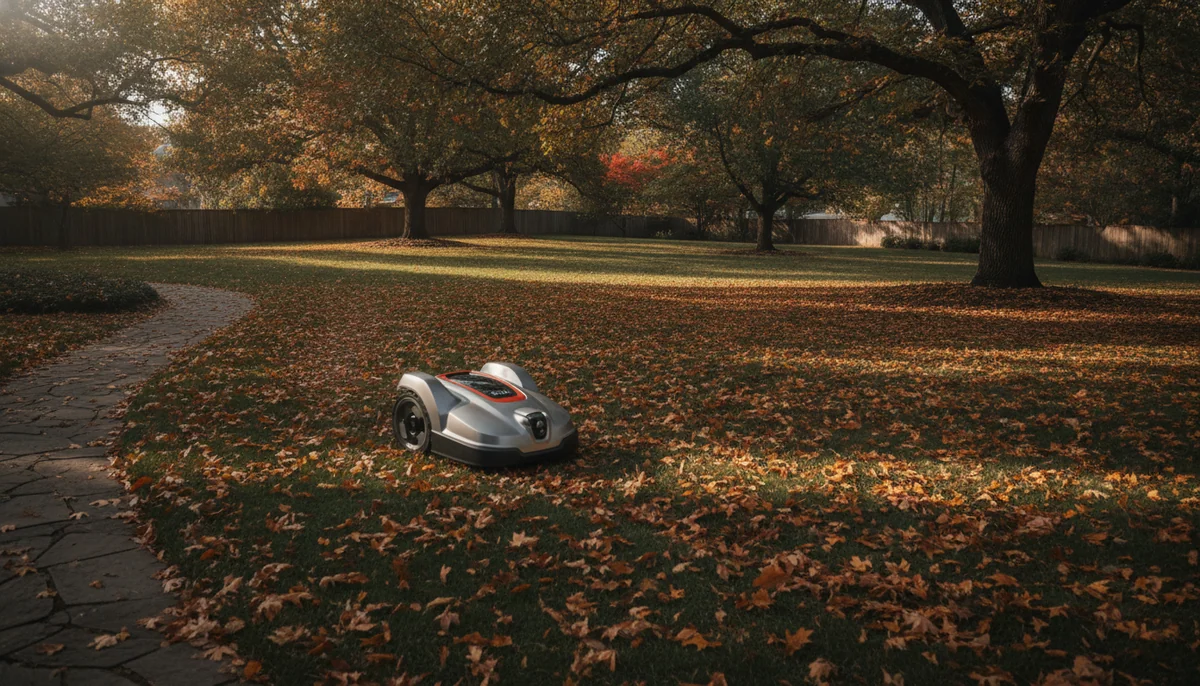
A tree-covered lawn is not inherently hostile to automation. It is hostile to a mower that depends on a clean satellite fix while branches, roofs, walls, and reflective surfaces interrupt or distort that fix. Put the right machine there and the same trunks, fences, and buildings that trouble satellite navigation become stable shapes for LiDAR to recognize.
The answer changes once navigation is separated from traction. LiDAR may tell a mower exactly where it is, but it cannot pull small caster wheels over a root or stop rear-wheel drive from sliding across damp shade. The mower must solve two different problems: locating the grass beneath the canopy and physically traveling across it.
Smart Lawn Bots would begin with the mowers selected specifically for tree-covered and satellite-obstructed yards, then reject any candidate that cannot also handle the property’s roots, slopes, gates, drops, and docking route.
Canopy blocks satellites, not every kind of navigation
An RTK mower calculates its position from satellite signals corrected by a reference service or local antenna. That can produce accurate virtual boundaries on an open lawn, but the installation has two signal questions rather than one: whether the reference station has a stable sky view and whether the mower remains positioned as it travels beside the house or beneath branches. A successful antenna location does not guarantee an equally good fix in the shaded side yard.
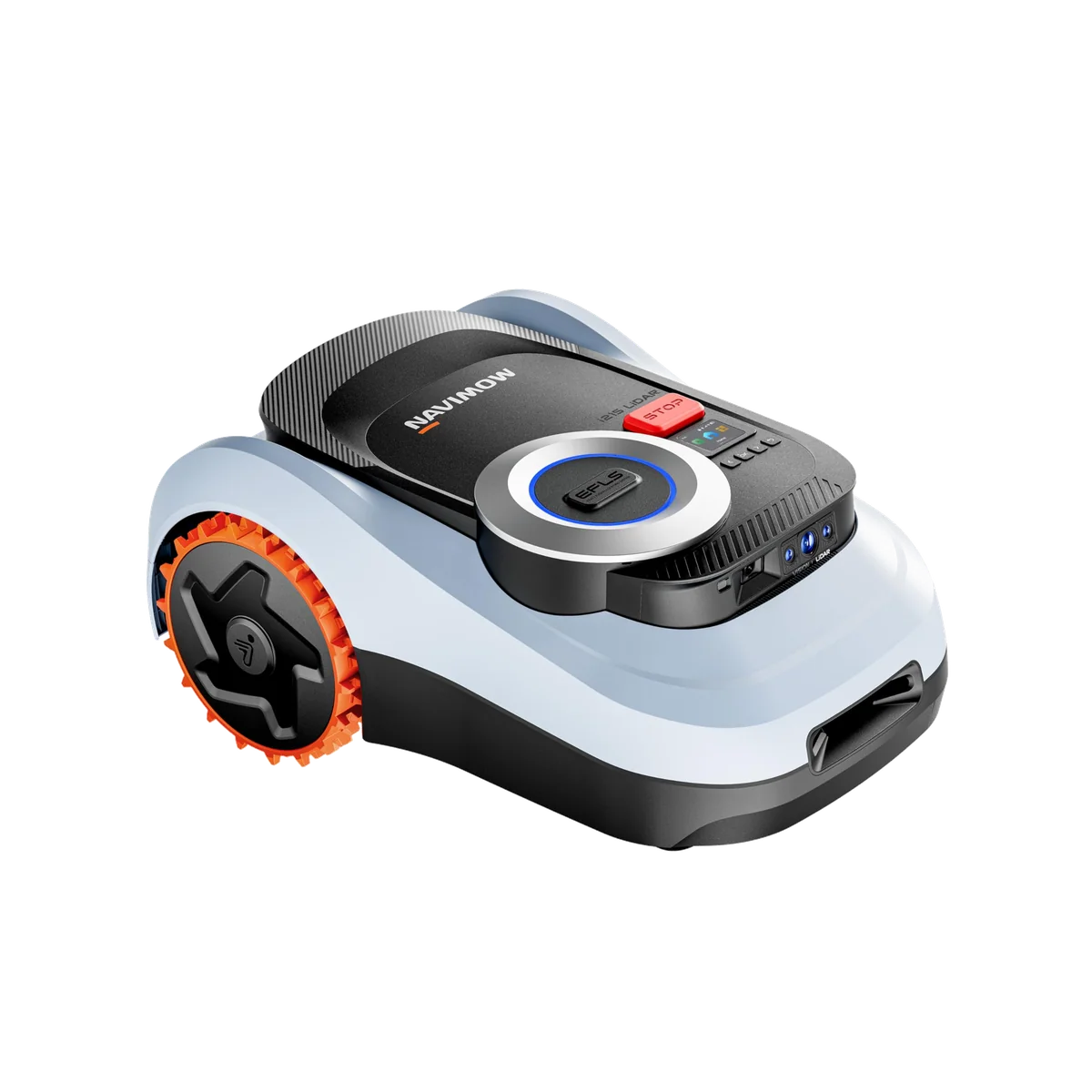
Onboard LiDAR works locally. The mower scans surrounding geometry and matches what it sees to its saved map, so it does not need a satellite correction antenna to hold a mowing line. A wall, fence, tree line, shed, or bed can provide useful structure. This is why the Navimow i215 and both LiDAR versions of the ECOVACS GOAT make their strongest case in enclosed residential lawns rather than broad, empty fields.
LiDAR trades one dependency for another. Stable surroundings help it orient itself, while a large featureless lawn offers fewer distinct references. Sensors also need to stay clean, and careless mapping can still send a perfectly located mower toward a curb, step, pond, or narrow lower strip. Satellite independence is valuable; it is not permission to stop supervising the first complete cycles.
Camera vision helps a mower recognize boundaries and objects, but it does not erase the limitations of the positioning system supporting it. The standard ANTHBOT M5 remains an RTK mower even though it carries two cameras. The Navimow X430 combines Network RTK with extensive vision and can succeed beneath substantial canopy, yet its dock and positioning conditions still need a property audition.
| Yard condition | Best starting point | What can still go wrong |
|---|---|---|
| Dense canopy and close walls | Onboard LiDAR without an RTK antenna | Dirty sensors, weak map geometry, roots, damp turf, and hazardous edges |
| Trees plus rough or steep ground | Strong traction first, with positioning proven on the property | A capable AWD chassis can still fail if the dock or navigation signal is unreliable |
| Open antenna site with occasional shade | RTK with camera assistance can be sufficient | Signal may weaken beside buildings or under the densest branches |
| Narrow side lawn between structures | A compact LiDAR mower with editable paths and zones | Manual mapping, turns, dock access, and minimum passage width become decisive |
| Drop, road, pool, or retaining edge | A conservative virtual buffer backed by a physical barrier where practical | No positioning system turns an exposed fall into a safe mowing boundary |
The lawn beneath the branches still has to be mowable
The quiet patch behind the house often stays wetter than the open lawn. Roots lift the surface, thin grass exposes soft soil, and fallen twigs or pine cones appear between scheduled runs. Those conditions expose wheel design and ground clearance long before they challenge the cutting motor. A two-wheel-drive mower that performs beautifully on firm turf can dig at a rut, spin on a damp transition, or slide while traversing a slope.
Tree trunks create a second kind of unfinished work. A mower can recognize every trunk correctly and still leave a ring of tall grass because its blade disc sits inside the body or its avoidance system keeps a generous distance. Flush paving allows a wheel to overlap the edge; bark, fences, raised beds, and inside corners do not. The edge-cutting guide explains why accurate navigation and a finished border are separate achievements.
Leaves are not free mulch either. These machines maintain grass with small pivoting blades and little suction. Flattened blades may survive until a later pass, while heavy leaves, branches, hoses, and low cords should be cleared before mowing. The central benefit remains substantial: frequent quiet cutting can remove the large weekly job, even though trimming and debris collection remain.
Four defensible choices for obstructed yards
The GOAT O1000 LiDAR PRO fits the compact shaded lawn
The ECOVACS GOAT O1000 LiDAR PRO is the cleanest answer for a firm, connected lawn comfortably below a quarter acre. Its onboard dual LiDAR avoids the antenna-placement problem, its narrow body can enter passages rated down to 31.5 inches under suitable conditions, and its dedicated side trimmer can remove much of the fringe beside long flush borders.
The drawback is that difficult geometry exposes both the app and the trimmer. Manually steering a straight invisible property line is fussy, fences and inside corners can remain visibly unfinished, and the rear-drive chassis with small front casters is poor insurance on loose, wet, or root-disturbed ground. Its complete case is in the GOAT O1000 LiDAR PRO review.
The Navimow i215 is the more flexible residential choice
The Navimow i215 raises the managed-area brief to 0.37 acre and combines solid-state LiDAR with vision, editable zones, directional mowing, and no need for a local RTK pole. It has worked convincingly in horseshoe-shaped lawns beneath very tall trees and in divided yards containing fences, beds, shade, play structures, and multiple routes. For a structured residential property with poor satellite reception, it is the best all-round answer in this group.
It is still a rear-wheel-drive mower. Thick turf, damp ramps, ruts, leaves, and lateral slopes can turn a navigation success into a retrieval job, while docking and connector routes are inconsistent enough to demand repeated trials. It also lacks a dedicated downward-facing cliff sensor, so steps and exposed drops need deliberately conservative boundaries. Read the Navimow i215 review before treating its easy first map as proof of autonomy.
The GOAT A2000 trades compactness for cutting speed
The ECOVACS GOAT A2000 LiDAR PRO suits a clearly bounded lawn approaching half an acre. Its two overlapping cutting discs cover almost 13 inches, and its separate TruEdge string head reduces routine cleanup along accessible driveways and beds. Trees and buildings strengthen its navigation case because the dual-LiDAR system does not need a clear satellite view.
The machine mows and charges in roughly 50-minute shifts, so its area rating describes repeated autonomous work rather than one uninterrupted sweep. More importantly, its software can combine closely adjoining zones across a fence and then refuse the real connecting path. Rough grades and exposed curbs are also poor territory for its rear-drive layout and free casters. The GOAT A2000 review is a qualified recommendation for simple geometry, not complicated acreage.
The Navimow X430 is for canopy plus serious terrain
The Navimow X430 belongs in the conversation when roots, steep ground, rough transitions, tall-cut grass, or meaningful acreage matter as much as tree cover. Four-wheel drive, suspension, steerable front wheels, a 17-inch dual-disc deck, and a cutting range reaching four inches give it physical authority the smaller LiDAR machines lack. Its one-acre rating also makes it the only primary option here built around a genuinely large workload.
The compromise is navigation certainty. The X430 uses Network RTK and vision rather than satellite-independent onboard LiDAR, and exact-property results range from dependable work beneath heavy canopy to repeated dock moves and severe positioning trouble near buildings and trees. One owner also reported an uncontrolled cutting-height drop that scalped grass and scraped concrete. The Navimow X430 review recommends the hardware only after the property proves the installation.
The ANTHBOTs belong under open sky
The standard ANTHBOT M5 is a credible small-lawn value, but not the answer to dense canopy or a narrow yard pressed between tall buildings. Its full-band RTK reference station needs an open, stable sky view, and the two cameras do not turn it into the separate M5 LiDAR variant. On roughly one-eighth acre of smooth, mostly open grass, it can produce orderly passes, manage zones, recharge, and resume; under obstructed sky, the M5’s navigation dependency becomes the reason to walk away.
The ANTHBOT M9 adds NRTK language, a quarter-acre brief, thirty-zone support, and an ambitious dual-camera specification, yet the record does not establish how its positioning systems divide the work beneath trees or beside walls. Its 3.2-star Amazon rating from 42 ratings is the strongest available ownership signal, while warranty terms, battery details, weather protection, NRTK costs, replacement parts, and long-run mapping reliability remain unsettled. That is too much uncertainty for a machine bought to remove a recurring chore, so most readers should skip it rather than promote it above the better-supported choices.
If the lawn is open enough for RTK and those models still appeal, the ANTHBOT M5 and M9 comparison separates the proven small-lawn value from the larger machine’s unresolved promises. If the property is genuinely enclosed, return to the LiDAR mower shortlist instead of trying to make a satellite-dependent purchase fit the wrong yard.
Give the property a trial, not a ceremonial first lap
Place the dock where the mower can approach on firm, level ground without scraping around a wall or repeatedly crossing the same soft strip. For an RTK model, confirm the dock and antenna arrangement before creating a detailed map. For LiDAR, preserve clear views of permanent structures and keep the sensor windows clean.
Map one zone first. Watch the complete boundary pass, the route beneath the densest canopy, the turn beside every trunk, the steepest traverse, the trip through the narrowest gate, and the return to the charger. Then let the mower recharge and resume so the test covers the whole autonomous chain rather than one attractive set of stripes.
Move boundaries inward around roads, pools, steps, drainage channels, retaining edges, and any place where a navigation error becomes more than untidy grass. Fill holes, remove loose branches, and test damp shaded sections before trusting a schedule. The right mower can work beneath the trees and beside the house, but the final yes belongs to the property rather than the specification sheet.
Frequently Asked Questions
Do robot lawn mowers lose their position under trees?
RTK models can lose or degrade their satellite fix beneath dense canopy, while onboard LiDAR models navigate from local surroundings and are generally the safer choice there.
Can a robot mower work beside a house or tall fence?
Yes, a LiDAR mower can use walls and fences as useful landmarks, although narrow access, dock clearance, reflective surfaces, and manually defined boundaries still need checking.
Is LiDAR always better than RTK for lawn mowing?
No, LiDAR is strongest where sky visibility is poor, while RTK can be an accurate and efficient choice on open lawns with a stable antenna or Network RTK connection.
Will LiDAR prevent a mower from falling over a curb or retaining edge?
No, hazardous drops still require a generous virtual buffer and, where the consequence is serious, a dependable physical barrier.
Which mower is best when trees also create roots and steep ground?
The Navimow X430 has the strongest terrain hardware among these choices, but it should be bought only after its Network RTK positioning and dock location prove reliable on the property.
Do robot mowers remove leaves and trim around tree trunks?
No, heavy leaves and branches need clearing, while trunks and other raised obstacles usually leave at least some grass for a string trimmer.
Sources (62)
- Amazon listings and customer reviews
- Owner reports across r/roboticLawnmowers, r/Navimow_Segway, r/SegwayNavimow and 10 more threads
- Owner and reviewer video, 103 channels
- Toptenreviews — Article — www.toptenreviews.com
- Expertreviews — Article — www.expertreviews.co.uk
- Segway — Article — navimow.segway.com
- Trustedreviews — Article — www.trustedreviews.com
- Therobotmower — Article — therobotmower.co.uk
- Navimow — Article — navimow.com
- Trustpilot — Article — www.trustpilot.com
- Pcmag — Article — www.pcmag.com
- Pcworld — Article — www.pcworld.com
- Facebook — Article — www.facebook.com
- Au — Article — segway.com.au
- Lifehacker — Article — lifehacker.com
- Theverge — Article — www.theverge.com
- Maison Et Domotique — Article — www.maison-et-domotique.com
- Au — Article — roboticmower.com.au
- Lowes — Article — www.lowes.com
- Techadvisor — Article — www.techadvisor.com
- Homedepot — Article — www.homedepot.com
- Tv — Article — www.stuff.tv
- Cnygreenteam — Article — cnygreenteam.com
- Outdoor Usa — Article — outdoor-usa.com
- Easylawnmowing — Article — www.easylawnmowing.com
- Protoolreviews — Article — www.protoolreviews.com
- Homebuilding — Article — www.homebuilding.co.uk
- Techradar — Article — www.techradar.com
- Gizmodo — Article — gizmodo.com
- Suncolawns — Article — shop.suncolawns.com
- Smartyardnw — Article — smartyardnw.com
- the Ambient — Article — www.the-ambient.com
- Outdoorica — Article — outdoorica.com
- T3 — Article — www.t3.com
- Notebookcheck — Article — www.notebookcheck.net
- Mowingmagic — Article — mowingmagic.com
- Smart Dots — Article — www.smart-dots.com
- Nytimes — Article — www.nytimes.com
- Trustpilot — Article — ie.trustpilot.com
- Homeandgardenselect — Article — homeandgardenselect.com
- Cnet — Article — www.cnet.com
- Yarbo — Article — www.yarbo.com
- Mammotion — Article — us.mammotion.com
- Consumerreports — Article — www.consumerreports.org
- Easylawnmowing — Article — easylawnmowing.co.uk
- Eu — Article — www.letemsvetemapplem.eu
- Robomowlab — Article — robomowlab.com
- Bobvila — Article — www.bobvila.com
- Eftm — Article — eftm.com
- ECOVACS — Article — www.ecovacs.com
- Au — Article — www.harveynorman.com.au
- Bestbuy — Article — www.bestbuy.com
- Thespruce — Article — www.thespruce.com
- Pcmag — Article — uk.pcmag.com
- 9to5google — Article — 9to5google.com
- Mensjournal — Article — www.mensjournal.com
- Tomsguide — Article — www.tomsguide.com
- Lawncraftsupply — Article — lawncraftsupply.com
- Smarthomecompared — Article — smarthomecompared.com
- Smarthomeexplorer — Article — www.smarthomeexplorer.com
- Mowscout — Article — www.mowscout.com
- Hunker — Article — www.hunker.com