The YARDCARE V100 does less than the E400, which is why it wins
Choose the V100 for a tiny, clearly enclosed lawn and accept manual charging; choose neither mower if dependable, unattended lawn care is the goal.
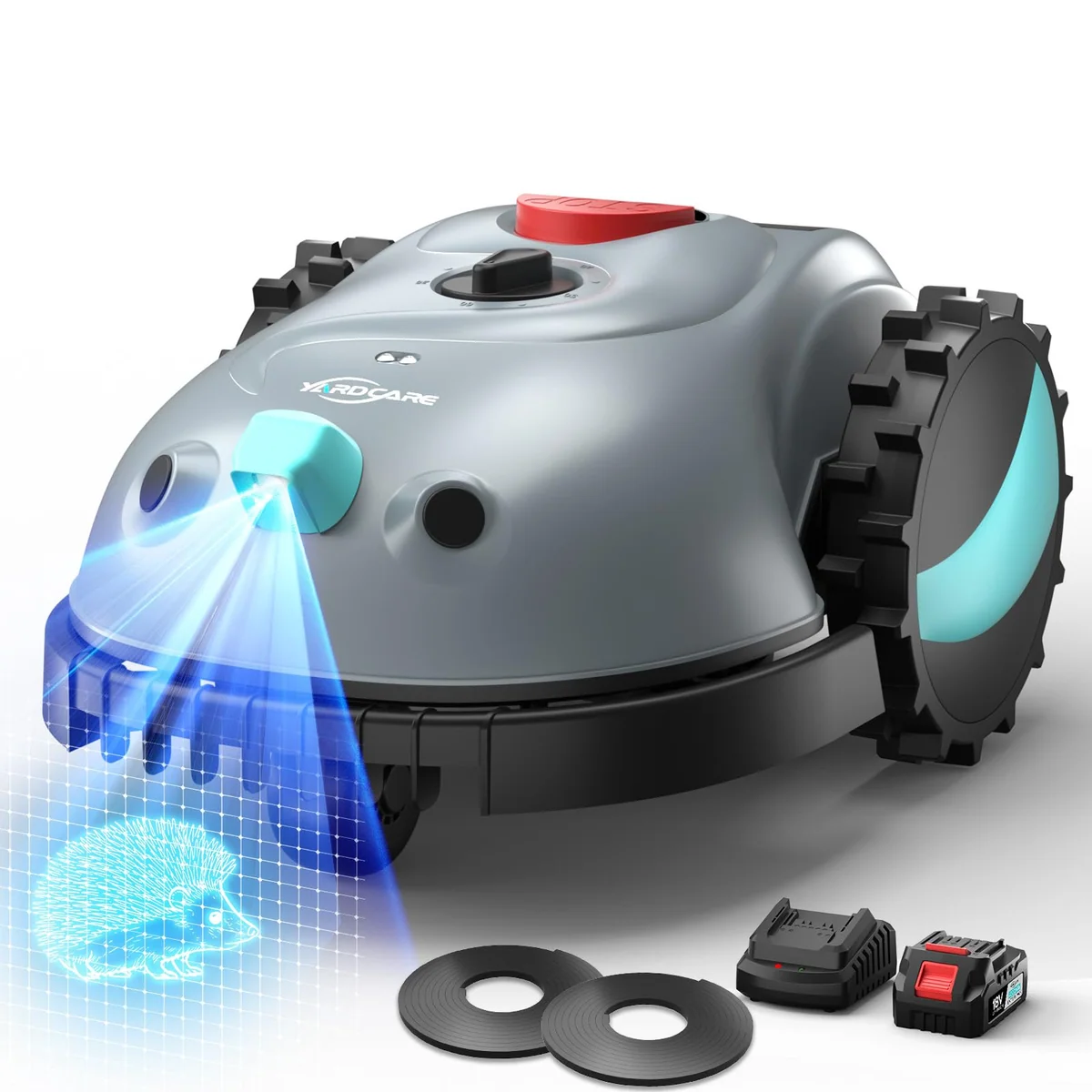
YARDCARE V100
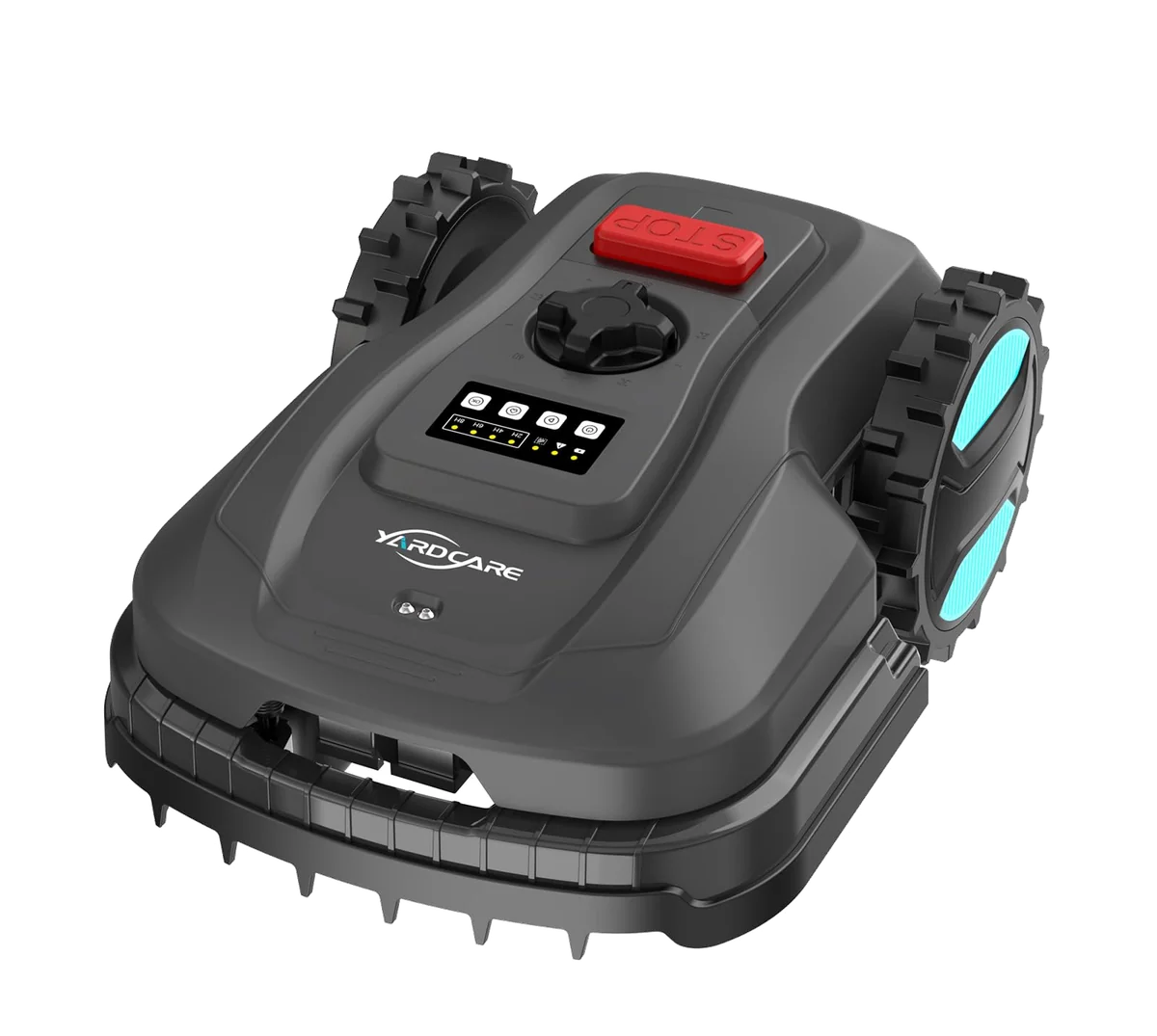
E400 Smart Robotic Lawn Mower
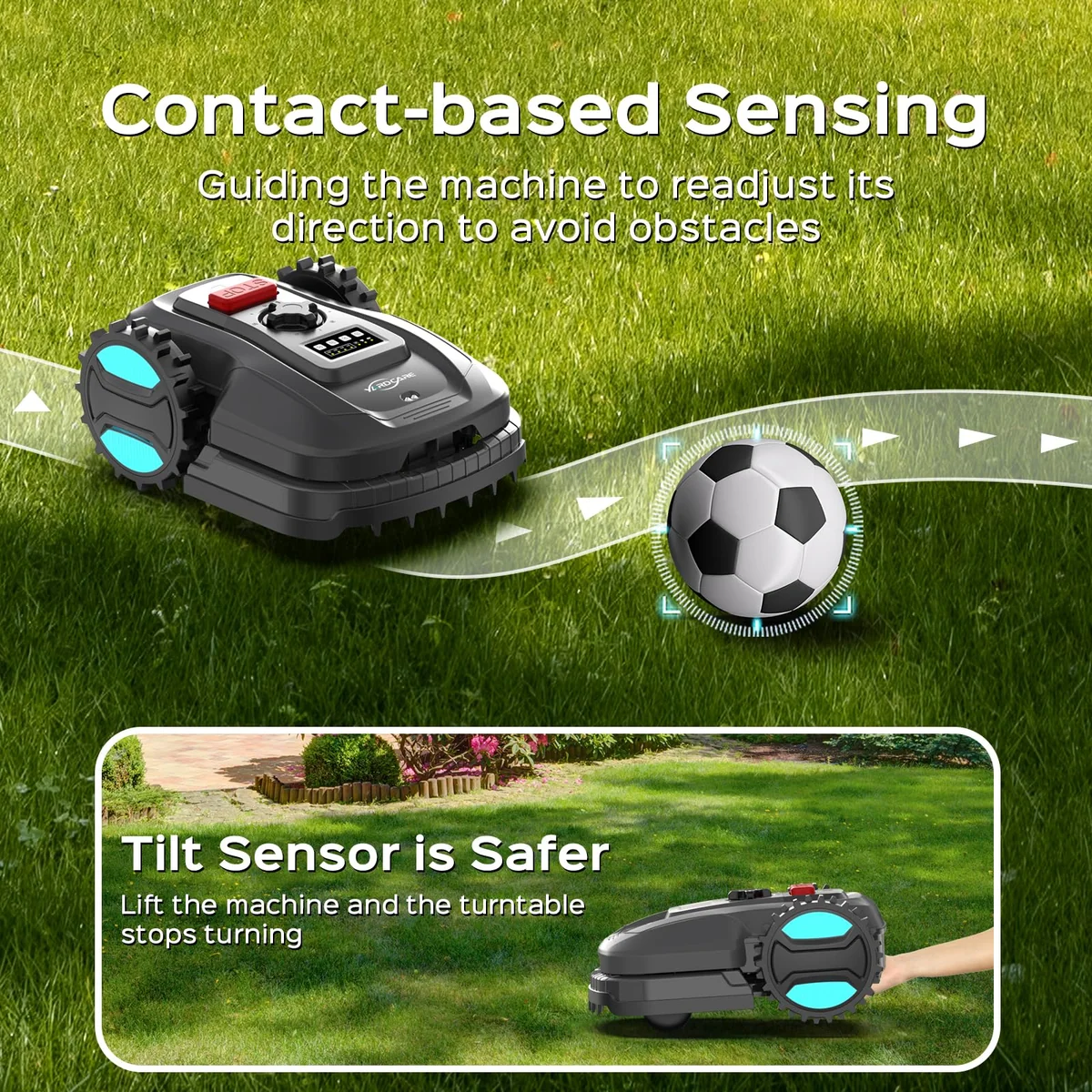
The E400 looks like the obvious upgrade. It has an app, a charging station, scheduled mowing and a much larger claimed coverage area. The V100 has none of those things. It must be placed on the grass, collected when it finishes and charged through a removable battery.
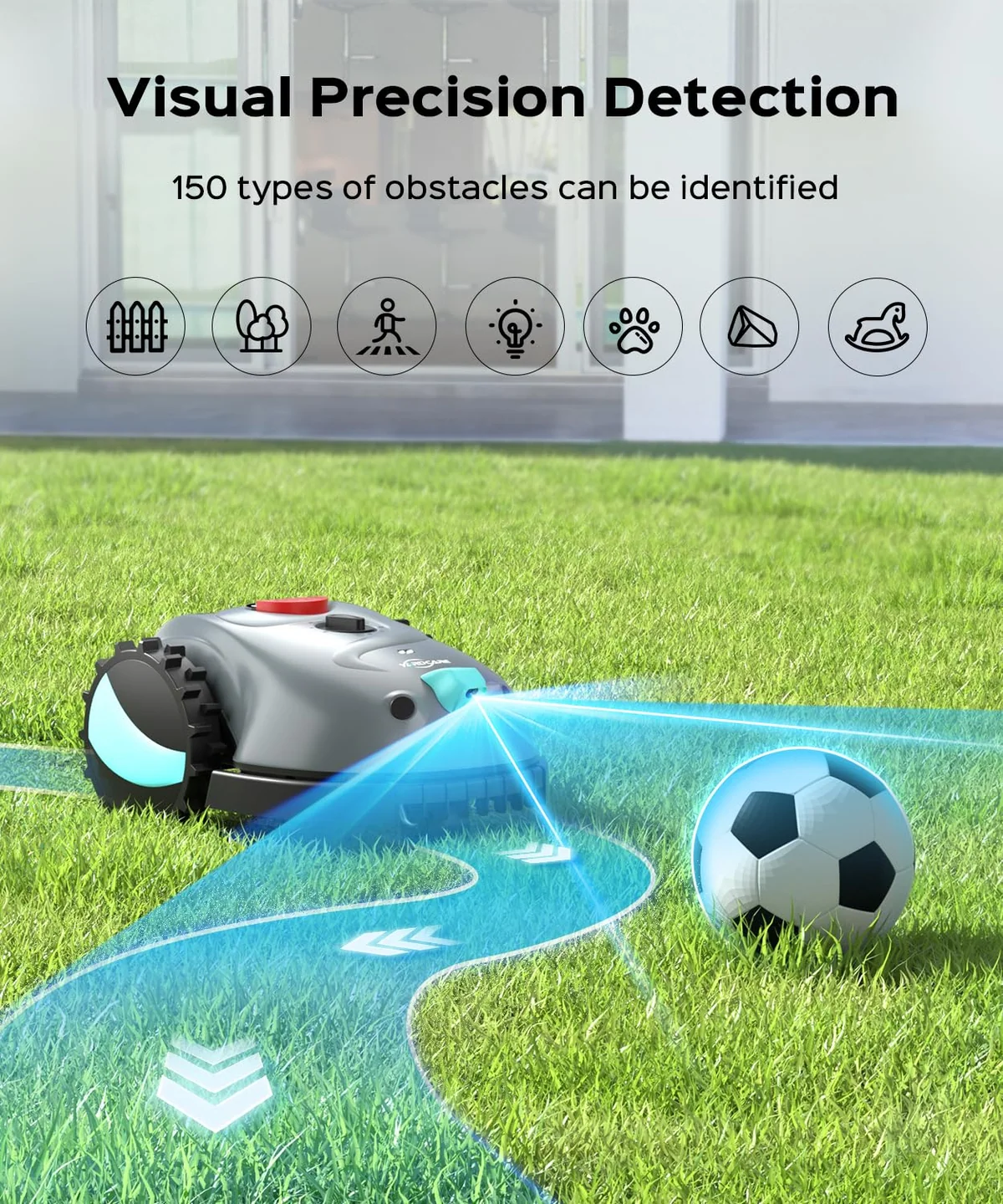
Yet the V100 is the safer recommendation because it asks less of its modest technology. Its camera identifies grass and obvious boundaries, then lets the mower wander until repeated passes cover the interior. The E400 adds automation without adding mapping or visual navigation. It still wanders randomly, but only after the owner has installed a powered perimeter loop and found a dock position from which the mower can reliably leave and return.
This is not a contest between a basic robot and a smart one. It is a choice between a portable vision mower that needs human handling and a conventional wire-guided mower whose promised independence depends on a demanding installation. Neither produces orderly lanes, neither eliminates edge trimming, and neither belongs on a complicated lawn.
YARDCARE V100
E400 Smart Robotic Lawn Mower
At a Glance
| Feature | YARDCARE V100 | E400 Smart Robotic Lawn Mower |
|---|---|---|
| Price Range | $200–$500 | $200–$500 |
| Recommended lawn size | About 1,076 sq ft, with 1,600 sq ft claimed as the ceiling | — |
| Cutting width | 6.3 inches | — |
| Check Price on Amazon | Check Price on Amazon |
The specifications flatter the E400 more than the lawn does
The headline numbers favor the E400: up to 4,300 square feet, automatic charging and app control against the V100’s 1,600-square-foot ceiling and removable battery. Those numbers describe capabilities, not the conditions required to make them useful. Random navigation consumes time revisiting cut grass, while beds, corners, ruts and narrow passages reduce the effective area further.
| Decision point | V100 | E400 |
|---|---|---|
| Best realistic setting | A tiny, connected lawn with obvious physical edges | A small, flat rectangle with a suitable powered dock position |
| Claimed coverage | Up to 1,600 sq ft | Up to 4,300 sq ft |
| Boundary method | Camera vision, physical edges and a disputed magnetic-strip feature | Powered perimeter wire beginning and ending at the dock |
| Navigation | Random, with vision and bumper assistance | Random, with contact-based bumper detection |
| Charging | Removable battery charged by hand | Automatic return to charging station |
| Controls | On-mower controls only | On-mower controls plus Bluetooth and Wi-Fi app |
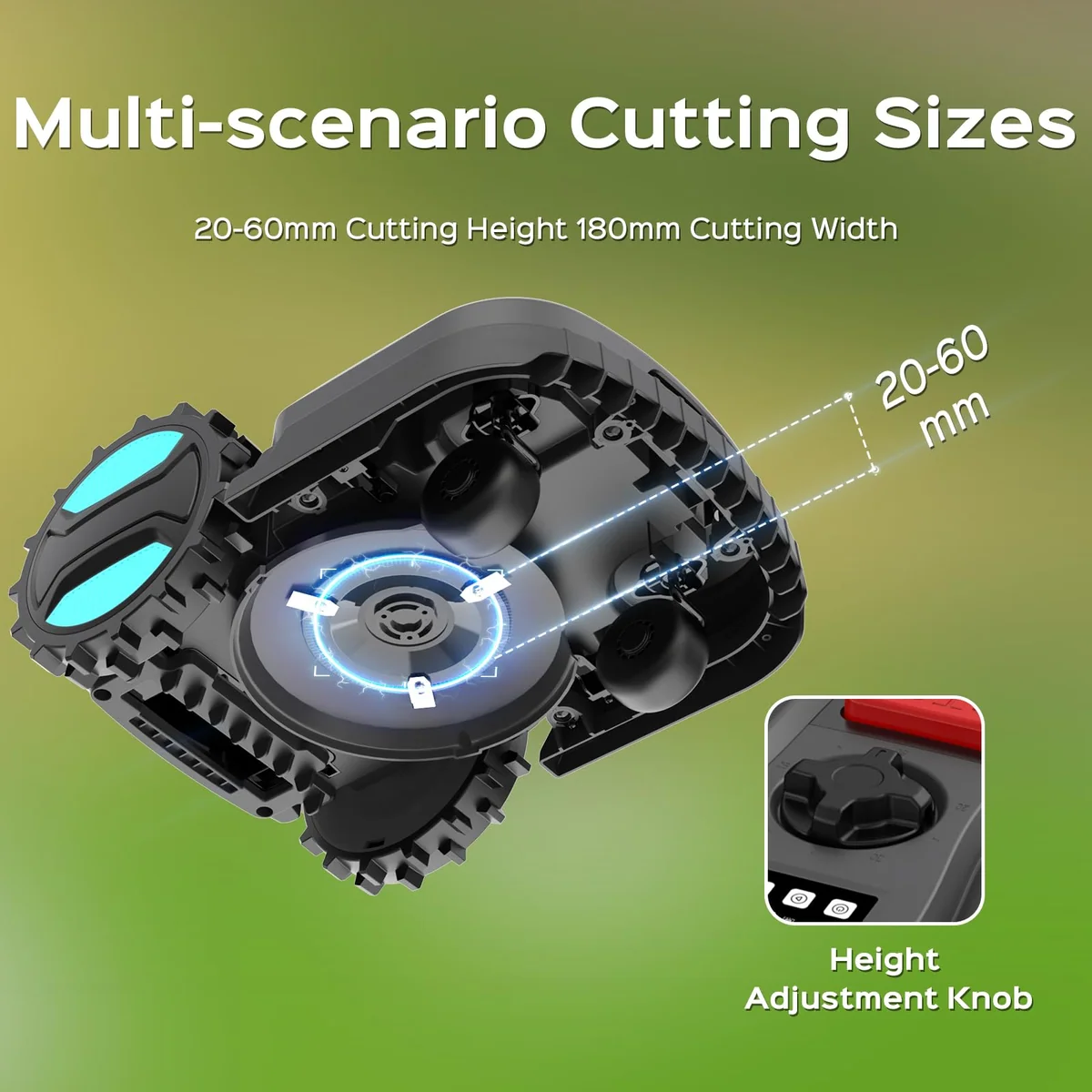
| Cutting range | 0.8–2.4 inches | 20–60 mm |
| Cutting width | 6.3 inches | About 7.1 inches |
| Main ownership chore | Carrying, charging and restarting the mower | Installing, protecting and troubleshooting the wire-and-dock system |
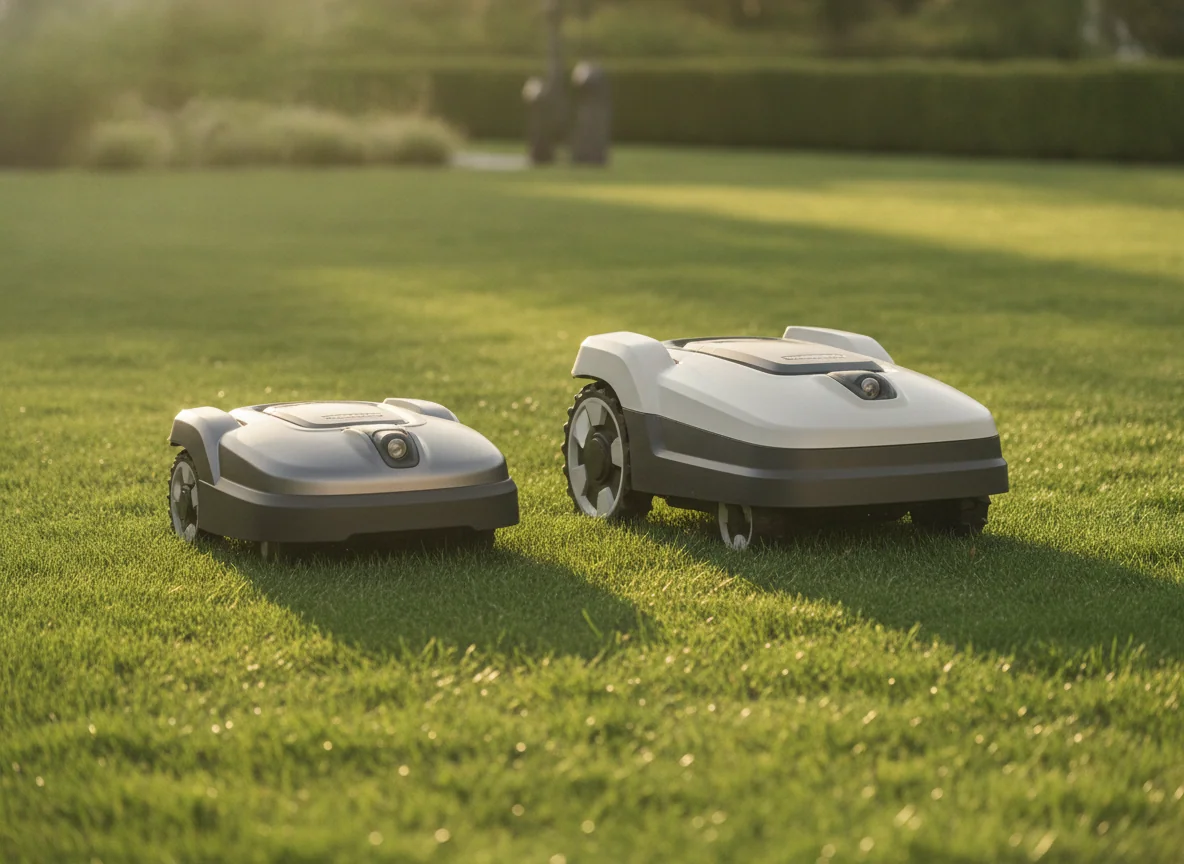
The V100 is the better compromise for a tiny lawn with obvious edges.
Its vision-based boundary detection avoids a powered perimeter-wire installation and keeps the mower’s limited automation understandable.
Manual charging, random coverage and a four-to-eight-inch unfinished border leave a person responsible for every mowing cycle.
Less automation creates fewer ways to fail
The V100’s routine is blunt. Put it on short, dry grass in daylight, select the cutting height and let it wander. Its camera distinguishes grass from non-grass surfaces, while a bumper supplies the backup response when a low or poorly seen object reaches the mower first. A run can last up to 70 minutes, after which the battery needs roughly 110 minutes for a full external charge.
That is not hands-off lawn care, but it avoids the E400’s most troublesome dependencies. There is no dock to align, no powered signal loop to break and no app pairing to solve. For someone who cannot comfortably push a conventional mower across a compact patch, carrying the V100 and handling its battery may be a worthwhile exchange for removing the harder physical work.
The mower is a maintainer rather than a rescuer. Grass above roughly 2.6 inches may be treated as an obstacle, so an overgrown lawn needs a conventional first cut. The 6.3-inch deck and random route are also better suited to a simple rectangle than a small garden fragmented by trees, beds and corners.
The property line matters more than the area
A fence, curb or raised border gives the camera a visible instruction. An open transition into gravel, flowers, a neighboring lawn or a pool surround does not. The V100 cannot store a virtual boundary, draw a no-go zone in an app or remember a map of the property.
The exact package creates another concern. The Amazon listing says the mower includes and recognizes a 32-foot magnetic strip, while YARDCARE’s own product information says the V100 does not support magnetic strips. A buyer whose lawn depends on that strip should confirm the revision and box contents with the seller before ordering.
Even a well-defined boundary will not be finished cleanly. The mower stops about 10–20 cm from the edge, leaving enough grass to make a string trimmer part of normal ownership rather than an occasional touch-up. The V100 wins this comparison by being the simpler gamble, not by becoming a complete mowing system.
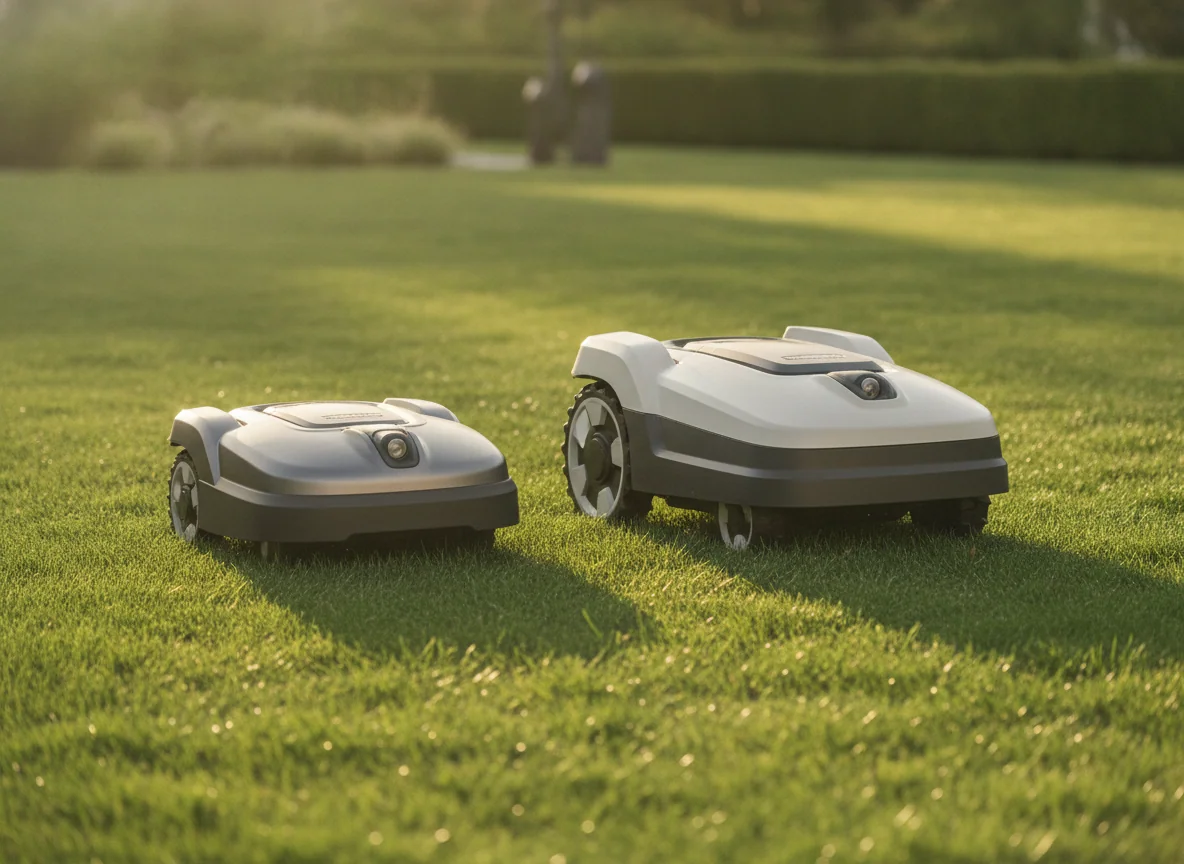
The E400 is for a patient installer who values scheduling over navigation.
It can quietly maintain a smooth, modest lawn through repeated mowing and charging cycles when the wire, dock and ground are all cooperative.
Demanding setup, basic collision sensing and recurring docking or stuck errors make its advertised autonomy difficult to trust.
The dock is useful only after the yard serves it
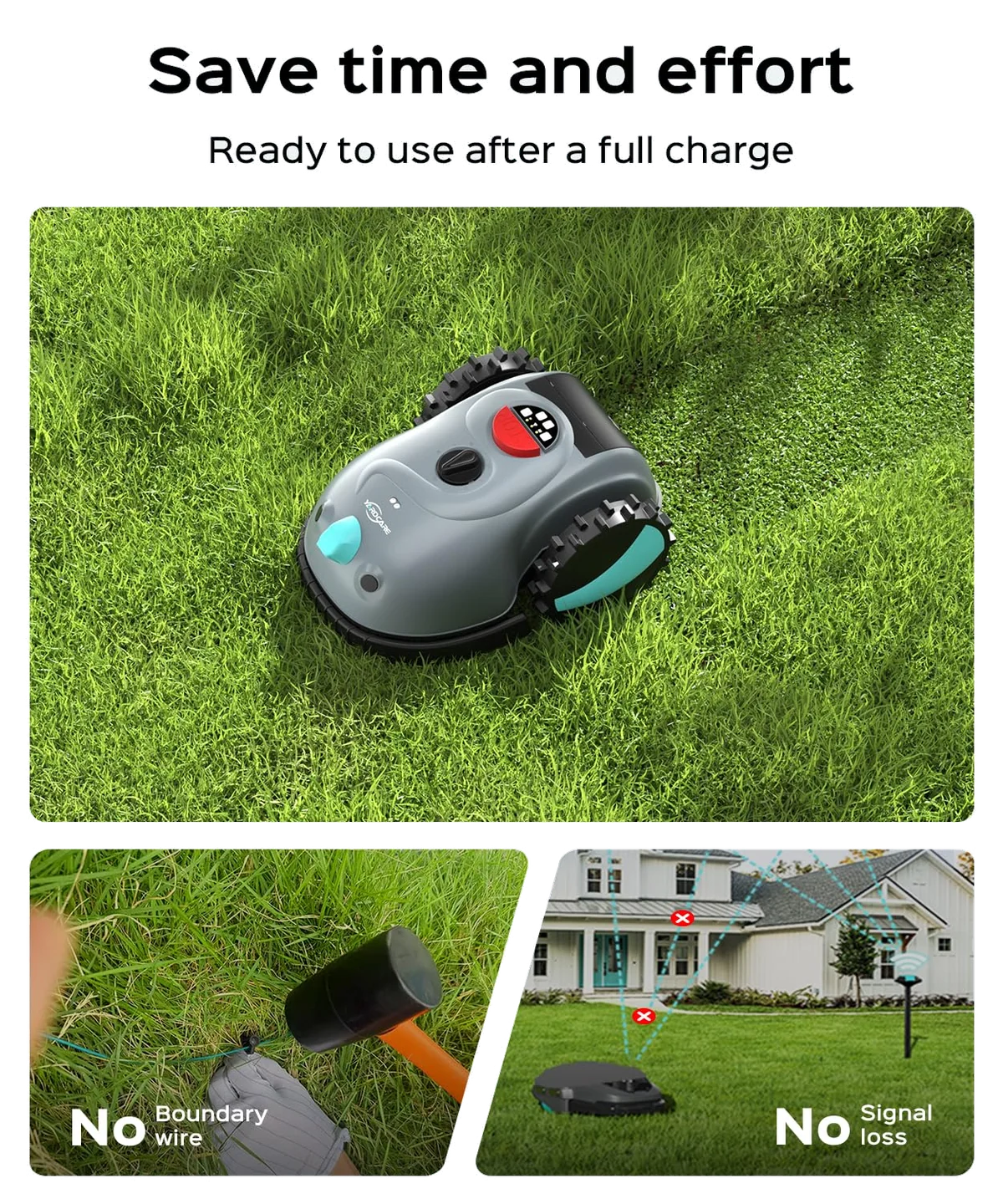
The E400 needs a complete powered wire loop beginning and ending at its charging station. The wire must remain the correct distance from walls and hazards, curve through changes of direction and avoid confusing closely spaced parallel runs. Beds, ponds, drops and delicate landscaping need their own exclusions. An irregular lawn can consume far more wire than its square footage suggests.
The station needs level, firm ground, nearby outdoor power and enough clean approach space for the mower to find its contacts. Testing the loop before fastening or shallowly burying it is essential because a poor corner, incorrect orientation or raised section can stop the system. The mower and station may also need shelter, which adds another job before the first automatic run.
When that installation works, the E400 provides the automation the V100 lacks. It can leave on a schedule, mow for roughly 30 to 40 minutes, follow the boundary home and recharge in about 70 minutes. Its three blades cut an approximately 7.1-inch path, and the 20–60 mm height range suits frequent maintenance of already-short grass.
The app cannot tell the mower where it has been
Bluetooth and Wi-Fi control can start or stop mowing, call the mower home, set weekly schedules and display basic status. The app cannot map the lawn, create virtual boundaries, divide mapped zones, show completed coverage or plan an efficient route. It controls a random mower rather than turning one into a mapped mower.
Obstacle detection is equally modest. The front bumper must generally touch a substantial object before the mower changes direction. Low edging, roots, shallow holes and rough sod can catch the small front casters or let the chassis climb before the bumper reacts. Children, pets, toys and wildlife should not share the lawn with it unsupervised.
Automatic charging is the E400’s decisive advantage over the V100, but it is also the feature with the most consequential failures. Reports of circling near the station, struggling to enter or leave it, spinning on clear grass and stopping with unexplained stuck errors undermine the reason to tolerate the installation. A machine that needs repeated rescues has not automated the chore; it has merely changed the chore.
YARDCARE V100
E400 Smart Robotic Lawn Mower
Choose by the inconvenience you can tolerate
Choose the V100 when carrying it is acceptable
The V100 fits one connected patch of short grass, preferably closer to the conservative 1,076-square-foot recommendation than the advertised ceiling. It needs daylight, dry conditions, clear borders and reasonably even ground. The owner must be willing to place it outside, retrieve it, charge the battery and trim the perimeter afterward.
Choose the E400 only when the installation is genuinely simple
The E400 makes sense on a private, flat, firm rectangle with few obstacles, an outdoor outlet and a sheltered, level dock location. Its automatic cycles can save more day-to-day effort than the V100, but only if the owner can install the wire carefully and tolerate troubleshooting when the mower or station misbehaves.
Walk away when the lawn needs intelligence
Neither mower is a sound choice for disconnected areas, narrow corridors, complicated beds, rough ground, exposed drops or a demand for orderly coverage. A lawn approaching the E400’s 4,300-square-foot claim deserves a mapped machine rather than more random passes. Our guide to RTK, LiDAR and camera navigation explains what better localization changes, while the small-lawn mower shortlist covers alternatives that do not force this particular choice.
The E400 is more autonomous on paper, but the V100 is the mower with the more credible job: it removes the pushing from a tiny lawn without pretending that an app, a wire and a dock have made random navigation smart.
Frequently Asked Questions
Can either mower manage separate front and back lawns?
Neither mower maps disconnected zones, although the portable V100 can be carried between suitable enclosed patches and started manually.
Which model charges itself?
The E400 returns to a powered charging station, while the V100 uses a removable battery that must be charged and reinstalled by hand.
Is either mower a good choice for an uneven yard?
No, because ruts and rough transitions undermine the E400’s small front casters and make the V100’s random coverage less dependable.
Will either mower eliminate edge trimming?
No, because both leave perimeter work behind and the V100 can stop roughly four to eight inches from the lawn edge.
Ready to Choose?
Sources (17)
- Amazon listings and customer reviews — Yardcare V100 and E400 Smart Mower App
- Owner reports across r/roboticLawnmowers, r/brisbane, r/berkeleyca and 6 more threads
- Owner and reviewer video, 5 channels
- Yardcareinc — Article — yardcareinc.com
- Thegadgetflow — Article — thegadgetflow.com
- Medium — Article — macsources.medium.com
- Wired — Article — www.wired.com
- Fr — Article — nos-jardins.fr
- Fr — Article — www.lesalexiens.fr
- Upzy — Article — www.upzy.com
- Maehroboter Testberichte — Article — maehroboter-testberichte.de
- Macsources — Article — macsources.com
- Wpa Pool — Article — www.wpa-pool.com
- Zdnet — Article — www.zdnet.com
- Stylistme — Article — stylistme.com
- Amgardaseeblick — Article — amgardaseeblick.com
- Cherrypicksreviews — Article — www.cherrypicksreviews.com