The WORX WR344 is the hill-climber to buy only if you can tolerate its software
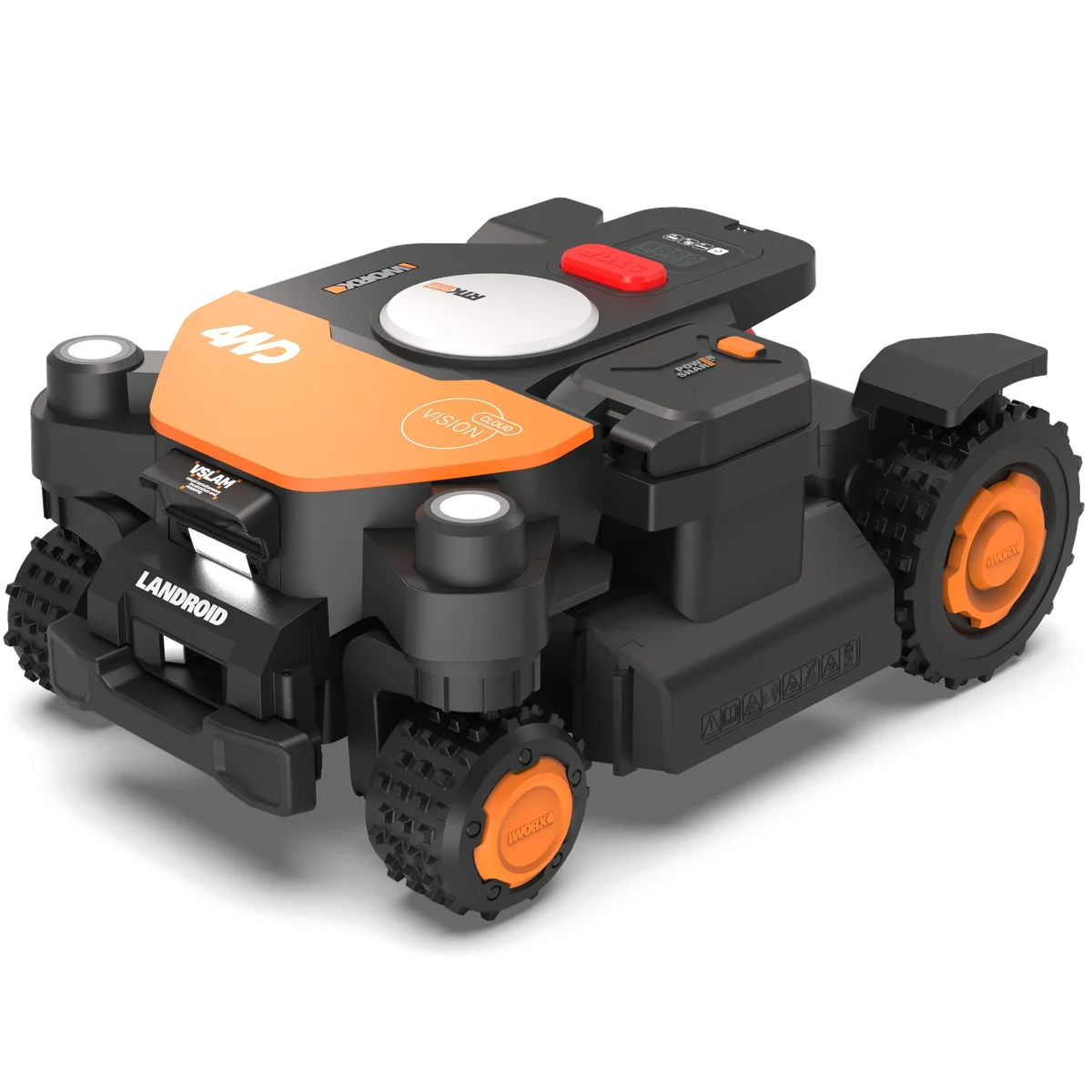
Buy the WORX WR344 for a connected, steep or badly uneven lawn where traction matters, but walk away if you need fast acre coverage or refuse to troubleshoot cloud-dependent software.
Who should buy it, and who should leave it alone
Buy the WR344 when the lawn is maintained, physically connected to one dock and difficult enough to justify genuine 4WD. It is especially persuasive where a local RTK mast would be awkward, tight landscaping rewards a compact chassis and conventional skid turns would damage the grass. Keep enough patience for mapping, firmware updates and the occasional reset.
Do not buy it for a flat open acre that must be finished quickly, a set of lawns divided by locked gates, a yard full of low branches and heavy debris, or a household that wants appliance-like certainty from the first afternoon. The Navimow X430 is the more convincing open-acre worker, while the WR344 remains the more interesting specialist for hostile residential terrain.
Strengths
Weaknesses
The WORX WR344 is not the safest general recommendation in the one-acre class, but it is the mower to choose when a punishing lawn makes its remarkable chassis more valuable than perfectly mature software.
The WR344 contains one of the best mechanical platforms in this class. Four driven wheels, an articulated chassis and front wheels that steer rather than scrub let it cross ruts, climb banks and turn without chewing a damp-looking crescent into the turf. Once it is following a healthy map, the narrow cutting disc lays down crisp, straight lines and the mower becomes quiet enough to disappear behind the ordinary noise of a house.
Then the software asks for attention. Initial commissioning can stall at Wi-Fi, SIM activation or an NTRIP connection error. Hard shadows, patchy grass, sandy areas, tall weeds and low branches can be interpreted as reasons to stop rather than things to mow beneath or across. Firmware has improved useful functions and mapping behavior, but updates have also changed vision and edge performance in the wrong direction for some lawns. This is a strong mower living inside a platform that still behaves like a developing technology product.
Key Specifications
No wire and no mast does not mean no setup
The physical installation is refreshingly light. There is no perimeter cable to bury and no local RTK reference antenna to mount on a pole or roof. The charging station still needs a level route to the lawn, power and a dependable 2.4 GHz Wi-Fi connection for commissioning and cloud communication. WORX RTK coverage should also be confirmed for the property before the mower arrives.
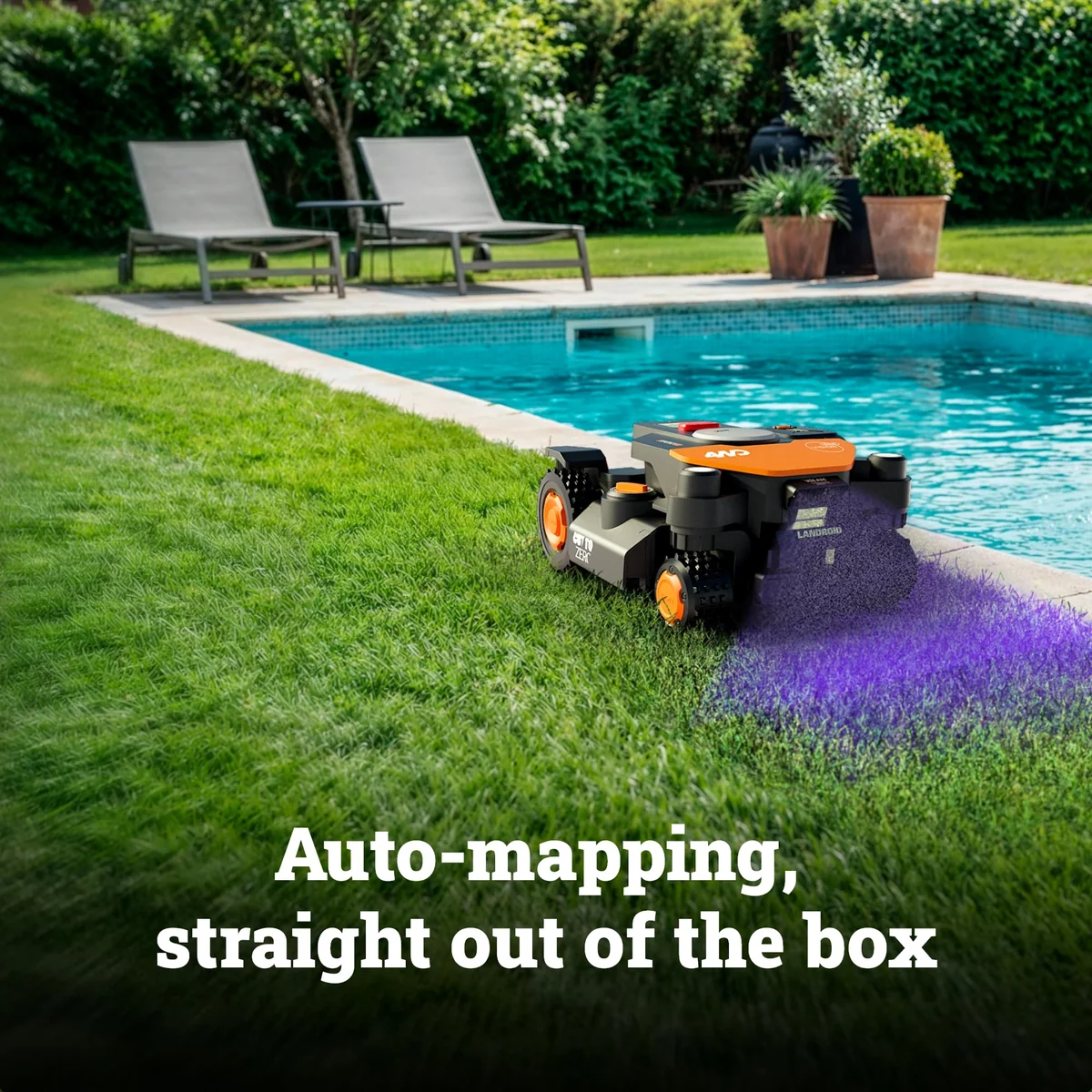
Auto-mapping can be excellent when the lawn presents clear visual boundaries against paving, beds and driveways. It becomes conservative or confused where grass continues into a neighbor’s property, where a pond or drop has no obvious border, or where a narrow transition combines several surfaces. Manual mapping is the better choice in those places. It takes longer because the mower must be driven around the boundary by phone, but it gives the owner control over safe margins and how closely the right-side edge hardware approaches flush paving.
Dangerous edges deserve more than confidence in the camera. A pond, retaining wall or road should receive a generous mapped exclusion, followed by supervised cycles in different light. A route that works in soft morning light can look different to the vision system when a tree throws a sharp midday shadow across it.
Obstacle avoidance is cautious until caution becomes refusal
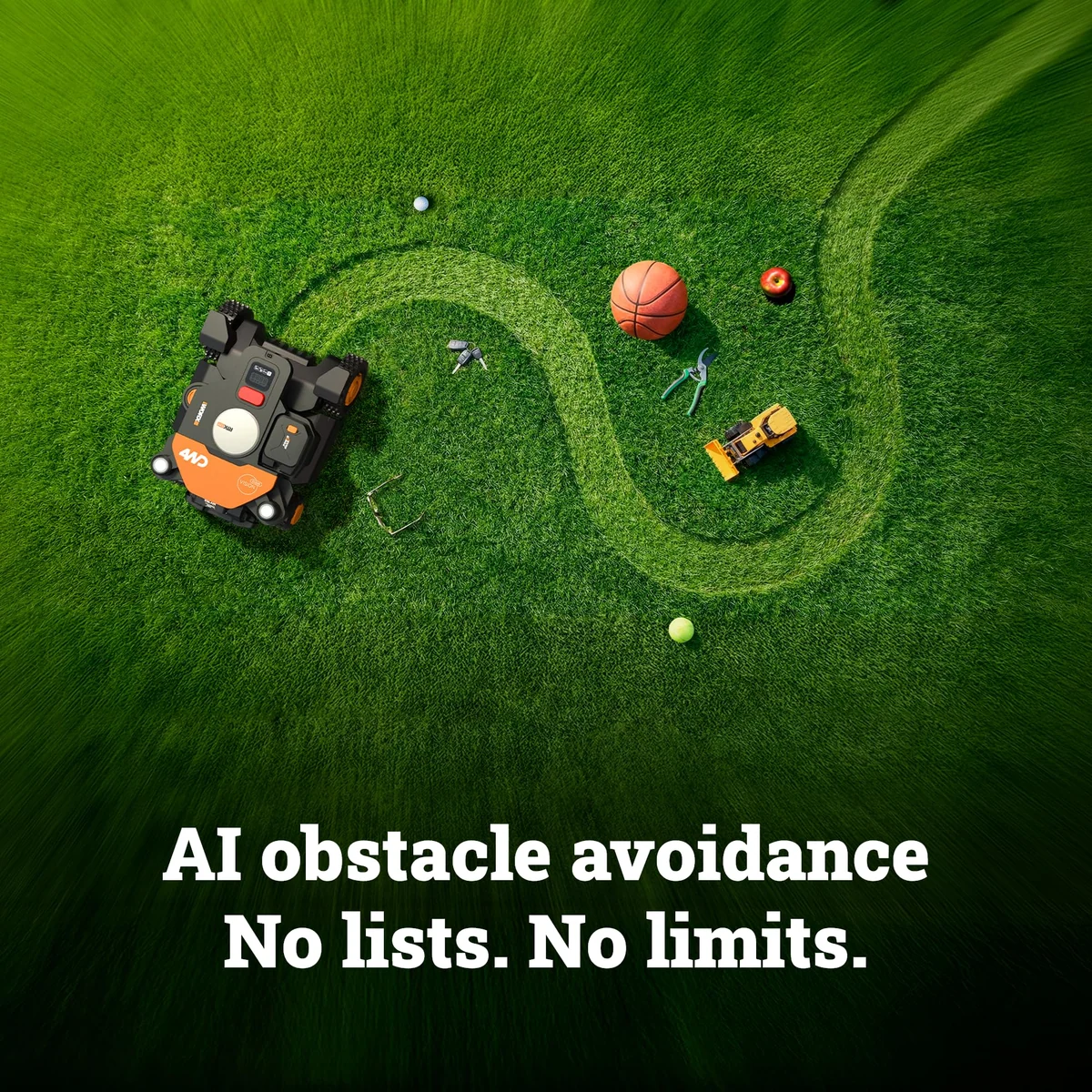
People, pets, cans, balls, hoses, furniture legs and raised garden objects are usually recognized in time for a stop or detour. Flat objects are less dependable. Gloves, short sticks, cords and debris can sit below the visual threshold and go beneath the chassis, while dandelions, taller tufts and overhead branches may provoke the opposite error and become imaginary walls.
No-vision zones can force the mower through a troublesome patch, but they remove the protection that caused the stop. That trade should be made only in an area cleared of objects, children, pets and exposed hazards. It is a workaround, not proof that the underlying recognition problem has disappeared.
Cut-to-Zero is a name, not a finished border
The separate offset edge blade genuinely reduces trimming. Its best case is a flush driveway or path where the wheels can overlap the hard surface and the blade can reach the grass line. Walls, fence posts, raised kerbs, tight corners and abrupt bed drops prevent the chassis from occupying the position the blade needs. Those borders still leave a strip for the string trimmer.
A careful manual map and a dedicated edge routine matter more than the feature name. The edge blade also has its own height adjustment, so changing the main deck does not excuse checking the smaller blade. Expect much less border work, not none.
Every autonomous zone needs a route home
The app can hold multiple zones, connecting paths and no-go areas, but the mower is not a true drop-and-mow machine. A fenced front lawn with a closed gate remains disconnected, even if it appears perfectly on a map. Carrying the WR344 into that space creates a manual ownership routine and can interfere with charging or completion of an edge task. For autonomous use, every zone needs a traversable path back to the single dock.
Strengths & Limitations
Strengths
- Four driven wheels, articulation and front steering deliver exceptional traction without routine skid-turn damage.
- Cloud RTK removes both the perimeter wire and the owner-installed correction mast.
- Frequent dry mowing produces a clean, quiet cut with precise narrow patterns.
- The removable PowerShare battery makes the most failure-prone consumable unusually easy to replace.
Limitations
- Wi-Fi, SIM and NTRIP failures can prevent an expensive mower from completing basic setup.
- The 8.7-inch deck makes full-acre maintenance slow and dependent on many charging cycles.
- Shadows, tall tufts, bare ground and low branches can provoke false obstacle or trapped errors.
- Cut-to-Zero still leaves manual trimming at walls, posts, corners and uneven borders.


The chassis is the reason to take this mower seriously
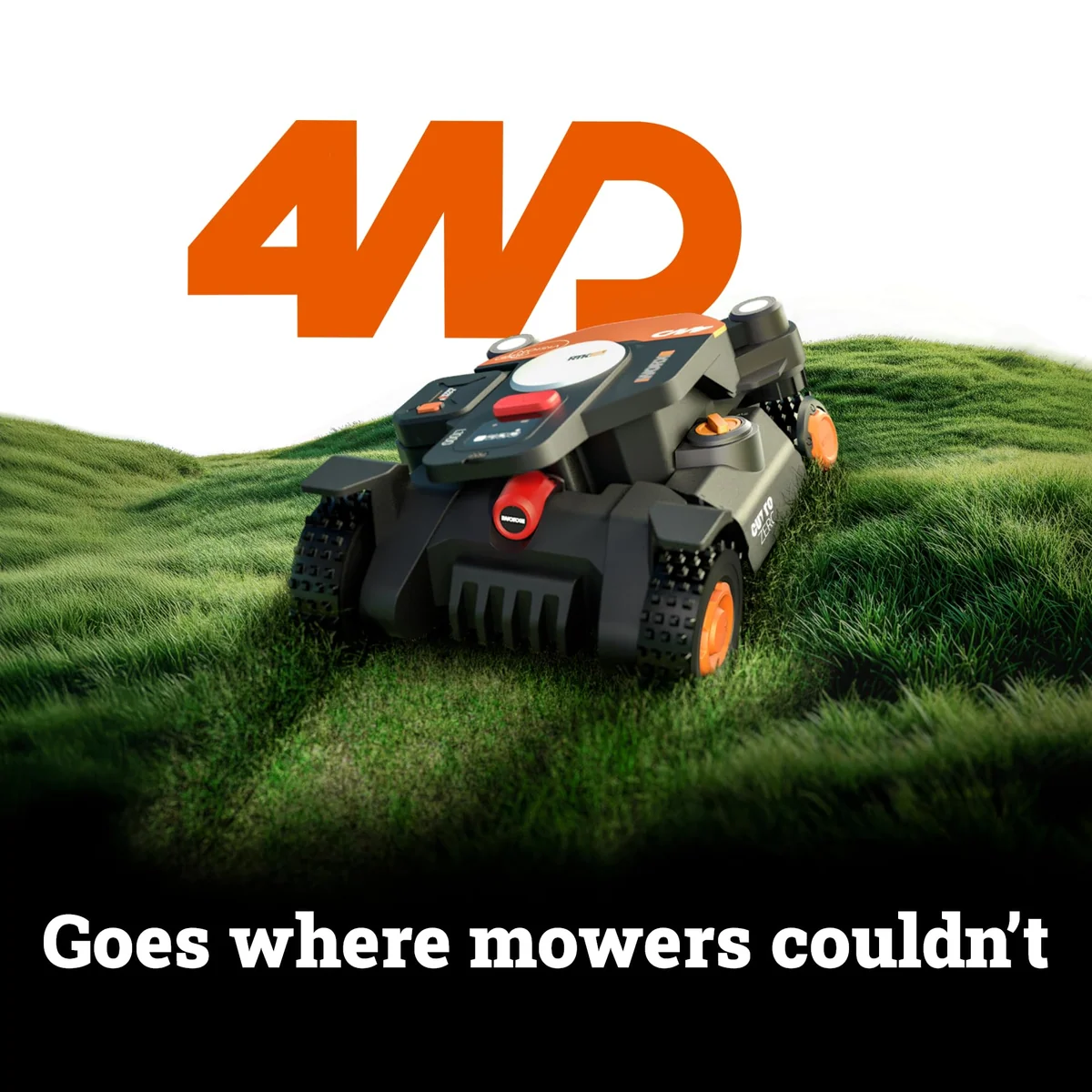
A steep lawn exposes decorative all-wheel-drive claims quickly. The WR344 has unusually persuasive terrain evidence: sustained work on lumpy ground around 35 degrees, successful climbs on a nominal 40-degree ramp, and repeated trips over roots, ruts, gravel transitions and raised lips. Its advertised 84% maximum is a grade, not an 84-degree slope; it is roughly 40 degrees.
That figure remains a favorable-condition ceiling. Dry grass and firm soil give the tires something to use, while wet clay, loose stone and an abrupt change of angle can defeat even excellent traction. The sensible purchase is not one whose hardest bank exactly matches the claimed limit. Leave margin for rain, worn grass and a route that approaches the incline at something other than the perfect angle.
The more important everyday achievement is how the WR344 turns. Many powerful robot mowers rotate by dragging one side of the machine across the lawn. WORX steers the front wheels and articulates the body, so direction changes look controlled rather than agricultural. That matters on a curving, multidirectional yard where hundreds of small turns can do more visible damage than the mowing blades.
It cuts beautifully, but it does not cut quickly
The main deck is only 8.7 inches wide. That compact footprint helps between beds and through narrow landscaping, yet it is a conspicuous bottleneck on open acreage. Real mowing bouts commonly land around 40 to 50 minutes before another charge, and a full property requires repeated mow, dock, charge and resume cycles. Owners of near-acre layouts report zones that can occupy most of a day, while the model’s rating is better understood as the area it can maintain across roughly two days of recurring work.
That is acceptable when the schedule runs quietly in the background. It is not acceptable if “one acre” means finishing the whole lawn in one afternoon before guests arrive. The WR344 rewards frequent maintenance mowing, taking small amounts from already controlled grass. It is not a brush cutter, a leaf mulcher or a machine for reclaiming a six-inch field after a wet fortnight.
On short, dry grass, systematic parallel, checkerboard and diamond routes produce the WR344’s most convincing result. The stripes are narrow because the deck is narrow, but they are unusually accurate. Wet grass brings clumps, underside buildup and occasional stragglers, so the machine’s ability to keep moving in damp conditions is not a reason to ignore the rain delay.
The right rival depends on whether the acre is difficult or merely large
The WR344 earns its premium on a property that uses the chassis: steep banks, exposed roots, irregular transitions, tight paths and turns that would let a skid-steer mower scar the lawn. On a flat rectangle, much of the expense is parked in hardware the yard never asks for.
Where WORX wins
Against the Mammotion LUBA 3 AWD, the WR344 offers a more compact body, true front steering, no owner-installed RTK mast and a battery the owner can remove without a service visit. Those are meaningful advantages around tight landscaping and over a long ownership period.
Where the faster rivals win
The Segway Navimow X430 carries a cutting system roughly twice as wide, so it is the stronger choice for a mostly open acre where throughput matters more than the WORX mower’s narrow-body accuracy. LUBA 3 also covers large open ground faster with its wider dual-disc arrangement and longer mowing bouts.
The removable PowerShare battery is the WR344’s best long-term value argument. A worn pack does not condemn the entire mower, compatible replacements are not tied to an internal service procedure, and an existing WORX tool owner may already have useful battery capacity in the garage. A larger compatible pack can extend a mowing stint, but it does not increase the model’s licensed mapping limit or turn the narrow deck into a faster one.
For a smaller property whose slopes and transitions do not require this chassis, the WR320 comparison explains what is surrendered by stepping down within the same Vision Cloud family. The WR344 makes sense when the answer is terrain, not simply because it is the larger number.
The replaceable battery will probably outlast the current software story
The ownership evidence is polarized rather than uniformly bad. Some WR344 installations settle into six weeks or two months with almost no intervention. A three-month rugged-property account recorded only a handful of mid-mow resets while replacing hours of conventional mowing. At the other end are machines returned because activation, Wi-Fi or RTK errors never cleared, plus yards that require several daily rescues when vision reports a false trap.
That split makes the return period part of the evaluation. The mower should complete every zone, recharge, resume, follow each connector and perform its edge routine before the packaging disappears. Run it beneath trees in strong sun, through the darkest passage, across bare patches and along the steepest transition. A successful lap on open grass proves the least controversial part of the machine.
Scheduling deserves the same attention. Very large zones can run into a calendar cutoff, after which unfinished work may wait for the next scheduled day instead of resuming cleanly. Dividing a near-acre property into zones that can finish within about six hours reduces the damage caused by rain, a stall or a delayed start. The app is reasonably understandable once connected, but task cancellation, fault recovery and schedule semantics remain less mature than the mechanical design.
Routine care is ordinary: clear sticks and pet waste, keep the cameras clean, remove wet buildup from the underside, inspect the pivoting blades and avoid pressure washing. The three-year manufacturer warranty offers useful cover, although a warranty is less comforting when a connection fault appears outside business hours and remote support cannot restore operation.
The deeper risk is service dependence. Navigation relies on an app, firmware, cloud RTK infrastructure and regional connectivity terms that can change over the life of the mower. The battery is refreshingly repairable; the cloud is not. Check the current terms for RTK correction, cellular tracking and anti-theft service rather than assuming every connected feature is included forever.
Sources (21)
- Amazon listings and customer reviews — Worx Wr344
- Owner reports across r/roboticLawnmowers, r/2011, r/pistols and 3 more threads
- Owner and reviewer video, 15 channels
- Walmart listing
- Target listing
- Lawncraftsupply — Article — lawncraftsupply.com
- Reviewed — Article — www.reviewed.com
- Facebook — Article — www.facebook.com
- Homedepot — Article — www.homedepot.com
- Lowes — Article — www.lowes.com
- Easylawnmowing — Article — easylawnmowing.co.uk
- WORX — Article — www.worx.com
- Easylawnmowing — Article — www.easylawnmowing.com
- Freshlycharged — Article — freshlycharged.com
- Ai — Article — www.robotmower.ai
- Homeandgardenselect — Article — homeandgardenselect.com
- Dreamhomeplace — Article — dreamhomeplace.com
- Mensjournal — Article — www.mensjournal.com
- Ibisik — Article — www.ibisik.com
- Smarthomecompared — Article — smarthomecompared.com
- Requiemforadream — Article — www.requiemforadream.com