Dreame’s A3 AWD Pro 3500 solves the sky and picks a fight with the ground
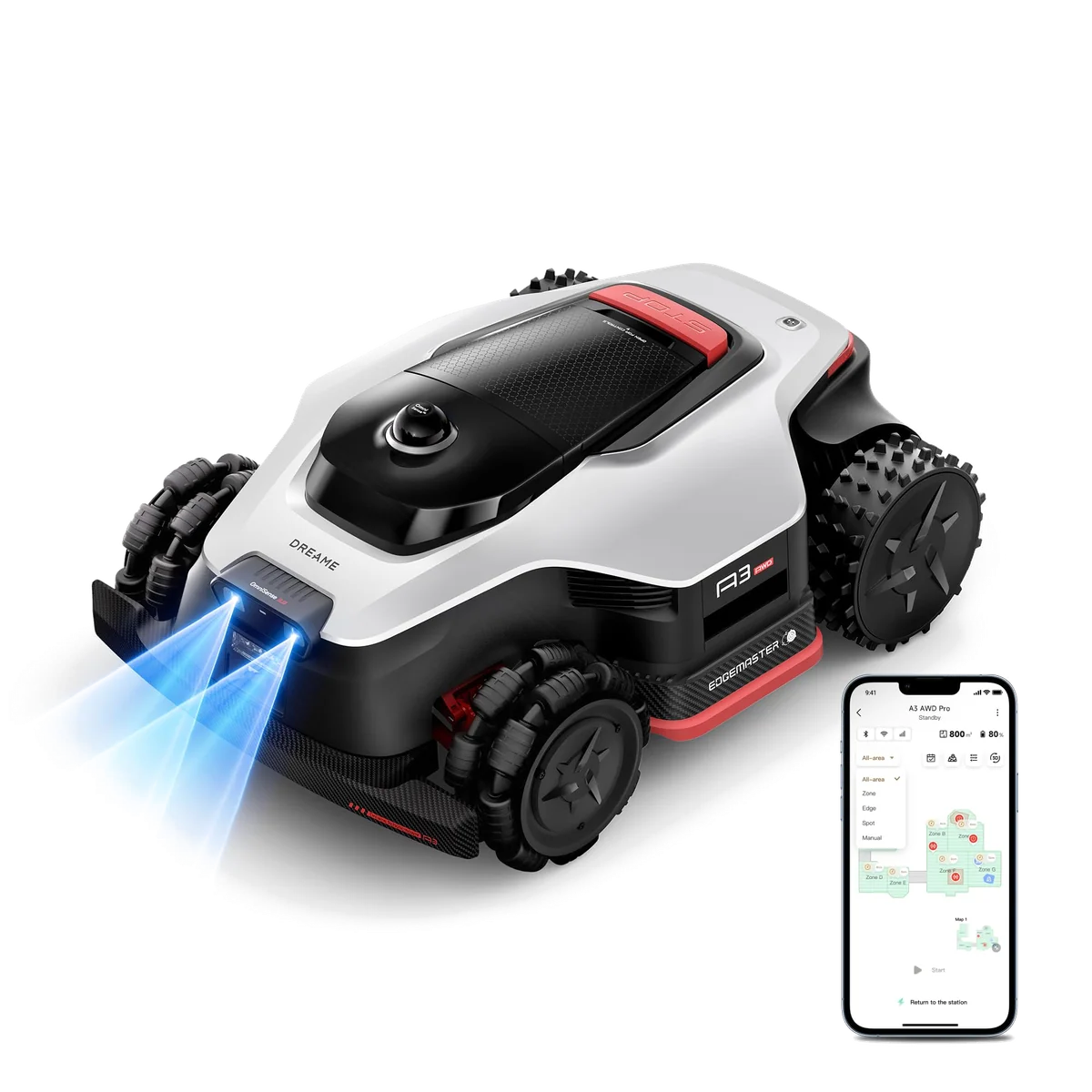
Buy the A3 AWD Pro 3500 for a large, tree-covered or steep lawn with firm turf, but choose something gentler and more mature if the ground stays wet, thin, or sandy.
Who should actually buy it
Smart Lawn Bots recommends the A3 AWD Pro 3500 for the difficult overlap of problems it genuinely solves: a substantial lawn, unreliable satellite view, meaningful slopes, roots or rough transitions, and firm enough turf to withstand a heavy AWD machine. Budget time for careful manual mapping, treat the first few cuts as setup rather than saved labor, and disable EdgeMaster if the lawn lives above 3 cm.
Walk away if the property stays wet, contains extensive sand or loose borders, has dangerous unprotected drops, or needs immaculate tall-turf edging. Also walk away if “robotic” means zero mapping, zero string trimming and mature software from the first afternoon. This machine can become impressively autonomous, but only after the yard and the map have made peace with it.
Strengths
Weaknesses
The condition in that verdict is the whole review. On established grass, the Dreame is a broad, quiet maintenance mower that climbs serious slopes, crosses roots and cuts systematic stripes without a boundary wire, satellite reference or external RTK antenna. Put the same 52.7-pound machine on damp loam, loose sand or a worn patch beside its dock and four driven wheels can become four very effective digging tools.
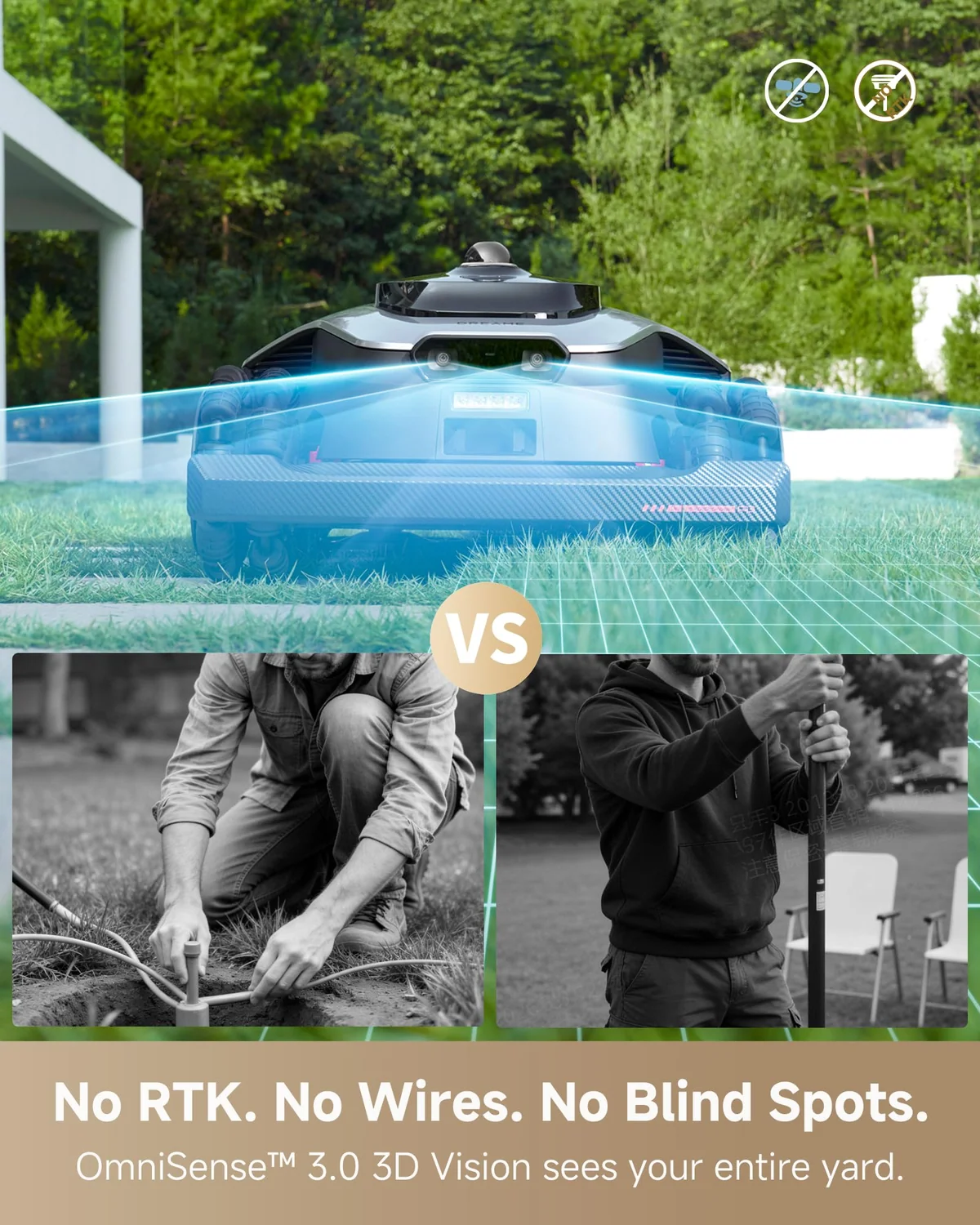
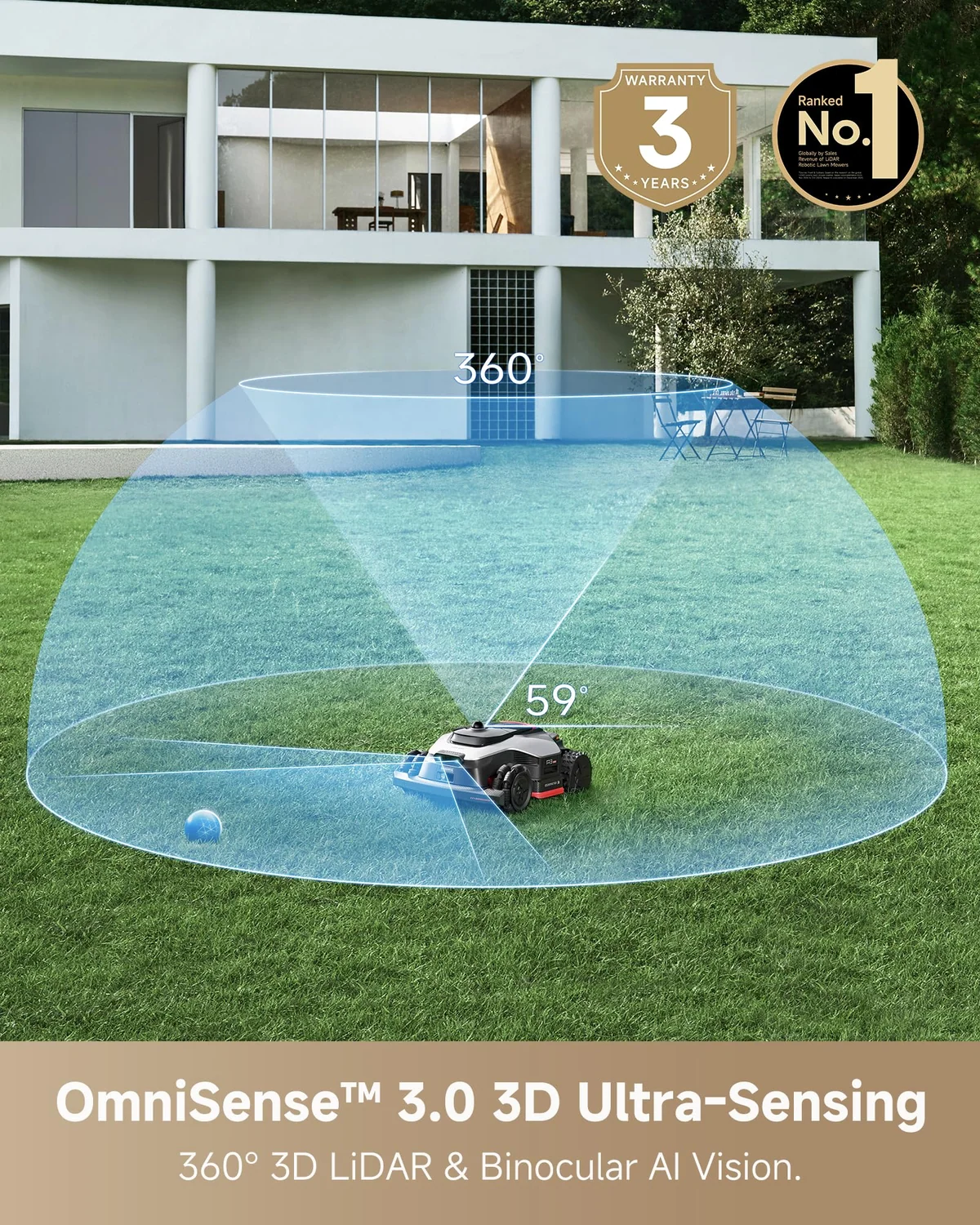
Its central advantage is genuine. LiDAR keeps the mower oriented beneath mature trees and beside buildings, where satellite-dependent machines can hesitate or lose precision. Once the map is sound, the A3 can divide a property into zones, follow connecting paths, change mowing direction and resume after charging. This is the reason to consider it, not the camera patrol, novelty lawn patterns or inflated promise of a string-trimmer-free life.
No RTK tower does not mean no setup. Automatic mapping can work around clear borders such as pavement, gravel and defined beds, but it becomes uncertain where lawn blends into a field, woodland or a neighbor’s grass. Manual mapping is the dependable route, and that means walking the perimeter while steering a large mower through an app that can feel polished one moment and strangely undiscoverable the next.
Ponds, pools, retaining edges and pits need more than optimism about object recognition. Trace them conservatively, add explicit no-go areas and use a physical barrier where a fall could injure someone or put the mower in water. A virtual line is useful software, not fencing.
Key Specifications
EdgeMaster reaches farther by cutting lower
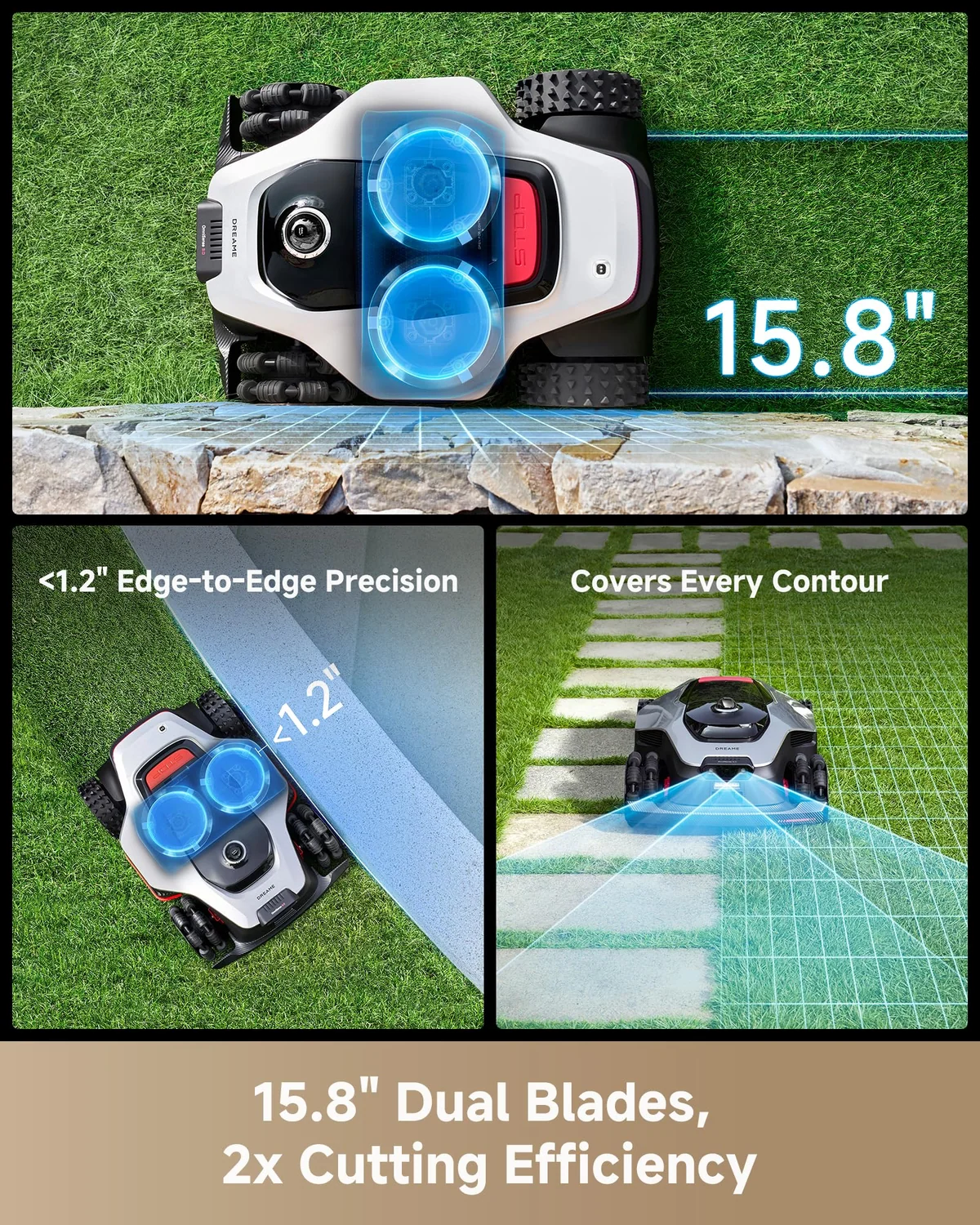
EdgeMaster 2.0 moves the cutting assembly toward the boundary, and its mechanical reach is real. Beside flush paving, where a wheel can safely overlap the hard surface, careful mapping can leave almost no upright strip. Along walls, fences, raised beds and tight inside corners, expect a narrow remainder for the string trimmer.
The catch is severe: the edge pass drops to a fixed 3 cm, or 1.2 inches, regardless of the main deck setting. A lawn maintained at 7 or 8 cm can emerge with a visibly shaved racetrack around its perimeter. The same low pass can scalp a purely virtual seam between adjacent grass zones. Owners of taller-cut lawns should disable EdgeMaster rather than let an impressive mechanism dictate an unsuitable agronomic choice.
This makes the “zero-edge” language the largest gap between the sales pitch and daily ownership. The system can reduce trimming, but it cannot eliminate physical clearance around every raised border, and its fixed height makes it unusable for some of the lawns that would otherwise suit the mower.
Obstacle avoidance is excellent until the object is low, thin or dangerous
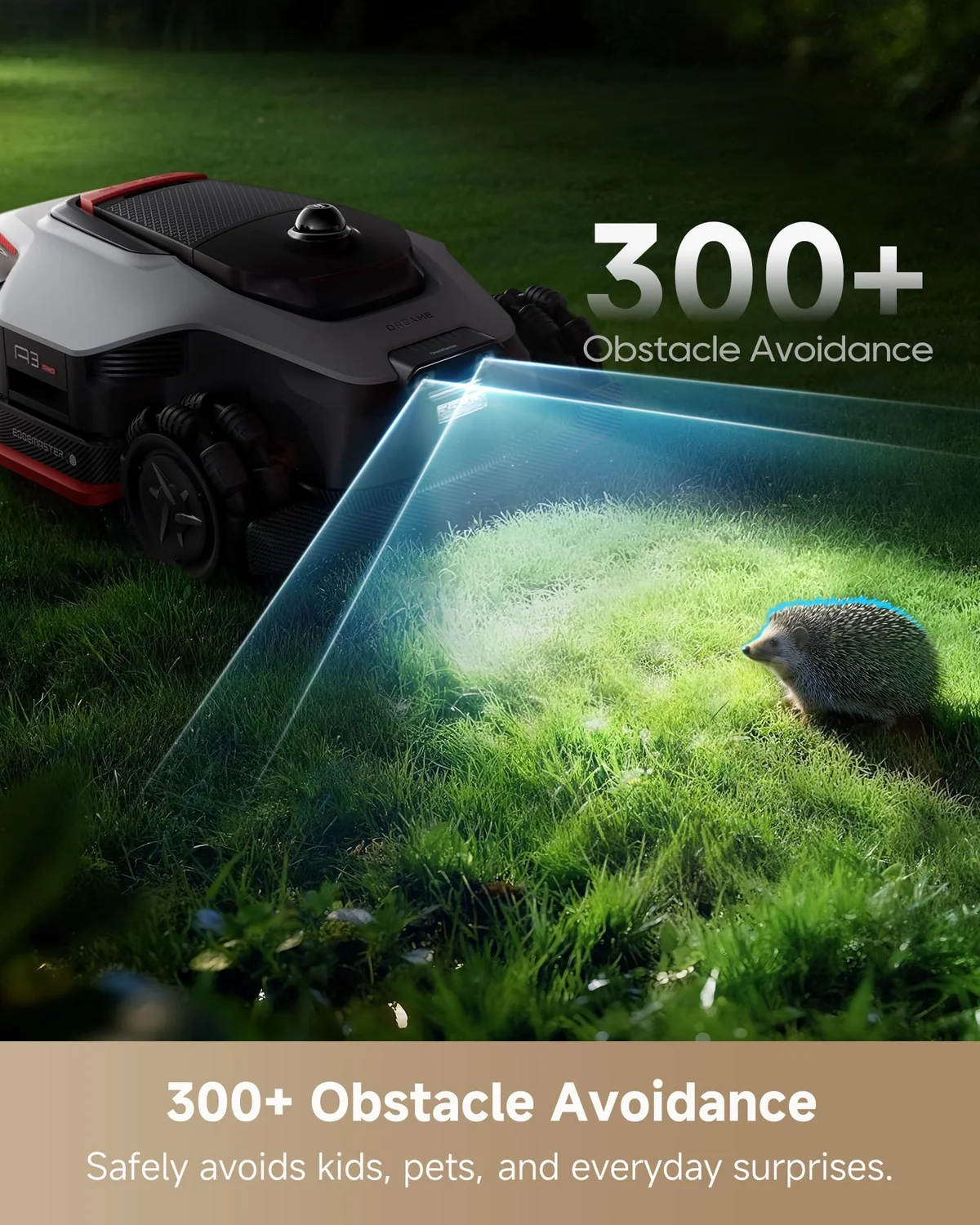
The LiDAR and binocular cameras are unusually good at recognizing balls, hoses, people and ordinary garden objects, and detected-item photos can explain why a patch was skipped. Low wooden blocks, thin sticks, wire fencing, sprawling plants and drop-offs remain failure cases. Conservative settings can also make the mower circle overhanging leaves or abandon grass beside a raised bed.
Clear toys, hoses, branches and hidden timber before mowing even if the app promises hundreds of recognizable object types. Rush mode further reduces the avoidance margin. Night operation is technically possible, but the headlight can annoy neighbors and no obstacle demonstration proves that every small nocturnal animal will be protected.
Strengths & Limitations
Strengths
- LiDAR navigation remains precise beneath trees and beside buildings without an external RTK antenna.
- True four-wheel drive handles firm slopes, roots and uneven transitions that stop ordinary robot mowers.
- The wide dual-disc deck produces clean stripes and fine mulch on frequently maintained grass.
- Obstacle recognition is unusually capable with ordinary garden objects and explains many detections in the app.
Limitations
- Its weight and turning routine can rut wet turf or dig into sand, thin grass and loose soil.
- EdgeMaster cuts at a fixed 3 cm and can visibly scalp lawns maintained higher.
- Automatic mapping is unreliable around ambiguous borders and dangerous drop-offs.
- Software, docking and early hardware reliability remain less consistent than the underlying mowing hardware.
AWD conquers hills, not soil physics
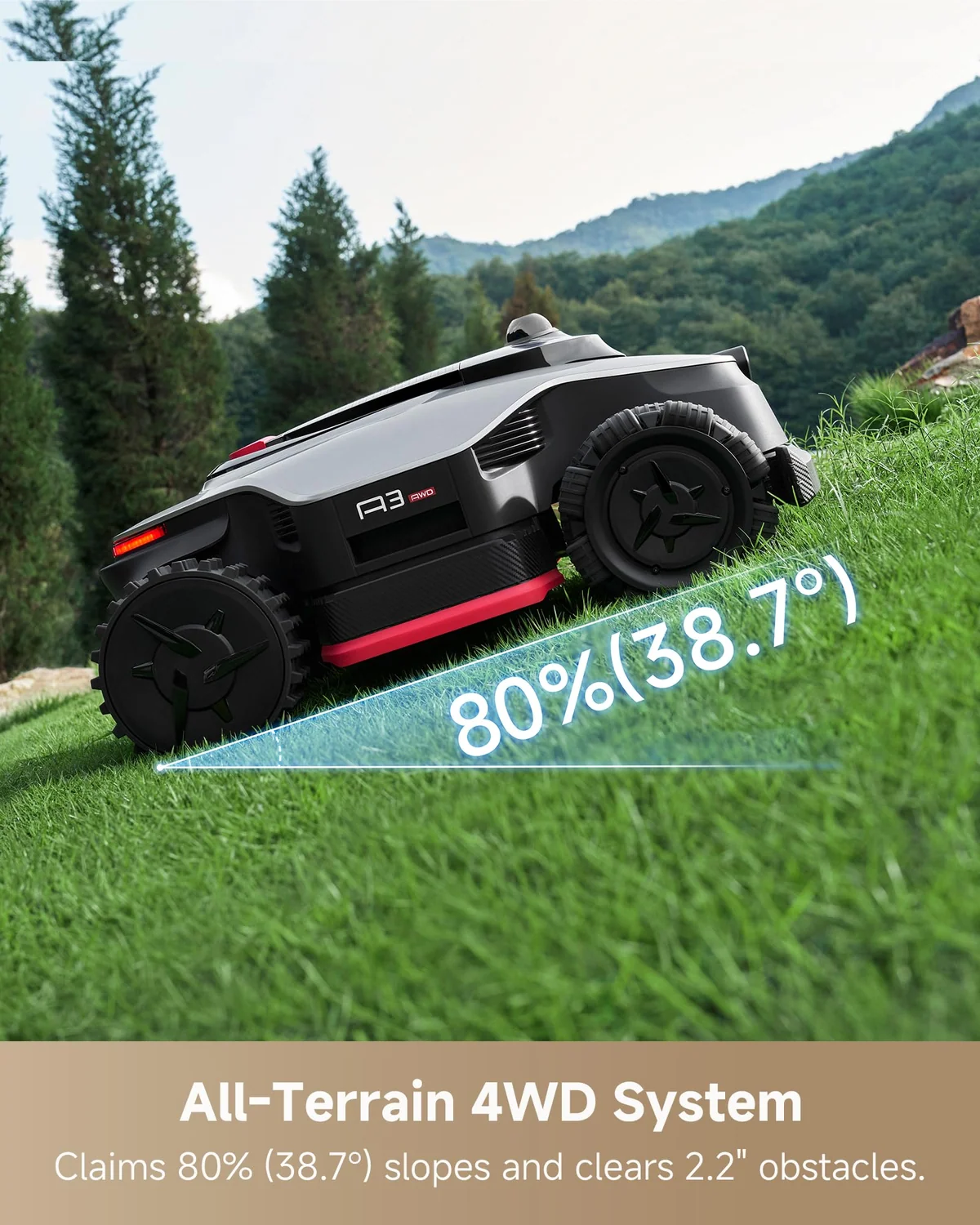
The A3’s four-wheel drive is far more than a badge. It has completed demanding, rutted slopes in the low-thirty-degree range, climbed sustained inclines that defeat two-wheel-drive robots and crossed roots and thresholds close to two inches high. The advertised maximum of 38.7 degrees is an 80 percent grade, not an 80-degree wall, and it should be read as a best-case traction limit rather than a promise for every hillside.
Approach direction, moisture, turf density and turning room matter as much as the number on a slope chart. Firm grass gives the tires something to push against. Wet turf packs the tread, bare ground moves beneath it, and loose sand can collapse under a turning wheel. The mower may climb a steep green bank cleanly, then excavate a nearly flat sandy corner during a routine pivot.
| Surface or boundary | Likely result | What the owner should do |
|---|---|---|
| Firm, established slope | Excellent traction and controlled systematic coverage | Run uphill, downhill or diagonally rather than forcing long cross-slope turns |
| Roots and hard thresholds | Unusually capable crossing within its clearance | Remove sharp hazards and map anything that could high-center the deck |
| Wet or thin turf | Risk of scuffs, ruts and bald turning patches | Delay mowing until the ground firms and vary the mowing direction |
| Loose sand, mulch or gravel | Wheelspin, digging or immobilization | Exclude the area or provide a firm travel surface |
| Pond, pool or drop | Vision and LiDAR are not dependable fall protection | Use a generous mapped setback and a physical barrier where safety demands it |
The most vulnerable patch is often directly in front of the charging station. The mower backs out, pauses and turns through a localization routine before leaving for work. Repeating that circle on soft or damp soil can wear the grass to bare earth. Give the dock a firm, level approach with roughly a metre of clear maneuvering space, open sensor sightlines and no coarse gravel beneath the wheels.
It cuts beautifully when grass is already under control
Two discs and a 15.8-inch span give the 3500 a meaningful throughput advantage over narrow single-disc robots. On turf mown every few days, the six pivoting blades leave straight rows, fine clippings and a convincing maintained finish. The electric deck covers a useful 1.2-to-3.9-inch range, so it can maintain both short warm-season grass and taller residential turf.
It is not a rescue mower for an overgrown lot. Small razor blades create little lift, allowing mature weeds and long folded grass to survive the first pass. Heavy growth can also leave clippings in visible rows rather than disappearing as fine mulch. Knock an overgrown lawn down conventionally, then let the robot preserve that height with frequent shallow cuts.
The 3500 badge describes capacity, not one heroic battery run
The 0.87-acre rating is the maximum managed-area class and aligns with claimed daily throughput in the faster operating modes. It does not mean the mower will finish 0.87 acre on one charge. In controlled standard mowing, the 3500 covered about 600 m², or 6,458 square feet, in roughly four hours before recharging, then reached full charge in under an hour and a half. Slopes, obstacles, narrow zones and cautious avoidance all reduce throughput.
That distinction matters because the A3 is physically large. Buyers with a flat quarter-acre lawn would be paying for battery, width and traction they may never exploit while accepting a 31.5-inch passage requirement and a heavy machine that is awkward to carry. The regular A3 AWD 1000 or 2000 keeps the same broad LiDAR-and-AWD idea in a smaller single-disc chassis, while the Pro 5000 adds a 10 Ah battery and a larger managed-area allowance. Our A3 AWD versus A3 AWD Pro comparison explains the chassis decision, and the 3500 versus 5000 comparison deals with the capacity step.
The rival it beats, and the rival that beats it
For a large property under mature trees or tight against buildings, the Dreame is a more natural choice than the Mammotion LUBA 3 AWD 5000H when the decisive problem is unreliable satellite visibility. On-board LiDAR removes antenna placement and sky-view anxiety while retaining genuine all-wheel traction.
The Segway Navimow X430 is the better fit when satellite reception is sound and the lawn is hot, exposed or vulnerable to pivot damage. Its smoother turning behavior, stronger mower-support pedigree and lack of a spinning LiDAR heat issue outweigh the Dreame’s navigation advantage on that kind of property. The detailed trade-offs are laid out in the Dreame versus Navimow X430 comparison.
Great hardware is carrying unfinished software
The app contains the controls a serious multi-zone mower needs: schedules, cutting directions, paths, alternate maps, no-go areas, obstacle sensitivity, logs and remote dispatch. Successful owners can send the mower across a mapped path, watch it complete a distant zone and trust it to return for charging. Other owners encounter failed firmware updates, intermittent Bluetooth during mapping, cryptic menu states, false positioning errors or jobs reported complete with grass still untouched.
LiDAR heat protection is the other ownership caveat. Direct sun has triggered cooling pauses even in moderate ambient temperatures, while shaded machines sometimes run without them. The mower normally docks, cools and resumes rather than suffering permanent damage, but repeated pauses can shrink the useful mowing window on a large hot-climate property. Morning or evening schedules and a ventilated shelter over the dock help, although shade at the station cannot cool a sensor that spends hours crossing an exposed lawn.
Reliability evidence is not settled enough for complacency. Reports include excellent continued operation, but also early bumper, wheel, docking and firmware failures, plus sharply inconsistent support and return experiences. Keep the packaging, record the serial number, retain shipping evidence and exercise every core function while the retailer’s return route is still straightforward.
Routine care is manageable. Rinse the IPX6 chassis sensibly rather than attacking seals with a pressure washer, clear grass from beneath the discs, check that all six blades pivot freely, clean the LiDAR and cameras, remove debris from the small front rollers and keep the dock contacts and reflective surfaces clean. The reversible blades release without tools, which is a small but worthwhile advantage on a mower designed to run several times a week.
Frequently Asked Questions
Does the 0.87-acre rating mean it can mow that area on one charge?
No, the figure describes its managed-area class and daily capacity rather than guaranteed single-charge coverage.
Does the A3 AWD Pro 3500 need an RTK antenna?
No, it navigates with on-board LiDAR and binocular vision without an external RTK reference station or boundary wire.
Can it mow without Wi-Fi across the whole yard?
Yes, scheduled mowing can continue after setup without continuous network coverage, but pairing, updates, remote control, video and alerts depend on Bluetooth, Wi-Fi or 4G as applicable.
Will EdgeMaster use the same cutting height as the main lawn?
No, its close edge pass cuts at a fixed 3 cm, so owners maintaining taller grass should normally leave the feature disabled.
Can obstacle avoidance protect a pool or retaining-wall edge?
No, dangerous drops need conservative manual mapping, an explicit no-go setback and a physical barrier wherever software failure could cause harm.
What changes between the Pro 3500 and Pro 5000?
The 5000 raises managed capacity to 5,000 m² and battery capacity to 10 Ah while retaining the same broad Pro navigation, AWD and dual-disc platform.
Sources (14)
- Amazon listings and customer reviews — Dreame A3 Awd Pro
- Owner reports across r/automower, r/roboticLawnmowers, r/Dreame_Tech threads
- Owner and reviewer video, 20 channels
- Facebook — Article — www.facebook.com
- Notebookcheck — Article — www.notebookcheck.net
- Lbtechreviews — Article — www.lbtechreviews.com
- Gizmodo — Article — gizmodo.com
- Freshlycharged — Article — freshlycharged.com
- Dreametech — Article — yardcare.dreametech.com
- Mammotion — Article — us.mammotion.com
- Ign — Article — www.ign.com
- Glroboticsusa — Article — www.glroboticsusa.com
- Androidauthority — Article — www.androidauthority.com
- Basic Tutorials — Article — basic-tutorials.com