The ECOVACS GOAT O1000 RTK Care is a good mower trapped inside unreliable mapping
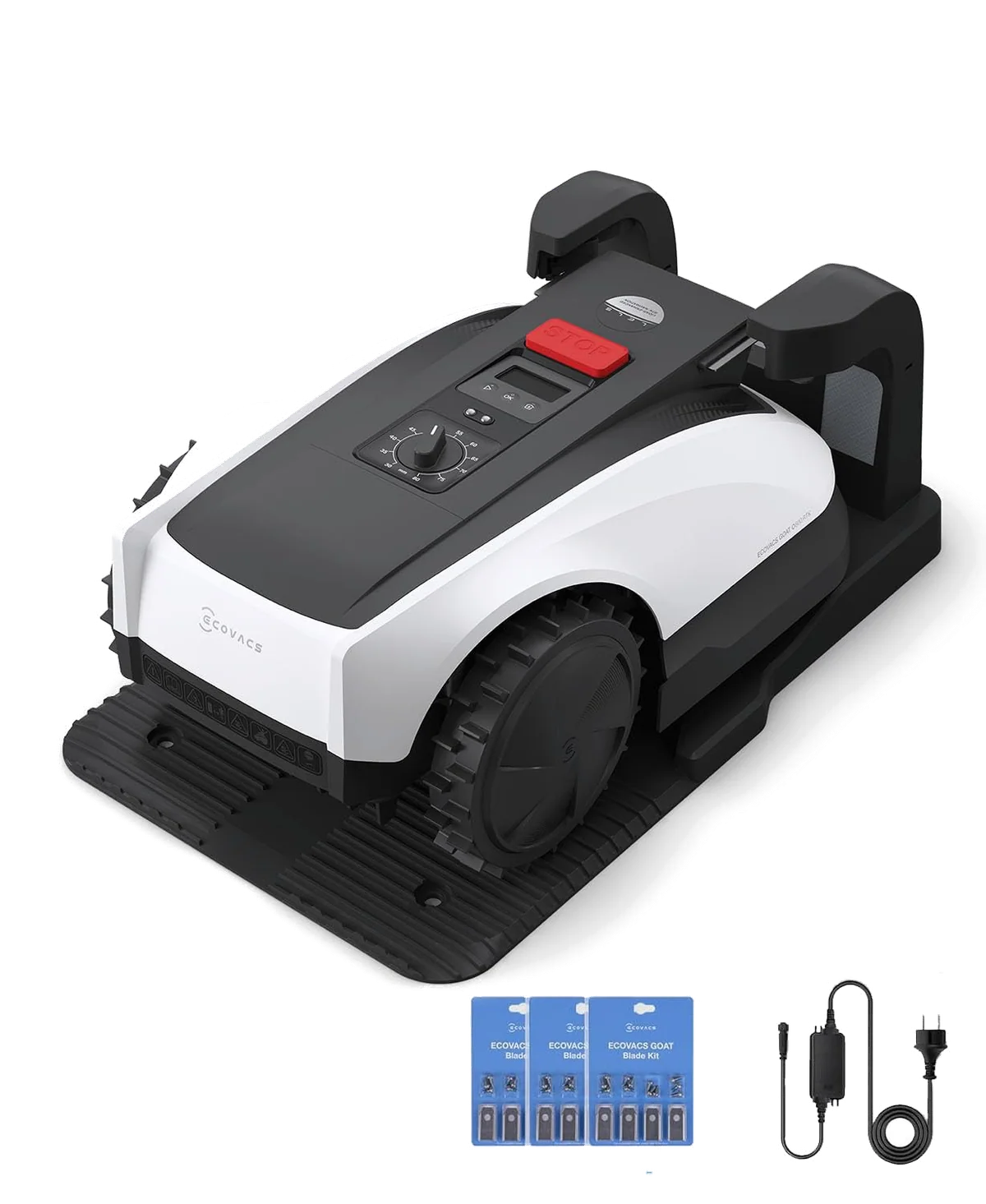
Buy the O1000 RTK Care only for a simple, open small lawn: its cut is convincing, but the app and route planning make complex multi-zone yards too risky.
A precise recommendation with a narrow boundary
Buy it if the grass is open, mostly firm and reasonably level, the antenna can see clear sky, and every scheduled zone is connected by an obvious route. In that setting, the quiet systematic cut, low Bermuda-friendly setting and automatic recharge cycle can remove most weekly push mowing.
Walk away if a fence divides adjacent maps, the mower must squeeze through a narrow satellite-blocked corridor, or nobody will be home to clear an occasional lockout. Also walk away if “TruEdge” led you to expect the powered trimmer shown on LiDAR Pro models. This machine leaves manual edging in the job description.
Wire-free does not mean hardware-free
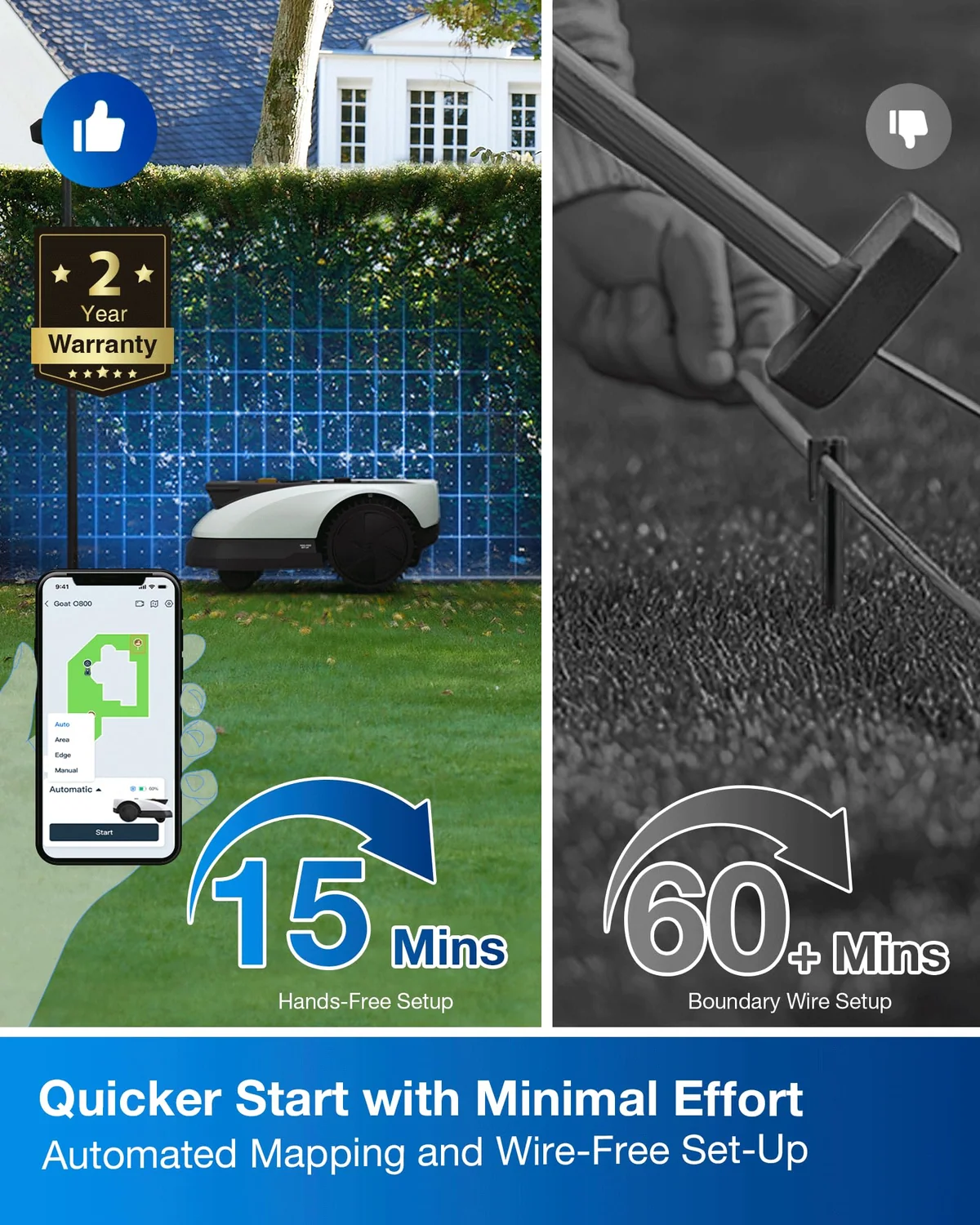
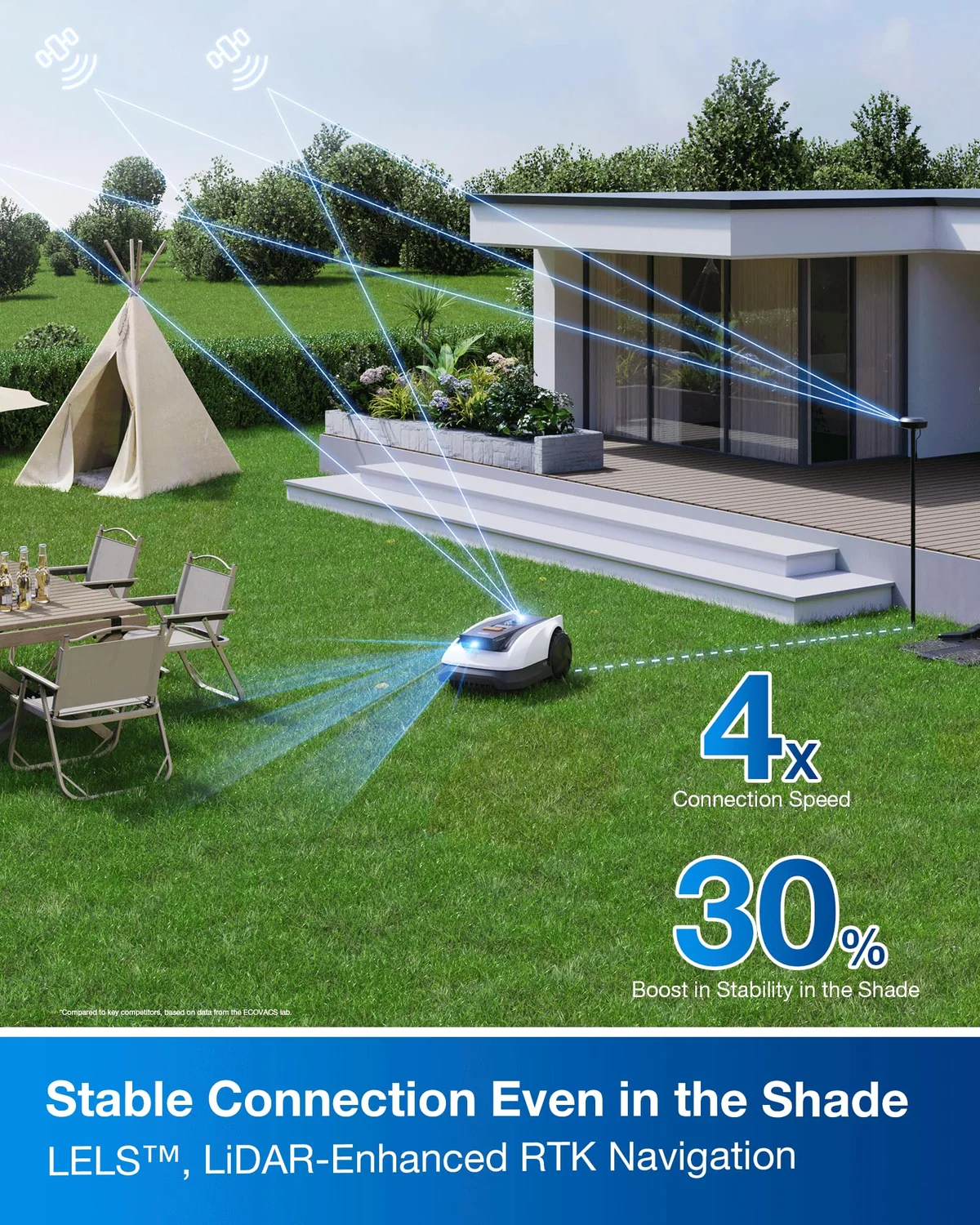
The O1000 RTK Care removes the worst job in an older robot-mower installation: there is no perimeter wire to bury around the lawn. It replaces that wire with an external RTK reference station, mounting hardware and a powered cable. The antenna needs a clear view of the sky, while the charging base and mower need a reliable positioning relationship with it.
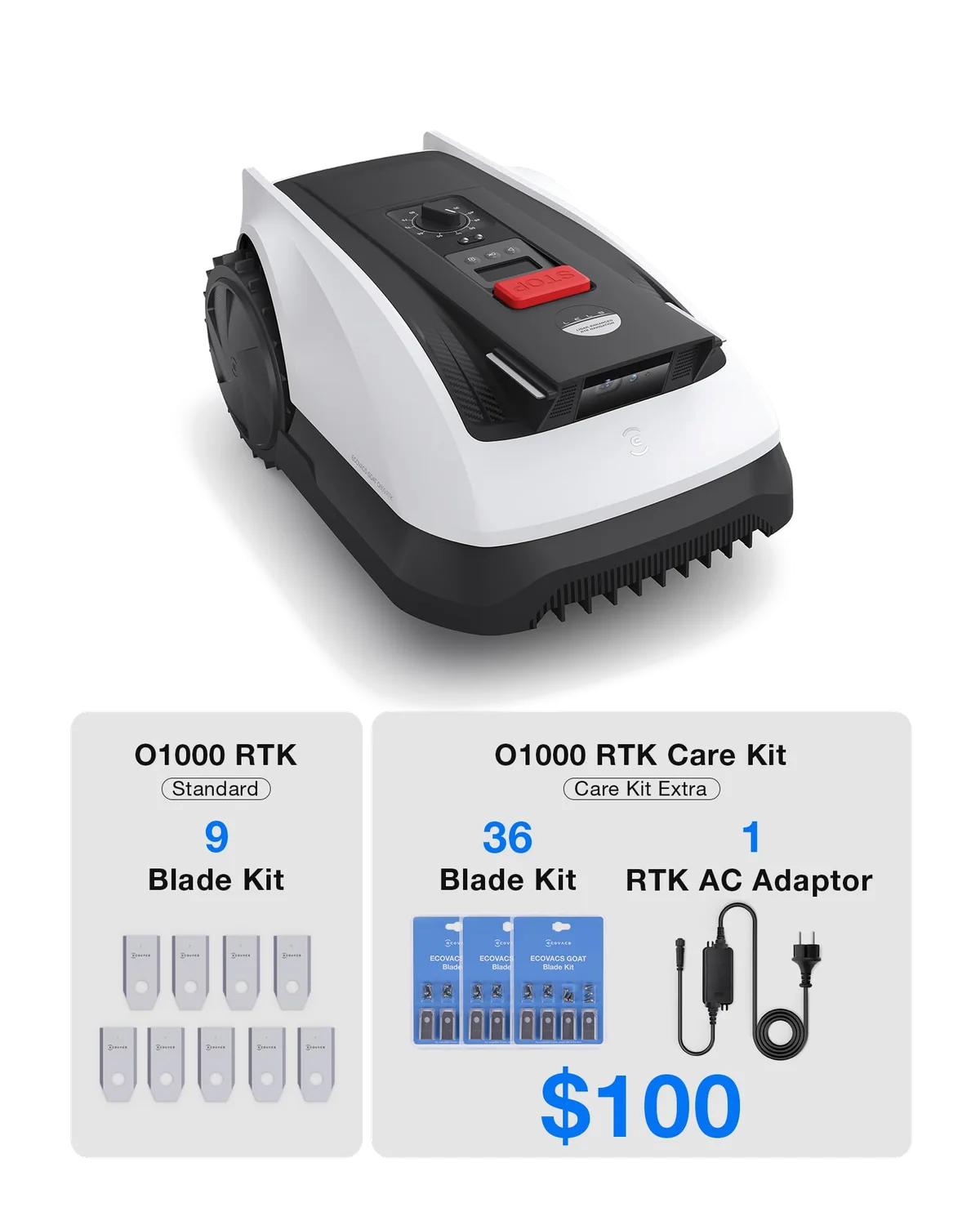
That trade can make sense. On an open lawn, the compact GOAT follows systematic rows, leaves tidy stripes, returns to charge and resumes the unfinished task. At 24.25 pounds, it is also manageable when it has to be lifted. The Care bundle adds an RTK extension cable and 36 replacement blades according to the exact Amazon and Best Buy listings, useful additions rather than decorative extras.
The catch appears when a property stops looking like one uncomplicated patch of grass. A metal mower shelter can interfere with initial mapping, a narrow side yard may become an unreliable route, and closely spaced maps on opposite sides of a fence can be merged into one impossible area. One exact-model owner saw strong satellite counts at both the mower and antenna yet still reached the front lawn through a three-foot passage only about half the time. Precise positioning and dependable whole-yard autonomy are not the same achievement.
Key Specifications
Your yard decides whether the map is clever or infuriating
Basic setup can be remarkably easy. Straightforward-yard owners paired the app, drove or generated a boundary and began mowing within an hour. Schedules can divide work among zones, alternate mowing directions and show progress remotely. Poor outdoor connectivity, however, can complicate mapping and manual control, and the supplied evidence does not establish which autonomous functions remain available during an internet outage.
The hard failures are more serious than a clumsy menu. Exact-model owners report timed-out start commands, stale status information, a virtual joystick that occasionally reverses steering input and lockouts that require someone to carry the mower back to its base and enter a PIN. In one case, the mower placed itself off the map while sitting in the lawn, kept draining its battery and could not be recovered remotely.
Fence-separated zones expose another fault line. Firmware has reportedly combined front and back boundaries that run close together, then insisted the mower could travel through the fence. The app would not accept the real route because its automated mapping believed a route already existed. Creating enough separation to stop the merge left a broad strip for manual mowing. Firmware is therefore part of the buying risk, since an update can change behavior after a map has already worked.
| Yard condition | Likely consequence |
|---|---|
| Open sky, one main lawn and wide routes | The GOAT has the best chance of becoming genuinely hands-off. |
| Trees, buildings or metal above the dock | RTK placement becomes critical and antenna-free LiDAR is safer. |
| Front and back lawns divided by a fence | Automatic map merging can create a route that does not exist. |
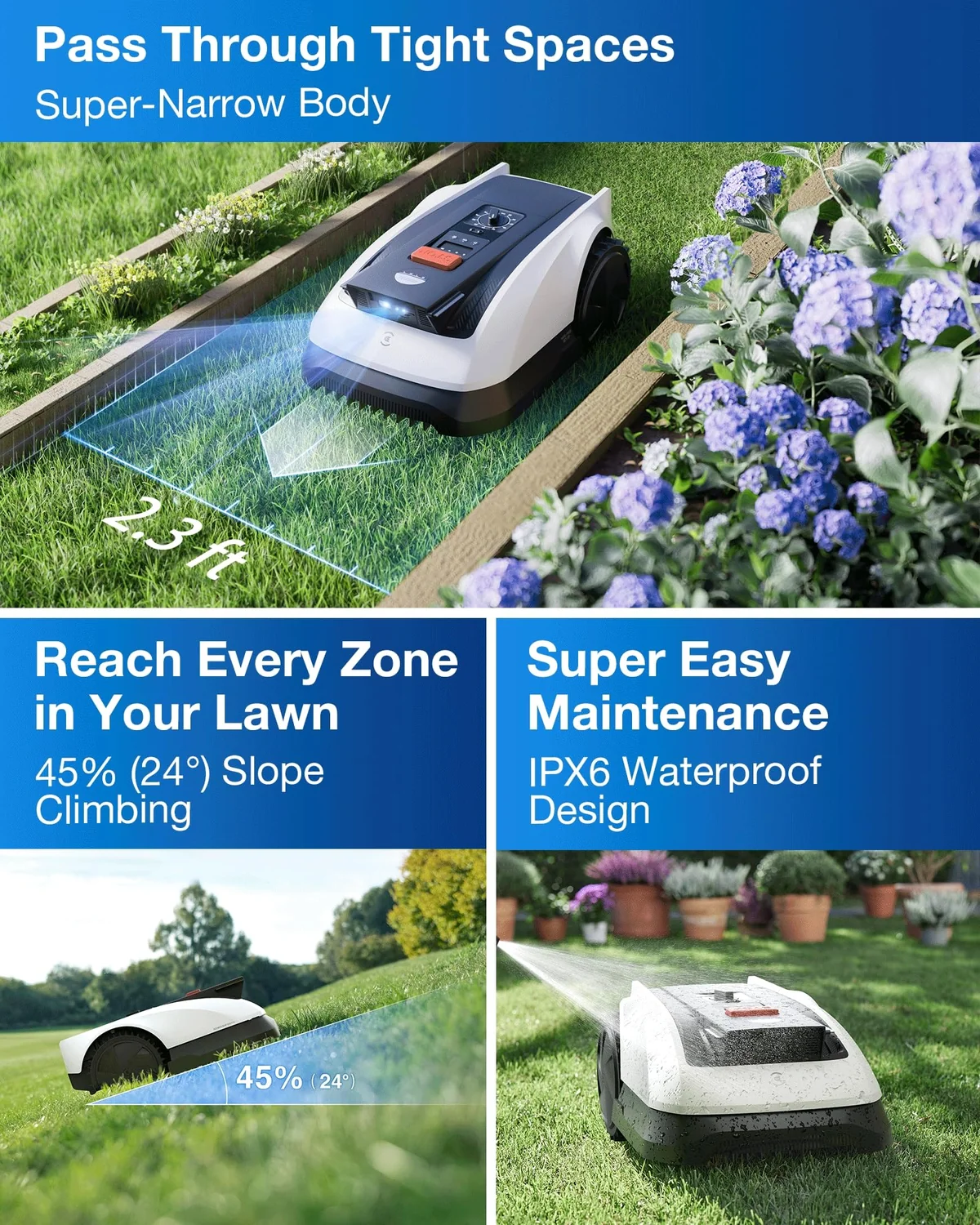
| A three-foot side passage | It exceeds the claimed 2.3-foot minimum but may still be unreliable. |
| Curbs, wet inclines or loose shoulders | Exclude the risky strip and expect some manual mowing. |
The published 45% slope rating applies inside the work area, while the virtual boundary itself has a much lower 17% maximum slope. Surface conditions matter just as much as the number. The mower has slid on modest inclines and fallen over a roughly five-inch curb during mapping, which is unsurprising because its specified barrier-crossing limit is only about 1.18 inches. Buyers with roots, ruts, drop-offs or wet turns should start with the broader guidance for robot mowers on difficult ground, not the maximum printed on this box.
Strengths & Limitations
Strengths
- The systematic single-disc cut produces orderly coverage and convincing lawn stripes.
- The compact 24.25-pound body is quiet, manageable and suited to smaller lawns.
- The Care bundle includes useful blade consumables and an RTK extension cable.
Limitations
- Map merging, route failures and physical-reset lockouts can defeat unattended multi-zone mowing.
- The external antenna demands good placement and makes the wire-free claim less effortless than it sounds.
- The recessed center disc still leaves trimming around walls, fences, posts and raised edges.
The blade does its job better than the software
The physical mowing case is strong. A single center disc carries three small pivoting blades across an 8.66-inch path, and the mower can cut low enough for Bermuda at its 1.2-inch setting. Owners describe clean, orderly lines rather than the patchwork left by random-navigation machines. Even the most critical exact-model report praised the construction, cut quality and runtime.
This is a maintenance mower, not a rescue machine for an overgrown yard. Bring tall grass within range first, then schedule the GOAT every few days so it removes only a small amount. Those fine cuttings disappear into the turf because the mower mulches in place; it has no collection bag. Leave it too long between runs and the clippings, flattened grass and missed tufts become much easier to see.
The official 65-minute mowing time does not mean a quarter acre will be completed in one pass. The machine is designed to work in cycles, docking when its battery runs low and continuing after recharging. ECOVACS currently specifies about 100 minutes for that recharge, although published figures disagree materially. One average-yard owner needed three charging sessions within the day, which is a better picture of capacity than imagining one uninterrupted sweep.
The edge claim needs trimming
“TruEdge” on this model means blade-based edge mowing, not the powered string trimmer shown on several newer LiDAR Pro siblings. The O1000 RTK can place a wheel across a flush boundary such as level pavement and reduce the strip left behind. Its recessed center disc cannot cut grass tight against a wall, fence, post, raised curb or inside corner. A six-month owner who no longer needed a push mower still edged manually, so the promise of zero trimming does not survive ordinary boundaries.
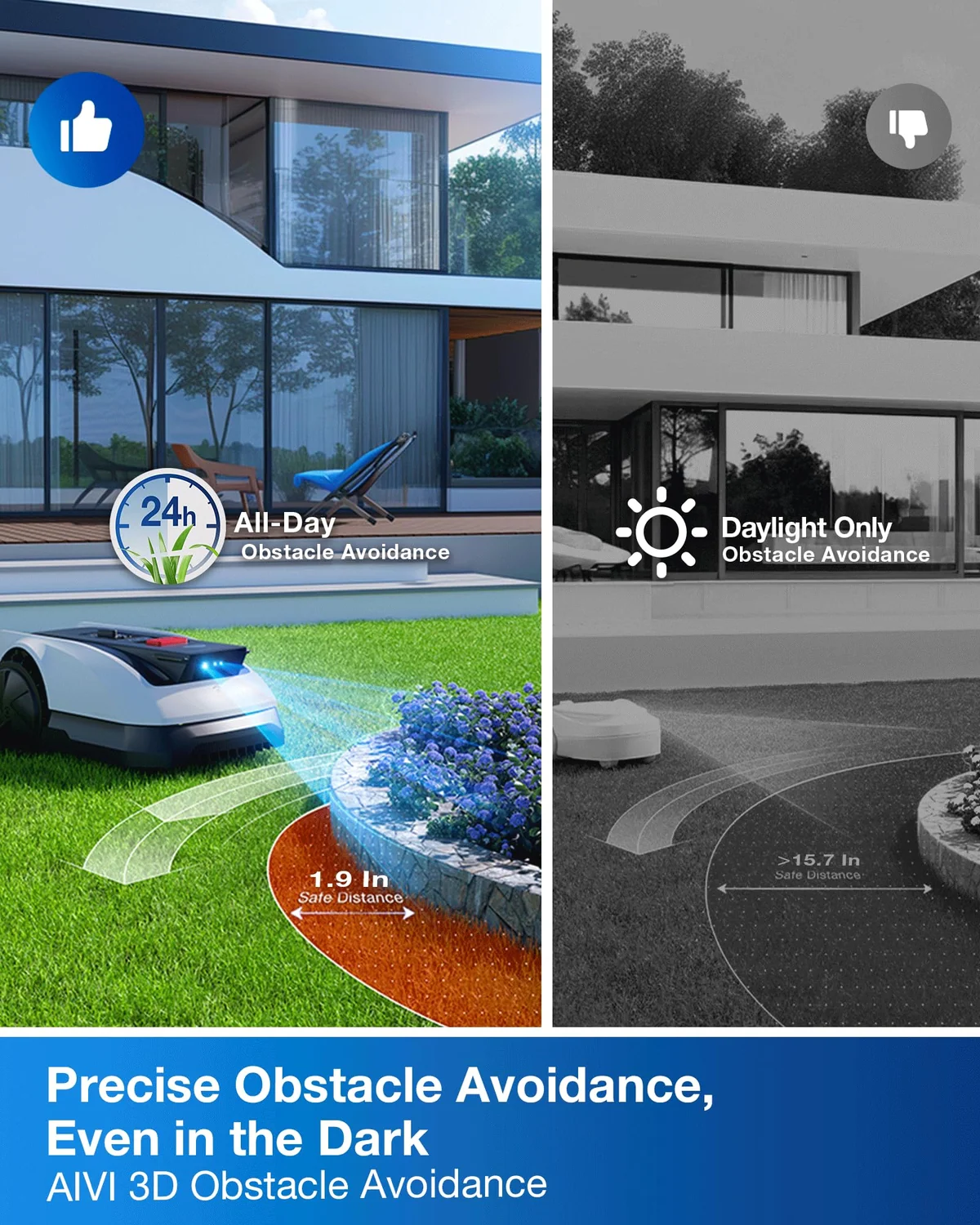
Its obstacle system combines a camera with 3D time-of-flight sensing, and reports include successful avoidance of rocks, people, cats, hedges and pool features. That is useful protection, not permission to schedule the mower among children, pets, hoses or scattered toys. Small debris that fits beneath the chassis can still reach the razor disc.
The right upgrade fixes the antenna problem, not just the acreage number
The O1000 RTK Care earns its place when a compact quarter-acre mower is enough and the property offers an easy antenna location. It is a more rational fit than the much larger GOAT A2000 LiDAR Pro for a modest, open lawn where its broader deck and half-acre capacity would go unused. The O1000’s small body, low cutting setting and included consumables are the relevant advantages.
The A2000 beats it decisively when the lawn is larger or the ownership goal is fewer compromises. It uses antenna-free dual-LiDAR navigation, cuts a 12.96-inch path with two discs, charges faster, adjusts cutting height electronically and includes a powered edge trimmer. The full differences are laid out in the O1000 RTK Care and A2000 LiDAR Pro comparison.
For the same quarter-acre class, the O1000 LiDAR Pro comparison is the more revealing decision. The LiDAR Pro removes the external antenna and adds the physical trimming hardware that this Care model lacks. Buyers with trees, buildings or awkward antenna placement should pay attention to those differences rather than assuming every machine carrying the O1000 name is interchangeable.
Anyone considering other navigation systems should also read the explanation of RTK, LiDAR and camera-only robot mowers. The O1000 RTK is the appealing compromise only when its lower-spec navigation arrangement matches the property; it is false economy if someone must repeatedly rescue it from a side yard.
Low maintenance still means regular attention
Six-month evidence shows what successful ownership can look like: frequent scheduled cutting, automatic recharge and resume, no need for the push mower, and one blade-set change. The Care bundle’s blade supply could therefore cover substantial use in a clean lawn, although grit, sticks and thick growth will shorten blade life.
Grass still gathers around the disc and wheels, cameras need a clear view, charging contacts need a clean approach, and the antenna cable deserves an occasional inspection. The mower, dock and RTK station are rated IPX6, so careful rinsing is supported; that rating is not an invitation to attack bearings, seals or electronics with a pressure washer.
A garage is optional rather than necessary for operation. If one is added, avoid a metal roof or other placement that blocks the initial RTK relationship. The wider question is covered in Smart Lawn Bots’ guide to robot-mower garages and weather protection.
Frequently Asked Questions
Does the ECOVACS GOAT O1000 RTK Care need an antenna?
Yes, it requires a powered external RTK reference station even though it does not need a buried perimeter wire.
Does it need Wi-Fi?
App connectivity is part of pairing, mapping, scheduling and remote management, and weak outdoor coverage can make those tasks less reliable.
Does the O1000 RTK Care include a string trimmer?
No, its TruEdge feature moves the cutting disc closer to passable borders but does not include the powered trimmer fitted to LiDAR Pro siblings.
Can it mow a quarter acre on one charge?
No single-pass promise is supported, since the mower is designed to return to its dock, recharge and resume larger jobs.
Can it handle narrow passages between lawn zones?
ECOVACS claims a 2.3-foot minimum passage, but an exact-model owner found a three-foot route reliable only about half the time.
Does it collect grass clippings?
No, it leaves fine cuttings in the turf, so frequent mowing is necessary to keep them unobtrusive.
Sources (16)
- Amazon listings and customer reviews — Ecovacs Goat O1000 Rtk
- Owner and reviewer video, 19 channels
- Cnet — Article — www.cnet.com
- Robomowlab — Article — robomowlab.com
- Facebook — Article — www.facebook.com
- Bobvila — Article — www.bobvila.com
- ECOVACS — Article — www.ecovacs.com
- Eftm — Article — eftm.com
- Au — Article — www.harveynorman.com.au
- Consumerreports — Article — www.consumerreports.org
- Pcmag — Article — www.pcmag.com
- Bestbuy — Article — www.bestbuy.com
- Thespruce — Article — www.thespruce.com
- Pcmag — Article — uk.pcmag.com
- Mensjournal — Article — www.mensjournal.com
- Tomsguide — Article — www.tomsguide.com